Business hours
Monday to Friday (8.30AM - 5PM)
Weekend (Closed)



You're comparing advisers, opening fee guides, and finding figures that seem to jump from “manageable” to “seriously expensive” in a few lines. One proposal includes a fixed planning fee, another mentions an annual retainer, and a third seems to charge in a way that's hard to pin down at all. Many Australians don't struggle because they're bad with money. They struggle because financial advice fees in Australia are often explained from the adviser's side, not the client's.
That's especially true for pre-retirees, business owners, and busy professionals who don't just want a number. They want to know what they're buying, what part of it may be tax-deductible, and whether the fee is likely to save more stress, time, and mistakes than it costs.
A good way to sanity-check any adviser is to look at how clearly they explain real client outcomes and service scope. Even outside your local area, pages like Dr Nina Giles' Testimonial page are useful because they show how transparent communication shapes trust before anyone signs an agreement.
If you're still working out the basics, this primer on what financial planning involves helps separate advice, implementation, and ongoing support. That distinction matters, because fees often make more sense once you can see which piece of work you're paying for.
Understanding Financial Advice Fees in Australia
A common scenario goes like this. A couple in their late fifties receives a proposal for retirement planning. They expected a simple meeting fee. Instead, they see a planning fee, implementation costs, and an ongoing service amount. Their first reaction isn't greed or scepticism. It's confusion.
That reaction is reasonable. The phrase financial advice fees australia covers everything from a one-off insurance strategy to a long-term retirement relationship. If you compare quotes without understanding the fee model behind them, it's a bit like comparing a builder's estimate for a bathroom renovation with another builder's quote for the whole house. The numbers aren't answering the same question.
What clients are really asking
Individuals seeking financial advice aren't asking, “What's the cheapest adviser?” They're asking four things:
- What am I paying for
- Is this a one-off cost or an ongoing commitment
- Can any part of this reduce my tax bill
- Will this help me make better decisions with meaningful money
A fee only feels vague when the scope is vague.
In practice, advice pricing becomes easier to assess when you separate the work into stages. Strategy work is one thing. Product implementation is another. Ongoing reviews, portfolio adjustments, tax planning support, and retirement cashflow monitoring are different again.
What makes a fee fair
A fair fee isn't just “low”. A fair fee is clear, matched to complexity, and tied to a service you can describe in plain English.
That means you should be able to understand:
- The problem being solved. Retirement income, insurance gaps, super structure, investment oversight, estate coordination.
- The service period. One meeting, one plan, or ongoing access over the year.
- The decision load. A single insurance recommendation is not the same as coordinating super, pensions, tax, investments, and family structures.
When those pieces are visible, fees stop looking random. They become easier to test against value.
Decoding the Four Main Fee Structures
The simplest way to understand adviser pricing is to think about paying a builder. You might pay for a fixed renovation quote, an hourly callout, a project percentage, or an annual maintenance arrangement. Advice fees work in much the same way.
Canstar's summary of Adviser Rating's 2024 Australian Financial Advice Landscape Report notes that the median yearly adviser fee in Australia reached $3,960, up 58% in five years, with increases linked to inflation, interest rate pressures, and greater compliance workloads. That's useful context, but the bigger issue for most clients is understanding how the fee is built.
Financial Advice Fee Models at a Glance
| Fee Type | How It Works | Best For | Key Consideration |
|---|---|---|---|
| Fixed fee | A set amount for a defined piece of advice | People who want clarity upfront | Works well only if the scope is tightly defined |
| Hourly rate | You pay for adviser time used | Narrow, specific questions | Can be efficient for small issues, less predictable for broader work |
| Percentage of assets | Fee linked to the value of investments managed | Clients wanting portfolio oversight | Easy to understand, but you should test whether service rises with portfolio size |
| Ongoing retainer | A recurring annual or monthly fee for ongoing service | Households needing regular reviews and access | Best when you'll actually use the service throughout the year |
Fixed fees
A fixed fee is like agreeing on a set price to draft plans before a renovation starts. You know the cost before the work begins, and it suits clients who want certainty.
This model usually works best when the adviser can define the job clearly. A retirement strategy, super review, or insurance advice project often fits here. The upside is transparency. The downside is that if your situation becomes more complex midway through, the original scope may need to change.
Hourly rates
An hourly rate can suit narrow advice needs. Think of it as paying a specialist tradesperson for a targeted job rather than engaging them for the entire project.
It's often sensible when you need help with one issue, such as reviewing an existing strategy or clarifying a decision. It tends to work less well when several moving parts are involved, because the final cost may feel uncertain unless the adviser sets clear limits.
Percentage of assets
A percentage of assets model charges based on the portfolio being managed. Some clients like it because the fee moves with the value of assets and feels connected to investment oversight.
The trade-off is straightforward. If two clients receive similar service but one has materially larger assets, the dollar fee may differ significantly. That's why this model needs careful scrutiny around service inclusions, not just the percentage itself.
Ongoing retainers
An ongoing retainer is closer to a maintenance agreement. You pay for continuing access, reviews, strategic adjustments, and accountability over time.
For clients approaching retirement, this can make sense when decisions don't stop after the initial plan. Drawdown strategy, tax coordination, investment behaviour, pension changes, and cashflow monitoring all tend to need ongoing attention.
Practical rule: If you can't explain the fee model in one sentence, ask the adviser to simplify it before you assess whether it's reasonable.
Why Financial Advice Fees Are Rising
The sharp rise in fees hasn't happened in a vacuum. Clients often assume higher prices mean advisers are charging more for the same work. Sometimes the more accurate answer is that firms are carrying much higher fixed costs before they give any personal advice at all.
Professional Planner's reporting on 2025 fee data states that the median ongoing advice fee in Australia reached A$4,668 in 2025, which was up 18 percent in one year and 67 percent since 2020. The same reporting links that rise to mandatory annual adviser expenses of A$37,000 to A$84,000 per adviser for licensing, insurance, and regulatory levies.
The part clients don't see
Much of the fee pressure sits behind the scenes. A client sees a meeting, recommendations, and review process. The practice also has to fund licensing, professional indemnity insurance, levies, file oversight, compliance systems, record keeping, and the extra time it takes to document advice properly.
That doesn't mean every fee is justified. It does mean the market now has a higher floor than many people expect.
Why cheaper advice is harder to find
Low-cost, broad-scope advice is difficult to sustain when a practice has heavy fixed costs and significant documentation requirements. That's one reason many firms have narrowed their focus to clients with more complex needs or larger balances.
Here's the practical effect:
- Simple issues may still suit limited advice. Not every person needs a full ongoing arrangement.
- Complex households usually can't be served well at bargain prices. Retirement income planning, blended families, business structures, and SMSF-related work all take real time.
- Consumers should expect more scope boundaries. Advisers are more likely to define exactly what is and isn't included.
Rising fees don't always mean a more bespoke service. Sometimes they reflect the cost of delivering compliant, documented advice in a regulated environment.
What this means for your decision
The useful question isn't whether fees have gone up. They have. The useful question is whether the service level, clarity, and fit match the price for your situation.
If your needs are modest, ask whether limited or project-based advice is available. If your position is more involved, a very low quote should raise as many questions as a high one. Cheap advice can become expensive if it leaves key issues untouched.
Typical Costs and Worked Examples for 2026
By the time someone searches for financial advice fees australia, they're not looking for theory. They're trying to work out what their own situation might cost.
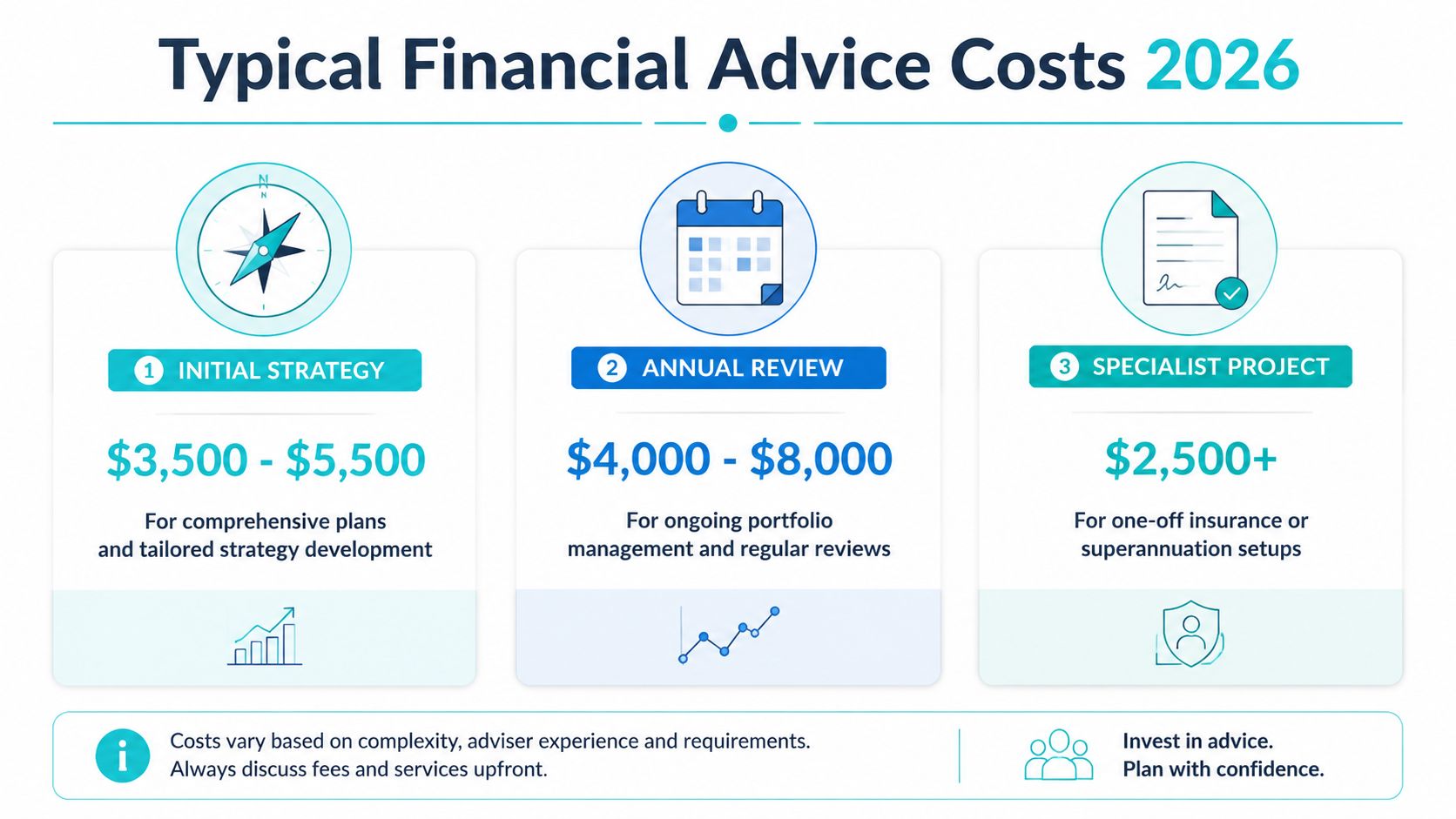
A practical way to estimate fees is to start with service type, then layer in complexity. Northeast Wealth's breakdown of industry pricing pressure notes that licensees face fixed costs of $20,000 to $50,000 per adviser annually, creating a structural floor that pushes many firms toward minimum retainer fees of around $4,000 to $6,000 annually to remain viable.
This visual gives a useful shorthand for the broad cost brackets many Australians are seeing.
Young professional couple
A couple in their thirties might want to optimise super, organise cashflow, protect income, and prepare for a property purchase. Their work is often strategic rather than investment-heavy.
A fee arrangement in this kind of case is often built around a one-off advice project, with optional ongoing reviews if the couple wants accountability and regular check-ins.
What tends to increase cost here:
- Multiple goals running at once. Property, super, debt reduction, and insurance.
- Two incomes and two super accounts. More moving parts than a single-client engagement.
- Implementation help. The fee rises if the adviser handles paperwork, provider changes, and follow-through.
What usually doesn't help is paying for a full ongoing service package when there's little to review after setup. In many cases, a defined project with a future review point is the cleaner option.
Small business owner
A business owner often needs a different mix. Personal risk protection, cash reserves, tax-aware investing, super strategy, and separation between business and household finances all matter.
Fees can feel high in such circumstances, but also become easier to justify. The wrong insurance ownership, poor contribution strategy, or muddled personal and business planning can create consequences well beyond the advice fee.
A business owner should watch for proposals that separate:
- Strategic planning work
- Insurance and super implementation
- Ongoing annual oversight
That separation helps you decide whether you need a project, an annual relationship, or both.
Pre-retiree couple
For pre-retirees, complexity tends to spike. Super drawdown timing, account-based pensions, tax position, investment structure, estate planning coordination, and the emotional side of stepping away from work all come into play.
A fee can be entirely reasonable here and still look confronting on paper, because the adviser isn't just preparing a document. They're helping reduce the chance of major sequencing, tax, or withdrawal errors at a stage where mistakes are costly and hard to reverse.
Good retirement advice often feels expensive right before retirement and very cheap after a costly mistake has been avoided.
For households in this stage, an annual retainer can make more sense than a one-off plan because retirement decisions don't end once the first document is delivered.
Where a firm like Wealth Collective fits
A practice such as Wealth Collective generally fits clients who need advice across clear service pillars like insurance, wealth building, and retirement planning, rather than a single isolated product transaction. That structure tends to suit clients who want defined scope and a path from strategy into implementation and review.
How Tax Deductions Can Reduce Your Advice Costs
This is the part many fee articles miss. The headline fee is not always the true cost to you after tax.
Wolters Kluwer's explanation of TD 2024/7 notes that, under updated ATO guidance, advice fees related to managing tax affairs under s25-5 and managing income-producing investments under s8-1 are generally tax-deductible, and that high-income earners may potentially recover 37 to 45 percent of their advice fees depending on circumstances.

If tax planning is part of your broader advice needs, this overview of taxation and tax planning is a good place to understand how strategy and deductibility interact.
What may be deductible
The ATO's position is nuanced. In general terms, the deductible portion is usually linked to advice about:
- Income-producing investments
- Whether an investment mix remains appropriate
- Income protection insurance advice
- Managing tax affairs
That means the fee should not be treated as one single deductible blob. It needs to be broken into components based on the actual work done.
What usually isn't deductible
Some advice is personal in nature rather than related to producing assessable income or managing tax affairs. That part typically won't qualify.
Examples often include:
- General personal financial planning
- Lifestyle goal setting
- Some initial plan construction work
- Advice components unrelated to assessable income or tax management
Why fee itemisation matters
A detailed invoice or advice fee breakdown isn't administrative fluff. It can materially change your after-tax outcome.
If part of your annual fee relates to investment management and part relates to tax planning, those components should be identified. That gives your accountant a clearer basis to assess what may be claimable.
The question isn't “Is the whole fee deductible?” The better question is “Which parts of the work were done for deductible purposes?”
For high-income earners, executives, and business owners, this can be the difference between judging advice at the gross fee and judging it at the net cost after tax. That's a much more realistic way to assess value.
Is the Advice Worth the Fee Key Questions to Ask
The better test of value isn't “Do I like the number?” It's “What decisions, behaviour, and outcomes does this service improve?”
IFA's reporting on adviser demand and affordability highlights the gap clearly. Only 6 percent of Australians are willing to pay current market rates for advice, yet 14 percent of advised clients report low financial confidence compared with 24 percent of unadvised clients. Confidence is not the whole story, but it matters. People make better decisions when they understand what they're doing and why.

If you're comparing firms, this guide on how to choose a financial advisor gives a solid framework for the selection process.
Questions that cut through the sales pitch
A useful comparison starts with blunt, practical questions:
- What exactly is included in the fee. Ask for a service list in plain English, not industry terms.
- What falls outside the fee. Misunderstandings often begin in this area.
- How often will we speak, review, or update the plan. An annual fee should connect to a clear cadence.
- What type of client is this service designed for. A good adviser should be able to tell you who isn't a fit.
- How do you separate strategic advice from product implementation. That distinction reveals how transparent the pricing really is.
Questions about value, not just cost
A second set of questions goes deeper:
- What are the biggest financial mistakes you're helping me avoid
- How will you measure progress if investment performance isn't the only outcome
- What parts of my fee may be tax-deductible and how will they be itemised
- When would you tell me I no longer need ongoing advice
That last question matters. If an adviser can't imagine a situation where ongoing service isn't necessary, ask why.
A useful parallel comes from outside advice. In sales, conversion usually improves when buyers understand the process, see the value, and know what happens next. The same logic sits behind this article on how to improve sales conversions. Clarity lowers resistance. Vague offers create hesitation.
What doesn't work
The weakest buying decision is choosing the lowest fee before comparing scope. The second weakest is paying for a premium ongoing arrangement you won't use.
What works better is matching the fee model to the job:
- One issue. Consider scoped or project advice.
- Several linked decisions. Expect a broader strategy fee.
- Ongoing retirement or portfolio oversight. Retainers can make sense when there's real ongoing work.
Your Path to Financial Clarity with Wealth Collective
Advice fees are easier to accept when they're attached to a clear problem, a defined service, and a result you can describe. What people usually resent isn't paying for expertise. They resent paying for ambiguity.
That's why after-tax cost matters. It's also why service scope matters just as much as the number itself. A one-off project, a strategic review, and a full retirement relationship shouldn't be priced or judged the same way.
Some clients also want more support between meetings and faster answers to common questions. Tools are starting to play a role there. If you're curious about how firms are using digital support, this overview of AI chatbots for wealth management is a helpful look at where client communication is heading. It doesn't replace advice, but it can improve access and responsiveness when used properly.
The right next step isn't to memorise every industry pricing model. It's to get a clear proposal based on your own situation, your own complexity, and the decisions you need to make. That's where fee conversations become useful instead of frustrating.
If you want a straightforward view of what advice could look like for your situation, book a call with Wealth Collective. A short introductory conversation can clarify whether you need one-off help, ongoing support, or a clearer second opinion on fees, tax treatment, and the value of professional advice.