Business hours
Monday to Friday (8.30AM - 5PM)
Weekend (Closed)



People don’t start searching what is financial planning because they love spreadsheets.
They start because money feels noisy. One account is growing, another is draining, bills keep arriving, and every week brings a new financial “should”. You should top up super. You should invest. You should pay off the mortgage faster. You should review your insurance. You should save for travel, school fees, renovations, retirement, and somehow still enjoy life now.
That pressure often creates the opposite of progress. Instead of making clear decisions, people freeze.
A young couple might both earn decent incomes and still feel behind. Their savings account moves up, then down. Their credit card gets cleared, then creeps back. They want a home, but also know they should be thinking about superannuation and investing. They’re not careless. They are trying to juggle too many priorities without a system.
If that sounds familiar, you’re not bad with money. You’re probably under-planned.
A lot of Australians don’t need more financial content. They need a way to turn information into action. Sometimes a simple beginner resource can help you reset your thinking, such as this stop being broke financial guide that breaks down everyday money habits in plain language.
Introduction The End of Financial Overwhelm
Financial planning isn’t a product you buy or a document you file away. It’s a way to make your money work toward your life, in the right order, with fewer false starts.

Why smart people still feel stuck
Many people assume financial stress comes from low income or poor discipline. Sometimes it does. More often, it comes from competing priorities without a plan.
You might have enough income to make progress, but no clear decision-making framework. So every choice feels expensive. Put extra into super, and you worry about missing out on investment growth elsewhere. Build a share portfolio, and you wonder if that cash should’ve stayed in your offset. Focus on the mortgage, and retirement gets pushed into the background again.
That’s where financial planning becomes useful. It helps you answer practical questions like:
- What matters first: Which goal needs attention now, and which can wait?
- What fits together: How super, debt, investing, insurance, and tax decisions affect each other
- What’s realistic: What you can do consistently without burning out or overcommitting
Financial planning is less about perfection and more about creating a sequence you can actually follow.
What financial planning really means
In plain English, financial planning is the process of looking at your full financial life, deciding where you want to go, and building a strategy to get there.
That usually includes your income, spending, debts, superannuation, investments, insurance needs, retirement goals, and estate considerations. It also includes something people often miss. Behaviour.
A plan can look excellent on paper and still fail in real life if it doesn’t match your habits, your priorities, or your tolerance for change. That’s why a good plan isn’t built only around numbers. It’s built around decisions you will make.
Clarity changes the feeling of money
Once a plan is in place, money often feels less emotional and more organised. You stop trying to solve everything at once. You know what each dollar is meant to do. You can measure progress against your own goals, not someone else’s checklist.
That doesn’t mean life becomes perfectly predictable. It means you’re no longer guessing your way through major financial choices.
The Five Pillars of Your Financial Future
A strong financial life works like a well-built home. If one part is weak, the whole structure feels less stable. You might have good income, but poor protection. You might invest well, but carry inefficient debt. You might build assets and still have no clear retirement path.
The goal of financial planning is to make these parts work together.

Pillar one Superannuation
For most Australians, superannuation is the foundation. It’s one of the largest assets they’ll own, yet many treat it as a background account they rarely review.
Super matters because it combines long-term investing with tax settings, contribution rules, insurance arrangements, and retirement income planning. A small change in fund choice, fees, investment option, or contribution strategy can shape your future outcomes in ways that aren’t obvious today.
If you’d like a clearer primer, this guide on superannuation in Australia is a useful starting point.
A super strategy often involves questions like these:
- Fund structure: Are you in the right type of fund for your needs?
- Investment option: Does your current mix suit your age, time horizon, and risk comfort?
- Contribution approach: Would salary sacrifice or personal contributions support your goals?
- Insurance inside super: Do you know what cover you hold, and whether it’s enough?
Pillar two Investments
If super is the foundation, investments are the framework that helps build wealth outside compulsory retirement savings.
This doesn’t just mean picking shares. It means deciding how much to invest, where to invest, how much risk to take, and how that investment strategy supports specific goals. A house deposit in a few years needs a different approach from wealth you won’t touch for decades.
A practical planning approach uses forecasts and models to test different scenarios and trade-offs, rather than relying on guesswork or market headlines, as discussed in this guide to financial planning and analysis. Good investing decisions usually come from context, not hot tips.
Practical rule: An investment is only “good” if it suits the job you need it to do.
Pillar three Insurance and protection
People often overlook this pillar because it doesn’t feel exciting. But protection is what stops one illness, accident, or loss of income from damaging everything else you’ve built.
Insurance planning looks at the financial consequences of risk. Could your household keep functioning if one income stopped? Would debts, living costs, and future plans still be manageable? Would your family have options, or pressure?
This pillar can include personal insurance held inside or outside super. It can also include reviewing emergency savings and ownership structures. Protection doesn’t create wealth directly. It protects your ability to keep building it.
Pillar four Debt and cash flow
Debt isn’t automatically bad. A mortgage on a well-chosen home and a credit card balance growing month after month are very different problems.
Financial planning looks at how debt interacts with cash flow. It asks whether repayments are helping you move forward or limiting your options. It also asks whether your day-to-day spending leaves enough room for your actual priorities.
One simple place to begin is understanding recurring commitments. If you’re trying to tighten cash flow, this explainer on how to identify fixed expenses can help you see what’s locked in and what can be adjusted.
Pillar five Retirement and estate planning
This pillar brings the whole structure together. Retirement planning isn’t just about reaching a number. It’s about understanding when work becomes optional, how income will be drawn, what lifestyle that income can support, and what happens to assets over time.
Estate planning sits alongside it. That includes making sure your wishes are documented, ownership arrangements are appropriate, and the people around you aren’t left with confusion.
A useful planning process needs good information to work well. That includes your assets, liabilities, income sources, goals, family circumstances, and legal structures, which aligns with the data requirements outlined by Finance Strategists.
The value of coordinating all five pillars is significant. A 2024 Russell Investments report found that professional financial advisers can add at least 5.2% in value to client portfolios annually through a combination of behavioural coaching, asset allocation, and strategic advice.
Your Financial Planning Journey with Wealth Collective
For many people, the hardest part isn’t deciding they need help. It’s not knowing what happens next.
That uncertainty keeps people stuck. They assume the process will be formal, confusing, or full of jargon. A good planning experience should feel the opposite. It should feel calm, structured, and easy to follow.
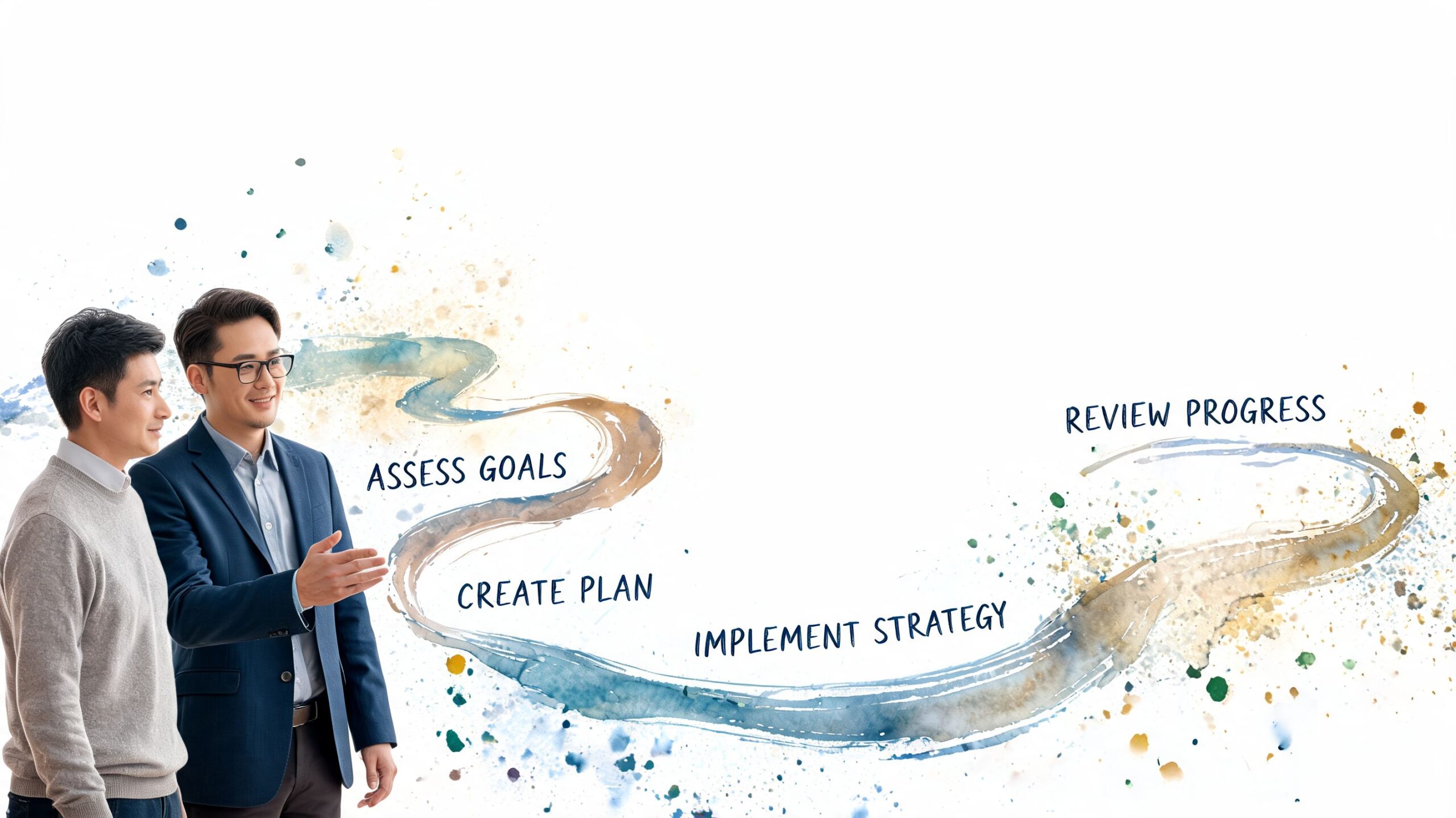
It starts with a short conversation
The first step is simple. There’s an initial call to understand what’s going on in your world and whether the relationship is likely to be a good fit.
That matters because financial advice is personal. You’re not just discussing accounts. You’re discussing uncertainty, trade-offs, goals, and sometimes long-delayed decisions. The best first conversation doesn’t pressure you. It helps you feel understood.
If you’re still comparing your options, this article on how to choose a financial advisor can help you ask better questions before committing.
Discovery is where the real work begins
Once you move forward, the process shifts into discovery. At this stage, your financial life gets organised into a clearer picture.
That usually means gathering details about income, expenses, debts, super, assets, insurance, family needs, and future goals. It also means discussing what matters to you. Some people care most about flexibility. Others want confidence, protection, or a defined retirement date.
This stage often surfaces the issues that generic advice misses:
- Conflicting goals: Wanting to invest, reduce debt, and preserve lifestyle at the same time
- Hidden gaps: Inadequate insurance, stale super settings, or no estate planning
- Behaviour patterns: Delaying decisions, avoiding risk, overspending after pay rises, or abandoning plans too early
A financial plan only becomes useful when it reflects the life you’re actually living.
Strategy turns information into decisions
After discovery, the adviser develops a strategy specific to your situation. At this stage, the plan becomes more than a list of ideas.
A strong strategy doesn’t drown you in options. It narrows the field. It shows what to do first, what to defer, and how each decision affects the others. Instead of asking whether you should “do more with your money”, you get a practical order of operations.
That strategy may include:
- Cash flow priorities so surplus income has a clear purpose
- Debt reduction actions to improve flexibility and lower pressure
- Super and investment recommendations that align with your goals
- Protection adjustments if personal risk cover needs attention
- Retirement or estate steps if longer-term decisions need structure
Implementation is where many plans succeed or fail
This is the part many articles skip. Knowing what to do is not the same as doing it.
Implementation involves paperwork, account changes, contribution adjustments, insurance applications, investment setup, beneficiary reviews, and follow-through. It can be tedious. It can also be emotionally difficult. People second-guess themselves when money starts moving.
That’s why support matters here. Without it, even a sensible plan can stall at the point where action is required.
Reviews keep the plan alive
A plan shouldn’t sit untouched while life changes around it. Income shifts. Kids arrive. Roles change. Parents age. Priorities evolve. Markets move. Your confidence level changes too.
Regular reviews help keep the plan relevant. They’re a chance to test whether the strategy still fits, whether progress is on track, and whether any assumptions need to be updated.
The best planning relationships aren’t built around one big meeting. They’re built around ongoing clarity.
Common Misconceptions That Derail Financial Success
Some financial mistakes come from lack of knowledge. Many come from beliefs that sound reasonable but lead people in the wrong direction.
These misconceptions don’t just delay progress. They make people feel like planning is for someone else.
Financial planning is only for wealthy people
This is one of the biggest myths. People often think planning starts after they’ve built wealth.
In practice, planning is often most useful while you’re still building. That’s when decisions around cash flow, debt, super, insurance, and investing have the most room to shape your future. Waiting until you feel “rich enough” usually means delaying the very process that helps create stability.
Planning is not a luxury add-on. For many households, it’s the tool that stops income from leaking into random decisions.
I’m too young, or too late
Both versions of this belief create the same result. Inaction.
If you’re younger, it’s easy to assume there’s plenty of time. If you’re older, it’s easy to assume the important decisions should’ve happened already. Neither view helps. A useful plan always starts from your current position, not from the ideal moment you think you missed.
Starting late is still starting. Starting early is still only useful if you act consistently.
Financial planning is just investing
Investing is part of financial planning. It isn’t the whole thing.
A person can have a growing portfolio and still be financially fragile if they have poor cash flow discipline, weak protection, too much debt, unclear retirement timing, or no estate planning. Focusing only on investments is a bit like choosing paint colours before checking whether the house has solid walls.
That’s one reason broad advice matters. It puts each decision in context.
I can do it all myself
Some people can handle a lot on their own. Many already do. The challenge isn’t always intelligence. It’s execution.
The internet gives you endless information, but not enough judgement about what applies to your exact situation. General tips often ignore behaviour, tax position, family structure, risk tolerance, and competing goals. That’s where people can make expensive mistakes without realising it.
Research highlighted by SmartAsset found that 52% of Americans have suffered a financial setback from acting on incorrect information. That’s a useful reminder that being proactive isn’t the same as being well-guided.
A budgeting app is the same as a financial plan
Apps can be excellent tools. They can track spending, automate transfers, and show patterns. But a tool is not a strategy.
A budgeting app usually tells you what happened. A financial plan helps you decide what should happen next. It helps connect today’s cash flow to future choices about super, investments, debt, protection, and retirement.
Here’s the difference in simple terms:
| Tool or approach | What it helps with | What it usually misses |
|---|---|---|
| Budgeting app | Tracking spending and habits | Broader strategy across life goals |
| Investment platform | Buying and managing assets | How investments fit with debt, tax, and timing |
| Financial plan | Coordinating the full picture | Requires decisions and follow-through |
The real problem is often behavioural
People rarely fail because they’ve never heard of saving, investing, or insurance. They fail because implementation gets crowded out by life.
Common blockers include:
- Procrastination: Waiting for the perfect time to start
- Overthinking: Researching endlessly but never deciding
- Competing priorities: Letting urgent expenses push out important goals
- Emotional reactions: Changing course every time markets, income, or confidence shift
That human side of money is why planning works best when it’s practical, personalised, and built for real life.
Financial Planning in Action for Everyday Australians
Financial planning becomes easier to understand when you see it in everyday situations. The principles are the same, but the starting point changes depending on your life stage.
The young professional
Mia is in her early thirties, earns well, rents comfortably, and has enough disposable income to know she should be further ahead than she feels.
She’s done some smart things. She contributes to super through her employer, keeps some savings in the bank, and has started reading about ETFs. But she also spends freely, books travel without much thought, and doesn’t really know whether the next priority should be investing, saving a deposit, or paying down a personal loan faster.
Her problem isn’t lack of effort. It’s lack of sequencing.
A financial plan helps her define the order. Build an emergency buffer first. Review cash flow. Set a realistic property goal. Decide how much goes to investing outside super and how much stays available for shorter-term use. Once the plan is clear, she can enjoy her income without wondering whether every purchase is setting her back.
The growing family
Daniel and Priya have children, a mortgage, rising household costs, and busy careers. They’re not struggling, but their finances feel fragmented.
Most months, they earn enough. Yet school costs, home expenses, insurance premiums, and irregular bills keep pulling them off course. They want to reduce debt faster and improve long-term wealth, but every extra dollar already seems allocated before it arrives.
In this stage, planning often starts with the household engine room. That means reviewing spending patterns, debt structure, protection needs, and whether surplus cash is flowing to the right place. Many families also benefit from sharper cash flow management guidance because the issue isn’t income alone. It’s coordination.
Sometimes practical savings outside the big-ticket areas can help free up room too. For households trying to trim running costs, this guide for homeowners on appliance savings offers useful ideas on reducing energy-related expenses.
When family finances feel tight despite decent income, the first fix is often structure, not sacrifice.
The pre-retiree couple
Helen and Mark are approaching retirement and asking the question nearly every pre-retiree asks in some form. Are we ready?
They’ve built assets over time, hold super, and own their home. But they don’t have clarity on when work can stop, how retirement income would be drawn, or whether their current path supports the lifestyle they want.
Planning takes a concrete form. Retirement isn’t a vague concept anymore. It becomes a timeline, an income strategy, and a set of decisions around risk, access, spending, and legacy. The stakes feel higher because there’s less time to correct avoidable mistakes.
The numbers matter here. The ASFA Retirement Standard estimates that for a comfortable retirement, a couple retiring in 2026 will need a lump sum of approximately $690,000, assuming they also receive a partial Age Pension. That projection helps frame how important retirement planning is before the transition arrives.
Financial Planning Scenarios at a Glance
| Life Stage & Persona | Primary Financial Challenge | Key Planning Solution | Wealth Collective Service |
|---|---|---|---|
| Young professional | Good income but no clear priority order | Set goals, improve cash flow, balance saving and investing | Guided Growth |
| Growing family | Mortgage pressure and competing household costs | Coordinate debt, cash flow, protection, and long-term wealth building | Protection Plus |
| Pre-retiree couple | Uncertainty about retirement timing and income | Model retirement options, review super, plan drawdown and legacy | Retirement Roadmap |
The common thread across all three is simple. Financial planning isn’t about having the same answers as everyone else. It’s about having the right answers for your stage of life.
Begin Your Wildly Successful Financial Life Today
By now, the question what is financial planning should feel less abstract.
It’s not a stack of documents. It’s not investment jargon. It’s not something reserved for people who already feel sorted. Financial planning is the process of making informed decisions about your money so your life becomes more deliberate, less reactive, and easier to manage.
That matters because financial stress usually doesn’t come from one dramatic mistake. It builds from dozens of small unresolved decisions. Delayed super reviews. Insurance left unchecked. Debt that lingers. Cash flow without a clear purpose. Retirement goals that stay fuzzy for too long.

A good adviser helps cut through that noise. Not by giving generic tips, but by helping you decide what matters now, what can wait, and how to follow through with confidence. The technical side matters, but so does having someone who understands the human side of money. The hesitation, the second-guessing, the tendency to put important things off because life is busy.
If you’re feeling financially stretched, uncertain, or ready for a clearer plan, the next step doesn’t need to be complicated. A short introductory conversation can help you see whether professional advice makes sense for your situation.
If you’d like practical, personalised guidance, book a conversation with Wealth Collective. It’s a simple way to talk through where you are, where you want to go, and what a clear financial plan could look like for you.