Business hours
Monday to Friday (8.30AM - 5PM)
Weekend (Closed)


You've opened an SMSF, or you're close to it. The investment side feels familiar enough. Shares, cash, maybe property, maybe a pension soon. Then the paperwork starts. Bank feeds need checking, contributions need coding, minutes need keeping, an auditor needs a clean file, and the annual return can't be guessed at.
That's where many trustees get the first unpleasant surprise. An smsf accounting service isn't there just to “do the books”. It exists to keep the fund's records, reporting, and tax position aligned with the rules that sit underneath your retirement savings. If the records are messy, the problem isn't cosmetic. It affects tax, audit outcomes, and trustee risk.
For new trustees, the practical question isn't whether admin matters. It's whether you want to manage a regulated structure with a spreadsheet mindset, or treat it like what it is: a private super fund with legal obligations attached.
What an SMSF Accounting Service is Really For
A new trustee often starts with the same assumption. If all money in and money out is recorded, the hard part is done. It isn't.
In practice, SMSF accounting sits closer to governance than ordinary bookkeeping. The accountant's work supports the fund's annual reporting, tax treatment, member balances, pension records, and audit trail. That's why a good service doesn't just process data. It helps stop small admin errors turning into compliance problems months later.
The size of the sector explains why this matters. The ATO reported that as at 30 June 2025 there were over 653,000 SMSFs, holding $1.05 trillion in assets, with more than 1.2 million members in the latest annual statistics for SMSFs. This isn't a niche corner of super. It's a large, mature part of Australia's retirement system.
Why trustees misread the job
A trustee usually sees transactions. An SMSF specialist sees consequences.
A contribution isn't just cash received. It may need correct allocation to the member, correct classification, and support for later reporting. Pension payments aren't just withdrawals. They affect minimum drawdown tracking and year-end records. A rollover isn't just money moving from one account to another. It has timing and reporting implications.
Practical rule: If a transaction changes a member balance, pension status, tax outcome, or audit evidence, it's not “just admin”.
That's why cloud tools matter, but only as part of a process. If you want a plain-English primer on how digital ledgers and connected data flows work, a simple guide to cloud accounting is useful background. In SMSFs, though, software only helps when someone knowledgeable reviews what the system is doing.
What trustees are really buying
A proper smsf accounting service gives you structure. It should help you answer questions such as:
- What happened in the fund? Every transaction should be recorded and explained.
- Was it treated correctly? Coding and classification matter.
- Can it be defended in an audit? Documents need to support the entries.
- Can the annual return be lodged cleanly? Year-end work depends on good records during the year.
If you're still deciding whether an SMSF fits your situation, what is a SMSF is a useful starting point before you compare service models.
The Core Compliance Tasks Your Accountant Manages
Think of the accountant as the fund's compliance engine. The engine doesn't choose the destination. Trustees and advisers handle strategy and decisions. The engine keeps the vehicle running within the rules, with the right documents, the right reporting, and the right tax treatment.
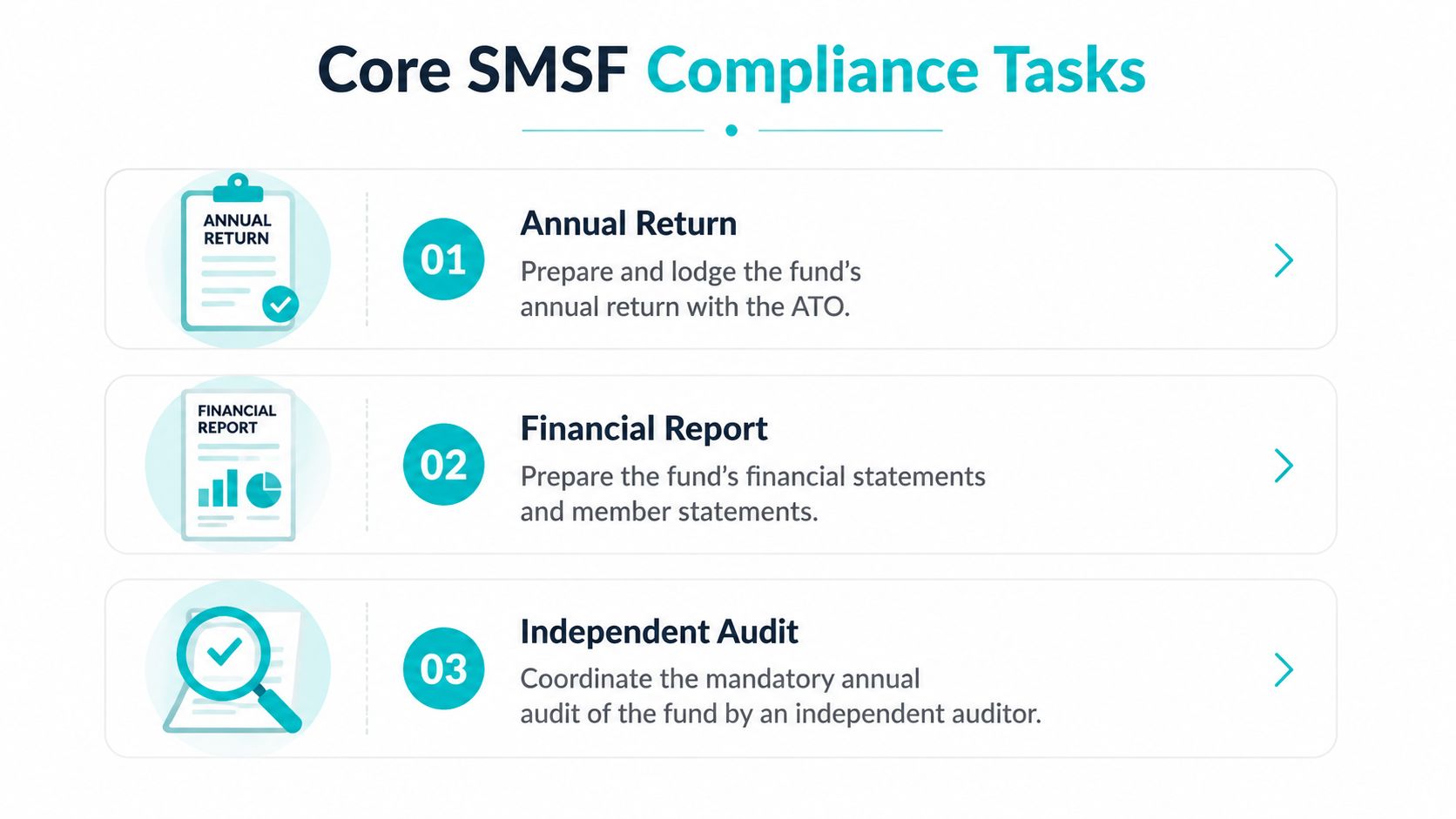
Australian SMSF providers commonly bundle the same core year-end obligations. As explained in this overview of SMSF accounting, the accounting function produces the annual financial statements, SMSF Annual Return, member statements, and audit working papers. It also notes that mis-coding transactions can lead to incorrect tax outcomes and delayed lodgements.
The annual deliverables that actually matter
At minimum, you should expect your provider to manage or coordinate these tasks.
Financial statements
These bring the whole year into one defensible record. Assets, liabilities, income, expenses, and member balances all need to reconcile. If the statements are weak, everything built on top of them is weak too.SMSF Annual Return
This is not a formality. It draws together tax, regulatory, and member information for the ATO. A late or inaccurate return tends to expose weaknesses elsewhere in the file.Member statements
Members need accurate opening balances, movements, and closing balances. In a multi-member fund, poor allocation work creates avoidable disputes and reporting issues.Tax calculations
This includes capital gains tax treatment, income classification, and support for any exempt current pension income calculations where relevant. Tax doesn't start at year-end. It starts with how transactions are coded during the year.
The records behind the return
Good SMSF accounting also creates the paperwork that an auditor expects to see. That usually includes transaction reports, supporting documents, investment records, pension documentation, contribution evidence, and trustee minutes where needed.
Weak administration becomes apparent quickly. Trustees often think the annual job begins after 30 June. It usually starts much earlier, with whether the fund's records are complete and usable.
A clean audit file is built month by month. It can't be assembled properly from memory at the end of the year.
For trustees handling many PDFs and bank documents, tools that assist with data extraction can reduce manual handling. Something like DigiParser financial data extraction shows the broader principle. Pull data consistently first, then review it carefully. In SMSF work, automation helps, but review is where compliance is won or lost.
SuperStream and ESA are part of the job
Modern SMSF accounting also reaches into operational plumbing. SuperStream and ESA compatibility are part of that.
If the fund doesn't have the right electronic service address setup and maintained properly, contributions and rollovers may not move through the system as intended. Good providers help trustees keep those details aligned with administration processes, contribution handling, and reporting records.
That's one of the clearest examples of why SMSF accounting is not just historical reporting. It supports the fund while the year is still happening.
Understanding the Annual SMSF Timeline and Fees
Most trustee stress comes from uncertainty. People don't mind obligations as much when they know the rhythm. A well-run SMSF follows a yearly cycle. The exact dates can vary by circumstances and lodgement arrangements, but the workflow itself is predictable.
Typical Annual SMSF Compliance Timeline
| Period | Key Activities |
|---|---|
| During the financial year | Record transactions, reconcile bank and investment activity, track contributions, pensions, expenses, and supporting documents |
| Around year-end | Check asset records, confirm member movements, review pension payments, and make sure documentation is complete |
| After year-end | Prepare financial statements, finalise tax positions, produce member statements, and assemble audit working papers |
| Audit phase | Provide records to the independent auditor, respond to queries, and fix gaps before lodgement |
| Final lodgement phase | Complete and lodge the SMSF Annual Return and retain final records for trustee files |
What a good process feels like
The best providers don't disappear for most of the year and then send a long list of urgent requests after 30 June. They keep the fund organised as it goes.
That usually means:
- Regular transaction capture so coding issues are found early
- Clear document requests rather than vague year-end scrambling
- Audit-ready files before the auditor starts asking questions
- Defined responsibilities so trustees know what they still need to sign, approve, or supply
If you're still at the beginning of the journey, setting up a superannuation fund helps frame the administration commitments before you take on trustee duties.
How fees are usually structured
SMSF accounting fees are often charged in one of three ways.
| Fee model | What it usually means in practice |
|---|---|
| Fixed annual fee | One quoted price for standard annual compliance work, often easier for budgeting |
| Hourly billing | Charges depend on time spent, which can suit unusual matters but can create fee uncertainty |
| Base fee plus extras | A standard package with additional charges for pensions, property, complex transactions, amendments, or urgent work |
The cheapest quote often excludes the work trustees assume is included. That's where disappointment starts. Before you agree to a service, ask what triggers additional charges.
Watch for this: pension work, CGT calculations, transfer balance reporting, late records, property paperwork, and audit issue resolution are common areas where “standard” pricing can stop being standard.
The question isn't just what the annual fee is. It's whether the service model matches your fund's complexity and whether the scope is clear enough to avoid disputes later.
The Hidden Risks of Poor or DIY SMSF Accounting

Poor SMSF accounting rarely fails in one dramatic moment. It usually fails out of sight. A rollover is coded incorrectly. Pension payments aren't tracked properly. A contribution record is missing. A trustee minute was never prepared. None of that looks catastrophic on the day it happens.
Then year-end arrives. The statements don't reconcile cleanly. The auditor asks for evidence that no one can find. Lodgement is delayed while old transactions are rebuilt from bank statements and email trails. What looked like a manageable admin shortcut becomes a compliance problem.
Outsourcing doesn't remove trustee liability
This is the point many trustees miss. The ATO makes trustees legally responsible for running the fund correctly and lodging annual returns. Outsourcing accounting tasks does not transfer those legal obligations away from the trustee, as noted in this discussion of outsourced SMSF accounting responsibilities.
That changes how you should think about service providers. You're not hiring someone to “take the risk off your hands”. You're hiring someone to help you manage risk that still sits with you.
What goes wrong in DIY setups
DIY arrangements often struggle in the same places:
- Transaction coding breaks down when trustees rely on memory rather than process.
- Documents scatter across inboxes, portals, folders, and paper files.
- Audit preparation is left too late, which turns simple questions into time-consuming reconstruction work.
- Trustees assume the software knows the law, when software only reflects the data put into it.
A spreadsheet can total numbers. It can't judge whether the transaction belongs in the right category, supports the right tax outcome, or has the paperwork to survive review.
If your SMSF records only make sense to you, they're not strong records. They need to make sense to an independent auditor and, if required, the ATO.
Cheap administration can become expensive administration
The most expensive SMSF file is often the one that looked cheap at the start. Rework, missing records, corrections, and delayed lodgements consume time quickly. So do repeated auditor questions caused by preventable gaps.
A trustee doesn't need premium bells and whistles to run a compliant fund. But they do need a service standard that produces accurate records, clear responsibilities, and timely follow-through. Anything less usually shifts work back to the trustee at the worst possible time.
How to Choose the Right SMSF Accounting Provider
Choosing a provider isn't just about price or turnaround time. It's about fit. The right accountant for a simple cash-and-shares fund may not be the right one for a fund with pensions, multiple members, or more complicated investments.
One question deserves more attention than it usually gets. At what balance and complexity does outsourced SMSF accounting become worth it compared with staying in a large APRA-regulated fund? That decision point is highlighted in this discussion about SMSF accountants and fund suitability, and it's rarely answered clearly on service pages.
Questions worth asking before you sign
Ask direct questions. If the answers are fuzzy, assume the service will be too.
What types of SMSFs do you usually handle?
A provider should be able to describe the kinds of funds they work with, not just say they do “all SMSFs”.What does your standard annual service include?
Ask specifically about financial statements, annual return preparation, member statements, audit coordination, pension reporting, and issue resolution.How do you collect and review data during the year?
You want a process, not a vague promise. Bank feeds, portals, document requests, and review points should all be clear.What happens if the auditor raises questions? Weak providers get exposed during this process. Ask who responds, what's included, and what would trigger extra fees.
Who is responsible for what?
The provider should state plainly what trustees still need to approve, sign, retain, or monitor.
Look beyond the financials
When you assess a provider, think like someone doing due diligence on a business relationship, not just buying admin support. This broader lens is why resources on understanding due diligence beyond financials can be surprisingly useful. In SMSF terms, you're checking process quality, communication discipline, and accountability, not just technical claims.
A useful comparison point is whether the provider also works inside a wider financial planning framework. For example, how do you find a good accountant is relevant because the best fit often depends on whether your accountant can work sensibly with your adviser, your retirement strategy, and your broader family structure.
Signs the provider is probably a good fit
You don't need a flashy presentation. You need evidence of a controlled process.
Look for:
- Clear scope documents that explain inclusions and exclusions
- Straight answers on trustee responsibility
- A defined audit workflow
- Comfort with explaining rules in plain English
- Technology that supports review, not technology used as a substitute for review
The right provider should leave you feeling informed, not dazzled.
The Wealth Collective Approach in Perth and Dunsborough
For trustees in Western Australia, the practical value of support often comes down to integration. SMSF accounting works better when it's connected to the broader decisions around super, retirement income, investment structure, insurance, and estate planning.
That's where a partnership model tends to be more useful than a narrow admin-only model. The accounting still needs to be accurate and disciplined, but the primary benefit is that the compliance work supports a larger financial plan instead of sitting in a silo.
What this looks like in practice
A sensible approach usually includes three things.
Clear division of responsibility
Trustees know what remains their legal duty. The service team knows what must be prepared, checked, and followed up.Administration tied to strategy
Pension commencements, contribution decisions, cash management, and asset movements shouldn't be treated as isolated admin events.Communication before deadlines become problems
The best outcomes usually come from catching issues early, not cleaning them up late.
For WA clients who want local support, Wealth Collective provides SMSF compliance and administration as part of a broader advice process in Perth and Dunsborough. That means the fund's paperwork, deadlines, and reporting can be managed alongside the planning decisions that sit around the SMSF, rather than in a separate lane.
Who this tends to suit
This approach usually suits trustees who want more than a low-cost annual form-filling service. It's often a better fit for people approaching retirement, business owners juggling multiple priorities, or families where one trustee has effectively become the default administrator for everyone else.
Good SMSF support should reduce uncertainty. It shouldn't leave you wondering what your accountant is doing, what you still need to do, or whether the fund is actually on track.
If you want only the bare minimum annual processing, there are providers built for that. If you want an SMSF accounting service that works as part of a wider retirement and wealth plan, the conversation needs to be broader from the start.
If you want clarity on whether your fund structure, compliance process, and current administration setup are fit for purpose, book a short introductory call with Wealth Collective. It's a practical first step for trustees who want to understand their responsibilities, spot risks early, and decide whether they need a tighter accounting and advice partnership.