Business hours
Monday to Friday (8.30AM - 5PM)
Weekend (Closed)



If you're in Perth and your super feels important but unclear, you're in the right place.
You might be earning well, paying down a mortgage, carrying a few old super accounts from earlier jobs, and wondering whether you're making smart decisions or just hoping compulsory contributions will sort it out. Or maybe retirement is no longer an abstract idea. It's getting close, and the key question isn't what your balance is. It's whether that balance can support the life you want in WA.
Generic super advice usually misses the point. Perth households deal with different pressures. FIFO income can be lumpy. Property costs can distort every cash-flow decision. Couples often have uneven balances because one person stepped back for children, changed roles, or earned less over time. That changes the strategy.
Is Your Super Ready for Your Perth Lifestyle
A lot of people I speak to are in one of two camps.
The first is the professional couple in Subiaco, Mount Lawley or Dunsborough who have good incomes, strong careers, and a decent mortgage, but no real confidence that their super is set up properly. The second is the FIFO worker or small business owner who has earned solid money over the years, yet still has a messy structure, patchy insurance, and no clean plan for retirement timing.
Both groups usually ask the same question in different words. Am I really on track, or just busy?
That uncertainty is common. The advice gap is real. ASFA reported that only 51% of adult Australians had ever consulted any source of information on preparing for retirement, and only 21% had used professional services such as financial advisers, according to ASFA's retirement information findings.
Why Perth clients need more than generic advice
WA life doesn't fit a standard eastern-states template. If you're balancing a mortgage, school fees, travel, aging parents, or the dream of a coastal retirement, your super can't be treated like a set-and-forget account.
For some households, the right move is to push harder on super. For others, the smarter move is to clear debt first, protect income, or sort out structure before adding another dollar. If you don't know the difference, you're guessing.
Good super strategy starts with your life, not with a fund brochure.
A lot of people also benchmark against the wrong thing. They compare balances with mates, headlines, or broad retirement rules of thumb. That's a fast way to get bad answers. A more useful starting point is understanding the lifestyle your money needs to fund, which is why many Perth clients first look at the ASFA retirement standard guide before making bigger planning decisions.
The real issue
The issue usually isn't effort. It's translation.
Your super statement shows a balance, an investment option, some fees, and maybe insurance. It doesn't tell you whether your settings match your income, tax position, retirement timing, partner's situation, or the lifestyle you want in WA. That's where proper Superannuation Advice Perth becomes practical. It turns a pile of accounts and rules into a plan you can use.
What Perth Superannuation Advice Actually Involves
It's often thought that super advice means picking a better fund. That's too narrow.
Real advice is closer to designing a house. The fund is one building material. What matters more is the design. If the layout is wrong, better bricks won't save it. Super works the same way. Strategy, structure, tax settings, insurance, and retirement sequencing matter more than product shopping on its own.
Australia treats this as a serious professional service, not a side topic. IBISWorld estimates the Financial Planning & Investment Services industry in Australia at $6.1 billion in 2026 and 17,530 businesses in 2025, with superannuation and retirement advice included as core service lines, according to IBISWorld's industry profile.
The four parts that matter
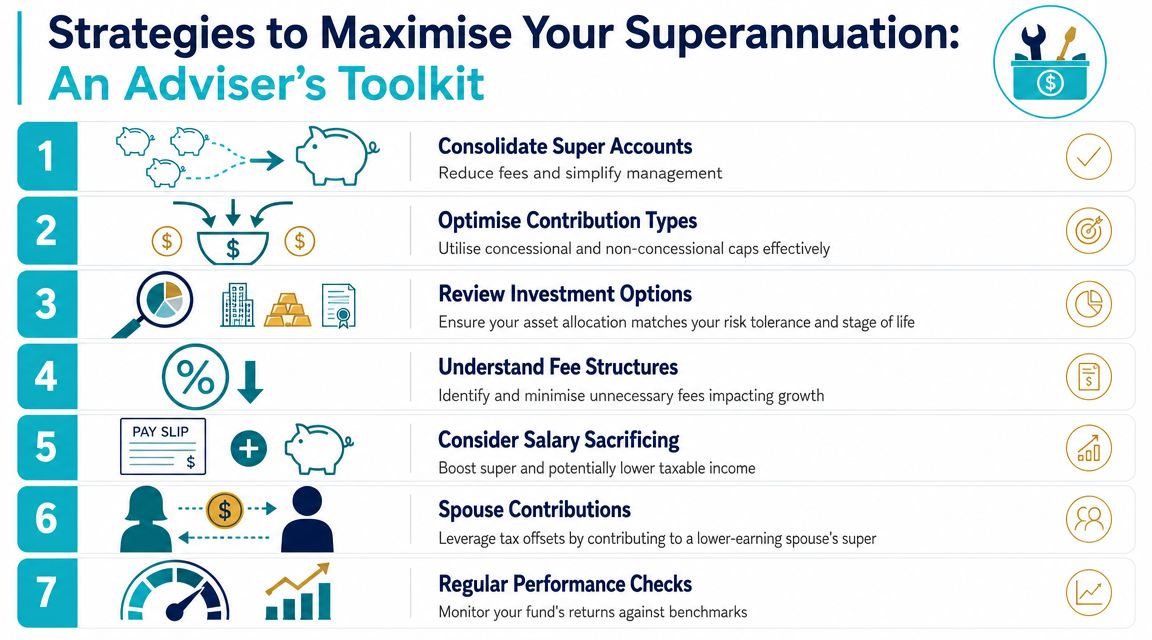
A proper super strategy usually sits on four pillars.
| Pillar | What it actually means |
|---|---|
| Contribution strategy | Deciding how money goes in, when it goes in, and whose super should receive it |
| Investment strategy | Matching your investment option to your timeframe, risk tolerance, and need for liquidity |
| Insurance inside super | Checking whether cover is appropriate, duplicated, outdated, or draining the balance |
| Structural planning | Making sure your super setup works for retirement income, tax treatment, and household fairness |
Some clients need all four fixed. Others only need one or two adjusted. The point is that advice should diagnose before it prescribes.
What advisers should be doing
You want an adviser who can answer practical questions such as:
- Should extra cash go to super or the mortgage
- Is your insurance inside super still fit for purpose
- Are you carrying multiple accounts and unnecessary fees
- Does your investment option still suit your stage of life
- Should one spouse be catching up while the other slows down
That's why broad financial planning matters. If you're comparing service scope, this plain-English guide on what financial planning covers is a useful reference point.
A good adviser doesn't start with a product recommendation. They start by working out what problem you're actually trying to solve.
What this looks like in Perth
For a FIFO worker, advice might centre on volatile income, tax-aware contributions, insurance, and a realistic exit plan from full-time site work.
For a younger couple, the issue might be whether to push super harder now or direct cash toward debt reduction and protection first.
For someone in their late fifties, the focus shifts. At that point, super isn't just an accumulation tool. It's becoming the engine room of your retirement income.
How Advisers Unlock Hidden Value in Your Super
The difference between generic help and skilled advice becomes obvious.
Most of the value in super planning doesn't come from finding a magic fund. It comes from using the rules properly. That means contributions, tax position, spouse strategies, account structure, and timing all need to work together. If one piece is out of place, the rest can underperform.
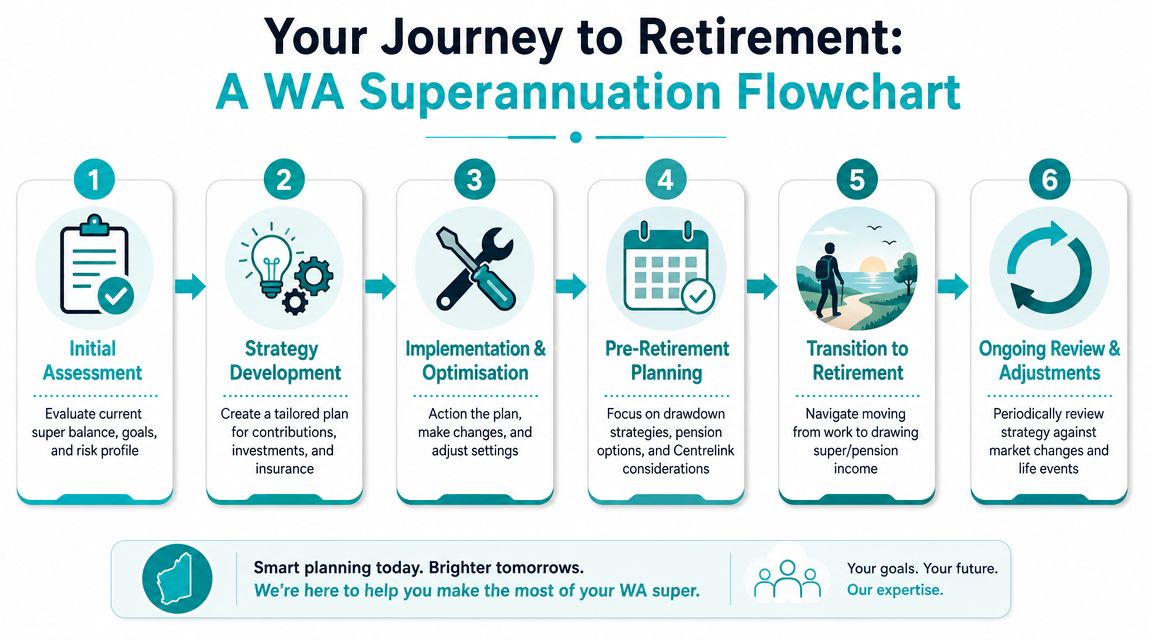
A major lever is the concessional contributions cap. For 2025 to 2026, the cap is $30,000 per person, and concessional contributions are generally taxed at 15% inside super, which creates an opportunity to move income from higher marginal tax rates into the super environment, as outlined by Rainmaker's superannuation guidance.
Contribution strategy is not just about adding more
Plenty of Perth clients assume the answer is simple. Earn more, put more into super.
That's incomplete. The better question is whose super, what type of contribution, what tax outcome, and what cash-flow trade-off. A strong strategy weighs all of that before anything gets implemented.
Here are the areas I think deserve the closest attention.
- Salary sacrifice for high earners. This can work well when the tax gap is meaningful and your day-to-day cash flow can handle it.
- Deductible personal contributions. Useful for people with variable income, bonus income, business income, or irregular contribution patterns.
- Timing around bonuses or peak earning years. This matters more in WA than many people realise, especially for FIFO households and business owners.
- Watching Division 293 exposure. The strategy has to be tested, not assumed.
Couples should stop treating super as two separate silos
This is one of the biggest missed opportunities I see.
If one partner has carried more paid work and the other has had lower income, career breaks, or part-time years, you can end up with a lopsided retirement position. That creates tax issues, fairness issues, and flexibility issues later on.
Industry advisers have described spouse splitting as a secret that's well kept, with up to 85% of a year's concessional contributions able to be split to a spouse. Spouse contributions can also create a $540 tax offset where the receiving spouse's income is in the relevant range. The same discussion highlighted why equalising balances matters more now that, since 1 July 2025, Australians with total super balances above $3 million face an additional 15% tax on earnings attributable to the excess, as discussed in this industry adviser interview on spouse splitting and balance management.
Practical rule: If you're a couple, don't optimise super person by person. Optimise it household by household.
The best strategies are coordinated
A skilled adviser doesn't look at one lever in isolation. They ask questions like these:
- Is extra concessional contribution the right move, or do you need more liquidity outside super first
- Should balances be equalised between spouses before retirement gets close
- Are you accidentally building one partner's tax problem while leaving the other underfunded
- Does your insurance setup still make sense if contributions increase
- Will today's contribution strategy create tomorrow's pension structure problem
A defined planning process matters. Some Perth clients use a broader advice framework such as Wealth Collective's retirement and super planning services when they want contribution strategy, insurance, debt decisions and retirement timing considered together, rather than in isolation.
Hidden value often comes from fixing old decisions
You don't always need a fresh start. Sometimes the win is cleaning up what you've already got.
Old employer funds, stale investment options, outdated insurance, uneven spouse balances, and contribution patterns that no longer match your income can all reduce long-term outcomes. None of that is dramatic. All of it matters.
Building Your Retirement Roadmap in WA
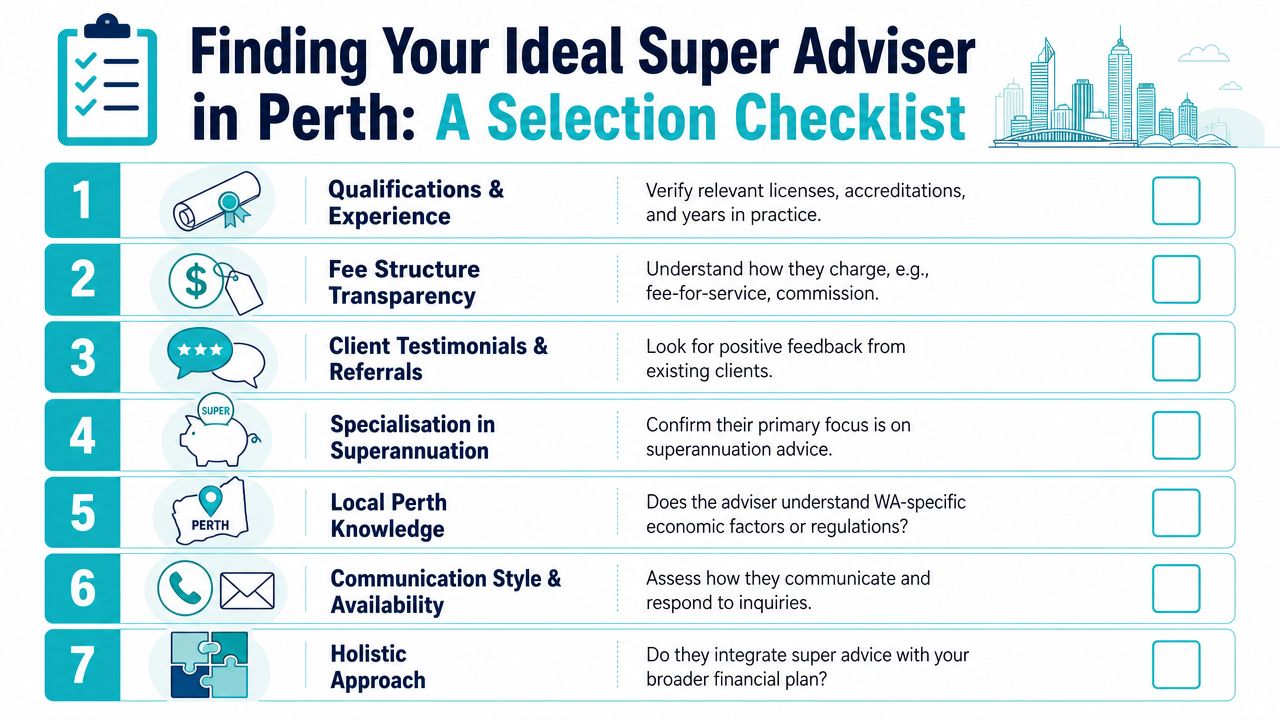
The final years before retirement need sharper planning than the accumulation years.
When retirement is still far away, small mistakes can be absorbed. When it's close, timing matters more. A market fall, a poor drawdown order, or the wrong pension setup can do real damage because you have less time to recover and less flexibility to correct course.
That is why retirement advice isn't just about growing the balance. It's about turning super into a reliable income system.
The structural decisions matter most
One of the most important technical issues is the Transfer Balance Cap, which limits how much can be moved into a tax-free retirement-phase pension and forces careful structural planning, as explained in AustralianSuper's overview of retirement-phase advice considerations.
That means the question isn't, "Can I retire?" It's also:
- What stays in accumulation
- What moves into pension phase
- When should that happen
- How should income be drawn
- What assets should remain more defensive
For Perth clients nearing retirement, these aren't administrative details. They're the mechanics that determine how tax-efficient and durable your retirement income will be.
The WA retirement problem people overlook
A lot of pre-retirees in WA still have one major issue hanging over the plan. They may want to slow down before government support becomes available.
The Age Pension qualifying age is now 67 for people born on or after 1 January 1957. That creates a genuine bridge-financing problem for people who want to stop work, reduce work, or step away from physically demanding roles before that point. The problem is often bigger for FIFO workers and couples carrying housing debt later into life.
If you're planning to retire before Age Pension eligibility, you need a funding bridge, not wishful thinking.
That bridge might involve super drawdown, non-super assets, debt restructuring, staged retirement, or a mix of all four. Generic calculators rarely help because they don't handle sequencing, taxation, liquidity, and household cash flow in one place. If you're approaching that stage, this guide on how to plan retirement gives a sensible foundation.
Sequencing risk is real
The years just before and after retirement are fragile. If markets fall early while you're starting to draw income, the damage can be harder to repair than a similar fall during your forties or fifties.
That's why I usually prefer retirement planning that separates short-term income needs from long-term growth assets. Clients need enough accessible capital and stable income sources to avoid selling growth assets at the wrong time. The exact structure depends on the household, but the principle is simple. Retirement portfolios must be built for spending, not just for statements.
Retirement planning should answer these questions
| Question | Why it matters |
|---|---|
| When can I realistically stop work | Retirement timing drives every other decision |
| How will I fund the years before Age Pension eligibility | This is where many plans break |
| What income can I draw without unnecessary tax drag | Structure affects spending power |
| How should assets be split between growth and stability | This helps manage sequencing risk |
| What happens if one partner retires earlier than the other | Household planning beats individual planning |
Your Checklist for Choosing a Perth Super Adviser
Don't choose an adviser because they sound polished. Choose one because they think clearly, explain plainly, and can show you how strategy connects to your actual life.
Too many people hire based on comfort in the first meeting and only later realise the adviser is light on technical depth. Super isn't the place for vague competence. If someone can't explain contribution strategy, retirement structure, and spouse balance issues in plain English, keep looking.
What to look for first
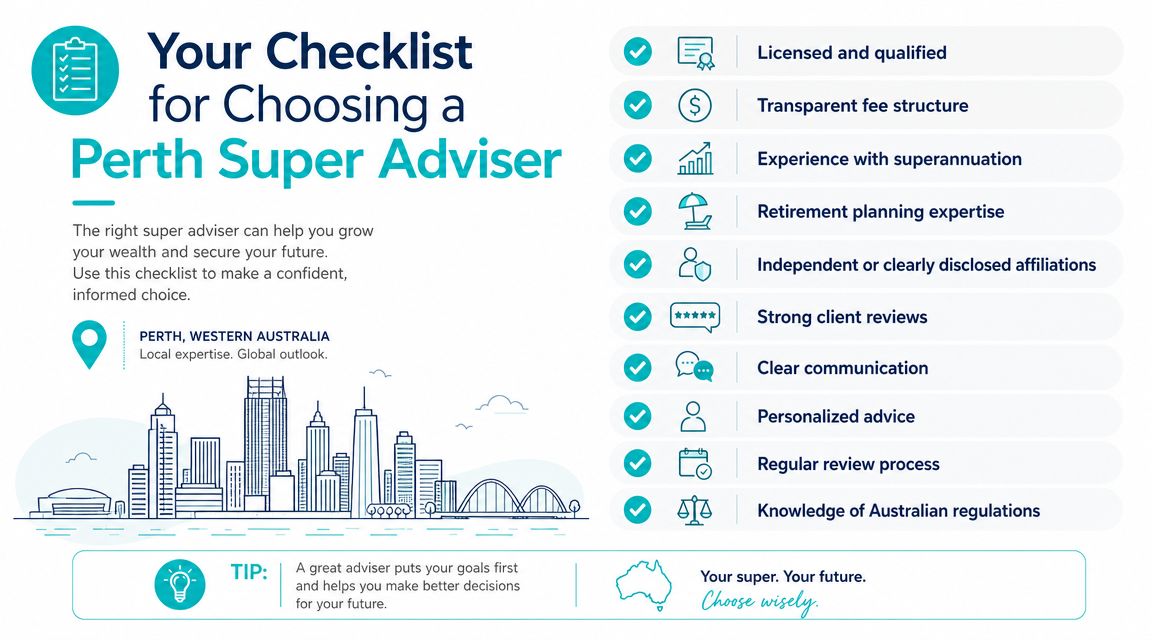
Use this checklist early, before you get pulled into product talk.
- Clear licensing and authority. They should be properly authorised to provide the advice you need, with no fuzziness around scope.
- Strong super and retirement depth. Lots of advisers say they "do super". Fewer can explain contribution caps, pension structuring, spouse equalisation and retirement sequencing clearly.
- Transparent fees. If the fee model feels slippery in the first conversation, it won't improve later.
- A defined process. Good advice follows a structure. Discovery, analysis, recommendations, implementation, review.
- Relevant client experience. A Perth executive, a FIFO worker, a dual-income family and a near-retiree don't need identical advice.
The question that reveals technical depth
Ask this: How would you approach super for a couple with unequal balances and different incomes?
That one question tells you a lot. An expert adviser should be able to discuss strategies like super splitting, where up to 85% of a year's concessional contributions can be moved to a spouse to equalise balances, especially in light of the $3 million balance tax settings already noted earlier.
If they answer with a generic "we'll review your fund options", that's not enough.
The right adviser should make complex rules feel organised, not overwhelming.
Red flags that should end the conversation
Some signs are minor concerns. These aren't.
| Red flag | Why it's a problem |
|---|---|
| They push a product before understanding your goals | That reverses the advice process |
| They can't explain their recommendation simply | Confusion now becomes mistrust later |
| They ignore your partner's position | Household strategy matters in super |
| They don't ask about debt, insurance or retirement timing | Super doesn't operate in a vacuum |
| They rush implementation | Pressure usually hides weak advice |
What good advice feels like
A good first meeting should leave you clearer, calmer, and more specific about the decisions in front of you.
You should understand:
- What problem is being solved first
- Which parts of your super setup need review
- What information is still missing
- Whether you need a narrow super fix or broader planning
If you leave with more jargon than clarity, the fit is wrong.
See the Difference Real Advice Makes
A FIFO worker in his fifties comes in with strong income, multiple old super accounts, and no clear idea when he can stop site work. His real issue isn't picking a new fund. It's whether he can create enough flexibility to step back before his body makes the decision for him. The work usually starts with structure, contributions, insurance and a bridge plan for the years before Age Pension eligibility at 67.
A professional couple in Perth come in with solid incomes and completely uneven super balances. One partner has built momentum. The other lost ground through career breaks and part-time work. Their problem isn't under-earning. It's household imbalance. The right advice often centres on contribution strategy, spouse contributions, contribution splitting, and making sure retirement doesn't leave one partner with too much trapped in super and the other with too little.
A pre-retiree couple in the South West come in thinking they're close to ready. Their balances look fine on paper, but they haven't mapped the drawdown order, pension structure, or short-term cash reserve they need. That's where confidence can collapse. Retirement stops feeling exciting when the income plan is vague.
What changes after advice
The outcome isn't magic. It's clarity and control.
- Messy accounts become a cleaner structure
- Tax decisions become intentional
- Uneven spouse balances get addressed
- Retirement timing becomes a real plan
- Super starts serving the household, not just sitting in the background
Real advice turns super from a statement balance into a working retirement tool.
If your super feels disorganised, underused, or too important to keep guessing with, act on it. Waiting usually doesn't simplify anything.
If you'd like a straightforward starting point, book a brief initial chat with Wealth Collective. It's a practical way to talk through where you are, what isn't clear, and whether you need a focused super review or a broader retirement plan.