Business hours
Monday to Friday (8.30AM - 5PM)
Weekend (Closed)



Your business began straightforwardly. You invoiced in your own name, used your own ABN, and kept moving because speed mattered more than structure. That works well for a while.
Then the business grows up. Clients ask for bigger engagements. You're signing longer contracts. You're thinking about taking on staff, buying equipment, or building something with sale value beyond your personal effort. At that point, changing from sole trader to company stops being a paperwork question and becomes a wealth decision.
For many Australian business owners, this shift happens right when personal financial risk starts rising. The same momentum that creates profit can also expose the family home, personal savings, and future retirement plans if the structure no longer fits the business.
Is Your Business Ready for a Company Structure
A common pattern looks like this. A sole trader builds a strong book of business, earns reliable income, and enjoys the simplicity of running everything directly. Then one contract gets larger, one employee becomes necessary, or one dispute with a customer makes personal liability feel less theoretical.
That's usually the point where the structure starts to matter.
A sole trader setup is fast and lean. But as the business matures, the lack of separation between the owner and the business becomes a strategic weakness. If you're carrying more responsibility, more contractual exposure, or more assets, a company can become the more sensible vehicle for protecting what you've built.
In Australia, this isn't unusual. As of 30 June 2025, there were 1.21 million registered companies compared to 0.82 million sole traders, which means companies represented about 59% of the combined company and sole trader structures according to QuickBooks' overview of changing from sole trader to company. That tells you something important. Nearly six out of ten mature Australian businesses have adopted the company structure.
The signs usually appear before the paperwork starts
You might be ready if any of these feel familiar:
- Larger contracts are on the table and counterparties want to deal with a company rather than an individual.
- Personal asset protection matters more now because business risk has increased.
- Staff or contractors are becoming part of the model, which raises complexity around payroll, super, and management.
- You want to build business value that can operate with more continuity than a sole trader setup usually allows.
- Your financial life is becoming more layered, with super, investments, debt management, and tax planning all needing to work together.
Changing from sole trader to company often happens when business success creates enough value that leaving everything in your own name no longer feels prudent.
If you want a broad comparative read on how different business structures work in practice, this guide for entrepreneurs on business structures is useful for understanding the broader trade-offs, even though the Australian legal framework is different.
The key point is simple. A company structure isn't a badge of seriousness. It's a tool. The right time to use it is when the business has outgrown the risk profile and wealth limits of staying a sole trader.
The Decision Checklist Before You Change Structures
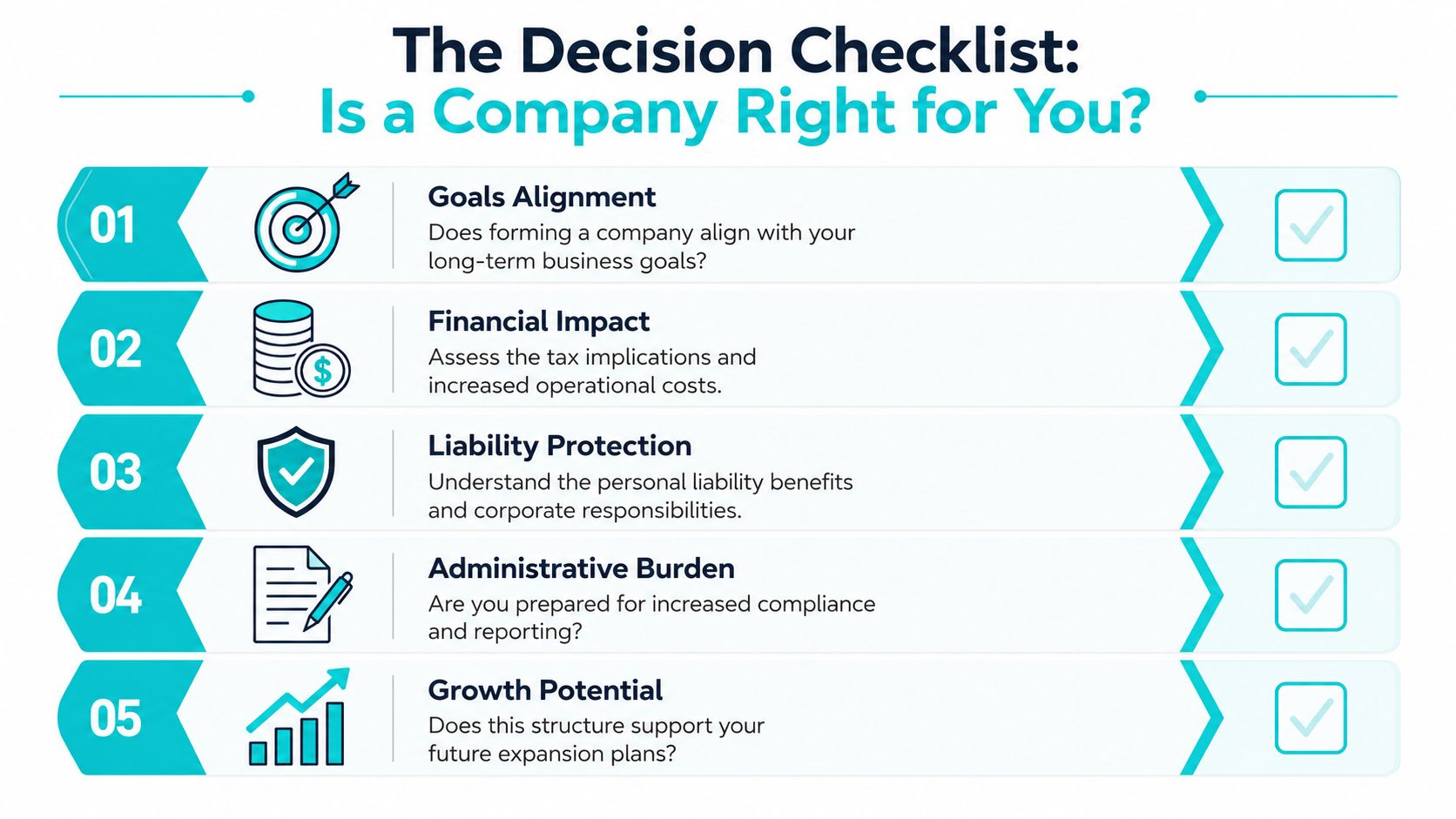
Before filing anything, ask a harder question. Will a company improve your position, or just add cost and admin?
That answer depends less on hype and more on fit. A company can be powerful, but only when it supports the business you're building.
Ask what the structure needs to do for you
A useful decision checklist starts with function, not form.
- Protect personal wealth. If the business is taking on bigger obligations, a company may create a clearer legal separation between business risk and personal assets.
- Support expansion. If you want to hire, bring in another owner, or build systems that outlast your direct labour, a company can make that easier.
- Improve financial discipline. A separate entity often forces better banking, bookkeeping, and decision-making.
- Create strategic flexibility. Companies can open different pathways for profit retention, super contributions, and longer-term planning.
- Match market expectations. Some clients, suppliers, and lenders prefer dealing with a company.
The real trade-off is complexity
The move isn't free from friction. You'll take on more compliance, more administration, and more formality around how money moves.
Use this quick test.
| Question | If the answer is yes | Why it matters |
|---|---|---|
| Are you worried about personal liability? | A company may be timely | Risk separation becomes more valuable as exposure grows |
| Are you planning to hire or formalise roles? | A company often fits better | Employment and governance tend to need more structure |
| Do you need cleaner separation between personal and business money? | A company can help | Better records usually support better tax and wealth planning |
| Are you likely to take on more complex contracts? | Consider changing sooner | Contracting in your own name can become a bigger risk |
| Are you willing to handle ongoing compliance? | Then the model may suit | The benefits only work if you maintain the structure properly |
What often works and what often doesn't
What works is changing structure because the business has reached a clear strategic threshold.
What doesn't work is changing because someone said companies are always “better”. They aren't. They're better for some business owners at some stages.
Practical rule: If your business goals are getting more sophisticated but your legal and financial structure is still basic, the gap usually causes problems before it creates opportunities.
This is also where employment status matters. Many business owners move to a company while also changing how they engage workers or how they themselves are paid. If that line is blurry, review the ATO-focused guide on contractor vs employee before you restructure.
For context outside Australia, this comparison on understand UK company types is a useful reminder that the same strategic questions show up in different jurisdictions, even if the legal mechanics differ.
If your answers point to growth, protection, and long-term planning, the decision is probably less about whether to change and more about timing the move properly.
Critical Pre-Change Considerations and Tax Pitfalls
A profitable sole trader often reaches the same point. Revenue is up, clients are larger, assets have built up inside the business, and the owner decides to incorporate quickly so the structure “catches up” with growth. That is exactly when expensive mistakes happen.
The primary risk sits in what changes hands, when it changes, and how it is documented. If the move is handled well, a company can support better tax planning, stronger asset protection, and more deliberate wealth creation. If it is handled poorly, you can trigger tax, muddy ownership, and carry weak records into a more demanding structure.

Asset transfers can trigger tax consequences
Many owners assume they can shift business assets into the company and keep trading. That assumption causes trouble.
Transferring assets such as equipment, vehicles, or intellectual property from a sole trader to a new company may trigger Capital Gains Tax events, although small business CGT concessions may apply to reduce or eliminate this liability, as explained in Moore Lewis's summary of the tax implications of changing your business structure.
The trap is not limited to obvious assets. Goodwill, a customer list, a domain name, a trademark, software, and internally developed IP can all carry value. If that value is transferred without proper advice, the tax outcome may be very different from what you expected.
Timing and sequencing preserve value
In practice, the biggest savings usually come from planning before anything is signed or transferred. Once an asset movement has occurred, your options narrow quickly.
That planning should cover valuation, ownership history, eligibility for concessions, and the date of effect. It should also deal with the commercial reason for the move. A restructure done for long-term profit retention, succession planning, or asset protection is usually far stronger than one rushed through at year-end because someone wants a lower tax rate.
Treat the restructure as a wealth decision first and an admin task second.
Other tax and setup issues owners underestimate
The entity change affects more than CGT. It changes how income is earned, how money is extracted, and how cleanly the business can operate from here.
- GST registration needs review under the new entity if the company will continue the same business activity.
- PAYG withholding may apply if the company pays wages to staff or directors.
- Superannuation needs to match the new remuneration approach.
- Record-keeping and bank accounts need a clean separation because company funds are not personal funds.
- Existing contracts and invoices may need to be updated so income is derived by the correct entity from the correct date.
This is often where weak bookkeeping gets exposed. A company gives you more planning opportunities, but only if the numbers are reliable and the separation between personal and business money is real. If your goal is to retain more profit while building long-term wealth, review these small business tax reduction strategies before you decide on the cutover date and payment structure.
For owners who want a plain-English refresher before comparing sole trader and company outcomes, this article on how to simplify sole trader tax in 2026 is a useful starting point.
Questions worth answering before you incorporate
Use this checklist before any transfer documents are prepared:
- What assets are being transferred? Include plant, vehicles, goodwill, IP, domain names, licences, and trading names.
- What is each asset worth? Market value matters, especially where related parties are involved.
- Are any concessions available? That needs tax advice before the transaction, not after it.
- How will profits be used once the company is operating? The right answer depends on cash flow, reinvestment plans, family needs, and broader wealth goals.
- How will you pay yourself? Salary, dividends, director fees, or a mix each carry different tax and compliance consequences.
- What cutover date gives the cleanest records? A poor date creates reporting issues, duplicated work, and confusion over who earned what.
The strongest restructures are deliberate. They protect what the business has already built and put the next stage of growth on better footing.
Registering Your New Company Step by Step
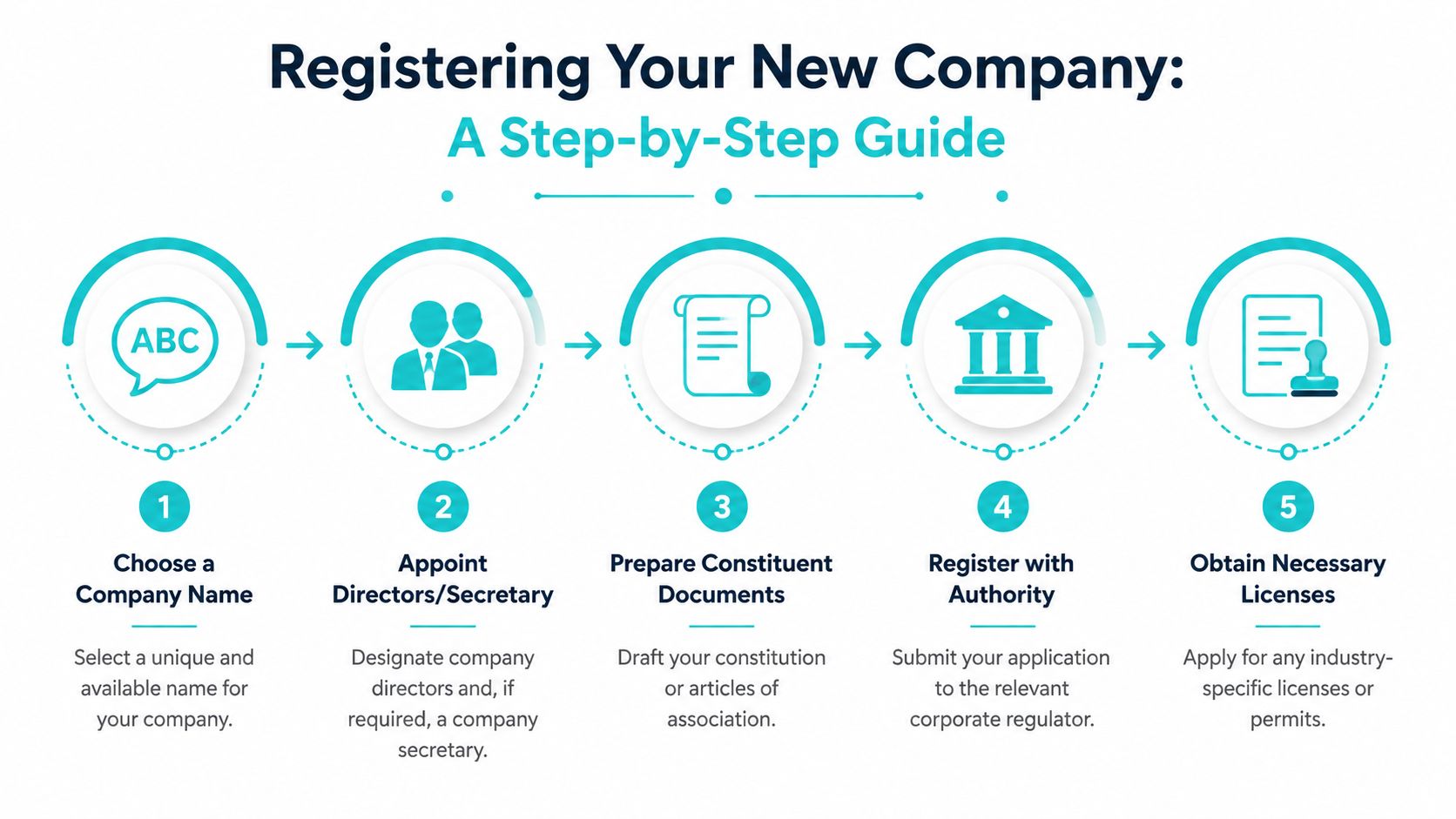
Once the strategy is sound, the formal setup becomes much easier to manage. The order matters because each registration builds on the one before it.
Start with incorporation
The first legal step is to incorporate a proprietary company through ASIC. That process gives the company its Australian Company Number, or ACN. Without that, the company doesn't exist as a separate legal entity.
Before lodging, make sure the company name is available and that you've decided who the directors will be. You should also have clarity on the registered office and how the company will be governed.
Then apply for the company's own tax registrations
A common misunderstanding involves the ABN: You cannot transfer your existing ABN from yourself as a sole trader to the new company. You must cancel the sole trader ABN and apply for a new ABN specifically for the company entity, as set out in NAB's guide to moving from sole trader to company.
That distinction matters because the company is not a renamed version of you. It is a new legal person.
A clean sequence usually looks like this:
- Choose and confirm the company details with directors and office details settled.
- Register the company with ASIC and obtain the ACN.
- Apply for the company ABN and TFN under the new entity.
- Register for other relevant tax obligations if the company will need them.
- Prepare the business for operational cutover so invoices, contracts, and bank accounts match the new entity.
Keep the registrations aligned with the real business
Owners often rush to register the company, then continue operating through the old setup out of habit. That creates confusion in invoicing, banking, and contracts.
Use a short implementation checklist:
- Banking first. Open a bank account in the company's name before trading through it.
- Invoices next. Update invoice templates, payment details, and remittance information.
- Accounting system. Keep the new entity's records separate from day one.
- Advisers on call. Have your accountant and lawyer aligned before the first transaction lands.
The cleanest restructures happen when the paperwork date and the trading reality match.
If you're unsure how to choose the right accounting support for this transition, this guide on how do you find a good accountant is worth reading before you appoint someone to handle the registrations and tax setup.
The administrative process isn't the hard part. The hard part is making sure the registrations reflect how the business will operate once the company exists.
Managing the Business and Asset Transition
Registering the company creates the shell. The actual transition happens when the business operations move into it properly.
Many restructures go wrong: The owner has a company on paper, but customers still contract with the individual, suppliers still invoice the old entity, and assets still sit in the wrong name. That defeats the point of changing from sole trader to company.
Transfer the business, not just the name
The transition requires a legally distinct method. That means incorporation, formal transfer of all business assets through sale agreements, and cancellation of the sole trader ABN. Contracts with employees, suppliers, and clients must be novated or re-entered under the company name, as outlined in Astraea Legal's guide to changing from sole trader to company.
That sentence carries most of the actual work.
A proper transfer can involve:
- Physical assets such as tools, plant, vehicles, stock, and office equipment.
- Intangible assets such as goodwill, domain names, trademarks, patents, and business names.
- Commercial relationships including client agreements, supplier terms, leases, and employment arrangements.
- Operational systems such as bank accounts, software subscriptions, merchant facilities, and insurance policies.
Contract novation is the step owners skip most often
A client contract in your personal name doesn't automatically become a company contract because your invoice footer changed. The agreement usually needs to be novated or re-entered.
If that doesn't happen, you may still be personally liable under the old contract even though you believed the company had taken over. That's one of the most common ways a restructure fails to deliver the protection the owner expected.
If the contract still names you, the risk may still sit with you.
Make the cutover visible everywhere
The practical side matters just as much as the legal side. Once the company is live, the rest of the business needs to catch up quickly.
Use a transition sweep across every touchpoint:
| Area | What to update |
|---|---|
| Banking | New business account in the company name |
| Invoicing | Company legal name, ABN, payment details |
| Website | Footer, contact page, terms, privacy wording if relevant |
| Insurance | Policies issued to the company, not the individual |
| Suppliers | New entity details and billing instructions |
| Clients | Notice of the change and updated contracting entity |
| IP records | Ownership details with the relevant registries |
What works best is a firm cutover date with disciplined follow-through. What doesn't work is a vague transition where old and new entities overlap for convenience. That creates accounting confusion, weakens legal separation, and raises the risk of mistakes that are harder to unwind later.
Ongoing Compliance and Your New Responsibilities
The first year after incorporation catches many owners off guard.
Revenue may be stronger, the business may look more credible, and the structure may finally match the scale of what you are building. But a company also brings a higher standard of administration, record-keeping, and director oversight. If that discipline slips, the structure stops doing its job well.
A company needs active upkeep
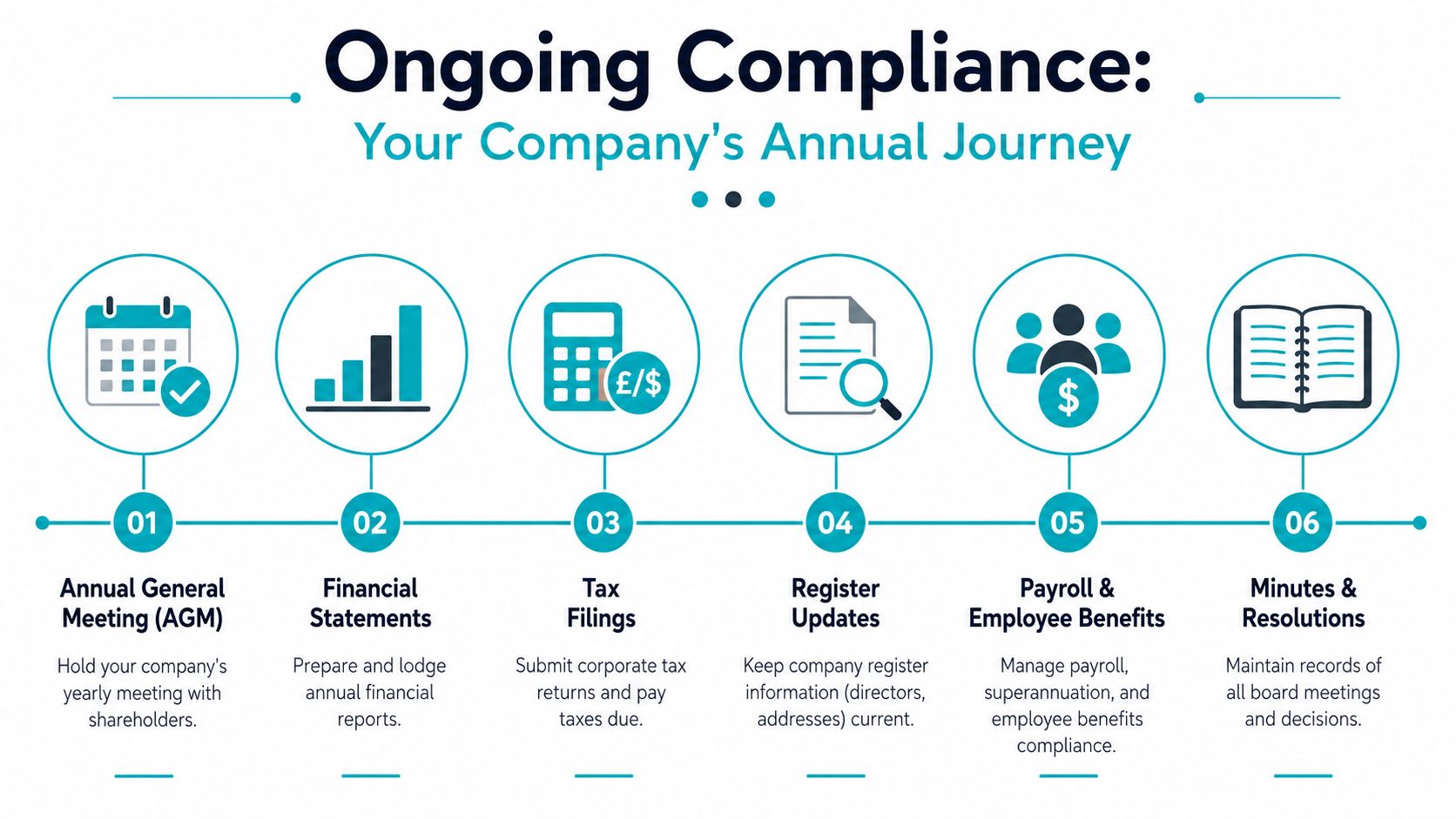
As noted earlier, ongoing company obligations include annual ASIC reviews and fees, financial reporting requirements where relevant, director disclosure obligations, and real penalties for missed compliance.
That matters for more than admin reasons. If you want a company to support long-term wealth creation, it needs to be run properly. Clean records, current registrations, and disciplined governance make the structure more useful for tax planning, finance applications, asset protection, and future sale discussions.
I often see owners focus hard on the setup, then treat compliance as something to catch up on later. Later usually costs more.
Director duties change the way you run the business
A sole trader can operate informally because the business and the individual are the same legal person. A company separates those roles. Once you become a director, you are expected to act with more care around decisions, solvency, reporting, and use of company money.
In practice, that means:
- Keeping company money separate from personal spending and private accounts
- Maintaining accurate records so tax, BAS, payroll, super, and year-end work can be handled properly
- Updating ASIC details on time when addresses, shareholders, or officeholders change
- Monitoring solvency closely so the company does not trade while unable to pay its debts
- Documenting significant decisions instead of relying on verbal agreement or memory
These are not technicalities. They are part of preserving the legal and financial integrity of the structure.
Good compliance protects value
Owners who build wealth through business usually benefit from better information, not just higher revenue.
When bookkeeping is current and company obligations are handled on time, it becomes easier to see what the business can afford. That affects how much profit can be retained, whether extra super contributions are realistic, how lending capacity will be assessed, and when it makes sense to invest outside the business.
Poor compliance weakens those decisions. Messy records blur the line between business and personal spending, create avoidable tax issues, and make the company look riskier to lenders, buyers, and advisers.
A company should give you better control. That only happens if the records are reliable.
Build a repeatable compliance rhythm
The owners who handle this well do not usually have a complex system. They have a consistent one.
A practical rhythm often includes:
- A compliance calendar for ASIC review dates, tax lodgments, super deadlines, and key reporting obligations
- Monthly bookkeeping and account reconciliation instead of year-end reconstruction
- Quarterly reviews of cash flow, tax provisions, director drawings, and retained profits
- Clear documentation for major contracts, loans, shareholder changes, and business purchases
- One coordinated advice team so accounting, legal, and strategic planning decisions do not drift apart
That rhythm does more than keep ASIC satisfied. It gives you cleaner numbers, fewer surprises, and a better base for making wealth decisions with confidence.
Build Your Wealth with the Right Structure
Changing from sole trader to company is rarely just an admin milestone. Done well, it's a strategic move that can protect personal assets, support smarter tax planning, and give your business a sturdier foundation for growth.
Done poorly, it creates a new entity on paper while leaving underlying risks untouched.
The difference usually comes down to timing, planning, and execution. You need to know why you're changing, what gets transferred, what tax consequences may arise, and how the new company will operate in practice. That's where good advice matters. Not because the process is mysterious, but because the mistakes are expensive and often avoidable.
If your business is growing and your personal financial life is becoming more complex, structure should be part of your wealth plan, not an afterthought.
If you want help making that decision with clarity, Wealth Collective can help you look at the business structure question in the context of your broader wealth strategy, including asset protection, superannuation, tax-aware planning, and long-term retirement goals. Start with a free 10-minute introductory call and get a clear view of what the right next step looks like for you.