Business hours
Monday to Friday (8.30AM - 5PM)
Weekend (Closed)



You've probably had this thought already. You buy or renovate an investment property, spend heavily on the parts that make the place stronger, safer, or more usable, then realise the tax treatment isn't nearly as simple as “I spent money, so I claim it”.
That's where many investors get stuck. They know the spend matters, but they're fuzzy on what counts as structural, what gets claimed over time, what paperwork the ATO expects, and how timing affects the deduction. If you're trying to make smart property decisions without creating a tax mess later, understanding what is capital works becomes part of the broader planning picture, not just an accountant's technicality.
Understanding Capital Works Basics
If you're weighing up a new build, a major renovation, or an extension on a rental property, capital works sits right in the middle of the decision. It affects cash flow, taxable income, record-keeping, and how long it takes to recover part of your construction spend through tax deductions.
A simple way to think about it is this. Capital works usually refers to the permanent structure of the property. These are the parts you don't pick up and replace like a toaster or microwave. They're built into the property and form part of its fabric.
For investors, that matters because structural spending is generally claimed gradually rather than all at once. That changes how you budget and how you assess the true after-tax value of a project. If you're still building your knowledge around how an investment property fits into a broader wealth plan, capital works is one of the key tax concepts to get clear early.
Defining Capital Works in Tax Law
A useful way to read the law is to picture a property file on a planner's desk. One invoice is for a new retaining wall. Another is for rewiring during a major renovation. Another is for a replacement dishwasher. All three relate to the same property, but tax law does not treat them as the same kind of spend. That distinction matters long before tax return time, because it affects cash flow forecasts, record-keeping, and the order your adviser will want documents collected in a broader Wealth Collective planning process.
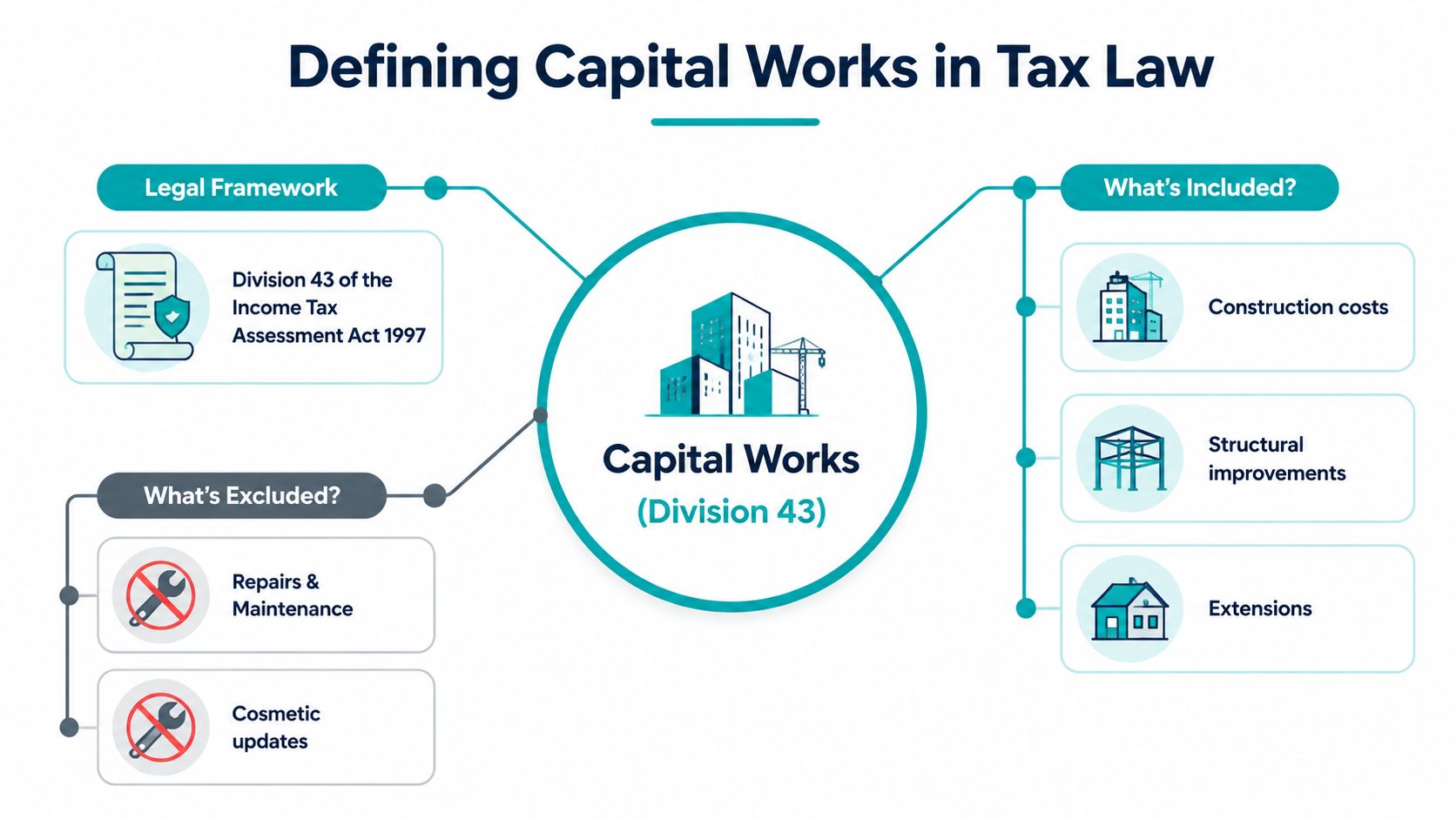
The legal starting point is Division 43 of the Income Tax Assessment Act 1997. It covers construction expenditure on buildings and other structural improvements that are fixed to the property and expected to last.
What usually falls into capital works
In practical terms, capital works generally includes the property's permanent fabric. That can cover walls, floors, roofs, brickwork, concrete, wiring, plumbing, driveways, fences, and retaining walls where the spending creates, extends, alters, or improves part of the structure, as outlined in the Division 43 capital works definition.
The easiest comparison is a house's bones versus its contents. If the item is built in and forms part of the building itself, it is more likely to be capital works. If it can be removed and replaced without changing the structure, it may sit elsewhere for tax purposes.
A few examples make that clearer. Building an extension will usually be capital works. Replacing major structural brickwork will usually be capital works. Installing a permanently fixed retaining wall will usually be capital works. Buying a removable appliance is a different category. Patching a minor defect to restore something to working order may be a repair instead.
Practical rule: If the spending becomes part of the structure and is intended to stay there for the long term, start by testing it against the capital works rules.
Why tax law treats it differently
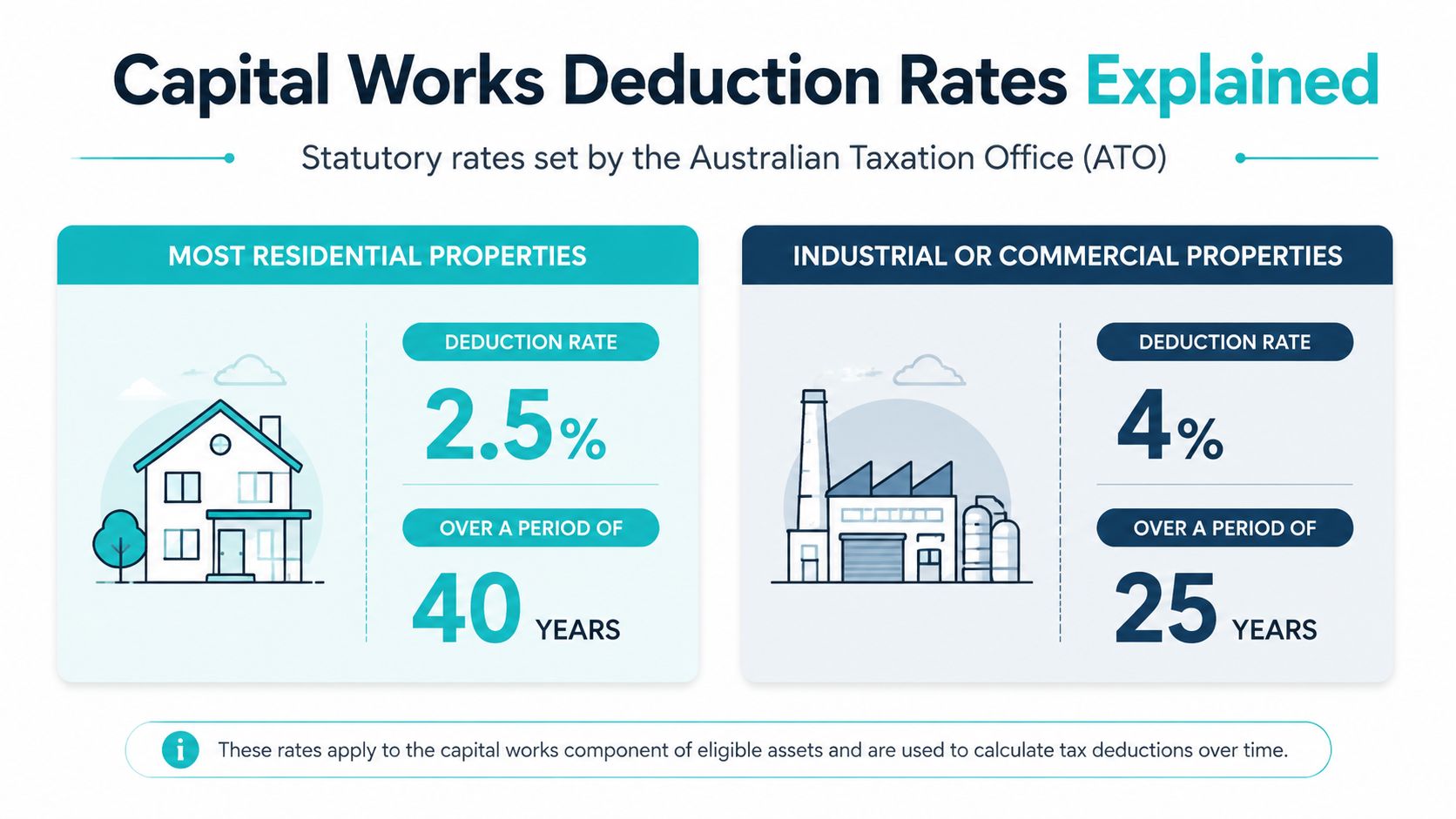
Division 43 spreads deductions over time because structural improvements usually provide value over a long period, not just in the year the money is spent. For many residential investment properties where construction began after 15 September 1987, the standard rate is 2.5% per year for 40 years. So if $500,000 of the project qualifies, the annual deduction is $12,500 rather than a full deduction in year one, according to the same Division 43 rules.
The same legislative guidance notes that 2.5% also applies to many residential and commercial office buildings constructed after 18 July 1985. Some industrial buildings and short-term accommodation properties, such as hotels and motels, may qualify for 4.0% per year over 25 years.
That timing point often gets missed in real-life planning. Clients may know a renovation cost a large amount, but if the work is classified under capital works, the tax benefit arrives gradually. That affects borrowing decisions, retirement income projections, and the after-tax return expected from a renovation strategy.
Points investors often miss
Two legal conditions often create trouble later.
First, the property generally needs to be used to produce income before a claim is available. Second, claims generally begin after construction is completed, not when the deposit is paid or when work starts.
The paperwork matters just as much as the rule. Start and finish dates, construction contracts, invoices, progress claims, and clear cost breakdowns can all affect what can be claimed and when. If original invoices are incomplete, a qualified quantity surveyor's estimate may help support the claim.
This is often the quiet link between legislation and long-term wealth planning. The law may allow a deduction, but poor timing records or missing documents can delay it, reduce it, or make it harder to defend if the claim is reviewed.
Comparing Capital Works with Repairs and Plant Equipment
Investors often blur three separate tax buckets. That's where mistakes begin. The same property can involve capital works, repairs, and plant and equipment, but the tax treatment isn't the same.
A side-by-side way to think about it
| Category | What it usually relates to | Typical example | General treatment |
|---|---|---|---|
| Capital works | Permanent structural elements | Extension, retaining wall, built-in structural improvement | Claimed over time under Division 43 |
| Repairs | Restoring existing items | Fixing damage, restoring function | Often treated differently from structural upgrades |
| Plant and equipment | Removable or mechanical assets | Appliances, removable items, certain fittings | Generally handled under Division 40 |
The big idea is purpose. A repair restores. Capital works improves or creates part of the structure. Plant and equipment covers assets that aren't really part of the building's fixed fabric.
Where people get confused
A fresh coat of paint after wear and tear may feel like an “improvement” because the property looks better. But visually better and structurally capital aren't the same thing. Likewise, replacing a removable appliance may cost real money, but it doesn't make that item capital works.
Confusion also creeps in during renovations. A single project invoice can include demolition, structural work, fittings, and clean-up. If you don't separate those costs properly, you can end up claiming the wrong amount in the wrong category.
Consider these common scenarios:
- Fixing a leaking tap: This usually looks more like a repair than capital works because you're restoring function rather than building a new structural asset.
- Building a rear extension: This is the classic capital works example because you're adding permanent structure.
- Installing removable appliances in a rental: Those items usually sit outside capital works because they aren't the building's fixed bones.
- Constructing a sealed driveway or retaining wall: These are commonly treated as structural improvements because they're permanent and integrated into the property.
A good renovation budget separates structural costs from removable assets before tax time, not after.
That separation also reduces risk. When investors mix categories together, they don't just create messy records. They make it harder to support claims if the ATO asks questions later.
Explaining Division 43 Deductions and Rates
Division 43 doesn't work on instinct. It works on property type, construction commencement date, and whether the property is producing income.
The rates investors need to understand
Technical eligibility depends on construction dates. Residential buildings constructed between 18 July 1985 and 15 September 1987 qualify for a 4% annual rate over 25 years, while those built after 15 September 1987 move to 2.5% per annum over 40 years, according to the Division 43 deduction rate rules.
That's a critical distinction for anyone holding older residential assets. Two properties can both be residential, both be rented, and both involve structural expenditure, yet their annual deduction profile can differ because the legislative cut-off dates differ.
Industrial properties such as warehouses, and income-producing short-term accommodation such as motels and serviced apartments, are benchmarked at 4.0% annually because of their use and wear patterns, as noted in the same source.
Why the commencement date matters so much
Investors often look at purchase date first. Tax law is looking elsewhere. For Division 43, the relevant issue is the construction commencement date of the building or qualifying works.
That means an older property purchase can still involve claimable capital works if later structural improvements meet the relevant rules. It also means a newer buyer can't assume every part of the purchase price is deductible. The law focuses on construction cost for the eligible structure, not the price paid for the whole asset.
What must be true before a claim starts
To claim these deductions, the property must be income-producing, whether rented or awaiting tenants, and the owner must be able to substantiate construction costs through builder handover documents. The same source makes clear that land value and purchase price are excluded, because the deduction applies only to the capital expenditure on the structure itself.
That point changes how investors should review contracts and settlement documents. If you only keep the purchase contract and ignore the build records, you may know what you paid, but not what you can properly claim.
Older properties aren't automatically poor candidates for capital works claims. But they do demand sharper date and document checks.
Examples and Worked Calculations
The easiest way to understand what is capital works is to run the numbers on a real structural spend. The method is simple. Start with the qualifying construction cost, apply the statutory rate, and that gives the annual deduction.
Residential example
Suppose you own a residential investment property and the qualifying structural spend is $500,000. Under the Australian tax framework, for residential investment properties where construction commenced after 17 July 1985, the statutory deduction rate is 2.5% per annum over 40 years, producing an annual deduction of exactly $12,500, based on original construction cost rather than purchase price, as explained in this capital works overview for structural building elements.
The calculation is:
- Capital spend: $500,000
- Rate: 2.5%
- Annual deduction: $12,500
- Claim period: 40 years
That doesn't mean you receive $12,500 in cash. It means you may reduce your taxable income by that amount for the year, subject to your own circumstances and correct eligibility.
Industrial example
Now compare that with a qualifying industrial building example using the same $500,000 structural spend. If the property qualifies for the 4.0% capital works rate over 25 years, the annual deduction would be calculated by multiplying the construction cost by the applicable rate.
The calculation is:
- Capital spend: $500,000
- Rate: 4.0%
- Annual deduction: $20,000
- Claim period: 25 years
The total pattern is different. The annual deduction is larger, but the claim period is shorter.
Worked example summary
| Capital Spend | Rate | Deduction Period | Annual Deduction |
|---|---|---|---|
| $500,000 | 2.5% | 40 years | $12,500 |
| $500,000 | 4.0% | 25 years | $20,000 |
A spreadsheet makes this much easier to model alongside rent, interest, and other ownership costs. If you want a practical way to test scenarios, an investment property spreadsheet can help you map the annual effect more clearly.
What these calculations do and don't tell you
These examples show the deduction formula. They don't replace specific tax advice. You still need to confirm that the spend qualifies as capital works, that the dates line up with the law, and that the property satisfies the income-producing requirement.
They do show something important for planning, though. Structural spending can support long-term tax efficiency, but it usually rewards investors who think in years, not just this quarter's cash flow.
Eligibility Documentation and Claim Timing
A familiar investor problem goes like this. The renovation is finished, the property is tenanted, and tax time arrives. Then the missing pieces show up: no clear construction start date, incomplete invoices, and no one can separate structural work from everything else paid during the project.
That is where legislative rules stop feeling abstract. In a real Wealth Collective planning process, the quality of your records affects how confidently you can claim, when you can start claiming, and how well those deductions fit into the broader tax benefits of rental property strategy.
Documents that matter
Capital works usually covers the building shell and other structural items: extensions, alterations, renovations, sealed driveways, embankments for environmental protection, and leasehold improvements such as shop fitouts. The tax law focuses on a few practical facts. What was built. When construction started and finished. What the construction cost. Who carried out the work. When the property was used to produce income.
Treat your documents like the logbook for a long road trip. Years later, you may remember the destination, but the ATO may ask for the route you took.
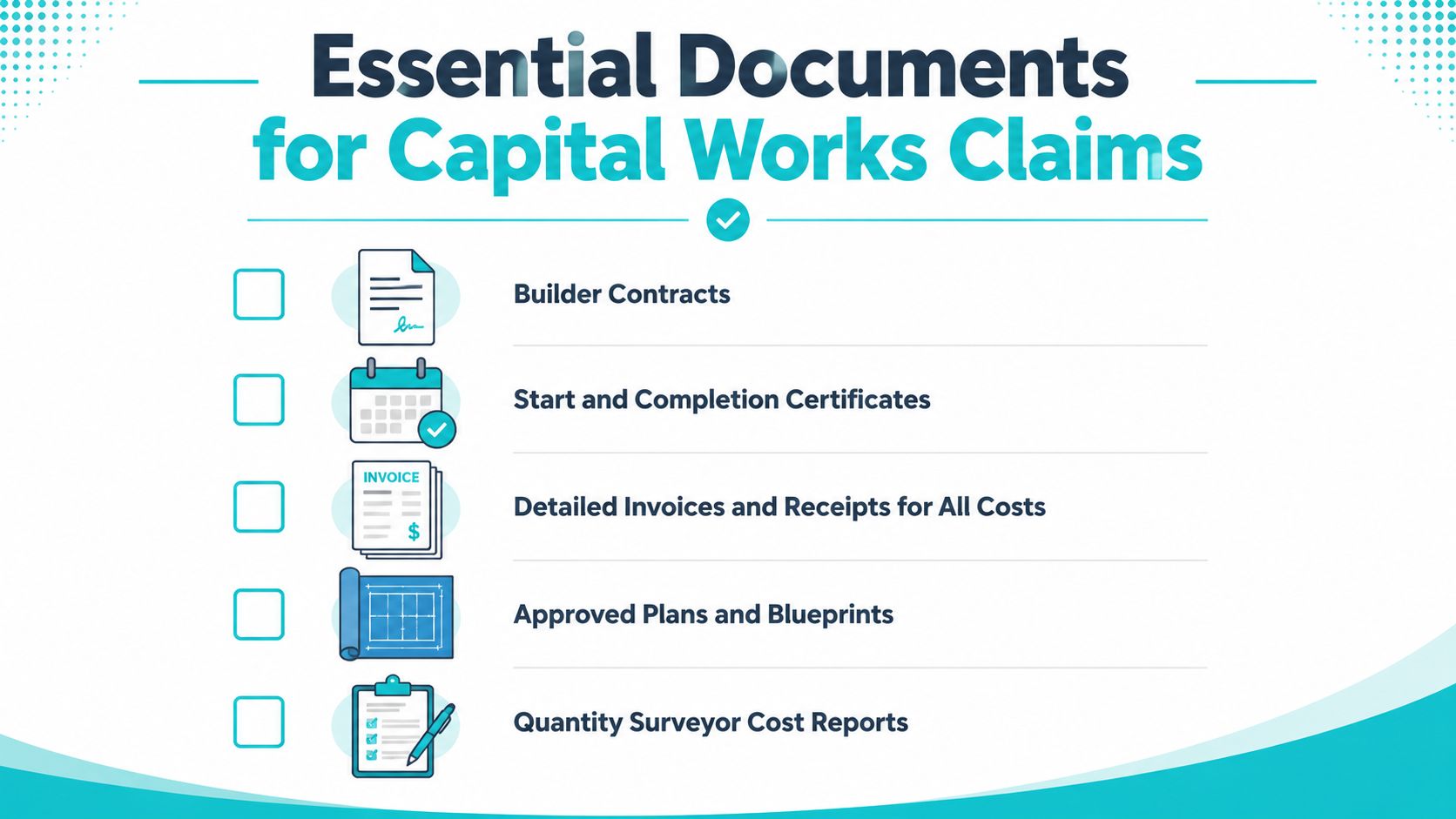
Keep these records together in one property file:
- Builder contracts showing the scope of structural work
- Start and completion records confirming the construction dates
- Itemised invoices and receipts showing actual construction costs
- Approved plans and blueprints supporting the nature of the works
- Quantity surveyor reports where original cost records are missing or incomplete
Claim timing starts with dates, not purchase settlement
Many investors assume the claim begins when they buy the property. That shortcut causes trouble.
Division 43 timing usually turns on the construction dates of the relevant works, not the settlement date and not the date a tenant first moves in. For residential property, the standard 2.5% deduction generally applies to qualifying construction that started after 15 September 1987. Some older properties can still include later qualifying renovations or extensions if those works were completed after the relevant cut-off dates. For commercial property, the legislative start date is earlier.
The practical lesson is simple. A property can be old, but the eligible structural work inside it can be much newer.
Where investors get caught
Documentation problems often start small. A builder issues one invoice for demolition, structural framing, painting, and appliances. A folder goes missing after settlement. An owner keeps bank statements but not the contract that explains what the payment covered.
That creates friction later because your planner, accountant, or quantity surveyor has to reconstruct the story after the fact. Sometimes they can. Sometimes they are left making conservative assumptions, which can reduce what gets claimed or delay the claim until the evidence is clearer.
A simple system helps. Save every structural project document in one place, with dates in the file names and notes on when the property became income-producing. Good records do more than support this year's deduction. They make long-term planning cleaner, especially when renovation stages, refinancing decisions, and future sale calculations all depend on the same paper trail.
Tax Implications and Common Pitfalls
Capital works deductions can improve after-tax outcomes, but poor classification can create problems at both claim time and sale time.
The mistakes that show up most often
One common error is claiming against the purchase price instead of the eligible construction cost. Another is rolling land value into a structural claim. Neither approach matches the legislative framework.
Investors also get caught when they treat every renovation invoice as one thing. A project can include structural building work, repairs, and removable assets at the same time. If those categories aren't separated, the tax return can overstate or misclassify deductions.
Why long-term planning matters
Capital works isn't just an annual return issue. It also feeds into broader tax strategy. If you hold a rental property as part of a negative gearing approach, the timing and classification of deductions changes how that strategy works in practice. If you later sell, the history of what you claimed can affect the way you think about the final tax outcome.
That's why investors should review capital works alongside the broader tax benefits of rental property, rather than treating it as an isolated line item.
A few habits lower the risk substantially:
- Separate costs early: Ask builders and contractors for itemised invoices where possible.
- Check structural status carefully: Permanent improvements and removable assets shouldn't be merged.
- Confirm dates before claiming: Legislative cut-offs matter.
- Keep evidence beyond tax time: A deduction claimed today may need support years later.
The expensive errors usually aren't dramatic. They're small assumptions repeated over time.
Next Steps for Investors and Retirees
If you own investment property, have completed renovations, or are considering structural upgrades, now is a good time to tighten your capital works process.
Start with a property review
Pull together each property where you've completed major works. Look for projects involving extensions, structural renovations, retaining walls, fencing, driveways, fitouts, or other permanent improvements.
Then ask a short list of practical questions:
- Was the property producing income when the claim period began, or was it actively available for rent?
- Do you have clear evidence of construction commencement and completion?
- Can you separate structural costs from repairs and removable assets?
- Are you relying on purchase documents when you really need construction records?
Build a usable claim file
Don't aim for a perfect archive. Aim for a complete one. Gather builder contracts, certificates, invoices, plans, and any quantity surveyor reports into one digital folder for each project.
That simple admin step helps in three ways. It makes annual tax prep easier, reduces the chance of missed deductions, and gives you a stronger position if questions arise later.
Match the deduction to your wider plan
Pre-retirees often focus on dependable after-tax income. Younger professionals may care more about debt reduction and long-range wealth building. Business owners might be balancing property strategy against cash flow needs elsewhere.
Capital works sits inside all of those decisions because it affects taxable income over a long period. Used properly, it can improve planning accuracy. Handled casually, it can distort the numbers you're relying on.
If you're unsure whether past works were classified properly, or you're about to begin a major renovation, bring in the right professionals early. A quantity surveyor can help where cost evidence is incomplete. A tax professional can confirm treatment. A financial adviser can then place those deductions in the context of your investment, debt, super, and retirement strategy.
That's usually the difference between a claim that merely exists on paper and one that supports a stronger financial plan in real life.
If you want help turning property tax rules into a practical wealth strategy, book an initial call with Wealth Collective. Their team helps Australians connect moving parts like investment property, tax efficiency, super, debt, and retirement planning into one clear plan, so you can make confident decisions without getting buried in technical detail.