Business hours
Monday to Friday (8.30AM - 5PM)
Weekend (Closed)


After a long shift, the last thing you want is a tax return that feels like another rostered duty. But if you're a nurse in Australia, tax deductions for nurses can do more than trim your bill at tax time, they can free up cash you can redirect into super, debt reduction, or investments that build wealth. The ATO's nurse guidance is clear, you can only claim work-related expenses when you paid them yourself, the expense directly relates to earning your income, and you keep records, so the smartest approach is to claim only what you can support and use those savings with intention. If you want a simple way to compare service options before you lodge, start with 2026 online tax preparation reviews.
1. Work-Related Uniform and Laundry Expenses
A nurse's uniform does more than identify your role, it can also be one of the cleanest claims at tax time. If your clothing is required for work and you pay for it yourself, that cost can reduce your taxable income, which leaves more cash to direct into super, debt reduction, or investments that support long-term wealth. The ATO treats protective clothing and similar work items as common deductible expenses for nurses, and its laundry rule lets you claim up to $150 without written evidence for work-related laundry. Once your total laundry claims go above that amount, you need records, so a casual estimate is not enough.
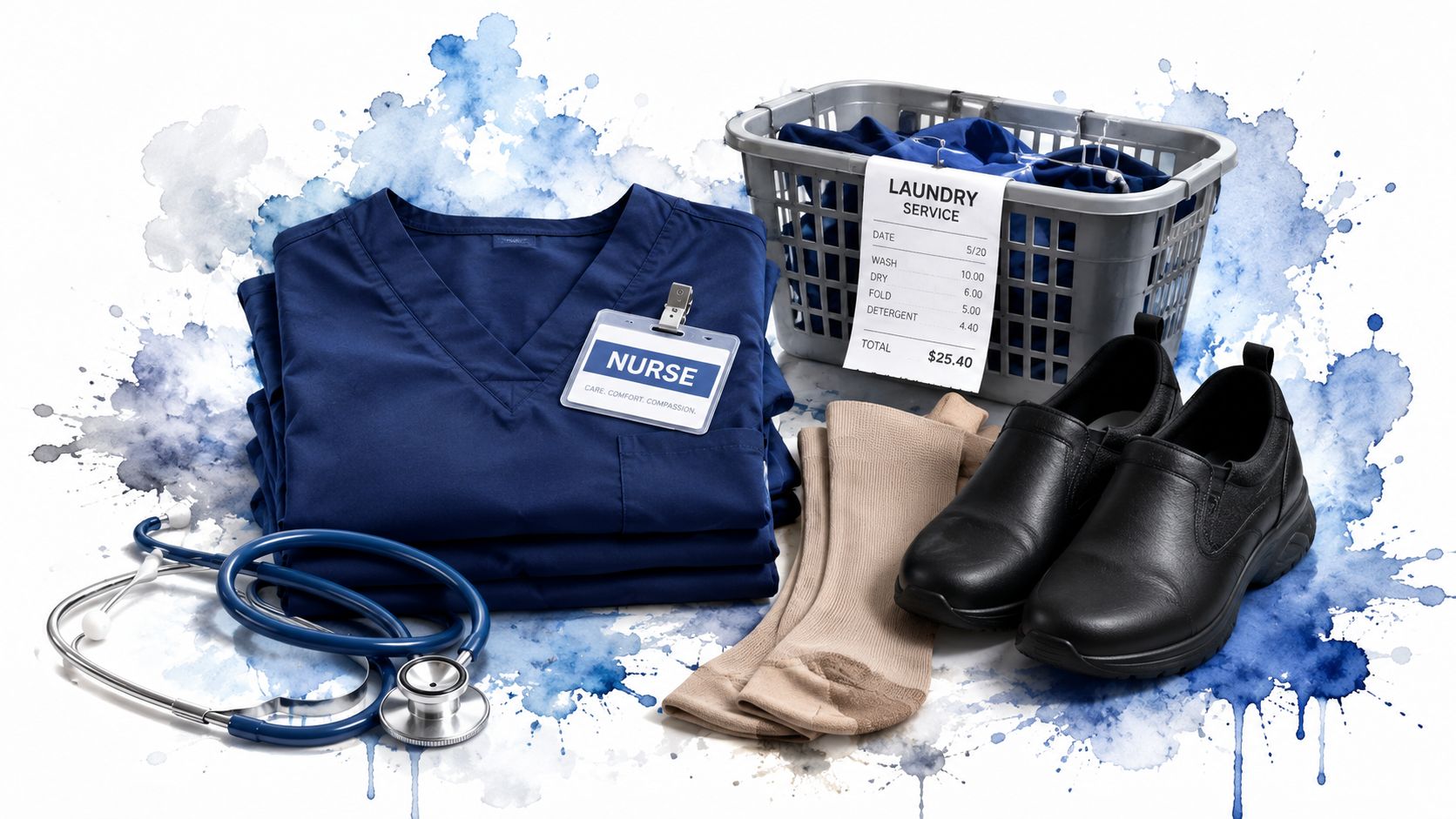
A hospital nurse who buys several sets of scrubs, washes them regularly, and keeps receipts is setting up a defensible claim. A home care nurse required to wear compression stockings for safety can treat that as work-related when the item is tied to the job, not general everyday wear. An aged care worker paying for professional dry-cleaning can claim that cost when the clothing is required for work and the records are solid.
Keep the paper trail simple and strong
Practical rule: if the clothing would still suit normal life, be careful. The ATO's nurse guidance and TR 95/15 both point to the same standard, the expense must have a clear employment nexus and proper substantiation, not just a connection to your profession.
Use this approach for a stronger claim:
- Keep receipts for every purchase: Hold onto invoices for scrubs, caps, closed-toe shoes, and other work-only items.
- Record laundry costs early: If you use a laundry service, keep the cost notes instead of guessing later.
- Photograph work-exclusive items: A photo of your uniform set can help show it is not everyday wear.
- Track wash frequency: A simple log supports the laundry amount you claim.
- Stay within the ATO rules: The laundry shortcut only helps if you still respect the record-keeping threshold.
This deduction may be small on its own, but it matters. Every legitimate claim reduces taxable income, and that gives you more room to put money toward a deliberate wealth plan instead of letting it disappear at tax time.
2. Professional Development and Educational Courses
A shift nurse who pays for a course that sharpens their current clinical practice is making a claim that can stand up. A course that helps you do the job you already have, better, faster, or with more scope, fits the ATO's nursing guidance and TR 95/15. Keep the proof close, because the tax claim lives or dies on the connection between the study and your existing income-producing work. That includes self-education, registration fees, and the other nursing costs the ATO already treats as work-related deductions. ATO nurses and midwives deduction guidance TR 95/15 nursing industry ruling
A registered nurse studying leadership can claim the cost when the qualification supports the role they already hold. A general nurse paying for critical care training can usually connect that expense to current duties if the course strengthens the work they already perform. An aged care nurse paying annual registration and CPD fees is also on solid ground, because those costs sit close to the core of professional practice.
The best approach is simple. Ask one question before you pay: will this course improve the work I do now, or is it mainly aimed at a different career?
- Keep completion evidence: Save course receipts, certificates, and enrolment confirmations.
- Write the work link down: Note how the training improves the tasks you already handle.
- Track membership and registration fees: Professional body costs often sit alongside CPD in the same claim set.
- Save travel records for conferences: If the event is work-related, the related travel needs documentation too.
- Store everything together: Put fees, proof of attendance, and role notes in one folder so your claim is easy to substantiate.
A conference can also do more than support a tax deduction. It can point you toward your next income move, a specialty role, or a promotion path that feeds into superannuation planning and future investing. If you want the broader money strategy behind that mindset, see how to reduce taxable income in Australia.
3. Home Office and Study Expenses
A nurse who finishes charting after a shift, handles roster changes from home, or spends part of the week on telehealth can claim some household costs, but only where the expense is tied to earning income and the records support it. The ATO expects a clear work connection, not a vague sense that home life and work life blur together. That usually means a portion of internet, phone, stationery, office furniture, and similar running costs, limited to the part used for work.
The claim gets stronger when the home setup is clearly work-focused. A community health nurse who regularly plans shifts from home can usually justify part of internet and phone use. A telehealth nurse working from a dedicated desk has a better position than someone balancing work on the kitchen bench. A nurse manager using a proper desk and chair for administrative work should keep receipts and show that the workspace is separate from general household use.
Keep the work area and the paper trail aligned
The ATO cares about apportionment. If a room, desk, or set-up is shared between personal and work use, the claim has to match that split. Keep the method simple, consistent, and easy to explain later.
If you cannot show how the home office supports your income, do not claim it. The right deduction is the one you can defend.
A good file normally includes:
- Workspace notes: Measure the area used for work and keep the calculation.
- Hours log: Record when you worked at home and what you did.
- Receipts: Save invoices for office furniture, stationery, and equipment.
- Usage records: Keep internet and phone bills that show work use.
- Workspace photos: Show that the area is set aside for work.
This claim is about discipline, not excitement. Nurses who document home work properly usually claim only what is fair, which protects them at audit time and keeps the tax position clean enough to support later wealth decisions, including superannuation planning and investment strategy. For a broader view of how tax decisions fit into the bigger plan, see how to reduce taxable income in Australia.
4. Work-Related Travel and Vehicle Expenses
A nurse who spends the day moving between hospitals, clinics, aged care facilities, or patient homes is dealing with work travel that can belong in the tax return. The trip has to be part of earning income, and that is the line the ATO cares about. Your home-to-first-workplace trip stays private, but travel between work locations during the day can be deductible if you keep the purpose clear and the records strong.
That distinction matters because it changes how you treat every kilometre. A community nurse going from one facility to another for the same shift is in a different tax position from a nurse who drives from home to a single rostered workplace. Casual and agency nurses often have more scope to claim vehicle costs because their work pattern moves them around, but the claim still has to match the actual work trip. Keep the expense tied to the roster, not to a general sense that you were “on the road for work.”
If you use your own car, choose the method that fits your records. The actual-cost method can capture fuel, insurance, maintenance, registration, and depreciation, while the cents-per-kilometre method is simpler if your work travel is modest and easy to track. Either way, the ATO expects you to know why each trip was taken and how it relates to your income. Parking can also matter in some work situations, and the rules around fringe benefits tax car parking are worth understanding if parking is part of your broader work cost picture.
Build a log that stands up later
Write the trip down while it is fresh. Destination, purpose, and distance are the basics, and they should be recorded every time the trip is for work.
Use a simple system and keep it consistent:
- Separate private and work kilometres: Do not blend school runs, shopping trips, or family errands with facility visits.
- Name each work destination: Hospital, clinic, patient home, or aged care site should be clear.
- Keep car expense receipts: Fuel, insurance, servicing, registration, and depreciation support the actual-cost method.
- Use a logbook where needed: A logbook shows the work split and helps defend the claim.
- Treat parking carefully: Parking linked to work travel may be relevant, but only if the underlying trip is work-related.
Get this right and the deduction does more than reduce tax. It protects the integrity of your records, keeps your cash flow cleaner, and leaves more room to direct money into superannuation, investing, and the kind of long-term planning that reduces pressure to chase every extra shift.
5. Professional Union and Association Memberships
A nurse who pays union or professional association fees should treat those costs as part of the job, not as an afterthought. These fees are usually straightforward deductions because they exist to protect your income, support your practice, and keep your professional standing current. If a membership helps you stay credentialled, maintain CPD, or protect your role, it belongs in your tax records.
A registered nurse paying annual ANMF fees is dealing with a classic example. A critical care nurse who joins a specialist college is making a clear professional investment. A midwife paying registration-related fees and professional indemnity insurance has another claim area that should sit neatly beside the membership record if the cost is personally borne and tied to work.
The mistake is not missing the rule, it is missing the receipt. Membership charges are often automated, so the money leaves your account without notice and the paper trail disappears into email or app history.
Keep your professional costs in one place
Set up one folder for every membership expense. Store payment receipts, renewal notices, confirmation letters, and any invoices that show professional indemnity or association-related charges. A clean record makes the claim easier to support and helps you separate deductible fees from personal extras.
Keep the structure simple:
- Save every renewal notice: It shows the fee, the coverage period, and the organisation.
- Match the payment date to the correct tax year: This avoids confusion when memberships overlap years.
- Keep confirmation letters: They help show what the membership was for if the ATO asks.
- Review the benefits each year: If a package no longer supports your work, renew it with care.
- Keep indemnity records with the membership file: Work protection costs should sit together.
This deduction does more than trim tax. It keeps your career spending visible, which helps you make better decisions about where your money goes next. A membership is part of your professional toolkit, and tracking it properly fits the same mindset that supports stronger super contributions, better retirement planning, and smarter long-term investing.
6. Medical Examinations and Health Screening Required for Work
A required medical check is deductible only when the cost is yours and the test is tied directly to your nursing role. That covers pre-employment medicals, immunisation updates, annual health surveillance, tuberculosis screening, and occupational health assessments that your employer or regulator requires. Keep the rule simple. If the screening is part of the job and you paid for it yourself, it belongs in your tax records, not mixed in with personal health spending.
A nurse who pays for a mandatory pre-employment medical can generally claim it when the role demands it. A hospital nurse who funds compulsory tuberculosis screening is in the same position. Vaccination updates and fit-testing for respirator compliance can also be deductible when they are a condition of working safely. These costs sit in the background of nursing life, so they are easy to overlook. They still matter.
Keep the paper trail tight
The line is between work compliance and private health care. If the screening, test, or vaccination is required for your role, keep the documents that prove that requirement. If your employer pays you back, the expense is no longer yours to claim. Use the invoice, the policy, and the payment record together so the claim holds up.
Practical rule: ask for an itemised invoice every time. If the invoice does not say what the screening was for, your record is weaker.
Use this checklist to keep the claim clean:
- Save itemised invoices: Make sure the service type and cost are visible.
- Keep employer requirement evidence: Emails, policy notes, or onboarding documents help show why the cost was necessary.
- Retain certificates and reports: These show the screening happened.
- Track reimbursement separately: Don't count anything your employer paid back.
- Organise by tax year: Annual medical costs are easy to lose if they sit in different folders.
This deduction is small, but it sends a clear signal. You are treating job-related health costs as part of earning income, not as personal spending. That discipline helps beyond tax time. The same habit of separating work costs from lifestyle costs is what supports better cash flow, stronger superannuation decisions, and cleaner long-term investing choices.
7. Superannuation Contributions and Salary Sacrifice Strategy
For many nurses, the smartest financial move goes beyond claiming deductions. It uses those tax savings to build retirement wealth through salary sacrifice, and it does it inside a tax-effective structure that works in the background while you keep earning. If your goal is long-term security, your tax plan should connect directly to your superannuation plan. What is salary sacrifice super
A nurse who salary sacrifices through payroll is directing pre-tax income into super instead of taking the full amount as wages. That approach gives you a cleaner way to build retirement savings with discipline, especially if you are on a higher income or managing a busy roster. A dual-income household can also coordinate both partners' contributions so the family's overall tax position and cash flow both improve.
Use the same discipline you apply to deductible expenses here. The ATO nursing guidance does not set your retirement strategy, but it does reinforce the right habit, separate work money from personal spending, then direct the savings into assets that support your future.

Treat tax savings as seed capital, not spending money
A salary sacrifice arrangement only works if it fits your real budget. If a lower take-home pay figure creates pressure, adjust the plan before you commit. The right structure matches tax efficiency with cash flow discipline, debt reduction priorities, and a retirement target you can maintain.
Start with the numbers that matter. Keep your employer contributions and any personal contributions inside the concessional cap. Set the payroll arrangement properly so the sacrifice runs through your employer, not as a loose transfer you forget about. Review your fortnightly budget before you increase the contribution, and revisit the arrangement whenever your income, expenses, or family situation changes.
Once that is in place, super becomes part of your wealth plan, not just a tax item. Strong nurses do not stop at claiming deductions. They direct the benefit into long-term assets and keep compounding on their side. That is exactly why Wealth Collective's Retirement Roadmap matters here, because it links tax savings to superannuation strategy and keeps your retirement planning deliberate.
7-Point Comparison of Nurse Tax Deductions
| Deduction | Implementation Complexity 🔄 | Resources & Speed ⚡💡 | Expected Outcomes 📊 | Ideal Use Cases | Key Advantages ⭐ |
|---|---|---|---|---|---|
| Work-Related Uniform and Laundry Expenses | Low, straightforward receipts or shortcut method | Low cost; minimal time to document ⚡💡 | Consistent small-to-moderate annual savings 📊 | Clinical roles with exclusive work uniforms and frequent laundering | Easy substantiation, low audit risk, widely applicable ⭐ |
| Professional Development and Educational Courses | Moderate–High, must show direct relevance to current role 🔄 | High cost and time; slow payback but high value ⚡💡 | Potentially large long-term income and skill gains 📊 | Nurses seeking promotion, specialty certification or AHPRA compliance | Enhances career prospects and earning potential ⭐ |
| Home Office and Study Expenses | Moderate, apportionment or simplified rate options 🔄 | Variable setup costs; shortcut reduces admin ⚡💡 | Variable deductions; can be sizeable with regular use 📊 | Telehealth, administrative duties or regular home-based work | Meaningful deductions for regular home workers; simple shortcut option ⭐ |
| Work-Related Travel and Vehicle Expenses | Moderate, choose cents-per-km or actual-cost method; logbook may be required 🔄 | Ongoing vehicle costs and record-keeping; quick with km method ⚡💡 | Substantial deductions for multi-site travel; distance-dependent 📊 | Community nurses, home visits, multi-facility shift work | Generous travel deductions; simplified km method available ⭐ |
| Professional Union and Association Memberships | Low, annual fees with clear receipts 🔄 | Low cost; minimal administration ⚡💡 | Small-to-moderate recurring deduction plus membership benefits 📊 | All nurses needing registration, indemnity or CPD access | Simple to claim, includes professional protection and support ⭐ |
| Medical Examinations and Health Screening Required for Work | Low–Moderate, must be employer-required and evidenced 🔄 | Low cost; quick claims when not employer-covered ⚡💡 | Small consistent deductions; supports compliance with work requirements 📊 | Pre-employment checks, mandatory vaccinations, fit testing | Clear work nexus; easy to substantiate with receipts and certificates ⭐ |
| Superannuation Contributions and Salary Sacrifice Strategy | High, requires coordination, caps and payroll setup 🔄 | Reduces take-home pay now; needs budgeting and annual review ⚡💡 | Significant tax savings and long-term retirement growth 📊 | Higher-income nurses seeking tax-effective retirement savings | Major tax efficiency and compounded retirement benefits when well managed ⭐ |
From Tax Deductions to Financial Freedom
Claiming every eligible deduction is smart, but it's only the starting point. The win is what you do with the savings after tax time, because that cash can go towards superannuation, investing, or debt reduction instead of disappearing into day-to-day spending. For nurses, the habit of keeping records and claiming correctly is also the habit of taking control of your money with purpose.
The ATO's rules are straightforward if you follow the right order. First, pay the expense yourself. Second, make sure it directly relates to earning your nursing income. Third, keep the records that prove it. That same discipline is useful far beyond tax time, because it's the foundation of a stronger financial life, whether you're planning for retirement, growing investments, or protecting the income that keeps your household running.
A broader strategy matters here. A cleaner tax return can support better super contributions. Better super contributions can support a more comfortable retirement. And a more comfortable retirement starts with decisions made long before you stop working. If you want support turning deductions into long-term wealth moves, a structured advice process makes the difference between guessing and planning.
Wealth Collective helps nurses turn tax awareness into a wider financial strategy through Protection Plus, Guided Growth, and Retirement Roadmap. If you're ready to make your money work harder, book a complimentary 10-minute chat and get clear next steps from a team that speaks plain English and understands how to build, protect, and transfer wealth.
Wealth Collective helps nurses turn practical tax decisions into a stronger financial plan, from superannuation optimisation to investment strategy and retirement income. If you want advice that connects your deductions to your bigger goals, visit Wealth Collective and book a simple first conversation today.