Business hours
Monday to Friday (8.30AM - 5PM)
Weekend (Closed)


A staff member pulls into a CBD car park on a Monday morning, badges in, and leaves the car there for the day. Nothing about that moment feels like a tax event, yet for an employer it can be the start of a fringe benefits tax car parking issue if the parking fits the ATO rules. That's why this topic catches busy owners off guard, the tax outcome depends on who parked, where they parked, how long the car stayed, and what nearby commercial parking costs looked like.
For employers, the hard part isn't just knowing parking exists. It's working out whether the benefit exists on that day, then valuing it correctly, then keeping records that will stand up if the ATO asks questions. That's a lot to ask from an arrangement that often starts as a simple staff perk.
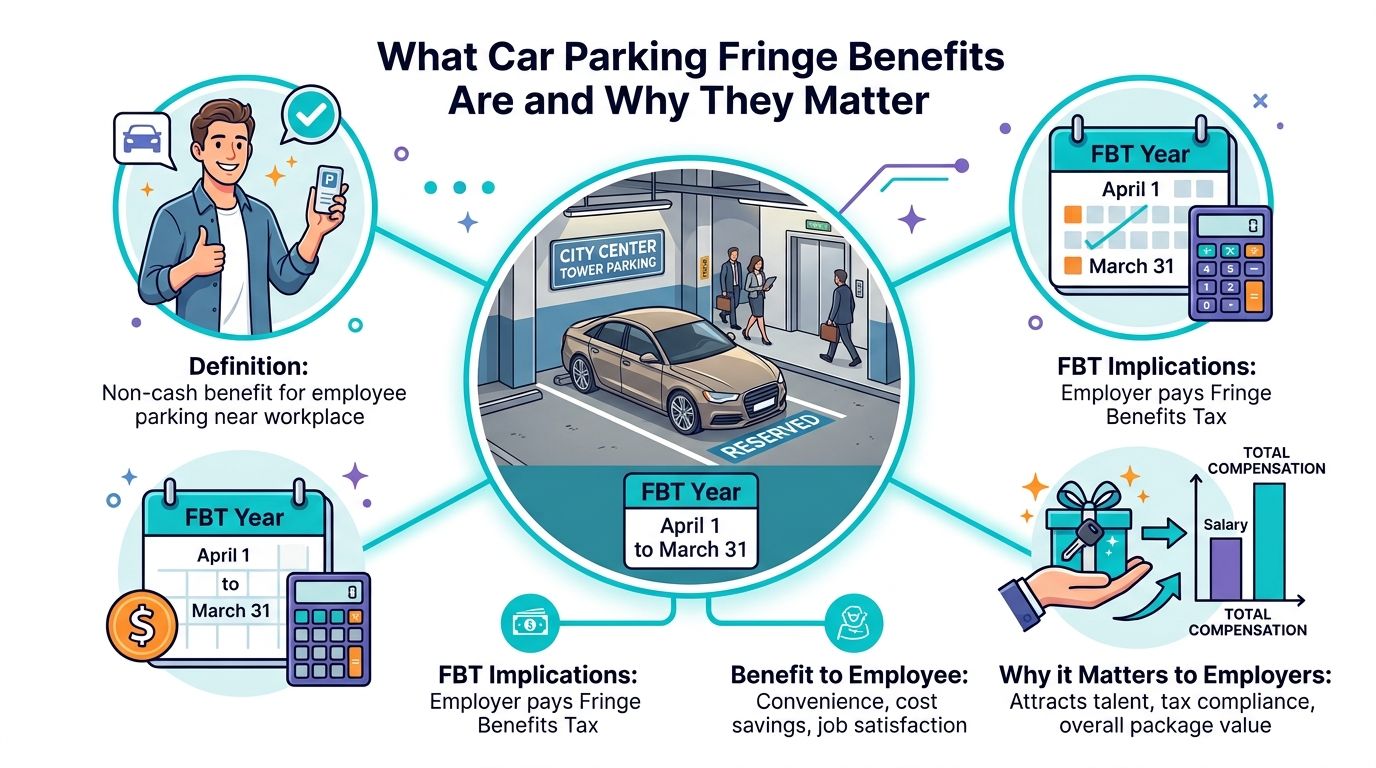
What Car Parking Fringe Benefits Are and Why They Matter
A parking bay can look like an ordinary workplace perk until tax law gives it a different label. Once an employer provides parking for an employee's commute and the ATO's location, timing, and use tests are met, the arrangement can become a car parking fringe benefit. The key question is not whether the space was convenient or whether the employer paid for it, it is whether that parking sits inside the rule set that brings FBT into play for that day's use. That is why this area catches busy employers out. The tax outcome turns on who used the car, where it was parked, how long it stayed, and what nearby commercial parking cost. The ATO's guidance sets out the mechanics and the valuation approach in more detail. ATO car parking FBT guidance
Why employers get surprised
Many employers first see parking as either a staff perk or a simple overhead. FBT treats it differently. Once the benefit is in scope, the employer has a taxable value that can accumulate across the year, because it is counted by parking day rather than treated as a one-off expense. A small daily amount can still become meaningful once it is repeated across many days in the FBT year.
That is where the practical surprise sits. A bay that feels routine in the morning can become a reportable fringe benefit by the time payroll, bookkeeping, and FBT review come together. The issue is usually not the parking space itself, it is the pattern of use around it.
Practical rule: if the parking arrangement sits near a workplace and follows the commute pattern, do not assume it sits outside FBT just because no cash changed hands on the day.
The Wealth Collective view is straightforward. Break the issue into a checklist, parking day, location, nearby comparator, employee contribution, and reporting. That turns a technical ATO topic into a process an employer can manage, which is the difference between vague concern and a clean compliance file. For a broader operational angle on managing bays and usage patterns, see TruTec's guide to parking management.
The Four Conditions That Trigger a Car Parking Benefit
The ATO doesn't treat every parked car as a fringe benefit. It starts with a specific set of conditions, and all of them need to line up before FBT enters the picture. That matters because many employers focus on the car space itself and miss the commute pattern or the timing window.
The four tests in plain English
First, the car must be parked in a car space at a work car park. Second, the employee, or an associate, must use the car for travel between home and their primary place of employment at least once on that day. Third, the work car park must be at or near that primary workplace. Fourth, the car must be parked for the minimum parking period of more than 4 hours between 7:00 am and 7:00 pm. The ATO's technical statement on these trigger conditions is set out in its guidance. ATO car parking FBT trigger conditions
That fourth test is the one people trip over most often. It is similar to a parking meter clock that only starts counting inside a specific daylight window. A car that sits for 3 hours and 45 minutes doesn't cross the line, while a stay that runs past 4 hours does.
If one condition fails, the parking day usually falls out of scope.
A simple way to test a day is to ask four questions. Was this a work car park, did the employee commute by car that day, was the park near the primary workplace, and did the stay exceed the minimum period in the relevant daylight window? If the answer to any of those is no, the benefit usually doesn't arise. If the answer to all four is yes, you're in FBT territory.
For employers trying to manage this across several sites, parking management software can help organise evidence, access patterns and day counts. TruTec's guide to parking lot management software is a useful reference point if you're mapping the operational side to the tax rules.
The Commercial Parking Station Threshold and One Kilometre Test
Once the parking day is in scope, valuation turns on the local market. The ATO asks employers to look for the lowest representative fee charged by a commercial parking station within a 1-kilometre radius of the work car park on the day the benefit is provided. That's a very different concept from using the employer's own cost, because the tax base is tied to what the market nearby is charging, not what the employer paid to secure the bay.
The practical benchmark used in current Australian commentary is the $11.03 threshold for the FBT year ending 31 March 2026, which helps test whether a nearby facility is treated as a commercial parking station for FBT purposes. PwC's explanation of car parking fringe benefits notes that threshold in the current context. The important point for employers is not just the dollar figure, it's what that figure does. It helps decide whether a parking facility nearby counts as a comparator at all.
Why the CBD usually matters more
In central business districts, the nearest qualifying market comparator often sits at a premium. That can materially lift the taxable value because the rule uses the lowest fee available in the relevant radius on that day. If a cheaper staff facility exists outside the radius, it doesn't help. If the nearby market changed by the day, your calculation should reflect that day's position.
| Test Element | ATO Requirement | 2025–26 Benchmark |
|---|---|---|
| Nearby comparator | Commercial parking station within 1 kilometre | Use the lowest representative fee on the day |
| Market test | All-day commercial parking benchmark | $11.03 threshold |
| Valuation basis | Local pricing, not employer cost | Day-specific fee evidence |
The ATO's post-2021 interpretation broadened the commercial parking station test, and from 1 April 2022 facilities such as penalty-rate lots can fall within scope if they meet the conditions in the guidance. BDO's technical update explains that broader approach and why employers need location-by-location evidence. BDO on the expanded commercial parking station test
That change matters because the set of valid comparators can expand. More valid comparators can change the lowest fee you rely on, so records need to be contemporaneous, not reconstructed later from memory.
Valuation Methods and the 228 Day Statutory Formula
Once you accept that a car parking benefit exists, the next task is working out its value. For an employer, this is the point where the rules stop being abstract and start affecting the FBT return. The ATO calculation steps are simple in sequence, choose the valuation method, work out the value of the parking benefit, multiply by the number of parking benefits provided, then reduce the result by any amount the employee contributes towards the parking cost.
The choice usually comes down to two paths. The alternative method relies on evidence of actual parking use and market value. The statutory formula method uses a fixed assumption, because it treats the employer as providing a car parking benefit 228 times during the FBT year whether or not the bay was used on every one of those days. That fixed rule is why the method matters so much. It removes daily variation and replaces it with an annual formula that can be easier to apply, but less forgiving if the assumptions work against you. Australian tax commentary on the 2025–26 FBT regime
A simple way to see the effect is to use a daily parking value. If the relevant parking value were $25 per day, the statutory formula would apply that amount across the deemed parking benefits for the year before the 47% FBT rate is applied. The arithmetic itself is not the hard part. The practical issue is that a modest daily figure can still produce a meaningful taxable value once it is carried through the full year.
That is why the method has to fit the facts, not just the payroll process. A business with stable parking access and clean records may find one approach easier to defend, while a business with changing parking supply, multiple sites, or irregular demand may need stronger evidence before choosing the alternative method. The right method is the one that matches how the parking works for your organisation, not the one that is quickest to apply.
For employers comparing their options, a careful review with a Perth financial adviser who understands FBT car parking rules can help clarify which method is easier to support and which one is more likely to hold up under review.
Worked Example for a Perth Based Executive
A Perth-based executive is offered secure CBD parking close to their main workplace. They drive in three days a week, leave the car in the same bay until late afternoon, and make a small after-tax contribution to the employer for the parking. On the surface, that looks straightforward. For FBT, each parking day still needs to be tested on its own facts.
Start with the day itself. If the executive drove from home to their primary place of employment, parked in a work car park, and the car stayed there for more than 4 hours between 7:00 am and 7:00 pm, that day can fall within the car parking rules. If they worked from home on one of the other days, or did not commute by car, that day may drop out of the count. The rule works like a gate, each day has to pass through it separately.
Valuation is the next decision. If there is a commercial parking station within 1 kilometre and the lowest representative fee applies, that fee becomes the taxable base for that day. An employee contribution then reduces the value, because the contribution is deducted from the taxable value rather than ignored. The practical point is simple, a small payment from the employee can lower the fringe benefits tax exposure, but only if it is recorded properly. For a Perth employer or executive wanting to compare the parking treatment with the rest of their remuneration settings, Wealth Collective's Perth adviser page gives a clear starting point for that broader advice conversation.
The statutory formula changes the picture again. Because the benefit is deemed to arise 228 times across the FBT year, a parking pattern that feels occasional can still create a full-year liability. The daily routine matters less than the way the formula carries that routine through the year.
The cleanest way to review the result is to look at the parking bay, the weekday pattern, the workplace location, the nearby market, and the employee contribution together. If the arrangement also connects with overseas payroll terminology or a broader expatriate package, it can help to understand P11D forms and expenses as a comparison point, even though the Australian FBT rules are the ones that govern the parking benefit here. For employers comparing executive parking settings or remuneration packages, a Perth financial adviser who understands FBT car parking rules can help test which approach fits the facts and which records are likely to support it.
Reporting Obligations and Common Pitfalls for Employers
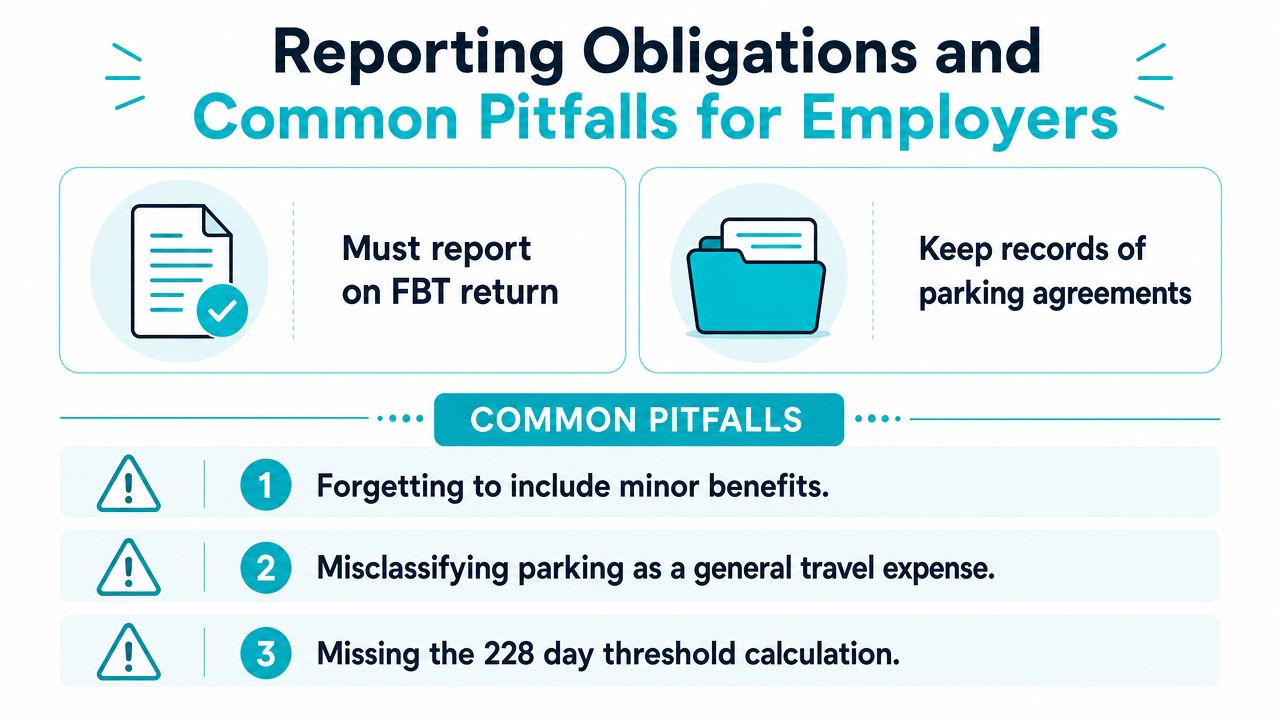
An employer who gets the parking treatment right needs more than a rough annual guess. The records should show the valuation method used, the nearby comparator relied on, the number of parking days counted, and any employee contribution that reduced the taxable value. The ATO expects the method to be supported by evidence, not just a year-end figure written into the FBT return. ATO car parking FBT calculation steps
Common errors that keep showing up
A lot of the mistakes come from treating the rules too casually. Some employers assume parking is exempt because it is bundled into a lease. Others use the wrong comparator station, or overlook that the four-hour rule is tested day by day. Another common error is classifying parking as a general travel expense, even though it is really a fringe benefit.
The post-2021 broader view of commercial parking stations also caught some employers off guard. A facility that was once outside the comparison set may now fall within it for benefits provided from 1 April 2022. That is why location-specific records matter more than a once-a-year estimate.
Practical rule: if the parking fee, the radius test or the attendance pattern changed during the year, the old assumptions probably need another look.
For readers used to UK-style payroll reporting, Umbrella Company's guide to understand P11D forms and expenses gives a useful comparison point, but Australian FBT parking uses its own rules and thresholds. If the paperwork is thin, the safer approach is usually to rebuild the evidence trail before year-end rather than after the return is lodged.
If you run a small business and want the parking issue checked alongside wider deductions and salary packaging settings, Wealth Collective's small business tax reduction page is the right starting point for a broader review.
Smart Strategies and How Wealth Collective Can Help
The smartest parking decisions are usually the quietest ones. Employees can sometimes reduce the taxable value through employee contributions, employers can improve certainty by choosing the valuation method that fits their facts, and hybrid work policies can naturally cut the number of parking days in scope. None of that removes the rules, but it can change the outcome in a way that's easier to manage.
Three practical angles
For executives, the question is whether parking should stay inside the remuneration package or be restructured. For small business owners, the issue is whether parking is a genuine staff benefit or an expense that needs tighter controls. For high-income earners, the relevant question is the net-of-tax outcome across salary, benefits and take-home value.
If you're weighing whether parking still makes commercial sense, a break-even analysis helps. Jumpstart Partners' break-even guide is a useful way to think about fixed costs versus the value of the benefit. The same logic applies here. If the parking arrangement no longer justifies the compliance load, the structure may need to change.
Wealth Collective's broader advisory process fits neatly around this kind of decision, especially when the issue sits beside debt reduction, cash flow and remuneration planning. If you're a business owner looking for a wider review, Wealth Collective's business advisory services can help frame the parking question inside a bigger financial picture.
If you're not sure whether your parking setup creates an FBT exposure, Wealth Collective can help you sort the facts, test the rules, and decide what to do next without the jargon. Book a conversation with Wealth Collective if you want a clear, practical view on parking benefits, remuneration packaging, and the next best step for your business or personal position.