Business hours
Monday to Friday (8.30AM - 5PM)
Weekend (Closed)


You're busy, the quarter looked fine on paper, and yet the business account is tighter than it should be. Payroll is due, a tax bill is sitting in the back of your mind, and the home budget is picking up the slack because nobody has drawn a line between the two. That's the point where small business financial planning stops being an admin task and becomes the thing that decides whether you sleep well this month.
In Australia, this isn't a niche issue. The ABS reported about 2.6 million actively trading businesses at the end of June 2024, and 98% were small businesses with fewer than 20 employees, while AAP-endorsed analysis of ABS data shows around 96% are non-employing or micro businesses (Consumer Financial Protection Bureau small business owner evidence). For most owners, the business isn't one asset in a portfolio, it's the portfolio. That's why the core planning question isn't just “How do I grow?” It's “How do I stop one weak trading period from spilling into my household, my super, and my retirement plans?”
Why Most Small Business Owners Plan Too Late
A lot of owners only open the books when something's already off. The bank balance feels thin, a supplier wants payment, a client invoice is still outstanding, and the week becomes a scramble to cover what should've been visible a month ago. I've sat with plenty of business owners who were profitable on paper, but still running on adrenaline because they had no cash buffer and no forecast that linked the business ledger to the home budget.
That's the structural difference between small business planning and corporate planning. In a corporate setting, there's usually a finance team, a board, and layers between the operating business and the owner's personal life. In a micro or small business, the owner is often the chief executive, the chief financial officer, and the person absorbing the downside if trading weakens.

The three statements that tell the truth
The income statement answers one question, am I profitable. It shows whether the business made money over a period, but it can flatter a business that invoices well and collects slowly. The cash flow statement answers a different question, can I pay next week's bills, and it often tells the more urgent truth.
The balance sheet asks what the business is worth at a point in time. It shows assets, liabilities, and equity, which matters because a business can look healthy in profit terms while sitting on debt, unpaid tax obligations, or low cash reserves. A strong balance sheet can also hide a money-losing operation if owners keep injecting cash or delaying decisions.
A simple example comes up often. A trades business can book a profitable-looking quarter, then nearly blow up because invoices land late, payroll lands on time, and materials had to be paid upfront. The profit existed, but the cash conversion was too slow.
Practical rule: when something feels wrong, check cash first, then profit, then balance sheet strength. If cash is tight, the problem usually appears there before it shows up anywhere else.
That's why small business financial planning starts with survival, not aspiration. The goal is to keep the business, the household, and the owner's future from collapsing into one stressed pile of bills. Once the three statements are working together, planning becomes clearer, calmer, and far more useful.
Building a 12-Month Cash Flow Forecast You Will Actually Use
A forecast only works if you'll open it again next month. Start with a simple spreadsheet and build one row for expected revenue by month, then list committed outgoings such as rent, wages, software, insurance, and loan repayments. Add a separate section for variable costs, because those move with sales and can hide pressure if you lump them in with fixed costs.
The key is to make it rolling, not static. A one-off budget is a snapshot, but a living forecast gets compared against actual results every month, then adjusted for the next 12 months. That habit matters because regular review beats annual wishful thinking, and the difference is not subtle.
A useful question to ask before you finalise any month is, what changes if a major client pays late or a supplier raises prices? If the answer is “we'd be short,” the forecast has done its job.
For a practical UK example of the mechanics, practical cash flow forecasting UK is a useful external reference because the structure of the exercise is similar even if the tax and compliance settings differ. For a local walkthrough, the team at Wealth Collective keeps a focused guide on small business cash flow management that fits neatly beside a rolling forecast.
A simple first draft
- List monthly revenue. Use conservative numbers, not best-case hopes.
- Lock in fixed costs. Include rent, wages, subscriptions, finance repayments, and insurance.
- Add variable costs. Materials, ad spend, freight, contractor fees, and transaction costs belong here.
- Add a buffer line. Leave room for the things you know will happen, but can't time perfectly.
- Stress test two scenarios. One late payment and one cost rise are enough to show where the weak spots are.
Build the first version in an hour, then improve it each month. A forecast that's rough but current is far more useful than a polished spreadsheet nobody updates. Once it's in place, you'll see whether the business can fund itself, or whether it needs outside support before things get tight.
The Core Numbers Worth Watching Each Month
Most owners don't need more metrics, they need the right few. The monthly dashboard should focus on gross margin, net profit margin, operating expense ratio, current ratio, revenue growth, and accounts receivable days. Research on successful SMEs also points to budget control, cash flow versus current liabilities, cash flow versus sales, and current ratio monitoring as critical success factors (SME success factors study).
What each number is telling you
Gross margin tells you whether the core offer is worth selling after direct costs. If it drifts down, pricing, supplier cost, or product mix usually needs attention. Net profit margin is the wider test of whether the business is earning enough after overheads.
Operating expense ratio shows how much of your revenue gets eaten by running the business. If that climbs, the business may be getting busier without becoming healthier. Current ratio is a simple liquidity check, and it matters because short-term obligations don't wait for a good month.
Revenue growth matters, but only if it's not hiding weak collection or rising costs. Accounts receivable days show how long money sits unpaid, which is often where stress starts long before the bank balance looks alarming.
If one number turns ugly, don't fix everything at once. Trace the issue back to cash collection, cost creep, pricing, or demand, then act on the cause rather than the symptom.
A one-page dashboard should sit beside the cash forecast and take about twenty minutes to review each month. If you're still checking only the bank balance, you're watching the result after the damage, not the cause. The point is to see the warning light early enough to do something useful.
Tax Planning and Superannuation as a Cash Flow Lever
Tax should not feel like a year-end surprise. It's a timing problem, a structure problem, and a cash-flow problem, which means the right decisions often happen months before the return is lodged. The practical work starts with the business structure, then moves through purchase timing, deductible expense timing, drawings, wages, and super.
For Australian employers, the Superannuation Guarantee rate is 12% from 1 July 2025 according to the ATO, and it has to be paid on ordinary time earnings for eligible workers. That's not a compliance footnote, it's a recurring cash obligation that belongs in the forecast. If you pay yourself through wages, or you employ staff, the super line should be visible every month, not discovered at quarter-end.
Where planning usually pays off
A structure review can change how income is taxed and how risk is held. Timing major purchases can improve cash management when the business needs the asset and the deduction fits the broader plan. Prepaying deductible expenses can make sense in the right year, but only if it doesn't leave the business short of working capital.
The drawings-versus-wage mix matters too, because owners often blur personal spending with business withdrawals. That may feel flexible, but it makes the household income picture harder to see. If the owner's family relies on irregular drawings, the forecast has to account for that irregularity rather than smoothing it away.
For bigger decisions, the small business CGT concessions and the instant asset write-off may be relevant, but both need proper advice before action. A tax move that looks good in isolation can create a cash squeeze or a compliance issue if it's not integrated with the forecast and the structure.
If you want a plain-English check on how a tax-aware plan fits into wider advice, Wealth Collective's service approach around tax, structure, and wealth coordination is one of the few ways owners can keep the business and the household on the same page without treating super as an afterthought. Good tax planning is legal, expected, and often the difference between keeping cash and handing too much of it away.
Risk Management and Insurance for Real-World Exposures
Insurance should match the way the business works, not a generic checklist. A sole consultant, a mechanic, and a retailer face very different exposures, even if they all call themselves small businesses. The task is to identify the three risks that could stop income, damage reputation, or force the owner to stop working.
One of those risks is income concentration. If the business depends heavily on one person, one channel, or one client base, then a health issue or accident can hit both the business and the household at once. That's where key-person risk matters, because the business may not have a second person ready to step in.
The insurance list usually includes professional indemnity, public liability, cyber cover, and business interruption. For a service business handling client data, cyber risk is no longer optional thinking. For a tradie, a physical injury can stop income fast, even if the business itself is otherwise sound.
If you need a broader view of liability protection in a business context, liability insurance for California firms is a useful external comparison point because it shows how seriously small operators need to think about exposure, even though Australian policy settings differ. For an Australian checklist that links protection back to operating reality, the Wealth Collective guide on small business insurance requirements is a better local fit.
A quick exposure check
- Owner illness or injury: If you can't work for three months, what happens to cash flow and household bills?
- Client data breach: If systems are compromised, what stops work and what fixes the damage?
- Single-client dependence: If one account leaves, does the business still cover fixed costs?
The insurance question is not “What can I buy?” It's “What would break first, and how do I protect the thing that pays the mortgage?” That's where business planning and personal financial resilience meet in the same conversation.
Funding the Business Without Mortgaging the Future
Not every funding problem should be solved with debt, and not every growth opportunity deserves equity. The right source depends on what the money is for, how long it needs to stay in the business, and how much stress the repayments would place on the forecast. If the business can fund the need from retained earnings, that's usually the cleanest path because it avoids extra pressure on cash flow.
Personal investment can also make sense, but only when the owner understands the trade-off. Putting in more capital from the household can stabilise the business, yet it also raises concentration risk if too much family wealth sits inside one operating entity. I've seen owners use personal credit cards or home equity to rescue a business shock, and that usually signals a planning failure rather than a strategy.
A business loan or line of credit works best when the cash flows are predictable enough to support repayments and the purpose is clear. A short-term working capital gap is one thing. Funding an ongoing loss with borrowed money is another. If the forecast can't sustain the debt, the debt is too expensive even if the interest rate looks tolerable.
How to think about the options
Retained earnings suit steady businesses that need a buffer, equipment refresh, or gradual expansion. Debt suits cases where cash is needed now and the business has a credible repayment path. Equity or outside investors make more sense when growth is hard to fund privately and the owner is prepared to share control.
The boundary between business and personal finance matters here because it reveals the true cost of capital. Once the owner's savings, redraws, and household commitments are separated from the business, the forecast becomes more honest. Then the funding decision becomes a real comparison, not a hopeful guess.
Exit and succession planning should start on day one, because the shape of the business affects the shape of the owner's retirement. A lifestyle business needs drawings and super to do more of the heavy lifting. A growth business may need a trade sale or capital event. A family business needs the next generation, or a backup plan when the next generation says no.
A business that can run without the owner for thirty days is usually easier to sell, easier to hand over, and less frightening to insure.
That means documenting processes, making the owner's role transferable, and not leaving the entire value in personal relationships that disappear the moment the owner steps back. The sale value of the business and the owner's retirement adequacy need to be modelled together, not in separate silos. If the business is going to fund the future, it has to be built with an exit in mind from the start.
Your 90-Day Plan and When to Bring in an Adviser
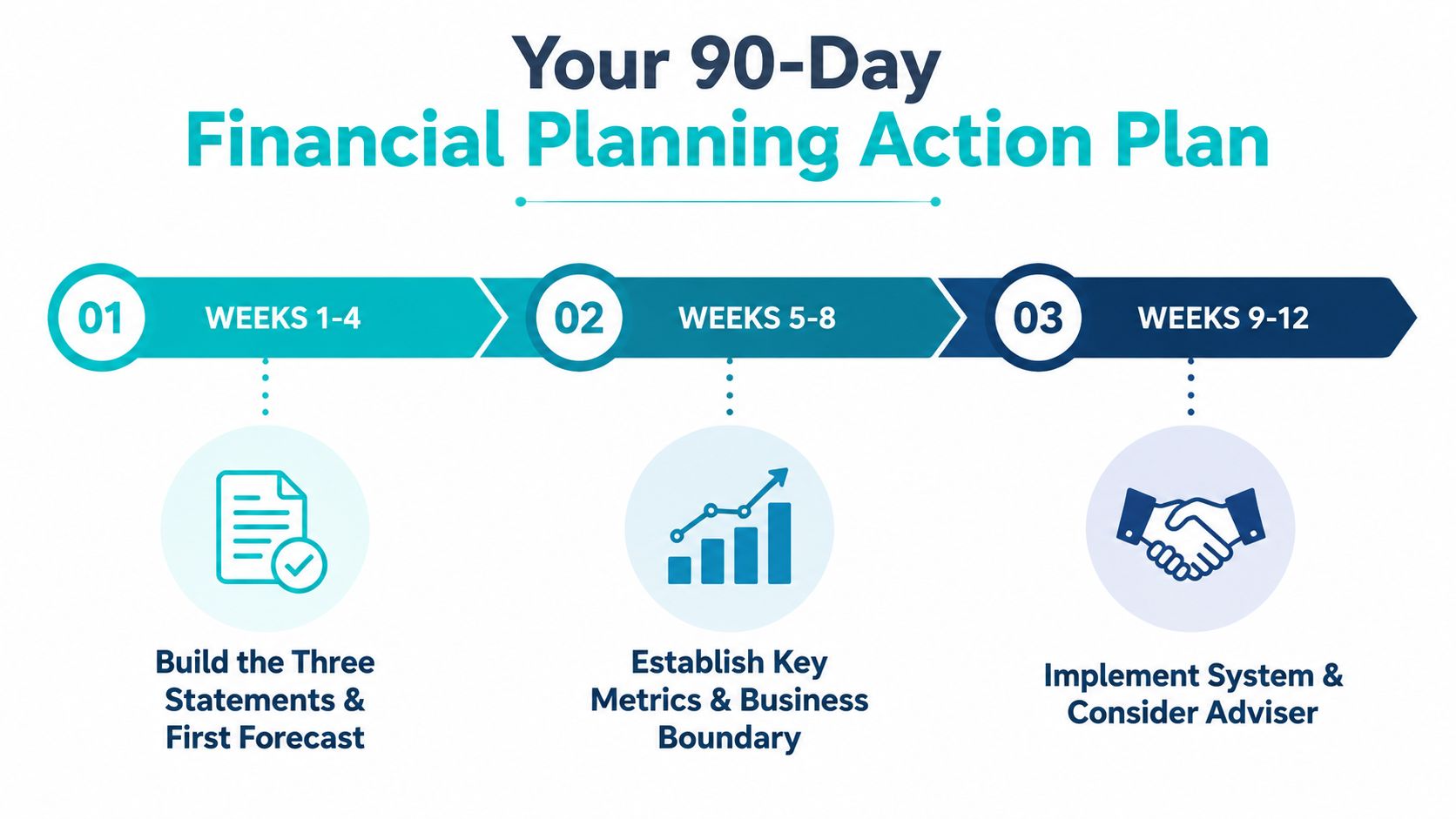
The next three months should be about turning scattered numbers into a system. In weeks one to four, pull together the income statement, cash flow statement, and balance sheet, then build the first 12-month forecast. In weeks five to eight, set up the monthly dashboard for the core numbers and draw a hard line between business cash and household cash.
In weeks nine to twelve, test risk cover, funding options, and super contributions against the forecast. Make a checklist of what needs updating, including the forecast, insurance schedule, tax settings, and any debt repayment assumptions. Keep the process simple enough that you'll use it.
A practical decision tree is easy to apply. If retained earnings cover the need without weakening the forecast, use them first. If the need is temporary and the repayments are manageable, debt may be the right lever. If the issue is bigger than the business can absorb on its own, bring in advice before adding pressure.
For owners weighing business funding or a guaranteed finance process, GoSBA Loans broker guide is a useful resource for understanding how brokers fit into the lending process. If you want help choosing the right adviser for the structure, tax, and protection side, Wealth Collective's page on how to choose a financial advisor is a sensible starting point.
An adviser adds the most value when the numbers get large, the tax consequences get messy, or the owner wants the business to fund a specific retirement outcome. A free introductory conversation is often enough to sanity-check the plan and see whether the pieces fit together. If you want that level of practical oversight, visit Wealth Collective and book a first call so the business, the household, and your long-term wealth plan stop pulling in different directions.