Business hours
Monday to Friday (8.30AM - 5PM)
Weekend (Closed)


You've spent years building a home, superannuation and savings, and now retirement is close enough to feel real. Then a neighbour mentions the Age Pension, and suddenly simple questions become difficult: will your age qualify, does your Perth or regional WA home count, and could investment income reduce your payment?
Age Pension eligibility isn't decided by age alone. Residency, relationship status, assessable assets and income all matter, and Western Australian property values can make the assessment especially difficult for homeowners who have substantial wealth tied up in their residence but limited cash flow. The rules also change how a single person, a couple, a homeowner and a non-homeowner are assessed.
Navigating Age Pension Eligibility in Western Australia
Consider a couple approaching retirement in the Perth hills. They own their home, have superannuation invested across several accounts and earn some income from investments. Their house makes them feel financially secure, but their accessible income feels less certain. They've heard that homeowners face different Centrelink limits from renters, yet they don't know whether their home, super, savings or expected drawdowns will affect the result.
That uncertainty is common. A property can be valuable without producing regular cash flow, while a relatively modest investment portfolio can generate assessable income. In WA, the choice between staying in a long-held home, downsizing, moving to a regional centre or renting can change both household finances and the way means testing applies.

Why the headline age can mislead
Reaching pension age only opens the door to an assessment. You'll still need to meet the residency requirement and pass the income and assets tests. A couple can therefore reach the required age but receive a reduced payment, or no payment, depending on their financial position.
For a WA retiree, the important question isn't, “Will I get the Age Pension?” A better question is, “How will my home, superannuation, savings, investments and income interact with the rules?”
Practical rule: Treat the Age Pension as one part of a retirement income plan, not as the entire plan.
That approach also helps with lifestyle decisions. If remaining in your home is important, resources about aging in place from DME Superstore can help you think through practical support and home suitability alongside your financial strategy.
The planning question behind the rules
A person with high home equity may have limited taxable or assessable income, while another retiree with more liquid investments may face a different result. The answer depends on the complete household picture, not one account balance or a property estimate.
The following sections separate each eligibility gate so you can identify what needs checking before making a decision about retirement timing, superannuation withdrawals or housing.
Age and Residency Requirements Explained
The first requirements are straightforward in principle, but residency details often catch people out. Australia's Age Pension qualifying age is 67 years, and the staged increase reached 67 from 1 July 2023, according to Services Australia's Age Pension guidance.
That means someone who planned around the older pension age of 65 or 66 may need to fund a longer period before government support becomes available. This matters when coordinating employment, superannuation drawdowns and other retirement income sources.
Age is only the first gate
Services Australia says an applicant must be 67 or older, be an Australian resident and generally have lived in Australia for at least 10 years to qualify, subject to the other eligibility tests. The age requirement doesn't override residency or means testing.
Residency is assessed as a history, not just as a current address. A person who has recently returned to WA after working overseas may live permanently in Australia today but still need to establish whether their earlier periods count as qualifying Australian residence.
How the 10-year rule works
The standard requirement is generally 10 years of qualifying Australian residence in total, with at least 5 years continuous. Services Australia also says the person generally needs to be living in Australia and physically in Australia when lodging the claim. The relevant residence rules for the Age Pension explain who may count as an Australian resident, including Australian citizens, permanent visa holders and protected Special Category visa holders from New Zealand.
The practical checks are:
- Count qualifying residence: Review the dates you lived in Australia, rather than relying on memory.
- Check continuity: Identify whether at least five years formed one continuous period.
- Confirm claim circumstances: Make sure you understand the requirement to be living in Australia and physically present when lodging the claim.
- Investigate exceptions: Refugees, some former pension recipients and people covered by international social security agreements may have different outcomes.
The residence requirement can be particularly important for migrants, returnees and Australians who spent extended periods overseas. A person may satisfy the age condition but still need specialist guidance before assuming they can claim.
Keep documents that help establish your residence history, including visa records and travel information where relevant. If your circumstances are unusual, check the official rules before changing work, travel or housing arrangements.
How the Assets Test Determines Your Pension
A Perth homeowner may have substantial property wealth but limited cash flow. A retiree in Bunbury may own fewer assets overall yet receive a different Age Pension outcome because housing status changes how the assets test applies. The test examines your assessable assets after the relevant exclusions and rules, with homeowner status as a central distinction.
Services Australia lists the assets-test thresholds where the full pension begins to reduce at $333,000 for a single homeowner and $600,000 for a single non-homeowner. For couples, the combined figures are $499,000 for homeowners and $766,000 for non-homeowners, according to the Age Pension assets test thresholds.
Compare the starting thresholds
| Couple status | Homeowner limit | Non-homeowner limit |
|---|---|---|
| Single | $333,000 | $600,000 |
| Couple combined | $499,000 | $766,000 |
These figures are planning reference points, not a promise of a particular payment. Services Australia also lists upper thresholds for receiving any part pension. For a couple, eligibility under the assets test ends at $1,102,500 for homeowners and $1,369,500 for non-homeowners, according to its assets-test rules.
Why WA housing decisions matter
The principal home is treated differently from many other assets. As a result, a Perth homeowner who sells before buying another property may temporarily hold more assessable cash, while moving into a rental property can change the relevant homeowner status. Timing and housing costs therefore deserve attention in a retirement plan.
Review the household position as a whole, including savings, shares, superannuation and other assessable holdings. Relationship changes, a property sale or a move from ownership to renting can shift the applicable threshold.
For a structured first review, the Centrelink Asset Test Calculator can help organise the figures you need to check. It does not replace an official assessment or personal advice, but it can show which details require closer attention.
Understanding the Income Test Limits
A Bunbury retiree may have stopped full-time work but still receive investment payments and superannuation income. A Perth retiree may work part-time while drawing less from super. Even with similar total assets, their Age Pension outcomes can differ because the income test examines the money those assets produce.
Services Australia lists fortnightly income cut-off points of $2,627.80 for a single person, $4,016.80 combined for a couple living together, and $5,199.60 combined for a couple living apart due to ill health, according to its Age Pension income test information.
What can count as income
Wages are only one part of the assessment. Financial assets such as savings, shares and superannuation may also affect the result. An account-based pension or investment portfolio therefore needs to be reviewed alongside employment income, rather than treated as a separate issue.
For someone in WA, this distinction matters because a high-value Perth home may provide security without producing regular income. Another retiree may hold fewer property assets but receive more from investments or super. The income test looks at the flow of money, while the assets test examines the broader financial position.
Read the figures as household limits
For couples living together, the applicable figure is combined. Both partners' wages, investment returns and relevant superannuation income need to be considered. Couples living apart due to ill health have a different combined threshold because Centrelink assesses that household situation differently.
Cash-flow planning can therefore affect pension outcomes. A person may hold enough assets to feel financially secure but receive less pension when assessable income is higher. Conversely, someone with substantial home equity may have limited regular income. Property values, rent, utilities and other WA living costs can make that interaction harder to judge from a bank balance alone.
A useful question: Don't ask only how much you own. Ask how your assets are producing income and how that income may be assessed.
Income-test figures can change, so an old online summary may mislead. Check current Services Australia information and review your specific superannuation and investment arrangements before restructuring them.
Partner Rules and Special Circumstances
Relationship status affects the way Centrelink assesses financial information. Married and de facto partners are generally assessed as a couple, so the household's relevant assets and income need to be considered together rather than treating each person as financially independent.
That can surprise couples who keep separate bank accounts or divide household expenses. Separate accounts don't necessarily create separate Age Pension assessments. The practical starting point is to identify the relationship status Centrelink will recognise, then gather both partners' financial information.
Living together and living apart
A couple living together is assessed using combined financial information and the relevant couple thresholds. A couple living apart due to ill health may be assessed under different circumstances, including a higher combined income cut-off of $5,199.60 per fortnight, compared with $4,016.80 combined for a couple living together, based on Services Australia's income-test figures.
The difference isn't an automatic entitlement to a higher payment. Centrelink still needs to assess the actual circumstances, and the couple must meet the applicable rules.
| Circumstance | Assessment focus |
|---|---|
| Couple living together | Combined household income and assets |
| Couple living apart due to ill health | Combined information, with the relevant separated-couple rules |
| Single applicant | Individual income and assets, subject to the applicable tests |
Residency exceptions
The standard residency pattern doesn't cover every person's history. Services Australia's residence guidance for special circumstances notes exemptions for refugees, some former pension recipients and people covered by international social security agreements.
These provisions may matter to migrants, returnees and people who have received social security support in another country. They shouldn't be assumed to apply automatically, so gather your immigration, residence and pension records before claiming.
Housing and superannuation decisions can also intersect with partner planning. If selling a home is under consideration, read about downsizer contributions to super as part of a broader discussion with a licensed adviser. The right strategy depends on eligibility, timing, cash-flow needs and the effect of the transaction on your broader retirement plan.
Next Steps for Checking and Optimizing Eligibility
Start with a written snapshot of your circumstances. Record your age, relationship status, residence history, homeowner status, superannuation, savings, investments and expected income. Then separate what you know from what still needs confirmation.
Use current Services Australia guidance for the official rules and calculators for an initial sense check. You can also review the Age Pension Eligibility Calculator to organise the information relevant to an eligibility discussion.
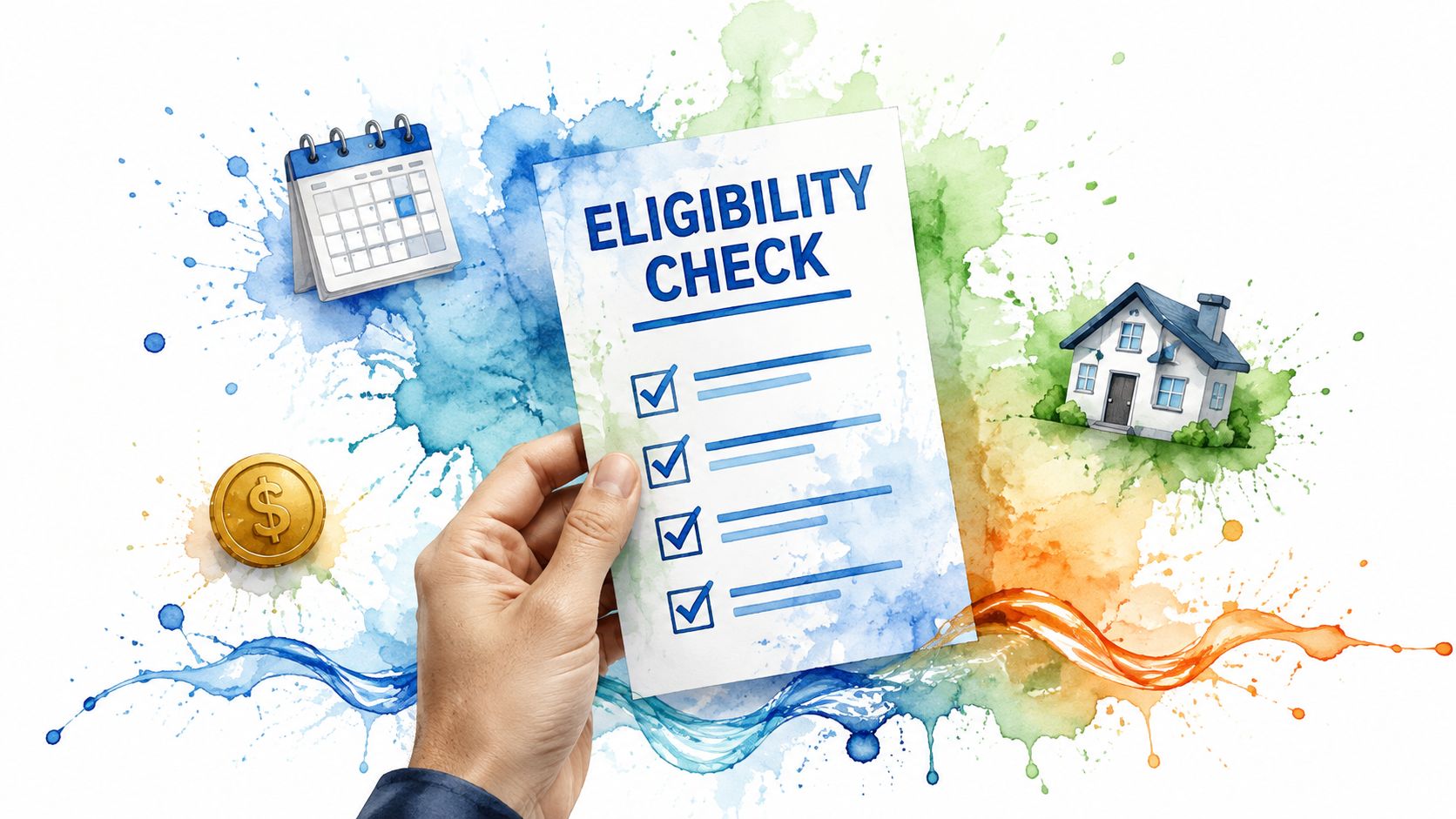
Before making a major decision, work through these practical checks:
- Confirm timing: Check when your age and residency conditions are satisfied.
- List assets accurately: Include relevant financial holdings and clarify how your home is treated.
- Map income: Identify employment, investment and superannuation income.
- Model changes: Compare staying put, downsizing, renting or changing withdrawals.
- Check the application: Confirm what documents and evidence Centrelink requires.
A financial adviser can help connect the eligibility assessment with superannuation drawdowns, investment structure, tax and spending needs. Wealth Collective's retirement planning service is designed to turn these moving parts into a practical Retirement Roadmap for WA clients.
Wealth Collective can help you assess Age Pension eligibility alongside superannuation, investments, housing choices and retirement income needs. Visit Wealth Collective to arrange an initial call and discuss a clear, personalised plan for your next stage.