Business hours
Monday to Friday (8.30AM - 5PM)
Weekend (Closed)


Dollar cost averaging means investing a fixed dollar amount on a regular schedule, such as weekly, fortnightly, or monthly, regardless of the market price. You automatically buy more units when prices are low and fewer when prices are high.
That makes DCA a practical answer for the Australian professional who has savings sitting in cash, watches market headlines move from optimism to panic, and keeps asking the same question: “When should I invest?” The honest answer is that nobody knows the perfect entry date. A repeatable process is more useful than another market prediction.
Why Dollar Cost Averaging Matters for Australian Investors
DCA turns investing into a habit rather than a test of confidence. You nominate an amount, choose a schedule, and continue buying the selected investment whether prices rise or fall. The approach is commonly used through weekly, fortnightly, or monthly contributions, with the number of units changing according to the price at each purchase. Australian investment guidance from HSBC describes the same core mechanism.
That matters because Australians often build wealth from salary, business cash flow, and compulsory superannuation rather than from a single inheritance or sale proceeds. Regular contributions fit naturally around pay cycles. They also reduce the pressure to make one large decision on one emotionally loaded day.
Practical rule: If a strategy helps you keep investing through ordinary volatility, it can be more valuable than a theoretically perfect strategy you abandon when markets fall.
Australia adds two complications that investors shouldn't ignore. Inflation changes what future contributions can buy, while currency movements affect the value of international investments. The ATO recorded annual Australian inflation of 7.3% in 2022, 4.9% in 2023, and 2.7% in 2024, as shown in its CPI history referenced through the Reserve Bank of Australia historical data archive. Recent AUD/USD observations also moved from 0.664352 USD per AUD at 31 December 2023 to 0.6217 at 31 December 2024, then to about 0.705205 by 19 August 2026, illustrating why repeated entry points can matter when both markets and currencies move.
DCA isn't a guarantee of profit, and it isn't a substitute for choosing suitable investments. It is a way to remove some emotion from deployment and create consistency. For a broader foundation, review this guide to long-term investment, then consider whether your super and personal portfolio are working towards the same objective.
Investors considering volatile digital assets should also understand the additional risks before setting up automated purchases. A practical resource on how to dollar cost average crypto can help explain the mechanics, but the strategy doesn't make an unsuitable asset suitable.
How Dollar Cost Averaging Works in Practice
Take a $6,000 investment and divide it into six monthly purchases of $1,000. The market price changes each month, so the amount buys a different number of units. Canstar uses a comparable Australian example and shows an average share price of about $12.60 with 476 units accumulated across monthly purchases. See its Australian dollar cost averaging example for the underlying illustration.
The table below uses the same mechanics with a simplified six-month sequence. It assumes whole units for clarity, so the figures are an educational illustration rather than a brokerage statement.
Dollar Cost Averaging Example: $6,000 Over Six Months
| Month | Share Price | Amount Invested | Units Bought | Running Total Units |
|---|---|---|---|---|
| Month 1 | $10 | $1,000 | 100 | 100 |
| Month 2 | $8 | $1,000 | 125 | 225 |
| Month 3 | $12 | $1,000 | 83 | 308 |
| Month 4 | $15 | $1,000 | 66 | 374 |
| Month 5 | $9 | $1,000 | 111 | 485 |
| Month 6 | $11 | $1,000 | 90 | 575 |
| Total | $6,000 | 575 | 575 |
The simple average of the six share prices is $10.83, while the investor's average cost per unit is about $10.43, calculated by dividing the total invested by the units acquired. The difference exists because the fixed contribution buys more units at the lower prices of $8 and $9, and fewer units at the higher prices of $12 and $15.
That distinction is the mathematical heart of DCA. The investor doesn't receive the simple average market price. They receive a weighted average based on how many units each contribution buys.
Why the Australian context matters
Inflation means a dollar invested later may have less purchasing power than a dollar invested earlier. The ATO CPI series shows quarterly index levels moving from 114.4 at 30 June 2020 to 136.1 at 31 December 2023, with the historical series also recording 130.8 at 31 December 2022. Those figures reinforce a practical point: leaving all investment capital idle while waiting for certainty carries its own cost.
Currency adds another layer for international ETFs. When the AUD weakens against the USD, an Australian investor's unhedged global exposure can rise in Australian-dollar terms even if the underlying overseas market is unchanged. When the AUD strengthens, the currency translation can work in the opposite direction. DCA spreads that currency entry across time, but it doesn't remove foreign-exchange risk.
Dollar Cost Averaging Versus Lump-Sum Investing
If you already have the money available, the decision is less obvious than many DCA explainers suggest. Lump-sum investing puts the capital to work immediately. DCA holds some of it back and deploys it gradually. In a rising market, earlier investment usually has the advantage because more capital has had time in the market.
That doesn't make lump sum automatically right. A large investment made immediately can fall soon afterwards, and some investors respond by stopping, selling, or abandoning their plan. DCA's main advantage is often behavioural. It gives a cautious investor a way to begin without demanding confidence about the next market move.
Australian evidence adds an important wrinkle. In a simulation of the ASX 200 accumulation index from the start of 2000 to May 2026, a plan investing $100 every Monday outperformed both a 10% dip-buying strategy and an omniscient dip-buying strategy. It finished about $30,000 ahead of both alternatives and roughly 21% higher over the 26-year period, according to BetaShares' Australian DCA analysis. The result doesn't prove DCA will always win. It demonstrates how continuous exposure and consistent contributions can beat selective entry rules over a long upward market history.
A useful decision framework
Choose lump sum when:
- Your horizon is long: You can remain invested through market falls without needing the money soon.
- Your risk tolerance is strong: A short-term decline won't cause you to change a carefully designed asset allocation.
- The money is available: You aren't investing an emergency reserve or funds needed for a known expense.
Choose DCA when:
- Volatility affects your behaviour: A staged plan makes it more likely you'll stay invested.
- Your income arrives gradually: Fortnightly or monthly contributions match your cash flow.
- You have a concentrated windfall: A bonus or business distribution can be introduced through a defined schedule rather than an improvised reaction to headlines.
The right comparison isn't “which method is always superior?” It is “which method will I follow when markets are uncomfortable?” Investors weighing that question should also understand sequence of returns risk, particularly when a portfolio is approaching retirement or funding withdrawals.
For a broader perspective on the cost of delaying investment decisions, this My Money Mentor Plus guide provides useful context on opportunity cost, even though its framing isn't specific to Australian superannuation.
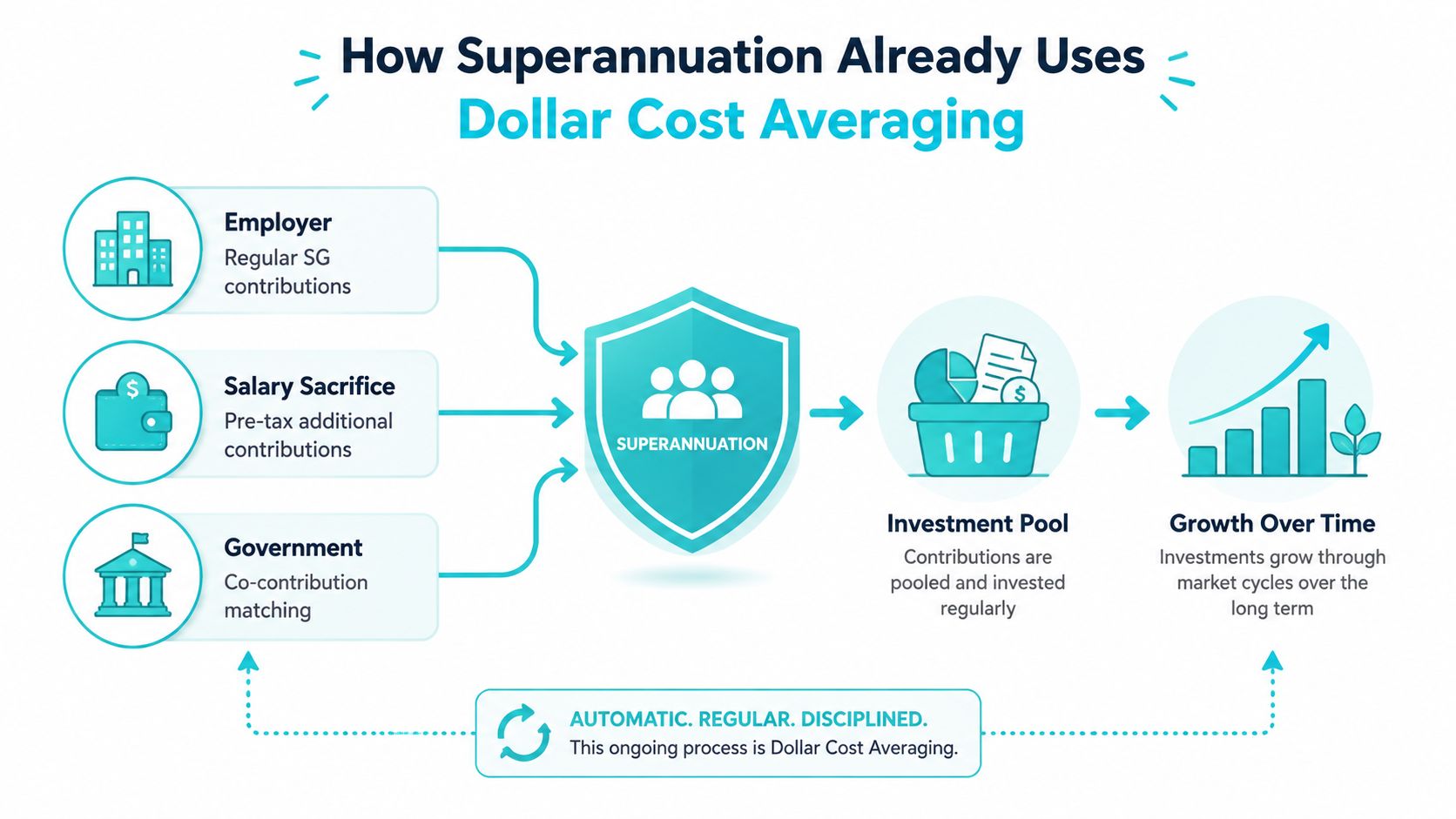
How Superannuation Already Uses Dollar Cost Averaging
Most Australian employees are already using a form of DCA without setting up a personal ETF plan. Employer super contributions arrive in regular instalments and are invested according to the fund's investment option. Australian guidance identifies compulsory super as a real-world example of repeated investing, because contributions continue across changing market prices. AFSG's explanation of dollar cost averaging discusses this connection.
That changes the question. Instead of asking, “Should I start DCA?”, ask, “What is my super already buying, and what gap would additional investing fill?”
Audit before you add
Check four things before directing extra money into an ETF or managed fund:
- Investment option: Is your super invested in a balanced, growth, indexed, cash, or another option?
- Asset exposure: Do you already have substantial Australian shares, global shares, property, or fixed interest?
- Purpose: Is the personal portfolio for a home deposit, financial independence, education, retirement, or another defined goal?
- Tax structure: Would additional concessional contributions, non-concessional contributions, or a taxable investment account better suit your circumstances?
Extra DCA adds value when it gives you flexibility, access to an asset allocation unavailable or unsuitable inside super, or money you can use before super becomes accessible. It can duplicate exposure when you buy a broad global or Australian ETF that mirrors what your super fund already owns.
The duplication isn't automatically harmful. Similar exposure can be intentional, but you should know you're doing it. A portfolio built by accident can become difficult to rebalance and may leave you overexposed to one market or asset class.
Currency changes the result
International DCA isn't only a share-price strategy. An Australian investor buying an unhedged global ETF is also converting exposure through the AUD exchange rate at each purchase. The ATO's monthly foreign exchange rates for the 2025 financial year, together with the RBA's daily exchange-rate records, show why cross-rates deserve attention.
A weaker AUD can increase the Australian-dollar value of overseas assets. A stronger AUD can reduce it. DCA spreads the timing of those conversions, but it can't guarantee protection from currency losses. Treat FX movement as part of the risk of global diversification, not as a problem a regular purchase schedule magically solves.
For investors considering direct super control, the decision involves governance, administration, investment choice, and suitability. A guide to SMSF benefits for Australians may help frame the discussion, but an SMSF shouldn't be established to make contributions feel more personalised.
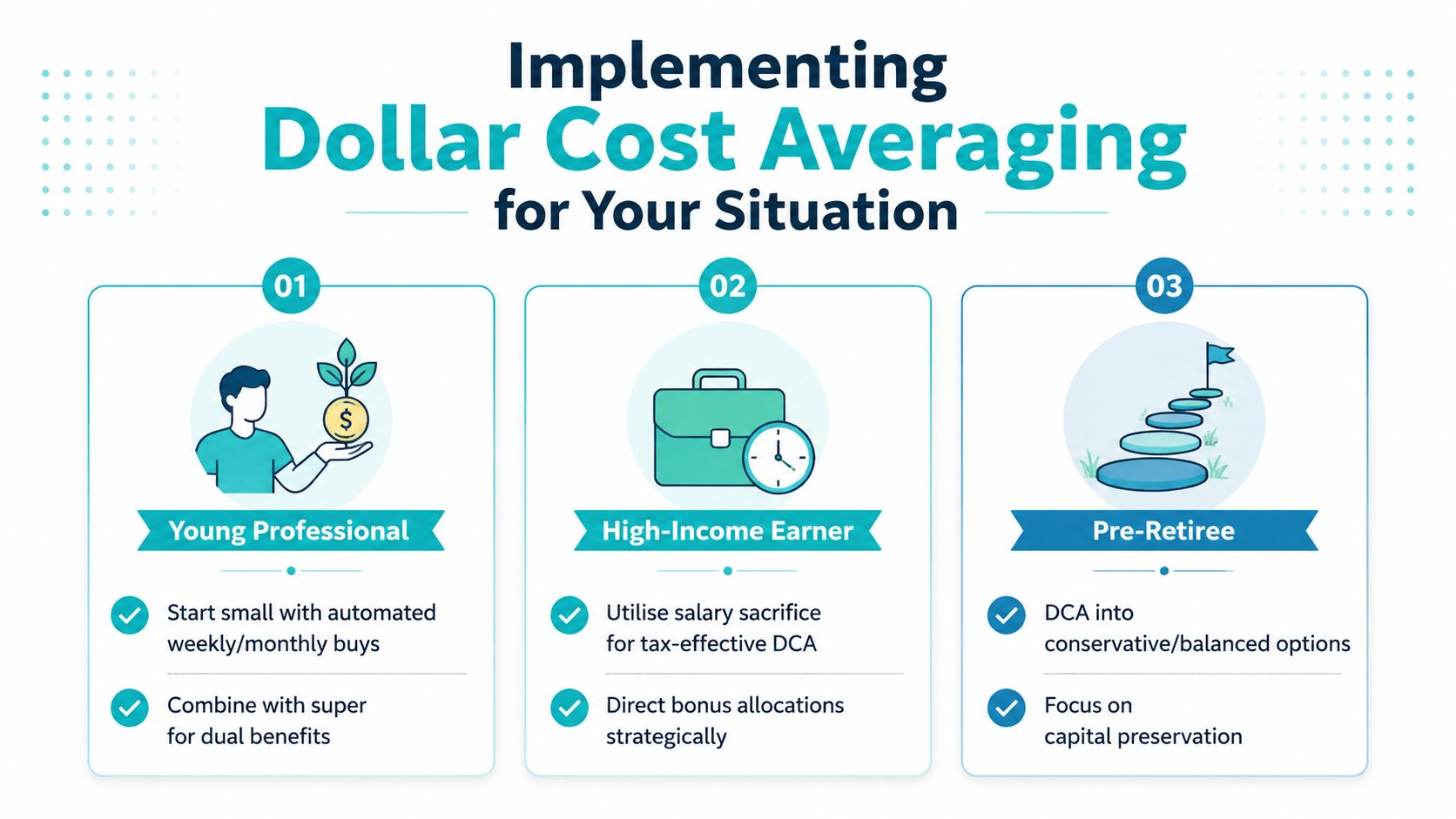
Implementing Dollar Cost Averaging for Your Situation
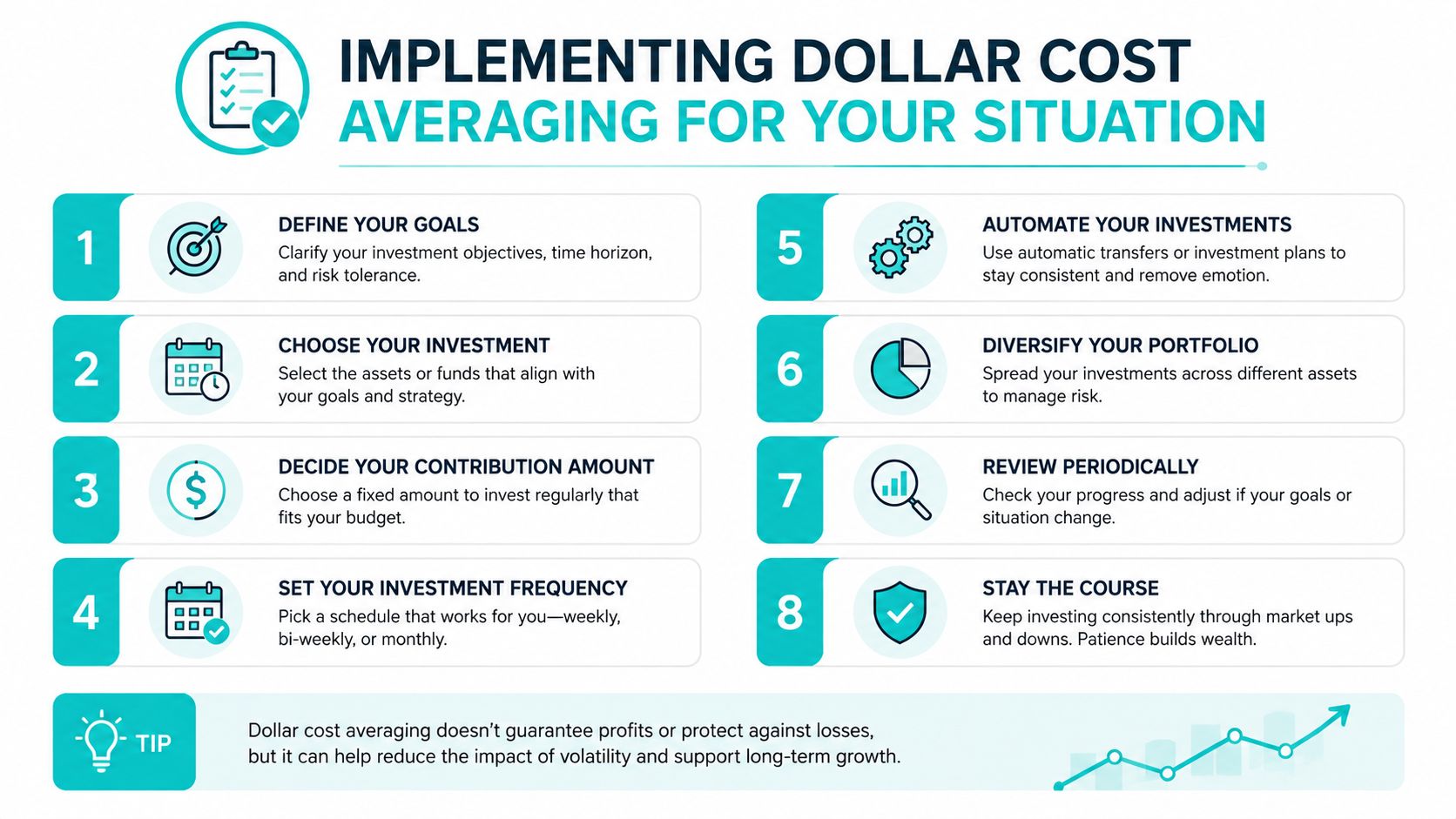
A sound DCA plan starts with the account, goal, and asset allocation. The purchase schedule comes after those decisions, not before them.
Young professionals
Start with an automated contribution that fits your actual surplus after rent, debt repayments, insurance, and emergency savings. A broad ASX-listed ETF can provide a simple structure, but check its holdings before buying because your super may already contain similar Australian and international exposure.
Use super for retirement-directed money and a taxable investment account for goals requiring access before super. Keep the plan boring. The value comes from regular execution, not from changing funds every time a headline changes.
Wealth Collective's Guided Growth service can be relevant when you need help coordinating personal investments, superannuation optimisation, and debt reduction. Its guide to starting investing in Australia also explains the fixed-contribution approach in an Australian setting.
High-income earners and executives
Variable income needs a variable process. Set a sustainable base contribution from ordinary salary, then create a separate rule for bonuses or surplus cash. That prevents an unusually strong income month from turning into an oversized investment decision without considering tax, liquidity, and existing exposure.
Salary sacrifice can direct additional pre-tax contributions into super, subject to the applicable contribution rules and your personal circumstances. A taxable portfolio may be more appropriate for money needed before retirement or for investors who have already considered their super contribution position.
Choose a cadence that matches your payroll or bonus cycle. Monthly investing may suit regular salary, while a defined staged plan can help deploy a larger cash balance without pretending to know the next market low.
Pre-retirees
Pre-retirees need a different priority. Accumulating units is no longer the only objective. The portfolio must also support liquidity, spending needs, tax planning, and protection against poor returns near the start of retirement.
DCA can be used for new contributions, but don't use it as an excuse to ignore asset allocation. A high-growth portfolio may not suit money required soon, while a conservative or balanced option may better align with a shorter horizon. Your retirement plan should specify which assets fund near-term spending and which remain invested for later years.
Wealth Collective's Retirement Roadmap can connect contribution decisions with drawdown planning, while Protection Plus addresses personal insurance and financial risks that could interrupt the strategy. The firm offers a free 10-minute introductory call to discuss a personalised plan covering tax, super, insurance, investments, and debt.
Common Dollar Cost Averaging Mistakes to Avoid
DCA fails most often because investors change the rules at the worst time. A falling market makes the strategy uncomfortable, but lower prices are precisely when a fixed contribution buys more units. Pausing because the news feels frightening converts a disciplined process into an attempt to predict the recovery.
That doesn't mean you should keep buying an investment whose fundamentals, structure, or role in your portfolio no longer make sense. Review the asset allocation and the investment itself. Don't make a panic decision based only on a falling price.
The avoidable errors
- Stretching out a lump sum indefinitely: If you have a large amount ready to invest, an overly long schedule can leave excessive money in cash while the portfolio remains underinvested. Set a defined start date, contribution frequency, and end point.
- Ignoring transaction costs: Frequent purchases can make brokerage and platform charges more significant, especially for small contributions. Compare the total cost of the chosen platform and consider whether fortnightly or monthly purchases are more efficient than very small transactions.
- Buying without an asset allocation: DCA controls when you buy, not what you own. A regular purchase into one company or narrow theme can create concentration risk.
- Treating automation as a substitute for review: Automation helps with execution, but you still need to check beneficiaries, contribution limits, fees, investment options, and whether the portfolio remains aligned with the goal.
- Stopping without an accountability rule: Decide in advance what would justify changing the plan. “The market fell” isn't a complete investment policy.
The best schedule is one you can maintain during ordinary enthusiasm and uncomfortable declines. Keep contributions affordable, use a low-cost structure, and review the plan at planned intervals rather than reacting to every market move.
Frequently Asked Questions About Dollar Cost Averaging
Is DCA tax-efficient in an Australian taxable account?
DCA doesn't create a special tax exemption. Each purchase can create a separate parcel with its own cost base, and income or capital gains may have tax consequences when distributions are received or assets are sold. A taxable account can still be useful for accessible wealth, but choose the account structure and record-keeping process with your broader tax position in mind.
What if my income changes each month?
Use a minimum contribution you can sustain, then make additional investments when cash flow allows. Small business owners and contractors should protect tax obligations and operating reserves before committing surplus cash. Automating an amount that becomes unaffordable will undermine the strategy.
Does DCA work for international shares when the AUD moves?
It can reduce the timing risk of converting Australian dollars into global exposure, but it doesn't remove currency risk. Unhedged investments respond to both overseas asset prices and AUD movements. Decide whether hedged, unhedged, or a combination fits your objectives rather than assuming regular investing solves the FX issue.
Should I change DCA as retirement approaches?
Yes, the purpose of the money matters more as withdrawals get closer. Review liquidity, defensive assets, super investment options, tax planning, and the order in which assets will be sold. DCA may remain suitable for long-term capital, but money required for near-term spending needs a separate risk assessment.
Wealth Collective helps Australians coordinate DCA with superannuation, tax planning, investment selection, personal insurance, debt reduction, and retirement income needs. Visit Wealth Collective to book a free 10-minute introductory call and map out a strategy that fits your cash flow and financial goals.