Business hours
Monday to Friday (8.30AM - 5PM)
Weekend (Closed)


You've retired, the super balance is finally working for you, and the plan looks sensible on paper. Your account-based pension pays the bills, the Age Pension may provide a top-up, and there's enough left for Christmas visits with the kids and the occasional trip. Then markets fall early in retirement. The statements look uncomfortable, but the key question isn't merely whether markets recover. It's whether you're forced to sell investments while they're down.
That's sequence of returns risk. It's the risk created by the order in which investment returns arrive while you're withdrawing money. For Australian retirees, the answer isn't automatically to move everything into defensive assets. A stronger plan combines flexible withdrawals with income sources that aren't linked to share-market performance.
Two Retirees, Two Very Different Outcomes
Margaret and Ron live a few streets apart in Perth. Both retire at 65 with $900,000 in an account-based pension. Both draw $55,000 a year, both invest similarly, and both experience a 7% average return over 20 years.
They talk about the same things at the kitchen table. Whether the Age Pension will provide a useful top-up. Whether the next downturn will arrive before the kids visit at Christmas. Whether they can keep spending on travel without leaving an awkward financial mess behind.
Yet their outcomes are completely different.
Margaret experiences several poor market years at the beginning of retirement. She keeps drawing the same amount because her bills don't pause when markets fall. She sells more units at lower prices, leaving fewer units available when markets recover. By age 83, her account has run out.
Ron experiences the difficult years later, after his portfolio has benefited from stronger early returns and withdrawals have reduced the balance. He dies at 92 with $400,000 still invested.
This isn't a claim that two real neighbours will follow these exact numbers. It's a simplified illustration of a genuine retirement-planning problem. Two people can start with the same balance, spending pattern and long-run average return, yet reach very different endpoints because their returns arrive in a different order.

The hidden variable
The difference isn't necessarily poor investing or reckless spending. It's the interaction between market performance and withdrawals. Challenger explains that sequencing risk is most dangerous around retirement, when savings are often at their highest and withdrawals begin, although the risk can occur whenever investment volatility coincides with portfolio cash flows (Challenger's explanation of sequencing risk).
Margaret and Ron's paradox has a simple explanation. During accumulation, you're adding money and have time to recover. During drawdown, you're removing money, so an early loss can permanently reduce the capital available for recovery. The next section shows exactly how that happens.
What Sequence of Returns Risk Really Means
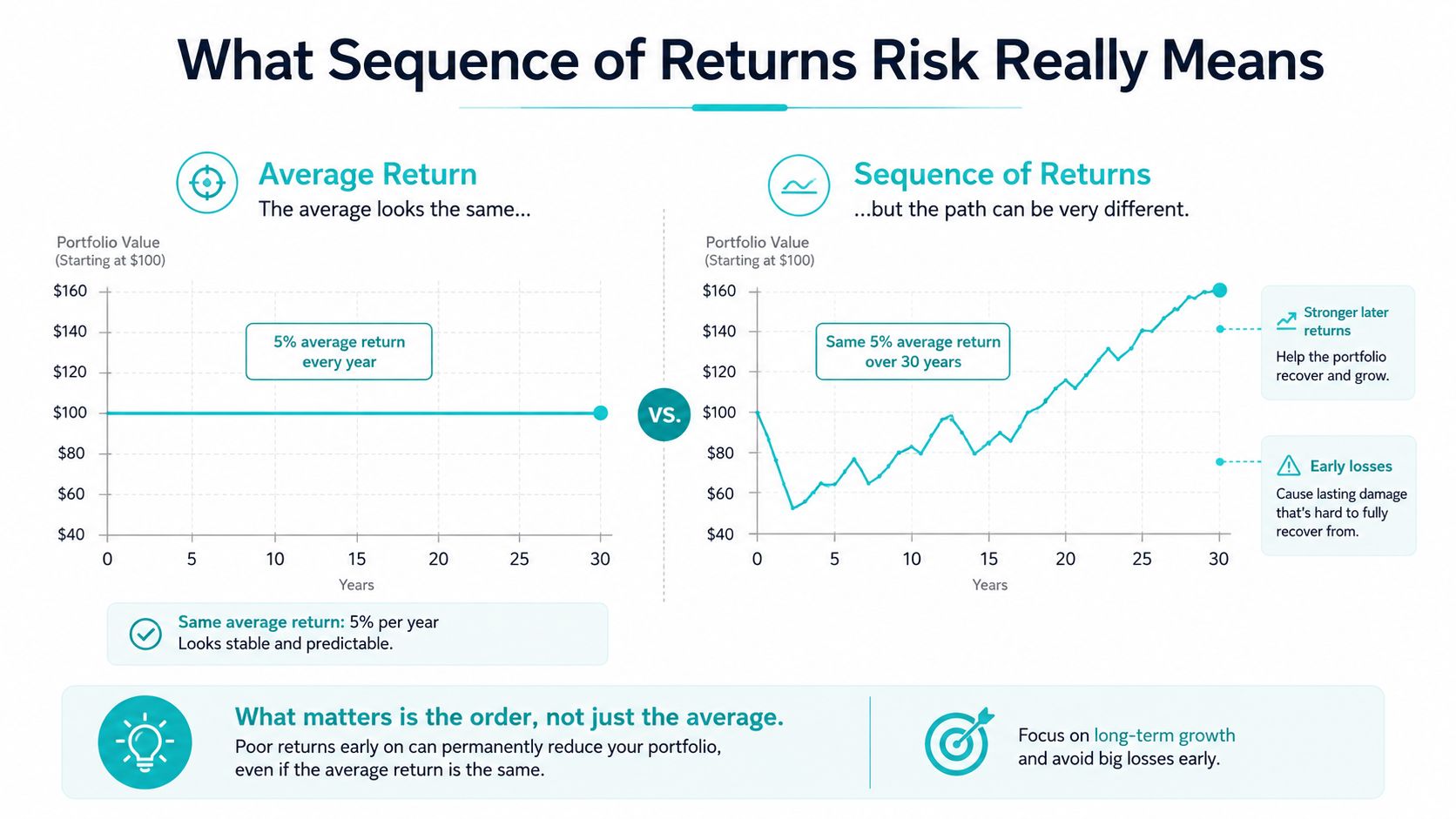
Sequence risk is a timing problem layered on top of ordinary market risk. Market risk asks whether investments might fall. Sequence of returns risk asks when those falls happen in relation to your withdrawals.
Take a hypothetical $1,000,000 portfolio with a 5% withdrawal rate. If the portfolio suffers a 20% fall in the first year, the damage can be roughly $150,000 greater over 20 years than if the same fall occurs in year 15, assuming the return experience is otherwise arranged to produce the same average. This is a mathematical illustration, not a forecast, and the result depends on the full return path, fees, tax and withdrawals.
Why the order matters
Suppose you withdraw $50,000 after a market fall. You need to sell more units to raise that money than you would have sold before the fall. Those units are gone. If markets later recover, the units you sold don't participate in the recovery.
The same return pattern can be much less damaging during accumulation. You're not selling to fund groceries, utilities or rent, and new contributions may buy more investments at lower prices. A fall can still be uncomfortable, but it doesn't create the same forced reduction in your capital base.
In retirement, the calculation changes:
- The portfolio falls.
- You withdraw money anyway.
- You sell more units at depressed prices.
- The recovery applies to a smaller balance.
The Griffith University retirement-risk research describes this as a material effect on terminal wealth and the probability of portfolio ruin, even when long-run average returns remain unchanged (Griffith University research on sequence risk).
Practical rule: A healthy long-term average doesn't make an early retirement drawdown safe. Your cash-flow plan has to survive the bad years, not just match an average return assumption.
The danger isn't confined to a neat calendar window. It's greatest when a significant decline overlaps with withdrawals, particularly while the account is large and your spending depends heavily on it. Australian evidence makes that exposure clearer.
Why Australian Retirees Feel It Most
Australian retirees face a specific combination of superannuation structures, market exposures and income-test realities. The problem isn't just that markets move. It's that many people enter retirement with a growth-oriented portfolio and immediately start selling units to fund their lifestyle.
The Actuaries Institute's Australian analysis found that, for a balanced portfolio, 81% of all observed yearly decline episodes occurred within one, two or three years, while the average cumulative decline over two years was -14.0% and the worst two-year cumulative decline was -31.6% (Actuaries Institute research on sequencing risk and asset allocation). These figures show why a short period of poor returns can matter more than a smooth long-term average.
Four pressures that amplify the damage
Withdrawals turn volatility into a balance problem. An account-based pension generally pays income from investments that remain exposed to market movements. If you withdraw during a fall, you lock in part of the loss and reduce the capital that can compound later. The Conexus Institute specifically identifies the interaction between negative returns and cash outflows as a major source of retirement fragility (Conexus Institute retirement explainer).
Australian portfolios may carry concentrated exposures. The local sharemarket has meaningful exposure to sectors such as banks and miners. That can make the experience of a downturn feel more concentrated than a diversified global portfolio. The answer isn't to abandon Australian assets, but to understand what your super fund's “balanced” label contains.
The move into pension mode can be abrupt. Many pre-retirees hold a substantial growth allocation inside super. A portfolio that made sense while salary and employer contributions continued may be too fragile once the same person begins drawing income. An age-based switch into a default defensive option isn't automatically better either. It may reduce some drawdown risk while increasing exposure to inflation and longevity risk.
The Age Pension doesn't remove portfolio pressure. The means test can affect how much income comes from government support and how much must come from personal super. A household may have a headline withdrawal rate that looks modest, but its actual spending need from the account-based pension can rise when Age Pension support is limited.
The Actuaries Institute also found a 9.29% historical average compound annual return across four calendar quarter-ends for ages 65 or 66 in a balanced portfolio. That long-run result can look reassuring, but it doesn't tell you whether poor returns arrived before or after withdrawals began.
A Tale of Two Market Sequences
Margaret and Peter both retire with $800,000 in a balanced portfolio. Each draws $48,000 annually, and each plans for a 30-year horizon. Margaret receives returns of -18%, -15% and -10% in the first three years, followed by recoveries averaging 10%. Peter receives the same returns in reverse order.
The examples use deliberately simplified assumptions to isolate sequence risk. They aren't forecasts, and the stated outcomes depend on the exact treatment of withdrawals, compounding and fees. The lesson remains useful because both retirees face the same broad return experience, yet the timing changes the capital available for future growth.
Margaret sells into the downturn. Her withdrawals represent a larger share of a falling balance, so the subsequent recovery starts from a damaged base. Her portfolio falls below $600,000 by year 18 in the illustration.
Peter enjoys stronger early returns while his balance is still large. His later losses occur after the portfolio has had time to grow and after withdrawals have reduced the dollar amount exposed to those falls. His portfolio finishes near $1.1 million in the illustration.
What the gap really costs
The obvious difference is remaining capital. The less obvious costs can be just as important:
- Margaret has less flexibility for health costs, home repairs or helping family.
- Her lifestyle cuts arrive sooner, because the portfolio can no longer support the original withdrawals.
- Her Centrelink position may change, but a higher potential Age Pension isn't a substitute for having liquid assets available when she needs them.
- Peter retains options, including leaving capital invested, increasing discretionary spending or transferring wealth.
The sequence is more important than the label on the investment option. A “balanced” portfolio can still experience a painful early drawdown, and a diversified portfolio can still be forced to sell when cash flows are rigid. For a practical explanation of the broader risk behind these movements, read this guide to understanding market volatility.
Your actual plan also needs to answer a harder question than “how long will the money last?” It must show which income sources cover essential spending, how withdrawals change after a poor year, and what happens if markets remain weak while you're drawing. Wealth Collective's guide on how long retirement savings will last is a useful starting point for that conversation.
Comparing the Main Ways to Soften the Blow
There are four practical levers. None is perfect, and anyone presenting one as a complete solution is oversimplifying retirement planning.
Dynamic withdrawals
This approach reduces discretionary withdrawals after poor returns and allows more spending after stronger periods. It directly addresses the mechanism of sequence risk because you sell fewer units when prices are depressed.
- Cost: Low in product terms, but high in discipline.
- Flexibility: High, provided your lifestyle can absorb changes.
- Longevity protection: Stronger than rigid withdrawals.
- Sequence effectiveness: High when the household can cut spending.
The difficulty is emotional. Retirees often want certainty precisely when markets are least predictable. A written rule is more reliable than making a decision during a stressful fall.
Defensive asset allocation
Moving more of the portfolio into defensive assets can reduce the size of early drawdowns. It also reduces exposure to growth, which may leave you more vulnerable to inflation and a long retirement.
A portfolio with a lower growth allocation may suit someone with a short horizon or strong guaranteed income. It isn't automatically suitable for a healthy retiree who needs the portfolio to fund many years of spending.
Cash buffers
Holding one to three years of income needs in cash or term deposits can reduce the need to sell growth assets during a downturn. The benefit is practical and easy to understand, but the buffer needs a replenishment rule.
Cash can also become psychologically dangerous. Some retirees spend it because it feels separate from the investment portfolio, while others keep too much in cash long after the original market threat has passed.
Annuities and guaranteed components
A lifetime annuity or another guaranteed-income structure can cover spending that you can't comfortably reduce. It removes sequence risk from the income it covers, but you exchange liquidity and investment upside for certainty.
| Approach | Main strength | Main trade-off |
|---|---|---|
| Dynamic withdrawals | Adjusts spending to portfolio conditions | Requires difficult spending decisions |
| Defensive assets | Reduces drawdown severity | Can weaken growth and inflation protection |
| Cash buffer | Avoids some forced selling | May reduce long-term growth and be misused |
| Guaranteed income | Covers selected income regardless of markets | Limits access to capital and flexibility |
For a broader discussion of spending rules, the Compass+ spending guidelines can help frame the conversation, but the final rule must reflect your super, Centrelink position and actual lifestyle. A review of your transition to retirement strategy can also help you decide whether the move into full pension mode should happen all at once.
Layering these tools usually works better than choosing one. The key is to match each dollar of spending with the right type of income.
The Strongest Antidote Is Income You Cannot Lose
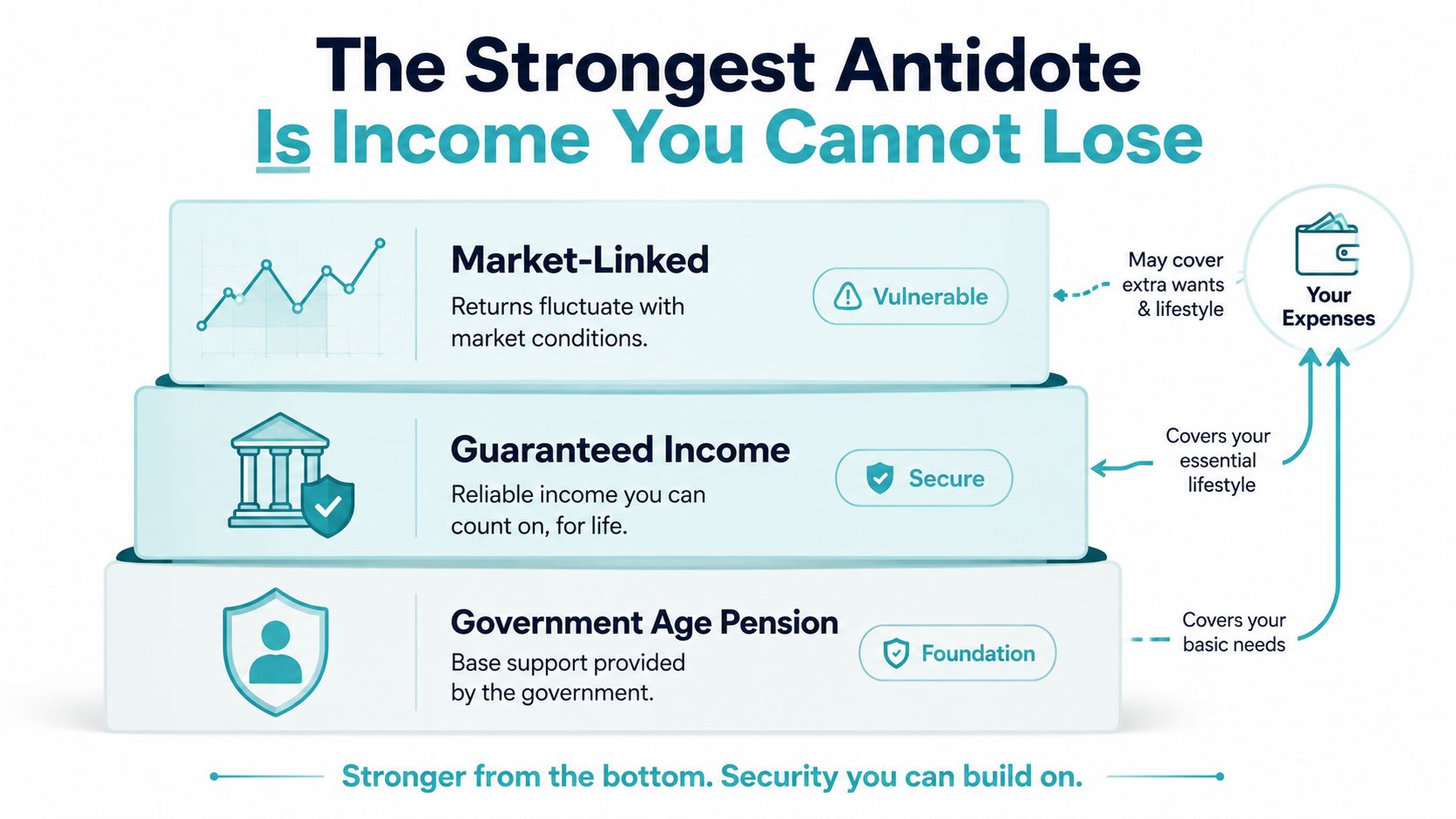
The strongest defence against sequence risk is often not a dramatically lower equity allocation. It's reducing how much your portfolio must sell when markets are falling.
That means building an income mix. Use the Age Pension where eligible, consider a lifetime annuity or another guaranteed-income component for essential expenses, and keep a flexible investment portfolio for discretionary spending and longer-term growth.
Three layers for retirement income
The foundation is government income. The Age Pension can provide a base for eligible Australians, but the assets and income tests matter. Your entitlement may change as your financial circumstances change, so it belongs in the plan rather than being treated as a fixed assumption.
The secure layer covers essentials. A lifetime annuity or a guaranteed component of an account-based pension may fit here. The objective is to fund needs such as housing costs, utilities, groceries and healthcare without requiring a sale of volatile investments at an unfortunate time.
The market-linked layer funds choice. Travel, gifts, renovations and other discretionary goals can remain linked to the portfolio. When markets are strong, you may spend more. When they're weak, you can defer or reduce those decisions without threatening the household's basic security.
The practical target is to identify roughly $30,000 to $40,000 of non-discretionary needs and consider how much can be covered outside the market-linked portfolio. If you reduce required portfolio withdrawals by 30% to 50%, the account has less work to do during a downturn. Those figures are planning illustrations, not universal targets, and the right level depends on your household budget and income sources.
This approach also supports better behaviour. Knowing that core bills are covered can stop you from selling growth assets in a panic. It can also allow a sensible allocation to Australian shares, where franking credits may be relevant inside superannuation pensions, without forcing every part of your lifestyle to depend on the sharemarket.
The trade-off is clear. Guaranteed income can reduce liquidity and may not suit every estate or health objective. But treating retirement as an income-mix problem, rather than only an asset-allocation problem, usually produces a more resilient plan. The retirement income streams available to you should be assessed alongside your pension, super structure and spending priorities.
Your Personal Sequence Risk Action Plan
You don't need to wait for the next market fall. Use the next 30 days to turn the idea into written decisions.
Days one to five
Map every income source into two columns:
- Market-linked: account-based pension withdrawals, dividends and investment distributions.
- Guaranteed or government-supported: Age Pension income, eligible pensions, annuity payments and other stable sources.
Then separate essential expenses from lifestyle spending. This shows how much pressure your portfolio carries before you change the investment mix.
Days six to fifteen
Set a starting withdrawal framework, perhaps within 3.5% to 4%, then write a rule for what happens after a negative market year. The rule might reduce discretionary spending, delay large purchases or draw from a defensive reserve rather than selling growth assets.
Stress-test the plan against a rolling three-year bear market. Don't ask only whether the portfolio survives. Check whether you can still pay bills, maintain your preferred lifestyle and respond to an unexpected cost.
Days sixteen to thirty
Review the asset allocation inside your account-based pension against your real time horizon. Your age alone shouldn't determine the answer. A retiree with strong guaranteed income may tolerate more growth exposure than someone whose entire lifestyle depends on monthly portfolio sales.
Finally, check your Age Pension eligibility, Centrelink assumptions and contingency reserves. A written advice process earns its keep. Wealth Collective's Retirement Roadmap service can bring together your super balance, projected Age Pension entitlement, withdrawal rules and lifestyle goals into one retirement income plan, rather than leaving each decision in a separate spreadsheet.
Questions Retirees Still Ask Us
When does professional advice pay for itself? It's most valuable when the decisions interact. Your asset allocation affects withdrawals, withdrawals affect Centrelink outcomes, and guaranteed income affects how much growth you can reasonably retain. A sequencing-focused review should identify these trade-offs and show what changes under poor market conditions. The cost depends on the adviser, scope and complexity, so ask for a written fee before proceeding rather than relying on a generic estimate.
How long does the danger window last? The early years matter most because balances are often largest and withdrawals have just begun. But the risk doesn't switch off after an arbitrary period. A bear market overlapping withdrawals can create sequence risk whenever it arrives, and the Actuaries Institute notes that a sequence of negative annual returns may not become evident until at least three years have passed.
Is a cash buffer better than a lifetime annuity? Neither is universally better. Cash preserves access and control, while an annuity can provide income for life and remove market exposure from the covered payments. Your health, marital status, desired estate, spending flexibility and Centrelink means-test position should shape the choice.
The honest adviser view is simple. You can't eliminate sequence of returns risk. You can manage it by combining non-market-linked income with flexible, rule-based withdrawals from an appropriately allocated account-based pension.
Wealth Collective helps Australian retirees and pre-retirees build written retirement income plans that connect superannuation, Age Pension considerations, investment strategy and spending decisions. Visit Wealth Collective to book an initial call and discuss how to make your retirement income less dependent on the timing of the next market downturn.