Business hours
Monday to Friday (8.30AM - 5PM)
Weekend (Closed)


A 38-year-old marketing manager in Melbourne leaves work on a Friday expecting to return after the weekend. Instead, a cycling accident fractures her spine, and her doctor expects she'll be unable to work for months. Her sick leave runs out after two weeks, but the mortgage, school fees, groceries, utilities and childcare continue as normal.
That's the financial problem income protection insurance is designed to solve. It isn't a lump-sum product. It provides a monthly cash-flow bridge by replacing part of your earnings when illness or injury prevents you from working, subject to the policy terms. The Australian Taxation Office describes it as cover intended to replace salary or wages, which distinguishes it from life, trauma and total and permanent disability insurance (ATO guidance).
For most households, earning capacity is the asset that funds everything else. This income protection insurance explained guide focuses on the decisions that determine whether a policy protects your actual household cash flow, including benefit amounts, waiting periods, benefit periods, super-linked cover and Australian tax treatment.
Why Income Protection Matters for Australian Households
The Melbourne manager may have savings, employer leave and a partner's income, but those resources can disappear quickly when a temporary absence becomes a prolonged recovery. A policy benefit won't make the injury less painful, but it can help keep essential commitments paid while she focuses on rehabilitation.
The key distinction is income replacement, not wealth creation. Income protection generally pays a defined share of recent pre-tax earnings. MoneySmart notes that common benefit levels can be 75% or 90% of pre-tax income, with the benefit tied to annual earnings in the 12 months before illness or injury (MoneySmart income protection guidance). The exact amount depends on the insurer, policy wording, income definition and applicable limits.
The cash-flow gap appears quickly
Employer sick leave can provide a short-term buffer, but it may not last through a serious recovery. Centrelink support may also be limited compared with a professional salary and ordinary household commitments. You shouldn't build a protection strategy around an assumption that government assistance or employer entitlements will cover the mortgage and family budget.
Practical rule: Start with the expenses that must be paid, then work backwards to the income benefit required.
The ATO's active data-matching program for income protection insurance covers the 2021–22 to 2025–26 income years and is expected to collect information on about 850,000 individuals each financial year (ATO income protection data program). That administrative attention reflects how widely held and tax-relevant the product is in Australia.
The right policy should support mortgage serviceability, essential living costs and longer-term goals without pretending to replace every dollar of take-home pay. The rest of a protection review is about making those settings fit your reserves, occupation, income pattern and family responsibilities.
How Income Protection Insurance Actually Works
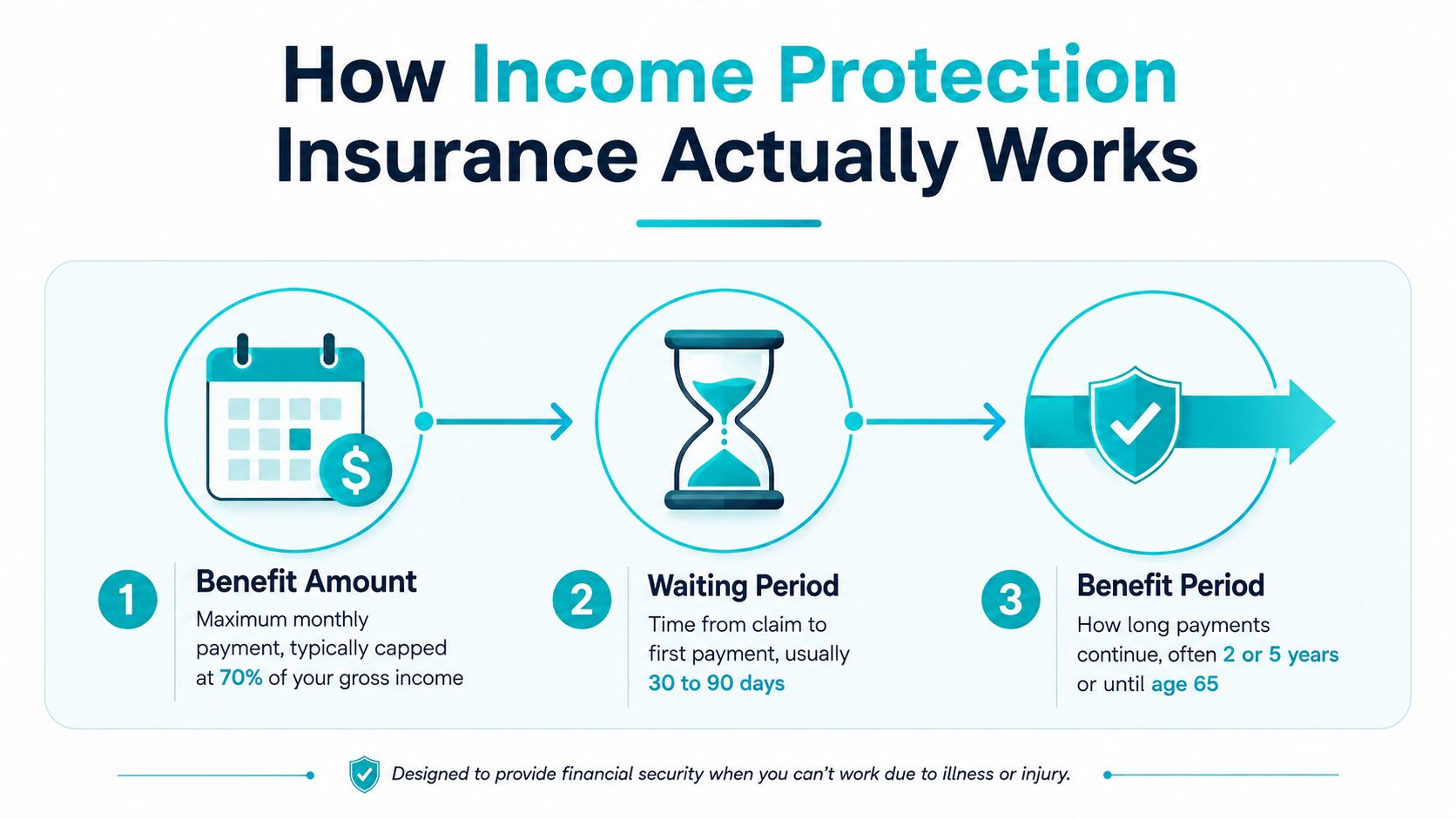
Every policy has three mechanical levers: benefit amount, waiting period and benefit period. Get one wrong and the policy can look affordable on paper while failing to protect the household when the claim arrives.
Benefit amount
The benefit amount is the monthly payment available if you satisfy the policy's disability definition. It's usually based on a proportion of pre-tax income, not your preferred spending level. MoneySmart identifies 75% or 90% as common benefit levels, while many market explanations use a lower headline replacement ratio. The important point is that insurers apply their own caps, offsets and income definitions.
Suppose a client earns $120,000 a year. A policy may assess the benefit against recent annual earnings, then apply its percentage and contractual limits. The resulting payment may be materially lower than the household's normal after-tax cash flow, particularly if the client receives bonuses, employer superannuation contributions or other remuneration that the policy doesn't fully recognise.
Waiting period
The waiting period is the time between becoming disabled and the first payment. AustralianSuper describes default super-linked waiting periods commonly as 30 or 60 days, while the broader market also uses longer settings such as 90 days (AustralianSuper income protection payments fact sheet).
A 30-day waiting period gives the $120,000 earner earlier access to benefits, but usually costs more. A 90-day waiting period can reduce the premium, yet requires enough liquid cash to cover rent or mortgage repayments, food, bills and other essential expenses during that unpaid gap. Don't select a 90-day wait only because the quote is cheaper. Select it only if your emergency reserve and employer leave can carry you through it.
Benefit period
The benefit period sets the maximum time payments can continue. Common structures include two years, five years or to age 65, depending on the policy and occupation (AustralianSuper income protection payments fact sheet).
For a 40-year-old professional, a two-year benefit period may help with a defined recovery but stop while the person remains unable to return to work. A longer benefit period costs more because the insurer carries a longer potential claim. I generally view a longer period as more valuable where the household has a large mortgage, limited assets, dependants or an occupation where recovery and retraining may take time.
Contract type and offsets
New agreed-value contracts have largely disappeared from the Australian market following APRA's 2021 sustainability measures. Most new policies assess income using evidence available around the claim and the policy's income definition, so maintaining accurate financial records matters.
Offsets can also reduce the amount paid. Workers' compensation, other disability benefits, Centrelink payments or certain lump-sum benefits may interact with the policy. The PDS should explain whether a payment reduces the monthly benefit, changes eligibility or affects the assessment period. Ask for those interactions in writing before applying.
What Is Covered and What Is Excluded
Income protection usually responds when illness or injury leaves you unable to perform work under the policy's disability definition. Mental health conditions such as anxiety, depression and stress-related incapacity may also be covered, but the outcome depends on medical evidence, policy wording, exclusions, benefit limits and the applicable occupation test.
Australian claims data gives consumers a more balanced view than the common fear that insurers never pay. APRA life insurance claims statistics for advised income protection policies report an average claims acceptance rate of 94.4% for the year to 30 June 2025 (Australian income protection claims statistics). Earlier ASIC research into direct life insurance recorded a 54% admitted rate for income protection during the 2014–17 period, with 14% declined and 32% withdrawn, showing why policy design, disclosure and advice quality matter.
Occupation definitions can change the result
An own occupation test considers whether you can perform the duties of your usual role. An any occupation test is stricter and may ask whether you can work in another suitable role based on your education, training or experience. Some policies apply different definitions over the life of a claim, which can reduce or end payments after the initial period.
Standard exclusions may include self-inflicted injury, undisclosed pre-existing conditions, war, criminal acts and normal pregnancy. Pregnancy complications may be treated differently, depending on the contract. Never rely on a sales summary for this. Read the PDS and underwriting outcome.
| Covered Events | Standard Exclusions |
|---|---|
| Illness that meets the policy disability definition | Self-inflicted injury |
| Injury that prevents work under the policy terms | Pre-existing conditions not disclosed at application |
| Some mental health conditions, subject to wording and evidence | War or criminal acts |
| Qualifying incapacity supported by medical evidence | Normal pregnancy, subject to policy terms |
Before applying, disclose past mental health consultations, counselling, medication, recurring back or joint problems, surgeries, chronic conditions and periods away from work. Underwriting may impose an exclusion or loading, but incomplete disclosure can damage claim integrity. For a practical review of claim boundaries, see what income protection does not cover.
Income Protection Versus Life TPD and Trauma Cover
These products solve different financial problems. Buying one doesn't automatically replace the need for the others.
Income protection is designed for a temporary or extended interruption to earned income. It pays an ongoing monthly benefit while you meet the disability definition and remain within the waiting and benefit periods.
Life insurance pays a lump sum to beneficiaries after death. It protects dependants from debts, housing costs and the loss of future financial support.
TPD insurance pays a lump sum when you meet the contract's permanent disability definition. That money may fund debt reduction, rehabilitation, home modifications or long-term care.
Trauma insurance pays a lump sum after diagnosis of a specified serious medical condition, such as cancer, heart attack or stroke. It can help with immediate treatment, recovery costs and time away from work, but it isn't a substitute for monthly income cover.
| Feature | Income Protection | Life Insurance | TPD Insurance | Trauma Insurance |
|---|---|---|---|---|
| Main purpose | Replace part of lost income | Provide a death benefit | Fund permanent disability needs | Provide funds after a specified illness |
| Payment style | Monthly benefit | Lump sum | Lump sum | Lump sum |
| Trigger | Incapacity from illness or injury | Death | Permanent disability under the policy | Diagnosis meeting the policy definition |
| Best fit | Working household cash flow | Dependants and debt | Long-term disability exposure | Acute medical and recovery costs |
I'd usually assess income protection as the foundation for a working household, then layer life, TPD and trauma cover around debt, dependants, assets and health risks. The right combination depends on the financial consequence you're trying to insure, not the number of products in a brochure.
If you're weighing employment-based support against private cover, this resource on comparing workers comp and disability benefits provides useful context. For the distinction between monthly income replacement and death cover, see life insurance versus income protection.
How Premiums Are Calculated and Taxed in Australia
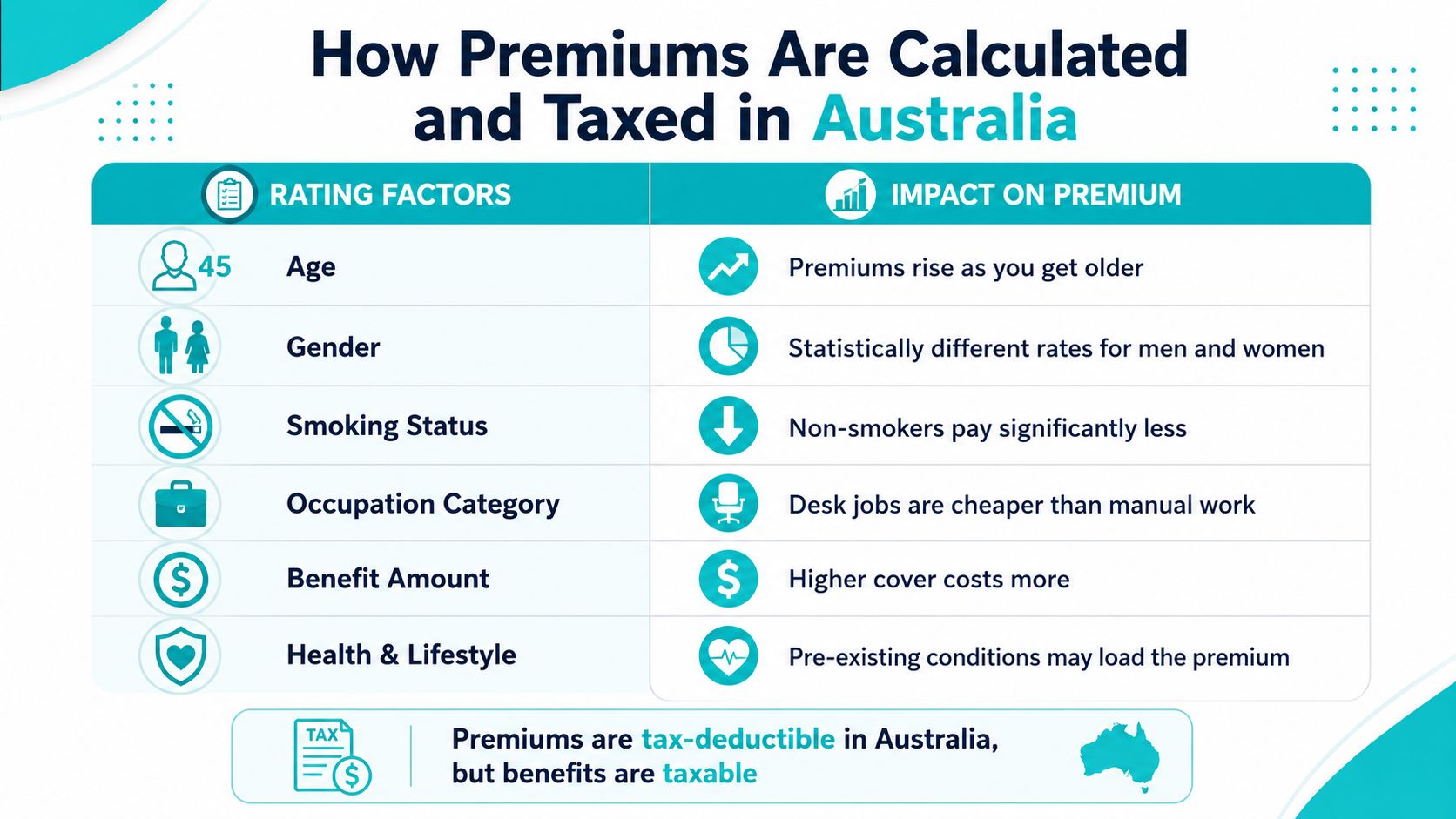
Insurers price income protection according to the risk and cost of the benefit you're selecting. Age, gender, smoking status, occupation, health, benefit amount, waiting period and benefit period all influence the quote. A younger office worker with a longer waiting period will generally be priced differently from an older tradesperson seeking earlier payments and longer protection.
Premium structure matters
Stepped premiums generally rise as you age. They can be cheaper at the beginning, but the future cost needs to fit your later working years. Level premiums spread more of the cost across the policy's life and can cost more upfront, but may offer greater predictability. The cheapest first-year quote isn't necessarily the cheapest strategy.
A higher benefit increases the insurer's potential payout. A shorter waiting period increases exposure to short-term claims. A longer benefit period increases the potential duration of payments. Those settings should follow your cash-flow needs, not an arbitrary target premium.
Australian tax treatment
The ATO says premiums can be deductible under section 8-1 when a policy is designed to replace salary or wages. The deduction generally doesn't apply to premiums paid through superannuation, or to portions covering lump-sum benefits such as TPD or trauma. A premium's deductible portion depends on the contract structure, not the label “income protection” (ATO interpretive decision on deductions).
Claim payments that replace salary or wages must generally be included in your tax return. Where no tax has been withheld, the ATO says the payment is declared as other income (ATO income protection deduction guidance). Benefits held through super may use superannuation money, but ownership can affect release conditions, policy features and the claims process.
Tax deductibility should influence the comparison, not dictate the design. A deductible premium is still poor value if the benefit is too low, the waiting period exceeds your reserves or the policy ends before your household reaches financial independence. For a focused explanation of the deduction rules, review income protection insurance tax deductions.
Real World Examples for Different Life Stages
A policy should change as your income, debt and family responsibilities change. The following examples illustrate the decision process, but they aren't quotes or recommendations for any individual.
A 28-year-old software developer with a mortgage and no dependants may prioritise a stronger short-term cash-flow response. The supplied life-stage illustration uses $4,000 per month, a 30-day waiting period and a two-year benefit period. That structure may suit someone with limited dependants who wants protection during early career years, but the client should still test whether the benefit covers essential repayments and living costs.
A 35-year-old teacher with a young family faces a different exposure. The illustration uses $6,500 per month, a 60-day waiting period and a five-year benefit period. Two children, a mortgage and reliance on a second income can justify a longer benefit period, while the waiting period needs to match sick leave and accessible savings.
A 45-year-old nurse may have a physically demanding occupation and a household that has accumulated more assets. The illustration uses $5,000 per month, a 90-day waiting period and a benefit period to age 65. A longer wait may be workable if reserves are strong, while the extended benefit period protects against a prolonged interruption during the remaining working years.
A 55-year-old business owner may have reduced fixed costs but still carry business loans. The example uses $3,500 per month, a 90-day waiting period and a five-year benefit period. The owner should separate personal income needs from business overhead protection and check how variable income is assessed.
Premiums need personal underwriting
No responsible adviser should attach a generic monthly premium range to these examples. Age, health, occupation, smoking status, benefit settings, ownership and underwriting can change the result significantly. Recent market commentary reported that individual income protection new business fell 8.3% in the year to September 2024, while another industry update reported average direct premiums for 30-day and 90-day waiting periods fell 12% and 13% from 2024 (Riskinfo market commentary). Those trends don't tell you what your policy will cost.
Common Mistakes to Avoid When Buying Cover
The most expensive mistake is treating income protection as a set-and-forget purchase. A policy that matched your first job may not match your current mortgage, income structure or family obligations.
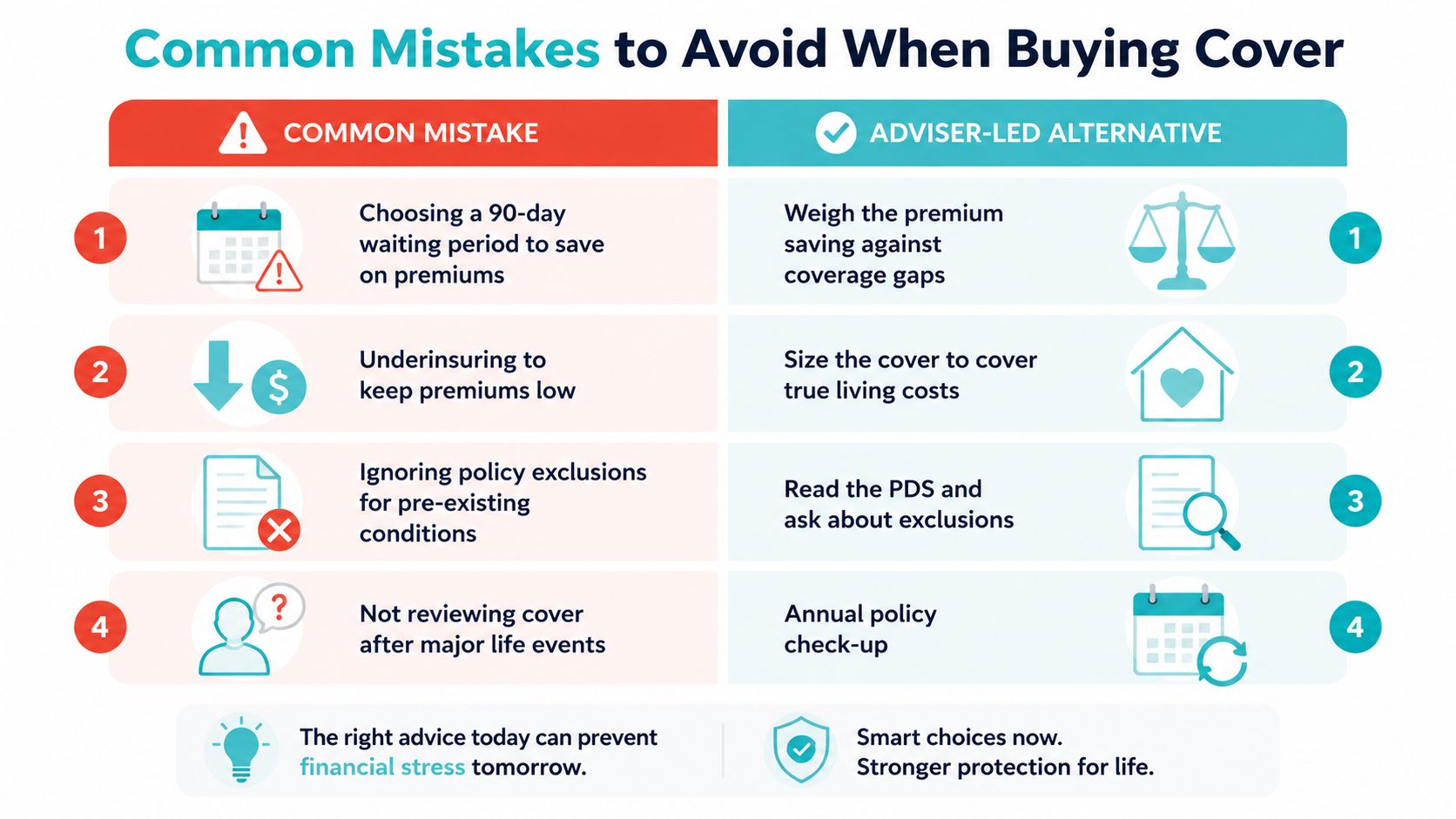
Choosing a 90-day waiting period solely to reduce premiums is a common error. If you don't have enough accessible cash or leave to fund that gap, the lower premium has transferred risk back to your household.
A two-year benefit period can also create false comfort. It may suit a person with substantial assets or a realistic short recovery path, but it can leave a family exposed if incapacity continues. A longer benefit period, potentially to age 65, deserves consideration when the household depends heavily on future earnings and has limited alternative resources.
The ownership and income traps
Cover held entirely inside super can appear convenient, but release conditions and fund administration may complicate access to benefits. Compare that arrangement with personally owned cover, including the tax treatment and policy flexibility, before deciding.
Under-insuring is another avoidable problem. Base salary may not reflect bonuses, super contributions, commissions or fringe benefits that support the household. The policy's definition of income may exclude some of these items, so calculate the gap rather than assuming a headline percentage is adequate.
Review cover after a mortgage increase, new child, career change, business restructure or substantial shift in savings. An adviser-led protection review should test:
- Cash reserves: Can you fund the waiting period without selling investments?
- Benefit duration: Would payments stop before your household could adapt?
- Ownership: Does super-based cover still suit your tax and access position?
- Disclosure: Have health and occupation details remained accurate?
The Australian market is changing. Recent reporting noted weaker new business alongside changes in premium pricing, which makes clarity more important than ever. Buy the structure your household can use, not the quote that looks cheapest today.
Next Steps and Questions to Ask an Adviser
Before an initial advice call, gather three inputs:
- Income records: Include gross salary, bonuses, commissions and superannuation contributions.
- Household commitments: List mortgage repayments, school costs, groceries, utilities, insurance and other essential expenses.
- Existing cover: Record policies held personally, through an employer and inside superannuation.
Ask a Wealth Collective adviser:
- How is my benefit calculated against my actual income structure?
- Which waiting period fits my sick leave and emergency reserves?
- Should the policy sit inside or outside super given my tax position?
- What exclusions, loadings or occupation definitions apply to my health history and work?
- How would other benefits or compensation affect a claim?
A Statement of Advice should document the reasoning behind each choice, rather than presenting a premium. If your broader plan includes business continuity and personal risk, external guidance on Melbourne asset protection advice may also help frame the relationship between household and business assets.
Income protection needs annual review. Your income, debt, dependants, super balance and retirement timeline will change, and your cover should change with them.
Wealth Collective helps Australians review personal insurance, superannuation and broader wealth strategies through a structured advice process built around real household priorities. Visit Wealth Collective to arrange an initial call and test whether your current income protection fits your cash flow, tax position and long-term plan.