Business hours
Monday to Friday (8.30AM - 5PM)
Weekend (Closed)



Lisa and Mark have been married for 14 years. They live in Perth, the family home is jointly owned, and both assumed the house would be the main issue in their settlement. Then their advisers totalled the two super accounts. Most of the couple's long-term wealth was sitting inside super, not in the visible property they were arguing about.
That situation is common in substance, even when the numbers and family circumstances differ. Superannuation is property under Australia's Family Law Act 1975, but it doesn't divide itself when a relationship ends. A couple needs a formal superannuation agreement or court order, and the outcome isn't automatically 50/50. The court considers what's fair and equitable in the circumstances, including contributions and future needs. The Attorney-General's Department guidance on superannuation splitting sets out the legal foundation.
If you're searching for super splitting divorce advice, start with the balance sheet rather than the emotion. The decision may affect your home, immediate cash flow and retirement income at the same time.
Why Super Splitting Matters When Couples Separate
Super is easy to overlook because you can't usually see it, spend it or use it to pay the mortgage today. That makes it feel less real than a bank account or family home. In a long relationship, though, super can represent a substantial share of the couple's accumulated wealth, particularly where one person reduced paid work to care for children or supported the other person's career.
Practical rule: Don't negotiate the house until you've identified every super interest and understood how each one will be treated.
Under the Family Law Act, super enters the pool of assets and liabilities. The parties can deal with it by splitting an interest or by offsetting one person's super against other property, but the result must be formalised. A private promise between former partners isn't enough to make a fund trustee implement a transfer.
The central trade-off is straightforward. The person receiving super generally receives retirement wealth, not cash. The amount remains inside the super system until a condition of release is met. Someone might therefore retain more home equity or savings in exchange for allowing the other person to keep more super, but that only works if both parties understand the long-term value of what they're exchanging.

The retirement imbalance matters
A settlement can look balanced today and still produce an uneven retirement outcome. One partner may leave with the house but limited super, while the other leaves with less property but a stronger preserved retirement balance. Both outcomes can be fair, but neither should happen by accident.
You'll also need to account for valuation differences. An accumulation account may show a clear balance, while a defined benefit interest requires a fund-specific family law valuation. The fund type changes the negotiating position, the wording required and the practical way the split is implemented.
Couples should also identify the relevant post-divorce timing requirements early. Government guidance says an application for a super splitting order is generally made within 12 months of a divorce order, while a later application requires court permission and evidence of financial hardship. That deadline is one reason to seek legal advice before signing a property settlement.
If you're unsure how retirement income fits into the broader settlement, use Wealth Collective's guide to how much super you may need to retire as a starting point. It won't replace personalised advice, but it can help you see why a dollar-for-dollar comparison between super and home equity is often misleading.
The Legal Framework Behind Super Splitting
The legal framework treats super as a special kind of property. You own an interest in a fund, but you generally can't live in it, sell it like a house or withdraw it because your relationship has ended. A useful analogy is a house you can't live in yet. It still has value, but access rules shape what that value means.
For married couples, the property settlement framework operates under the Family Law Act 1975. For eligible de facto couples, the federal provisions and Western Australian legislation apply through the relevant family law framework. The legal test isn't “who owns the account?” It's whether the overall division is just and equitable after the court assesses the relationship and each person's circumstances.
The four questions behind a settlement
The court generally works through four connected questions:
- Identify the pool. This includes assets, liabilities and superannuation interests.
- Assess contributions. Financial contributions matter, but so do homemaking, parenting and contributions that enabled the other person to earn or accumulate wealth.
- Consider future needs. Income capacity, age, health, care of children and other circumstances can affect the result.
- Check the outcome overall. The proposed division must be fair and equitable in the circumstances.
For married couples, the property framework is commonly associated with section 79. For de facto matters, section 90SF is relevant. The legislation and regulations also govern how a super interest is valued, what type of order can be made and how a fund trustee receives and implements the documentation.
Western Australia's de facto distinction
Western Australia was the only Australian jurisdiction where separating de facto couples couldn't split superannuation under the same family law process before reform. That changed on 28 September 2022, when legal changes took effect for new property cases filed in the Family Court of WA on or after that date. The Western Australian Government's explanation of the reform describes the change.
This distinction matters because many online explanations are written for national audiences and assume the same rule applies everywhere. In WA, married couples can split super during property settlement. Eligible de facto couples filing new cases from the reform date can also use the expanded framework, subject to the applicable relationship and procedural requirements. Older matters and excluded circumstances need specific legal review.
The Family Court of Western Australia's superannuation information should be read carefully, particularly if you're in a de facto relationship or your matter began before the reform. Don't rely on a general Australian explainer to determine your WA position.
A fund may also apply minimum-balance and excluded-payment rules. One major fund example states that balances below $5,000 can't be split and that payments made on severe financial hardship or approved compassionate grounds can't be split. That makes the fund's rules and the exact interest important before you promise a particular outcome.
Three Pathways to Formalise a Super Split
A super split becomes enforceable through a formal legal pathway. You can't write an agreement, sign it privately and expect the trustee to transfer money. The main options are consent orders, a binding financial agreement and court-determined orders.
The right choice depends on cooperation, privacy, complexity and the risk that the other party may later challenge the arrangement.
Comparing the three super splitting pathways
| Pathway | Best For | Average Cost | Timeframe | Key Requirement |
|---|---|---|---|---|
| Consent orders | Couples who agree on the complete property settlement | Varies with legal complexity and filing requirements | Often more efficient than a contested case when documents are ready | Correct orders, trustee review and court approval |
| Binding financial agreement | Couples who want a private contractual arrangement | Varies, with each party needing separate legal advice | Depends on advice, drafting and negotiation | Independent legal advice for both parties and compliance with the regulations |
| Court-determined orders | Couples who can't agree or need the court to resolve disputed issues | Can be substantially higher as evidence and hearings increase | Depends on the dispute, evidence and court process | Court application, financial disclosure and evidence |
Consent orders suit genuine agreement
Consent orders are usually the cleanest option when both parties have exchanged financial information and agree on the entire settlement. A family lawyer prepares the documents, the parties file them with the appropriate court, and the court considers whether to approve the proposed orders.
The trustee should review the proposed wording before filing. Fund details, the member interest and the calculation method need to be precise. A poorly drafted order can delay implementation or require further legal work.
Binding financial agreements require care
A binding financial agreement can provide privacy and contractual flexibility. It must meet strict legislative requirements, and each party must receive independent legal advice. The agreement also needs to be drafted in the way required for a superannuation split under the regulations.
The commonly discussed 28-day cooling-off period and related signing requirements are legal details your family lawyer should confirm for the agreement being used. Don't treat a template as a substitute for advice. A technical defect can undermine the intended result.
Court orders are for unresolved disputes
If one party refuses disclosure, disputes the valuation or won't agree to the proposed division, a court application may be necessary. The court can determine the property settlement and make the relevant superannuation orders, but the process carries more cost, delay and emotional strain than a properly prepared agreement.
My recommendation is firm. Use consent orders where there is real agreement and complete disclosure. Consider a binding financial agreement where privacy and contractual flexibility matter. If cooperation has broken down, speak to a family lawyer promptly rather than trying to force a private arrangement.
Valuation, Timing and What Can and Cannot Be Split
The value shown on a super statement isn't always the value relevant to a property settlement. An accumulation interest usually has a visible account balance, but a defined benefit interest depends on scheme rules, service and other factors. The trustee's family law valuation, and sometimes an actuarial certificate, may be required.
That difference can change the settlement. A defined benefit interest may look modest on an annual member statement while carrying a different family law value. The proper valuation method depends on the interest, so don't negotiate from an outdated statement or a figure copied from an online account.
Check the fund before agreeing to the amount
Ask the fund for the information required for a family law matter. The ATO explains that individuals don't request super information for a relationship breakdown directly from the ATO. Instead, a court-related Super information request form is used, which reinforces that the process is formal and evidence-based. You can review the ATO guidance on superannuation and relationship breakdown for the information pathway.
The amount may be expressed as a base amount or a percentage, depending on the interest and settlement strategy. A defined benefit pension or an interest about to pay may require different drafting from an accumulation account.
One fund example identifies $5,000 as a minimum balance below which an interest can't be split. It also excludes certain hardship and compassionate-ground payments. Other excluded-payment rules can apply to particular interests, including parts connected with child support, pensions already in payment and reversionary death benefits. Treat those exclusions as a reason to obtain fund-specific advice, not as a detail to resolve after signing.
Timing can change the outcome
A split requires the correct instrument and implementation process. Depending on the matter, that may involve a marriage breakdown order, a payment flag or another compliant splitting instrument. The Family Law Act also imposes time limits around property applications after divorce. Government guidance states that a court application is generally made within 12 months of a divorce order, with leave required later and financial hardship needing to be shown.
The practical perimeter is clear:
- Inside the process: eligible super interests, including accumulation and defined benefit interests where the rules allow a split.
- Outside immediate cash settlement: preserved super, because the transfer normally remains inside super.
- Potentially excluded: low-balance interests and payments excluded by the legislation or fund rules.
- Separate from the super split: non-super property such as the home, bank accounts, investments and liabilities, which may be used to offset retirement assets.
If defined benefit terminology is unfamiliar, Wealth Collective's explanation of what defined benefit super is can help before you speak with your adviser or lawyer.
A Worked Example of a Super Split
Consider a hypothetical WA de facto couple who have been together for 12 years and have two children. Partner A has $320,000 in accumulation super and Partner B has $180,000. Their combined super pool is therefore $500,000.
After considering contributions, care responsibilities and future needs, they negotiate an outcome where Partner A receives 55% of the combined super pool and Partner B receives 45%. This example is illustrative only. A real settlement may use a different percentage, an offset against the home or another approach entirely.
The calculation
| Metric | Before Split | After Split |
|---|---|---|
| Partner A super | $320,000 | $225,000 |
| Partner B super | $180,000 | $275,000 |
| Combined super pool | $500,000 | $500,000 |
| Agreed allocation | A holds 64% and B holds 36% of the initial balances | A holds 45% and B holds 55% of the pool |
| Transfer from Partner A to Partner B | Nil | $95,000 |
The agreed 55% allocation equals $275,000, so Partner A transfers $95,000 to Partner B's super fund. Partner A's balance falls to $225,000, while Partner B's balance rises to $275,000.
The transfer doesn't place $95,000 in Partner B's bank account. It rolls into Partner B's nominated super fund and remains preserved. The amount can then participate in the fund's investment returns, fees and normal super rules. The couple needs to understand that the settlement changes each person's retirement balance sheet, not their immediate spending power.
Why the result matters
Partner A keeps more of the original account because the negotiated result gives A 45% of the combined pool, while Partner B's preserved retirement balance increases from $180,000 to $275,000. At a projected retirement age of 67, the example shows how the split can reshape both futures rather than creating cash today.
The numbers don't answer whether the settlement is fair. They show the mechanics only. Before accepting a percentage, model the impact alongside home equity, debt, insurance, income, children's needs and each person's expected retirement timing.
A fair split isn't necessarily an equal split. It's a settlement both parties understand after the whole balance sheet has been assessed.
For a WA de facto couple, confirm that the matter falls within the post-reform framework and that the relevant case is filed in the correct jurisdiction. A family lawyer should prepare the formal documents, while a financial adviser can test whether the proposed retirement outcomes are workable.
Tax and Access Rules That Catch People Out
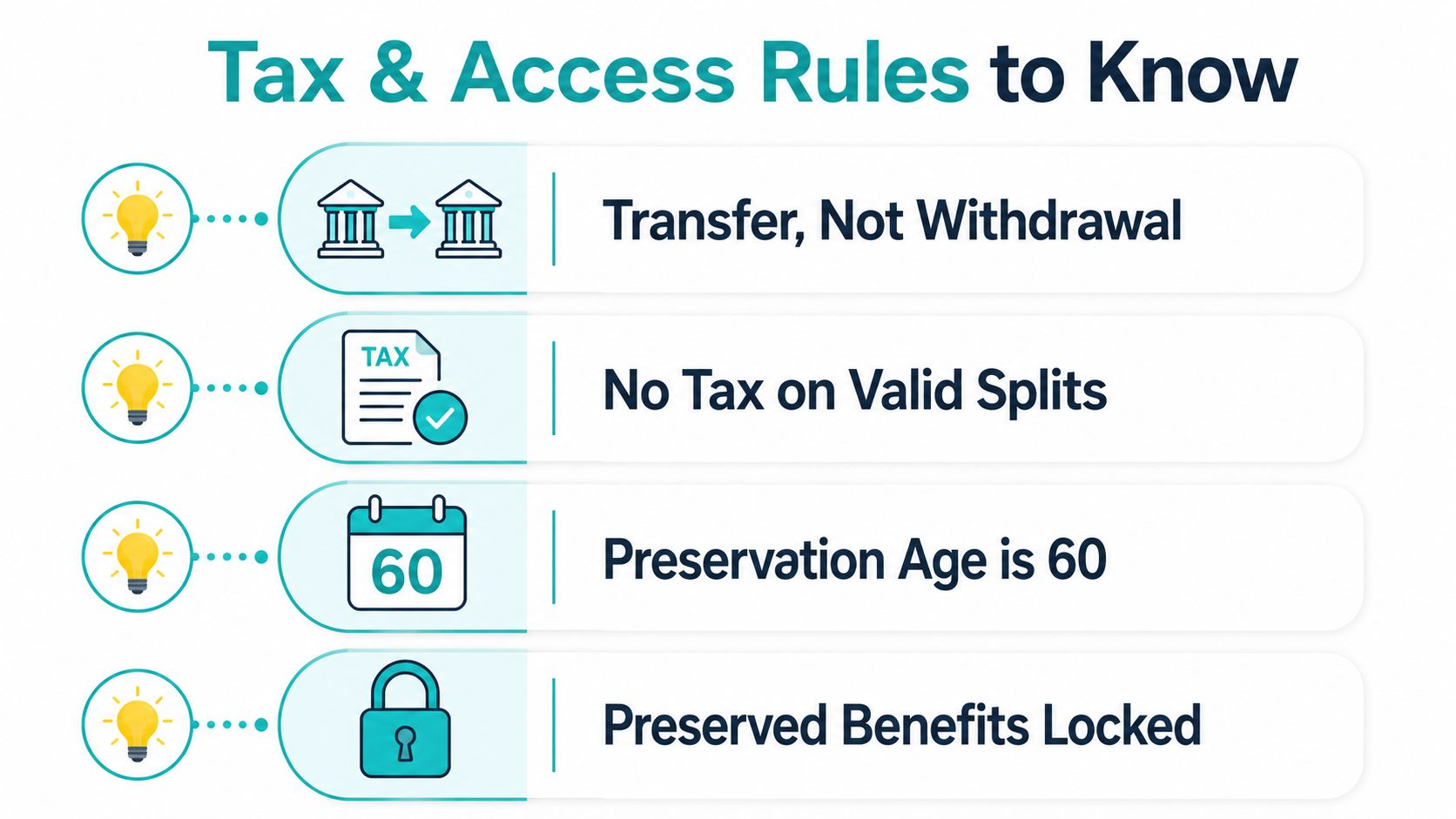
The biggest misunderstanding is simple: a super split is a transfer of preserved wealth, not cash in hand. A valid split generally moves the amount between super interests rather than paying it to the receiving spouse's bank account. The recipient's fund then applies the ordinary preservation and release rules.
That means a person may receive a larger retirement balance but still face immediate pressure with rent, mortgage repayments, legal costs or living expenses. Don't agree to a settlement that leaves you short of accessible money because the super figure looks large on paper.
Access remains restricted
For most current readers, preservation age is 60, although individual circumstances and release conditions matter. A recipient generally can't access the transferred amount because a divorce or separation has occurred. Common release pathways include retirement after preservation age, permanent incapacity and approved compassionate grounds, subject to super law.
A recipient can also lose the unrestricted non-preserved status that applied to part of the original member's interest. The transferred amount follows the super system rather than becoming freely available because it moved between spouses.
The ATO's explanation of tax on superannuation can help you understand the broader tax treatment, but a split needs to be considered with your fund, age and retirement phase position.
Tax planning belongs beside the settlement
A valid rollover is generally not treated like a cash withdrawal. The tax outcome can still depend on the components of the interest, the recipient's circumstances and whether either person is approaching retirement phase. A person close to pension phase may also need to consider the $1.9 million transfer balance cap, while contributions and withdrawals can have different tax consequences.
For a wider view of the financial decisions that follow separation, tax planning after major changes is a useful companion resource. It covers the broader tax questions that often arise after marriage breakdown, rather than focusing only on the super transfer.
Don't make tax decisions from a headline rule. Ask your adviser and accountant to coordinate the settlement, rollover destination, pension plans and any personal tax consequences before documents are signed.
Your First 90 Days and When to Bring in Professionals
The first 90 days should produce organised information and a formal plan, not rushed signatures. Keep the legal and financial work connected, but give each professional the right task.
Days 1 to 14
Start with documents and control.
- Gather statements: Locate every super account, pension statement, investment account, loan, insurance policy and tax record.
- Record separation details: Note when separation occurred and whether a divorce order has been made.
- Freeze joint liabilities: Review joint bank access, credit cards, guarantees, loan redraws and direct debits with your lawyer.
- Protect records: Save copies of statements and correspondence in a secure location.
- Identify the WA pathway: Confirm whether you're married, de facto, or dealing with a WA de facto matter affected by the post-reform rules.
A family lawyer should come first if there's domestic violence risk, a dispute about children, overseas property or a refusal to disclose financial information. Those issues can affect safety, jurisdiction and the entire settlement strategy.
Days 15 to 45
Move from collection to analysis.
Obtain current fund information and identify whether each interest is accumulation, defined benefit, pension-based or held through an SMSF. Request the relevant family law value, check any minimum or excluded-payment rules and identify whether a payment or retirement event is approaching.
This is the point to engage a financial adviser where a defined benefit is involved, an SMSF has related-party loans, balances are over $500,000, or the receiving spouse is close to preservation age. Those features can change the value of the settlement and the practical access to retirement benefits.
Compare a direct split with an offset. For example, one person might retain more super while the other receives more home equity, but the decision should reflect liquidity, debt, insurance, tax and projected retirement income.
Business owners may also need broader support around ownership structures, debt, valuation and future earning capacity. A resource on divorce financial planning for business owners can help identify issues that sit beyond the super account itself.
Days 46 to 90
Once the figures are reliable, negotiate the settlement and document it properly.
- Test scenarios: Compare percentage splits, base amounts and offsets against each person's retirement objectives.
- Draft accurately: Have a family lawyer prepare consent orders or a compliant binding financial agreement.
- Give the trustee a chance to review: Fund wording and implementation requirements should be checked before filing.
- Lodge the documents: File with the relevant court where required and provide the final documents to the fund.
- Confirm the rollover: The receiving spouse should nominate the destination fund and retain confirmation of implementation.
Wealth Collective can sit on the financial advice side of this process, helping clients model retirement outcomes, review super strategy, assess insurance and build a post-settlement plan. It isn't a substitute for family law advice, so use a qualified family lawyer for the agreement, court application and legal rights.
| Signal | First professional step |
|---|---|
| You agree and have complete disclosure | Family lawyer for consent orders, then financial adviser for modelling |
| A defined benefit, SMSF or significant super balance is involved | Financial adviser and specialist family lawyer |
| The other party refuses disclosure | Family lawyer immediately |
| Children, safety risks or overseas assets are disputed | Family lawyer before negotiating the split |
| You're close to preservation age | Financial adviser before accepting an offset or rollover |
| A fund payment may occur soon | Family lawyer urgently to assess protective court steps |
Book an initial advice call before you sign anything that treats super as an afterthought. Bring your latest statements, the proposed property division and your separation timeline, so the advice can focus on the decisions that will affect your retirement and immediate financial stability.
Wealth Collective helps separating Australians assess super, retirement income, insurance and post-settlement investment decisions through clear, practical financial advice. Visit Wealth Collective to arrange an initial call and discuss your next steps with an adviser.