Business hours
Monday to Friday (8.30AM - 5PM)
Weekend (Closed)


Yes, superannuation is taxed, but in most cases it’s taxed at 15% on concessional contributions and generally 15% on investment earnings in the accumulation phase, which is often lower than the tax you’d pay on ordinary income. That’s why super isn’t tax-free, but it is tax-advantaged, and understanding when that tax applies can help you make better financial decisions.
A lot of people ask this after opening a super statement and spotting deductions they didn’t expect. You see money going in, earnings building over time, and then tax appearing in different places. It can feel like your retirement savings are being chipped away without a clear explanation.
That confusion is normal. Super tax rules are technical, and the language around them doesn’t always help. Terms like concessional contributions, Division 293, taxed elements, and accumulation phase can make a simple question feel harder than it should be.
The practical answer is this. You do get taxed on superannuation, but the tax is usually designed to encourage long-term retirement saving. If you understand the key pressure points, you can make smarter choices about contributions, timing, and access. That’s where good advice often makes the biggest difference.
Unpacking the Mystery of Superannuation Tax
Most Australians don’t need a tax law lecture. They need to know what’s happening to their money and what they can do about it.
If you’ve ever wondered whether your employer contributions are taxed, why your super fund pays tax on earnings, or whether you’ll get taxed again when you retire, you’re asking the right questions. Super has its own tax system, and it works differently from your bank account, salary, or personal investments.
Super is tax-advantaged, not tax-free
That distinction matters. A lot of confusion starts when people assume super is either completely protected from tax or taxed just like ordinary income. Neither is quite right.
Super sits in a separate environment with its own rules. In broad terms, that means the government gives super favourable tax treatment to encourage retirement savings, but it still taxes money at certain points along the way.
Super works best when you treat it as part of your whole financial plan, not as a standalone account you only check once a year.
That’s why two people with similar incomes can have very different long-term outcomes. One person might accept the default settings in their fund. Another might use the rules strategically through salary sacrifice, contribution planning, and retirement timing.
Why the detail matters at different life stages
In your 20s and 30s, the tax treatment of contributions can shape how quickly your balance builds. In your 40s and 50s, the focus often shifts to contribution strategy, cash flow, and avoiding preventable tax friction. Closer to retirement, the big issue becomes how and when to access your super in the most effective way.
Here’s what readers usually want clarified first:
- Money going in: Is your employer super taxed before it lands in your account?
- Money growing inside the fund: Does your super fund pay tax on earnings and gains?
- Money coming out later: Will retirement withdrawals be taxed?
Those are the right checkpoints to focus on. Once you understand them, the rules become much easier to follow and far more useful in real life.
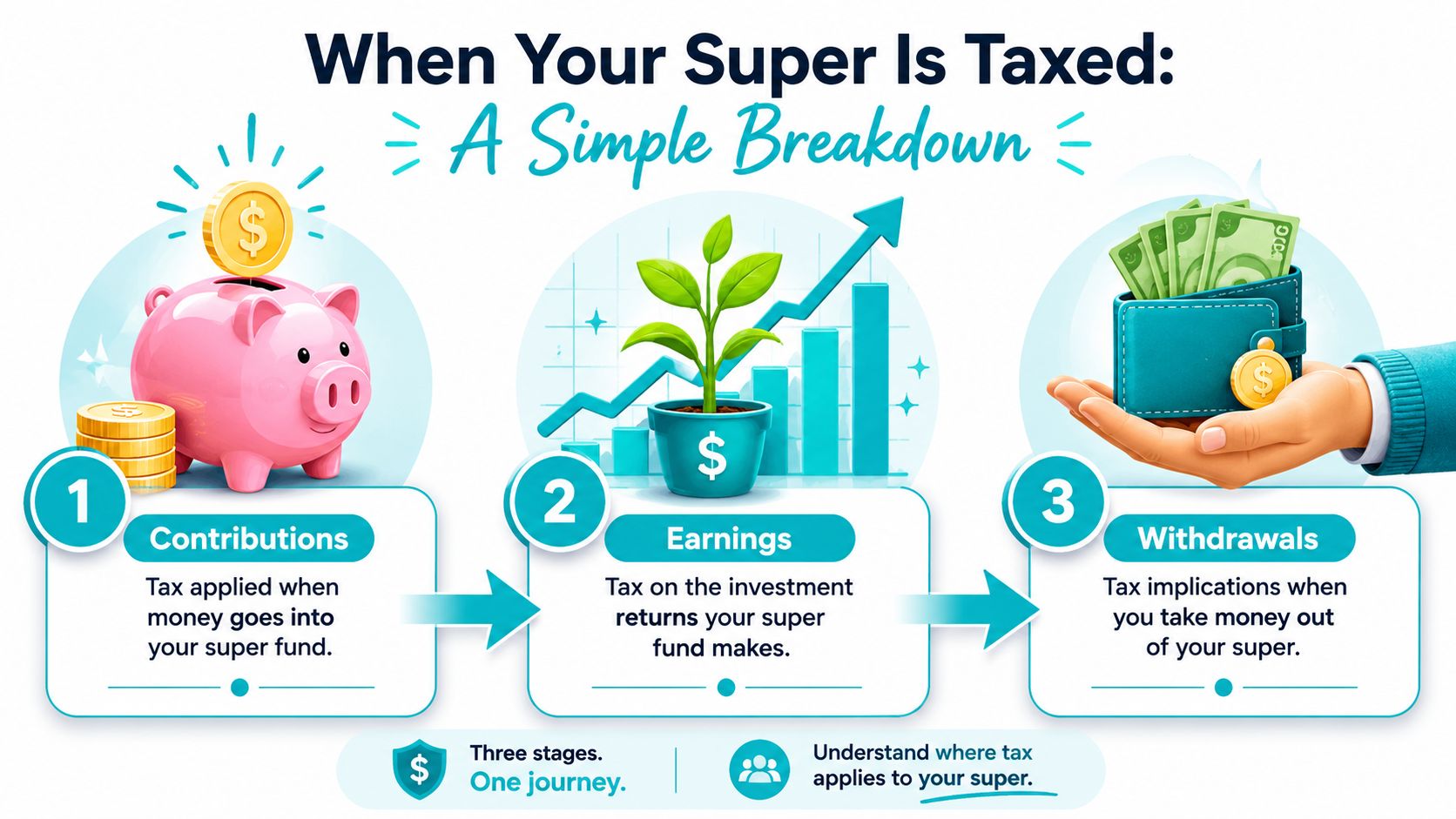
When Your Super Is Taxed A Simple Breakdown
A simple way to think about super tax is to imagine three tollgates on the journey of your money. The first sits at the entrance, when money goes into super. The second sits inside the fund, while your balance is invested. The third appears when money comes back out.
That mental model is far easier to work with than memorising isolated tax rules.
The three tax checkpoints
According to the Moneysmart guide to tax and super, superannuation in Australia is generally taxed at three different points: contributions, investment earnings, and withdrawals.
Here’s the high-level view:
- Contributions checkpoint: Employer SG and salary-sacrifice contributions are typically concessional contributions and are taxed at 15% when received by the fund.
- Earnings checkpoint: Investment earnings inside accumulation-phase super are also taxed at up to 15%, and capital gains on assets held for more than 12 months are effectively taxed at 10%.
- Withdrawal checkpoint: The tax outcome depends on your circumstances and how you access your super.
Why people often misunderstand this
Individuals are used to income tax coming directly out of their pay. Super tax doesn’t always feel as visible, because some of it happens inside the fund.
That leads to common mistakes, such as:
- Assuming employer super is tax-free: It isn’t. Concessional contributions are usually taxed when they enter the fund.
- Thinking all growth inside super is untaxed: It isn’t. Investment earnings in the accumulation phase can be taxed.
- Believing every withdrawal will be taxed: That depends on your age and the type of benefit you’re receiving.
Practical rule: Super is usually more tax-effective than holding the same money in your own name, but the tax benefit depends on using the rules properly.
The reason this matters is simple. If you know which tollgate affects you most right now, you can make better decisions without getting lost in every technical detail.
Understanding Tax on Your Super Contributions
For many workers, the first meaningful tax decision around super happens before the money even arrives in the fund.
The key distinction is between concessional contributions and non-concessional contributions. Concessional contributions are generally made from pre-tax income or claimed as a tax deduction. Non-concessional contributions are generally made from after-tax money. That difference drives the tax treatment.
Concessional contributions and entry tax
The ATO’s guidance on tax on super benefits states that the standard tax rate on employer Superannuation Guarantee contributions and salary-sacrifice contributions is 15%. The same source notes that the SG rate rose to 12% from 1 July 2025, after being 11.5% for the year ended 30 June 2025.
If you’re an employee, that means your employer can contribute to your super, but the fund will generally deduct tax on those concessional amounts as they come in. For many people, that’s still favourable compared with receiving the same money as salary and paying tax at their personal marginal rate.
If you’re considering sacrificing extra salary into super, it helps to understand how that trade-off works. This guide on salary sacrifice into super explains the mechanics in more practical terms.
Extra rules for lower and higher incomes
Not everyone is treated exactly the same.
The ATO guidance notes that if your combined income and concessional super contributions exceed AUD 250,000, an extra 15% Division 293 tax can apply on the relevant concessional contributions. That can lift the effective tax rate on some of those contributions to 30%.
At the other end of the spectrum, low-income earners may be eligible for the Low Income Superannuation Tax Offset, and Moneysmart explains that LISTO can offset up to $500 of contributions tax.
| Contribution Type | Tax Rate on Entry | Who It’s For |
|---|---|---|
| Employer SG contributions | 15% | Employees receiving compulsory employer super |
| Salary-sacrifice contributions | 15% | Employees choosing to direct part of pre-tax salary into super |
| Relevant concessional contributions for higher-income earners under Division 293 | Additional 15% may apply | People whose income plus concessional contributions exceed AUD 250,000 |
| Non-concessional contributions | Depends on the contribution type and circumstances | People contributing from after-tax money |
Where readers usually get stuck
The most common point of confusion is this: people hear that super is tax-effective, then feel surprised when they see tax deducted from contributions.
Both things can be true. The fund can tax concessional contributions on entry, and that treatment can still be favourable compared with taking the money as salary first.
If your income is rising, your contribution strategy usually needs to change with it. The same super approach rarely suits every career stage.
How Tax Applies When You Access Your Super
This is the part that often matters most emotionally. You’ve spent years building your super balance, so you want to know what happens when it finally comes back to you.
The answer depends heavily on your age and the type of super benefit you’re accessing. That’s why two retirees can have very different outcomes even if their balances look similar on paper.

Why age matters so much
For many Australians, age 60 is the major milestone. That’s the point where most super withdrawals become tax-free when accessed from a taxed super fund. This is the reason retirement tax planning often ramps up in the years leading into your late 50s.
That doesn’t mean everyone should rush to access super as soon as they can. Access rules, employment status, cash flow needs, and the structure of your retirement income all matter.
If you’re unsure when access becomes available in your own situation, this explainer on when you can access your super is a useful starting point.
Lump sums and income streams
People also tend to assume there’s only one way to take money from super. In practice, the way you draw from super can shape your experience in retirement.
Broadly, retirees often consider:
- Lump sum withdrawals: These can be useful for major one-off needs, such as clearing debt, funding renovations, or creating a cash buffer.
- Income streams or pensions: These can provide regular payments to support day-to-day living costs.
- A mix of both: Some people combine a structured income stream with selective lump sums for flexibility.
The best option usually depends on what you’re trying to achieve, not just what seems simplest.
The real planning question
A better question than “do you get taxed on superannuation?” is often “how do I access super in a way that supports the rest of my financial life?”
That includes things like:
- Cash flow needs: How much regular income do you need?
- Debt position: Should you use super to eliminate repayments or preserve liquidity?
- Timing: Would waiting change the tax outcome?
- Estate planning: How will your super be passed on?
Retirement access isn’t just about getting money out. It’s about turning a super balance into a sustainable plan.
Real-World Scenarios How Super Tax Affects You
Tax rules become easier to understand when you see how they play out in ordinary working lives. The same super system can create very different decisions depending on where you are in your career.

A young professional building momentum
Sam is in his 30s, employed full-time, and starting to pay more attention to long-term wealth. He’s heard that contributing more to super might be tax-effective, but he’s worried about locking money away.
For someone like Sam, the key issue isn’t just tax. It’s trade-offs. Extra concessional contributions may reduce the tax paid on that part of his income compared with taking it as salary, but they also reduce immediate cash flow. If he’s also saving for a home or trying to reduce debt, balance matters.
His main planning focus is usually:
- Using concessional contributions thoughtfully: Enough to create a tax benefit, without squeezing day-to-day goals.
- Reviewing fund settings: Investment mix, fees, and insurance inside super often matter as much as tax.
- Building habits early: Small strategic choices made consistently tend to matter more than occasional reactive changes.
A high-income earner managing complexity
Leah is in her 40s, earns well, and wants to use super more effectively. She knows concessional contributions can be attractive, but she also sits in the income range where extra tax may apply.
For Leah, the trap is assuming every extra contribution brings the same benefit. Once Division 293 enters the picture, the maths changes. The strategy might still be worthwhile, but it needs to be tested properly against cash flow, family goals, debt, and broader investment plans.
Her focus is usually less about “should I contribute?” and more about questions like:
- How much should go into super versus outside super?
- Am I using available contribution opportunities efficiently?
- Will today’s tax decision still suit my medium-term plans?
Higher income often creates more options, but it also increases the cost of getting the structure wrong.
A pre-retiree preparing for access
Michael is in his late 50s and retirement is no longer abstract. He’s less interested in contribution mechanics and more interested in what happens next. He wants to know when he can access super, how to shape income, and how to avoid making a rushed decision close to retirement.
For Michael, timing is everything. A withdrawal strategy that looks reasonable at first glance may be far less effective than one aligned with his retirement date, spending needs, and tax position after 60.
His checklist often includes:
- Sequencing retirement income sources: Deciding what to draw on first.
- Choosing between flexibility and regularity: Lump sums versus pension-style income.
- Aligning access with broader planning: Centrelink, estate planning, debt, and investment risk all sit alongside tax.
These examples show why super tax advice rarely works well as a one-size-fits-all answer.
Strategies to Legally Minimise Your Super Tax
Once you understand where super is taxed, the next step is using the rules well. Not aggressively. Not reactively. Just carefully and legally.
Some of the most useful levers are straightforward in concept, but easy to mishandle in practice.
Where planning can make a real difference
A stronger super tax strategy often involves a mix of timing, contribution type, and withdrawal design.
- Use salary sacrifice selectively: This can help some employees move more money into super in a tax-effective way, provided it suits their cash flow.
- Review after-tax contribution opportunities: In some situations, contributing from after-tax money may support a broader retirement strategy.
- Consider unused concessional contribution opportunities where eligible: Catch-up rules can open planning opportunities for the right person. This overview of carry-forward concessional contributions is useful if you want to understand that option.
- Plan withdrawals before retirement, not after: Access timing can affect how efficiently your super supports income needs.
- Coordinate super with the rest of your tax picture: If you’re self-employed or run a side business, your super decisions shouldn’t happen in isolation. The same goes for understanding freelancer tax expenses, because business deductions, cash flow, and super contributions often interact.
Advice matters because your rules aren’t generic
Many people hit a ceiling with online research. The rules might be clear enough on their own, but applying them to your income, family structure, mortgage, business, or retirement timeline offers real value.
Wealth Collective provides advice across superannuation optimisation, retirement planning, investment strategy, and tax-aware wealth planning through services such as Guided Growth and Retirement Roadmap. For people who want to move from “I think I understand this” to “I know what to do next,” that kind of personalised planning can be more useful than collecting more general information.
If you want clarity on how super tax applies to your situation, Wealth Collective offers a free 10-minute introductory call. It’s a simple way to talk through where you are now, what decisions matter most next, and whether a personalized plan could help your super work harder for you.