Business hours
Monday to Friday (8.30AM - 5PM)
Weekend (Closed)


You worked the extra shift. The overtime line is right there on the payslip. The super contribution looks exactly the same as last pay, and that's when workers in Perth start wondering if they're missing money they should've been paid.
That confusion is common because superannuation on overtime isn't decided by the word “overtime” alone. It turns on whether the payment sits inside ordinary time earnings, whether your ordinary hours are clearly defined, and whether your pay is bundled into an annualised salary or a registered agreement that changes the default rule. The ATO's position is simple on the surface, overtime is generally excluded when ordinary hours are clearly identified, but the hard cases are where people lose super they expected to receive ATO guidance on qualifying earnings.
The Payslip Question That Triggers This Search
A worker rings me after payday and says the same thing every time. “I did extra hours, my payslip shows overtime, but my super didn't budge.” That's the right question, because the answer is usually buried in the way the job was structured, not in the payslip summary.
The payslip is only the starting point. If your pay includes overtime, penalty rates, allowances, or a salary package that absorbs different kinds of hours, you need to know whether those amounts were paid for ordinary hours or for time outside them. The ATO says overtime is generally not ordinary time earnings when ordinary hours are clearly identified, but if those hours aren't clearly separated, all hours worked can end up treated as ordinary hours, which changes the super outcome ATO ordinary time earnings guidance.
Why the label on the slip can mislead you
A payslip line that says “overtime” doesn't settle the issue. The question is whether that payment is referable to hours outside ordinary hours, or whether your employer has bundled the hours into a structure that still attracts SG.
Practical rule: don't read the payslip in isolation. Read it with the award, the contract, and any registered agreement that sets your ordinary hours.
That's where annualised salaries trip people up. A worker may think the salary includes everything, while the payroll team may calculate super only on a portion of it. If ordinary hours are not carefully identified, the classification can swing the other way and make more of the package superable.
If you're checking your own figures, start with the payslips, the employment contract, the award or enterprise agreement, and the super transaction history. If you need a quick refresher on where employers usually pull annual income details from, this guide on how to get a PAYG summary can help you gather the paperwork cleanly.
Ordinary Time Earnings and the SG Earnings Base
Ordinary time earnings, or OTE, sets the base for calculating Super Guarantee. It covers pay connected with the hours treated as ordinary under your employment arrangement, rather than every dollar shown as gross pay. From 1 July 2025, the minimum SG rate is 12% of OTE for the quarter, according to the ATO super guarantee rate and OTE.
Gross pay and OTE can produce different results. Ordinary salary, some allowances, commissions, shift loadings, and paid leave may form part of OTE. Genuine overtime generally sits outside it when the award, contract, or agreement clearly identifies the ordinary hours ATO legal guidance on OTE.
Read the whole pay structure, not one line item
A payslip label does not decide your super entitlement. Payroll must classify the payment against the legal structure behind your pay. The key question is whether the amount relates to identifiable ordinary hours, or to work outside those hours.
Award-covered roles usually have ordinary hours set by the award. Contracts and enterprise agreements can define them differently. Annualised salaries need closer attention because one figure may bundle ordinary salary, expected overtime, penalty rates, or loadings. A calculator that treats the entire salary as ordinary pay can overstate the base, while payroll that strips out too much can leave super unpaid.
Pay-slip labels, award clauses, employment contracts, and registered agreements need to be read together. A bundled loading is not automatically outside OTE, and an “overtime” label does not automatically remove a payment from it.
Practical rule: establish the ordinary hours first, then classify each part of the package against them. Clear documentation usually keeps genuine overtime outside OTE. Unclear wording can make more of the salary superable.
Two workers with similar gross pay can therefore receive different super outcomes. One may have a clean ordinary-hours clause. The other may have an annualised or bundled arrangement that makes the super base wider than the payslip suggests. Check the structure, not just the label.
When Overtime Does Count Toward Super
The blanket line, “overtime never gets super,” is too crude to be useful. It's the default rule, not the full story. The ATO's legal view is that the outcome depends on whether the payment is for hours outside ordinary hours, and whether those ordinary hours are clearly identified in the relevant industrial instrument ATO legal guidance on OTE.
The edge cases that change the result
If ordinary hours aren't clearly identified, the payment needs closer analysis before anyone dismisses it as non-superable. A registered agreement can also change the position if its wording includes overtime-related amounts in the superable base. Annualised salary arrangements are another common trap, because the salary may be said to cover ordinary hours, expected overtime, or penalty rates all at once.
That's where good record-keeping matters. If you want a clean answer, track employee overtime hours properly and compare those records with the industrial instrument that governs the job. Without that paper trail, payroll often defaults to a neat-looking but wrong answer.
Casual loadings and bundled pay
Casual loading is not automatically superable just because it appears on a payslip. The same goes for overtime that's hidden inside a higher hourly rate. What matters is how the underlying hours and payment are classified. If the pay is for ordinary hours, it leans into OTE. If it is clearly for hours outside ordinary hours, it usually stays out.
Bottom line: a payslip line called “overtime” is not enough. Check whether the agreement makes the hours ordinary, special, or undefined.
That's why I ask clients to pull the award, the contract, the enterprise agreement, and several payslips before giving a view. Many only look at the pay run they're upset about. The better approach is to see the pattern across a full quarter, then decide whether the super treatment is defensible.
How Super Guarantee Is Calculated on OTE
A payslip can show strong overtime earnings while the super deposit looks short. The formula is simple only after the pay classification is settled. Identify the amounts that are OTE, total them for the quarter, then apply the 12% SG rate, subject to the quarterly maximum contributions base.
SG generally follows the quarter in which the work was performed, rather than the quarter when payroll processed the payment. A later back-pay adjustment therefore needs to be matched to the underlying work period. Check the records before accepting the date shown on the adjustment payslip.
What sits inside the calculation
Ordinary pay, qualifying allowances, shift loadings, and paid leave can form part of OTE when they relate to ordinary hours. Genuine overtime paid for hours beyond clearly stated ordinary hours is usually excluded. Annualised salaries, unclear ordinary-hour arrangements, bundled loadings, salary sacrifice, and contractor-style amounts need separate examination. The gross figure is not automatically the SG base.
For a small payroll, compare time records, the award or agreement, contract wording, and pay categories before calculating contributions. General guidance on overtime compliance for small firms can help explain how records and classifications should line up, but Australian awards and super rules control the result here.
The checks I use with clients
- Confirm the quarter's OTE base. Separate ordinary-time earnings from amounts excluded under the relevant classification.
- Apply 12% to that OTE figure. This produces the expected SG for the quarter, subject to the applicable cap.
- Compare it with actual employer contributions. Check contribution dates, payment records, and any back-pay adjustment.
- Check the cap. High earners may reach the quarterly maximum contributions base, so the apparent shortfall may require closer testing.
Use the classification, not the gross-pay shortcut. The practical question is whether the employer superannuated the earnings that belonged in OTE. That review is where annualised salaries and bundled overtime can reveal money left on the table.
Common Pay Structures and Their Super Outcomes
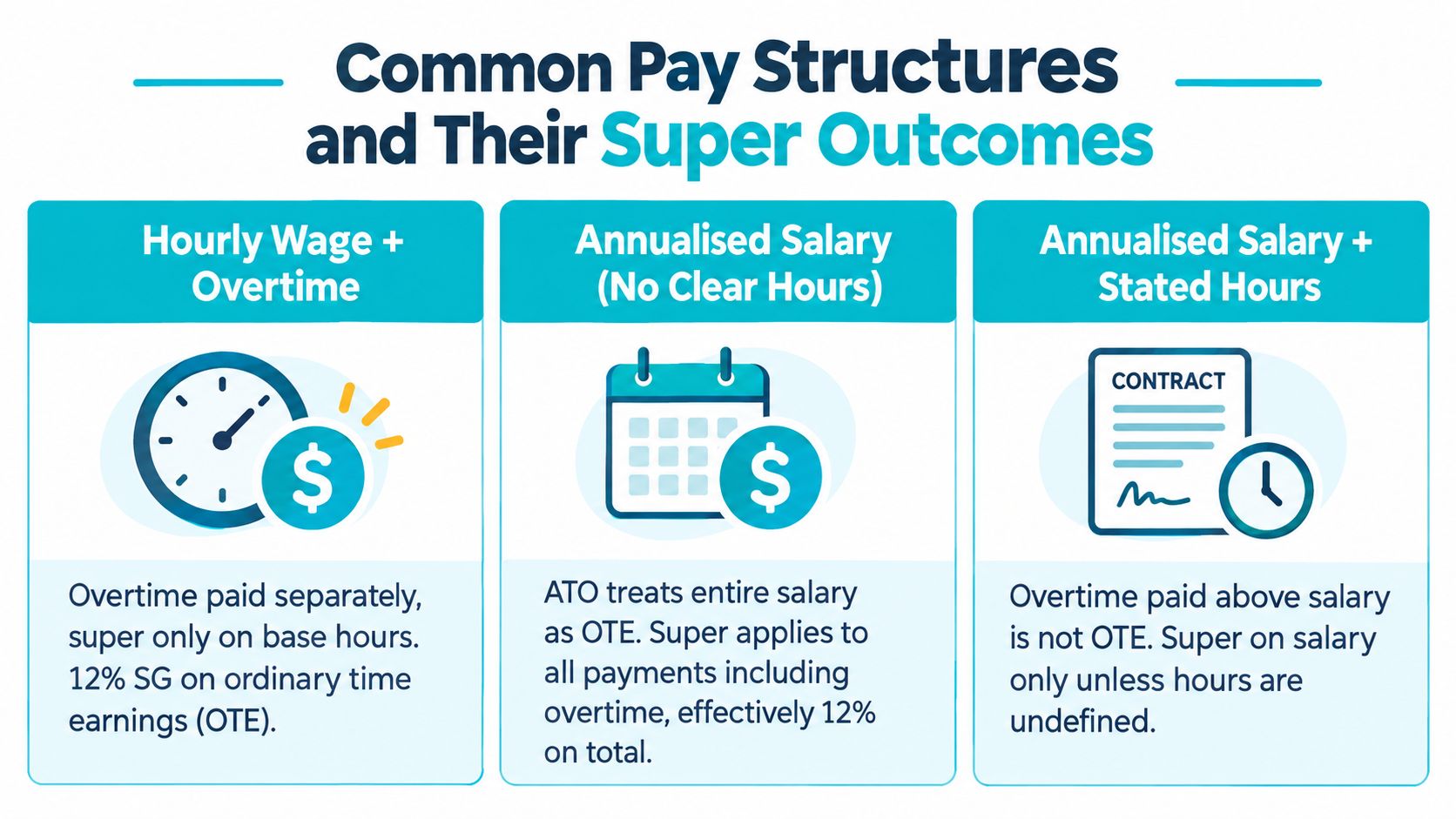
The same hours can produce very different super results depending on the pay structure. That's the uncomfortable truth most calculators gloss over. If you only ask whether overtime is paid, you miss the bigger question of how the role is classified.
Annualised salary with no clear ordinary hours
This is the nastiest setup for employees. If the salary doesn't clearly separate ordinary hours from overtime or penalties, the ATO can treat the whole package as OTE. In that case, the employer's SG obligation attaches to the salary as paid, even if some of it was intended to absorb extra hours.
Award-based role with stated ordinary hours
This is the cleanest structure. Ordinary hours are identified, overtime is separate, and SG is worked out on the ordinary-time component. The employer still contributes on wages, qualifying allowances, and other OTE amounts, but the overtime line usually stays outside the calculation.
Casual with loading
Casual loading doesn't automatically create extra super. The base-rate hours are still relevant for SG, while the loading and overtime penalties need to be tested against the classification. A payslip that bundles everything into one glossy total makes this harder, not easier.
| Scenario | Super outcome |
|---|---|
| Annualised salary, no clear ordinary hours | Entire salary can become OTE |
| Award with stated ordinary hours | Super usually follows the ordinary hours only |
| Casual with loading | Base hours count, loading and overtime need separate analysis |
Job titles where this goes wrong most often are ones with regular extra hours and vague contracts, admin roles on annualised pay, and salaried professional jobs where the employer assumes a fixed amount settles everything. It doesn't. The industrial instrument decides the outcome.
Worked Examples Showing the Real Dollar Gap
A worker doesn't feel a super shortfall in percentages. They feel it in dollars. That's why I prefer working examples, because they expose the difference between what was earned and what was contributed.
Example one, award clerical worker
Take a worker on a $40 base hourly rate. They work 38 ordinary hours and 8 overtime hours at time-and-a-half. Their overtime-free base pay is $2,280, and their overtime pay is $480. On the figures given, the quarterly OTE base is $13,536, and the quarterly SG owed at 12% is $1,624.32.
If the employer only paid super on the lower base component, the employee is left roughly $57.60 short per quarter. That shortfall looks modest in one quarter, but it's money that should've gone into the super fund instead of staying in payroll. Over time, that gap compounds through missed contributions, earnings on missed contributions, and the simple fact that the money never got invested in the first place.
Example two, annualised IT analyst
Now take an annualised IT analyst on $110,000 with no separate overtime line and 10 overtime hours per week. Because ordinary hours are unclear, the ATO can treat the whole salary as OTE. If the employer only paid 12% on an estimated $95,000 base, the gap becomes larger because the salary structure itself is doing the damage.
| Quarterly Super Shortfall Scenarios | OTE Base ($) | SG Paid @ 12% ($) | SG Owed @ 12% ($) | Quarterly Gap ($) |
|---|---|---|---|---|
| Award clerical worker | 13,536 | 1,566.72 | 1,624.32 | 57.60 |
| Annualised IT analyst | 110,000 annual salary structure | Lower than required if only base estimated | Higher if whole salary is OTE | Material shortfall |
If you want to model your own numbers, the superannuation growth calculator is a useful way to see how small quarterly gaps can turn into a bigger retirement problem over time. That's especially true for workers who regularly do extra hours and assume the fund is being fed correctly.
Steps to Check and Claim Unpaid Super on Overtime
Start with your own records before you chase payroll. Pull at least four payslips across the quarter, because one pay run can lie to you while the pattern tells the truth. Then compare the overtime, penalty, and allowance line items with the ordinary hours definition in the award or agreement.
A practical sequence
- Pull the paperwork: Gather payslips, contract, award, enterprise agreement, and super transaction history.
- Identify the OTE base: Separate ordinary hours from overtime and review any bundled salary arrangement.
- Check the contribution rate: Compare actual super paid with what 12% would produce on the correct OTE base.
- Raise it in writing: Send payroll a clear request and ask how the OTE base was calculated.
- Escalate if needed: If payroll doesn't fix it, take it to HR or head office and give them a reasonable window to respond.
If the employer still won't resolve it, lodge an ATO enquiry through online services or the unpaid superannuation enquiry process. The ATO can pursue unpaid super, and the practical historical window for claims is four years. If you're sorting out missing contributions already, this guide on missing super funds is a sensible place to start before the issue gets messier.
When to get advice
You need help fast if the role sits under a hard-to-read award, if the annualised salary includes overtime expectations, or if the employer is insolvent. Those are the cases where the paper trail matters more than the payslip summary, and where a bad assumption can cost real money.
Rule of thumb: if the super answer depends on how the hours are classified, don't guess. Get the documents and run the numbers.
Bringing It Together With Your Super Strategy
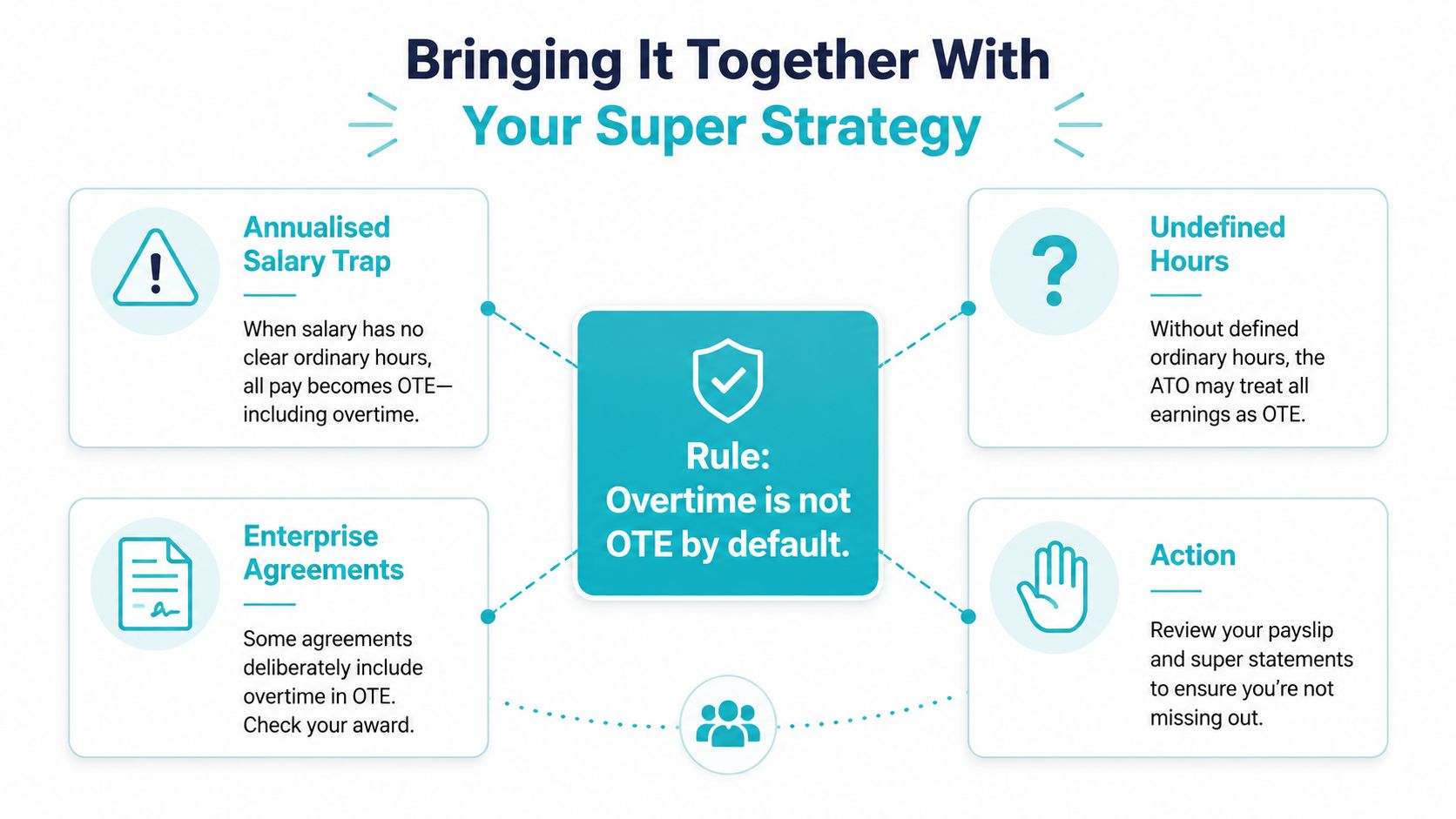
The default rule remains in place. Overtime is generally outside OTE when ordinary hours are clearly identified. However, the exceptions matter more than many realise, especially in annualised salary roles, contracts with vague ordinary hours, and enterprise agreements that fold extra payments into the super base.
The common mistakes are easy to name. People assume all overtime is non-superable. They trust the employer's SG calculation without checking the industrial instrument. They ignore bundled loadings and casual arrangements that can shift the answer once the hours are classified properly.
SG is only one part of the picture. If you're a high earner, a salaried professional, or someone regularly doing extra hours, you should also think about concessional contributions, salary sacrifice capacity, and the insurance held inside super. That broader view is where a proper review pays off, because the right structure can protect you from both underpayment and missed planning opportunities.
Wealth Collective's superannuation optimisation service is built for people who want a clear answer on awards, agreements, salary packaging, and contribution strategy. If you want your overtime, salary, and super to line up properly, visit Wealth Collective and book an initial call.