Business hours
Monday to Friday (8.30AM - 5PM)
Weekend (Closed)



You and your partner may have organised the mortgage, combined your savings and started planning for the next stage of life. Then one question interrupts the comfortable picture: what happens if one income disappears? For a Perth couple with a home loan, children or shared business commitments, the financial effect can extend well beyond funeral costs. It can affect repayments, childcare, household work, education plans and retirement savings.
That's why life insurance for couples shouldn't begin with the question, “Should we buy one policy or two?” The more useful question is, which financial obligations belong to each partner, and what protection would keep the household stable if either person couldn't contribute?
Why Couples Need Shared Protection and What It Really Covers
A young couple in Como may both earn well, but their contributions won't necessarily look the same on paper. One partner might bring in most of the salary, while the other manages school pickups, household administration and unpaid care. If the higher earner dies, the family may lose repayment capacity. If the primary carer dies, the surviving partner may need to reduce work or pay for support.
The risk is shared, but it isn't always equal.
Life insurance is designed to provide financial support after death, while related covers can respond when someone becomes disabled, suffers a specified serious illness or can't work. The practical purpose is to help replace the contribution that would otherwise disappear, whether that contribution is a wage, care or both. You can read a plain-English overview of what life insurance covers before considering specific policies.
The household safety net
Think of your household finances as a safety net with several strands:
- Income: salary, business drawings or other regular earnings.
- Debt: mortgage and personal liabilities that still need servicing.
- Care: childcare, domestic work and support for dependants.
- Plans: education, home upgrades and retirement savings.
- Existing resources: superannuation, savings and current insurance.
If one partner dies, the remaining strands may not hold the same weight. A lump-sum benefit can help clear debt, fund ongoing costs or create breathing space while the surviving partner reshapes work and family arrangements. It isn't a substitute for a complete financial plan, but it can stop an unexpected event from forcing immediate decisions under pressure.
Australian coverage data shows why couples shouldn't assume that having a policy means the family is fully protected. Around 15.0 million people in Australia were covered by life insurance in 2022, while 77% of the non-dependent working-age population had at least one form of cover as at 30 June 2020, down from 94% in 2017. The same CALI publication identified 1.0 million Australians underinsured for death or TPD needs and 3.4 million underinsured for income protection needs.
Practical rule: Shared finances don't automatically mean shared insurance needs.
Before comparing products, decide what each partner's death, disability or absence would cost the household. Resources that help you compare joint life insurance plans can clarify the broad options, but personalized advice is still important when incomes, dependants and debts differ.
Joint or Individual Cover and How Ownership Works for Couples
A joint policy can appear straightforward. Both lives sit under one arrangement, applications may feel simpler and an insurer may offer a partner discount. The problem emerges when the couple's obligations aren't symmetrical.
A single joint policy generally pays one shared benefit rather than creating separate payouts for each person. That can work for a household with similar incomes and uncomplicated finances, but it can be less suitable when one partner earns substantially more, one owns a business, or children from earlier relationships need different beneficiary arrangements.
Three ownership structures
Joint ownership means the couple owns one policy covering both lives, or one life under a shared arrangement. Policyholders generally claim benefits jointly, and changing or cancelling the policy usually requires all policyholders' consent, often through a signed request or transfer document. If the relationship ends, that consent requirement can become a practical obstacle.
Individual ownership gives each partner control of their own policy. Each person can usually maintain separate cover, nominate beneficiaries and seek changes without relying on the other partner's agreement. This structure often suits couples whose income, health history, debts or family responsibilities aren't identical.
Cross ownership means each partner owns cover on the other partner's life. It can help with particular planning objectives, but changes affecting a policy generally require agreement from the relevant parties. Separation can make ownership, premiums and beneficiary decisions more complicated.
| Feature | Joint Ownership | Individual Ownership | Cross Ownership |
|---|---|---|---|
| Payout mechanics | One shared benefit under the policy terms | Each policy can pay separately | Each owner controls cover on the other life, subject to policy terms |
| Flexibility | Changes generally require all policyholders' consent | Each partner manages their own policy | Changes usually require agreement between the parties |
| Beneficiary control | Shared arrangements may limit individual control | Each partner can update their own nominations | Ownership and beneficiary decisions need careful coordination |
| Separation implications | Policy division or cancellation can require cooperation | Policies can generally remain separate | Ownership can require restructuring after separation |
Australian guidance confirms that joint policy ownership can make changes dependent on consent from all policyholders. For a blended family, that matters because a shared payout may not reflect each partner's responsibilities to children, former partners or separate debts.
The decision lens is simple: insure the relationship, or insure each person's financial obligations? Many couples benefit from two individual policies with different sums insured, rather than forcing both partners into an equal joint amount.
Understanding Cover Types Every Couple Should Consider Together
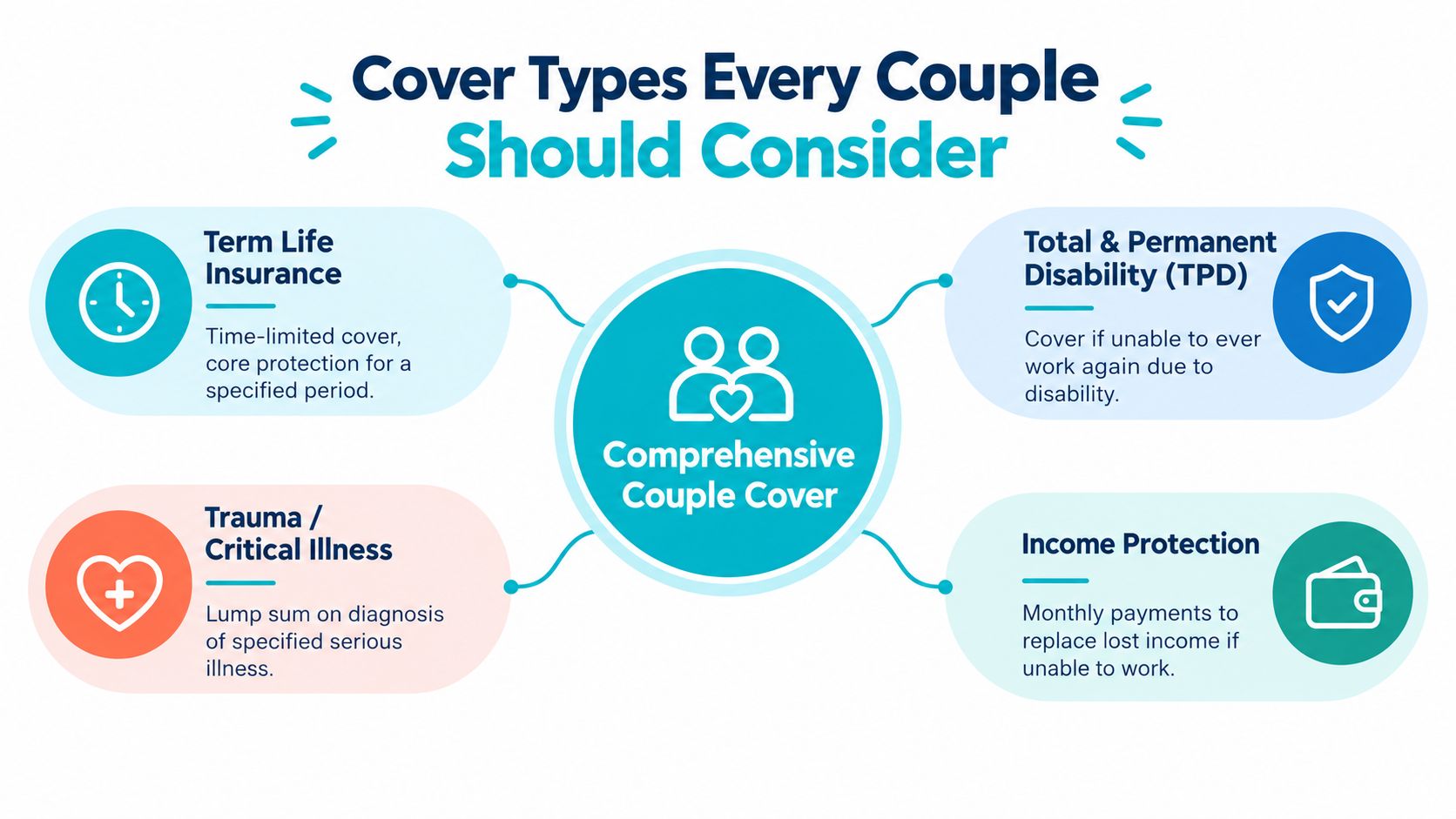
Couples often treat “life insurance” as one product, but household protection usually involves several layers. Each responds to a different interruption, so buying one type doesn't automatically solve every risk.
Term life insurance
Think of term life as replacing the financial contribution that ends when someone dies. It can provide a lump sum for debt reduction, living costs, children's needs or future planning. Both partners may need it, but the amount shouldn't automatically be equal. The higher earner may need more income replacement, while a primary carer may need cover for outsourced care and domestic support.
Total and permanent disability
TPD is the household's long-term disability buffer. It's intended to provide a benefit when a person meets the policy definition of total and permanent disability, including circumstances where they may never return to work. A partner with a physically demanding occupation, business ownership or limited alternative work may require particular attention here.
Trauma or critical illness
Trauma cover is a recovery fund rather than a death benefit. If a policy pays after diagnosis of a specified serious illness, the lump sum may help with treatment-related costs, time away from work, modifications at home or specialist support. Couples should consider whether each person's illness would create different financial pressures.
Income protection
Income protection works more like a replacement tap than a bucket of cash. It may provide monthly payments when illness or injury stops someone working, subject to the policy's definitions, waiting period and benefit period. Australian research found a significant gap in this area. For a couple aged 30 with young children, income-replacement needs for the higher earner were estimated at 17 to 21 years of income, while median cover met only 37% of those needs. These findings appear in the AIA-hosted Rice Warner research document.
The same research estimated 9 to 12 years of income for basic life cover for that higher-earning partner, with median life cover meeting 61% of basic needs. Those figures don't prescribe your amount, but they show why default super cover can fall short when a family has a mortgage, children and long-term commitments.
The right plan is layered: a death benefit, disability protection, serious-illness support and income replacement solve different household problems.
How to Calculate Combined Cover for Your Household
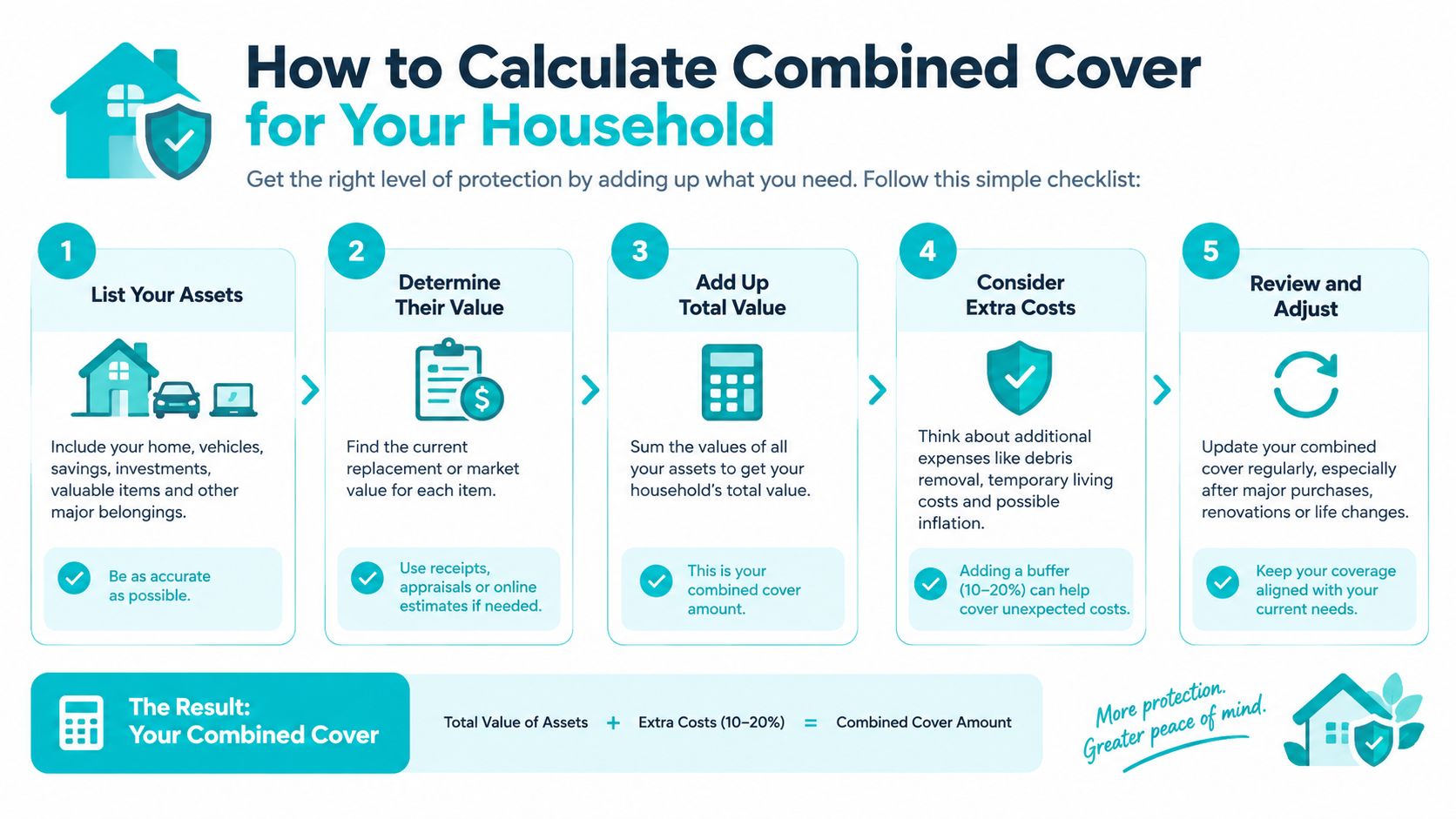
Start with the cost of disruption, not the amount already sitting in super. A useful worksheet separates the household's total needs from the amount each partner should carry.
Build the household figure
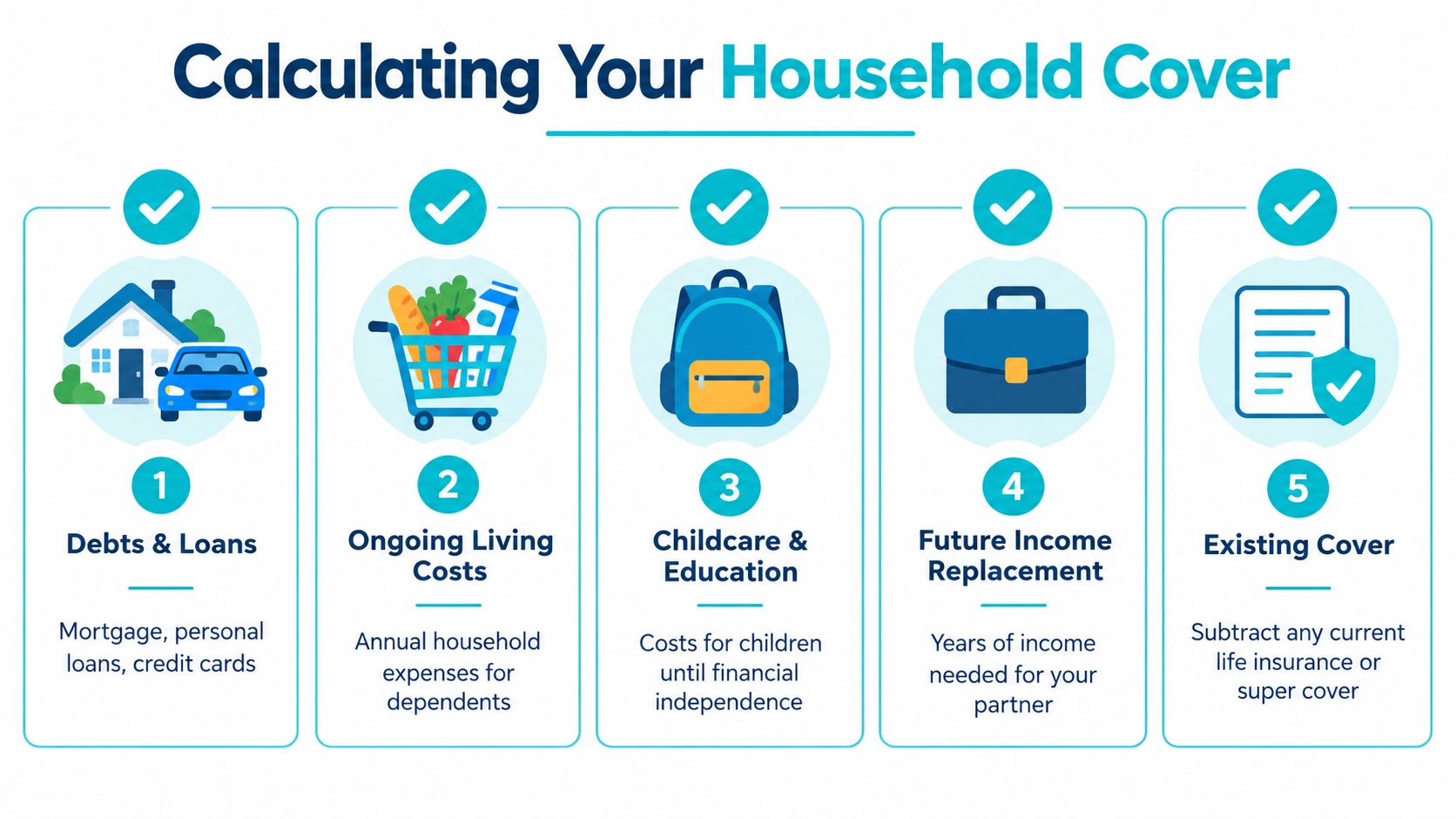
List the following without trying to make the result perfectly precise at first:
- Debts and loans: Record the mortgage, personal loans, credit cards and any guarantees.
- Ongoing living costs: Estimate the costs the surviving partner would still face, including housing, food, utilities and transport.
- Childcare and education: Include care, school-related expenses and support required until children become financially independent.
- Future income replacement: Consider how long the household would need help replacing the deceased or disabled partner's contribution.
- Existing cover and assets: Account for current life insurance, super cover, savings and other accessible resources.
The result is a needs estimate. To understand the process in more detail, use this guide to work out how much life insurance you need.
A worked WA family example
Consider a young couple in Baldivis with a mortgage, two children and unequal incomes. The higher earner's cover may need to address the mortgage, ongoing family costs and a longer income-replacement period. The other partner may need a lower death benefit, but still require meaningful cover because replacing school runs, household management and care can affect the surviving partner's ability to work.
The couple could calculate the higher earner's target by adding outstanding debt, projected family expenses and income replacement, then subtracting existing cover. They could calculate the other partner's target separately, using the cost of care and the income effect of losing unpaid household work. Equal cover might look tidy, but it can leave the higher earner underinsured and ignore the financial value of caregiving.
Set beneficiary proportions deliberately
A beneficiary nomination doesn't always have to be an even split. Australian guidance explains that benefits can be allocated by percentage, such as 50/50 or 30/70, provided the total equals 100%. That may help a couple direct benefits between a spouse, children or other dependants according to their intentions. Beneficiary arrangements should be checked alongside policy ownership, super rules and estate planning rather than treated as a set-and-forget form.
Costs Life Stages Super and Tax Implications in Australia
Premiums reflect the person being insured and the policy selected. Age, health, occupation, smoking status, recreational activities, cover amount, policy definitions and ownership structure can all influence the cost. A young professional may prioritise affordable income protection, while a family with a mortgage may place greater weight on debt protection and income replacement.
Life stage changes the trade-off. A couple without dependants may focus on protecting shared debt and each other's earning capacity. New parents add childcare, education and longer financial commitments. A couple approaching retirement may review whether the original income-replacement need still applies, or whether the priority has shifted towards debt, estate liquidity and supporting a surviving partner.
Super versus stand-alone ownership
Insurance through super can be convenient because premiums are paid from the super account rather than directly from the household bank account. It can also create control issues, particularly where the member's default cover doesn't match the family's actual obligations or where beneficiaries need careful attention.
Stand-alone policies may provide more direct ownership and policy control, depending on the product. The right structure depends on affordability, cover definitions, claims needs, tax considerations and the couple's wider superannuation and estate planning position. This guide to life insurance through super can help explain the distinction.

Premiums paid through superannuation are generally not tax deductible to the individual, and death-benefit taxation depends on whether the recipient is a tax dependant. Benefits paid to a spouse or a child under 18 are generally tax-free, while payments to non-tax dependants can attract tax on the taxable component, as outlined in this Australian life insurance tax guide.
Review trigger: Revisit ownership and beneficiaries after marriage, a de facto relationship change, a new mortgage, children arriving, a major income change or separation.
Australian survey data also shows that people often act at relationship milestones. Marriage was a purchase trigger for 21% of respondents, and 26.9% in Western Australia cited marriage as their trigger. Dependants were cited by 25% of Australians, which reinforces an important point: couples may buy cover when they formalise a relationship, then fail to update it as debts, children and family structures evolve. The survey also found 52% held life insurance through super and 48% held stand-alone cover, according to the ANZ guide for couples.
How to Choose and Buy the Right Policy Without Common Pitfalls
A confident purchase starts with a needs conversation, not a quote comparison. Each partner should disclose income, debts, health history, work duties, dependants and existing cover before deciding whether the policies should be joint, individual or cross owned.
Follow a practical decision path
- Map the household: Write down debts, essential costs, care responsibilities and future plans.
- Separate the obligations: Identify which costs depend on each partner's income, and which arise from shared commitments.
- Compare cover definitions: Check what counts as disability, serious illness or inability to work. A cheaper premium may reflect narrower terms.
- Check ownership: Confirm who owns each policy, who can change it and whose consent is required.
- Review beneficiaries: Make nominations consistent with your intentions and wider estate planning.
- Apply carefully: Answer health and occupation questions accurately, then keep copies of documents and policy schedules.
- Schedule reviews: Revisit cover after relationship changes, new debts, children, career changes or significant health developments.
Joint applications and partner discounts can make shared cover attractive at the start. They shouldn't override the longer-term question of flexibility. If a relationship ends, a joint policy may require cooperation to change or cancel, while individual arrangements can be easier to manage separately.
Wealth Collective's Protection Plus service is one advice option for couples who want help assessing personal insurance, comparing suitable structures and putting a review process in place. Its process begins with a complimentary 10-minute introductory call, followed by needs analysis, recommendations, application support and ongoing review. The firm also backs its advice with a satisfaction guarantee.
The key check is whether the arrangement would still work if the couple's circumstances stopped being aligned. If one person's income rises, one partner leaves work, a blended family forms or a mortgage changes, the policy should be reviewed rather than left on its original settings.
Take the Next Step to Protect Your Family with Confidence
Good couple protection doesn't mean buying identical policies. It means matching the cover type, amount, ownership and beneficiary settings to the actual contribution each partner makes and the obligations the household would still face.
A joint policy may suit some couples, but it can create inflexibility when earnings differ, family structures change or each partner carries separate debts. Two individual policies may offer clearer control, while a layered plan can combine death, TPD, trauma and income protection without treating them as interchangeable.
The Wealth Collective process helps translate those decisions into a practical protection plan. A short initial conversation can identify where default super cover, existing policies or beneficiary nominations may not match your current life. From there, personalised advice can help you choose a structure that remains relevant as your Perth or wider WA household changes.
Protection is most useful when it's organised before a crisis, not during one. Book an initial call when you're reviewing a mortgage, starting a family, changing work or questioning whether your current cover would protect the person you love.
Wealth Collective offers practical personal insurance advice through its Protection Plus service, including needs analysis, policy structure guidance and ongoing reviews for couples. Visit Wealth Collective to arrange an initial call and turn your household commitments into a clear, personalized protection plan.