Business hours
Monday to Friday (8.30AM - 5PM)
Weekend (Closed)


A fire, flood or serious supply-chain failure can stop trading overnight. The rent still falls due, payroll still needs funding, loan repayments continue, and customers quickly look elsewhere while the business waits for repairs or replacement stock. The policy sitting in your filing cabinet may be called business interruption insurance, but its real value depends on two questions: what event triggers cover, and whether the insured amount still reflects the business you run today.
Australian small businesses learnt those questions the hard way during COVID-19. ASIC reviewed 392 business interruption policy wordings issued to Australian small businesses, while APRA required 10 general insurers to complete board-endorsed self-assessments of their risk management frameworks after coverage issues emerged from lockdowns and restrictions. The Australian general insurance sector remained well capitalised at 1.7 times the minimum requirement as at 30 June 2021, but that industry resilience didn't remove the claimability problems faced by individual businesses. (ASIC's letter on business interruption insurance expectations)
For owners, the lesson is direct. Having a policy isn't the same as having usable protection. The wording, trigger, gross profit calculation, indemnity period and financial records all determine whether the cover keeps your business alive when revenue stops.
The Cash Flow Gap When Trading Stops
A fire tears through the Riverside General Store after closing. The building is unsafe, stock is damaged and the doors stay shut while tradespeople assess the structure. The owner hasn't lost only shelves, equipment and inventory. The business has lost its ability to generate cash.

The bills don't pause with the trading activity. Rent, essential salaries, software subscriptions, finance repayments and other standing costs can continue while turnover collapses. Even a profitable business can run out of cash if it must fund months of expenses without normal sales.
That's the gap business interruption insurance is designed to address. In Australia, it's generally packaged within property or cyber insurance rather than sold as a standalone policy. The cover usually responds only after an insured trigger occurs, most commonly physical damage or a specified access or supply-chain event. It doesn't normally pay because the business has experienced a downturn. (APRA submission on small business insurance)
Survival depends on time, not just assets
Property insurance can help repair the premises or replace damaged equipment. Business interruption cover deals with the period in between, by responding to the financial consequences of the interruption and certain additional operating costs, subject to the policy wording and limits.
That distinction matters for a café, trades business, professional practice and retailer alike. The most expensive part of a shutdown may not be the damaged asset. It may be the time needed to restore operations, retain capable staff, find temporary premises, source replacement stock or rebuild customer activity.
Practical rule: Treat interruption cover as a cash-flow survival plan, not an extension of your contents insurance.
A disciplined cash-flow review should sit beside the policy review. Wealth Collective's small business cash flow management guidance can help owners identify which expenses continue, which can be reduced and how long available reserves would last. If a disruption creates an immediate funding shortfall, owners may also need to understand the role and cost of short term business loans from Business Loan, while recognising that borrowing isn't a substitute for correctly structured insurance.
Business interruption cover buys time. The quality of that protection depends on how accurately you define the cash flow that time must support.
Calculating Gross Profit and Indemnity Periods
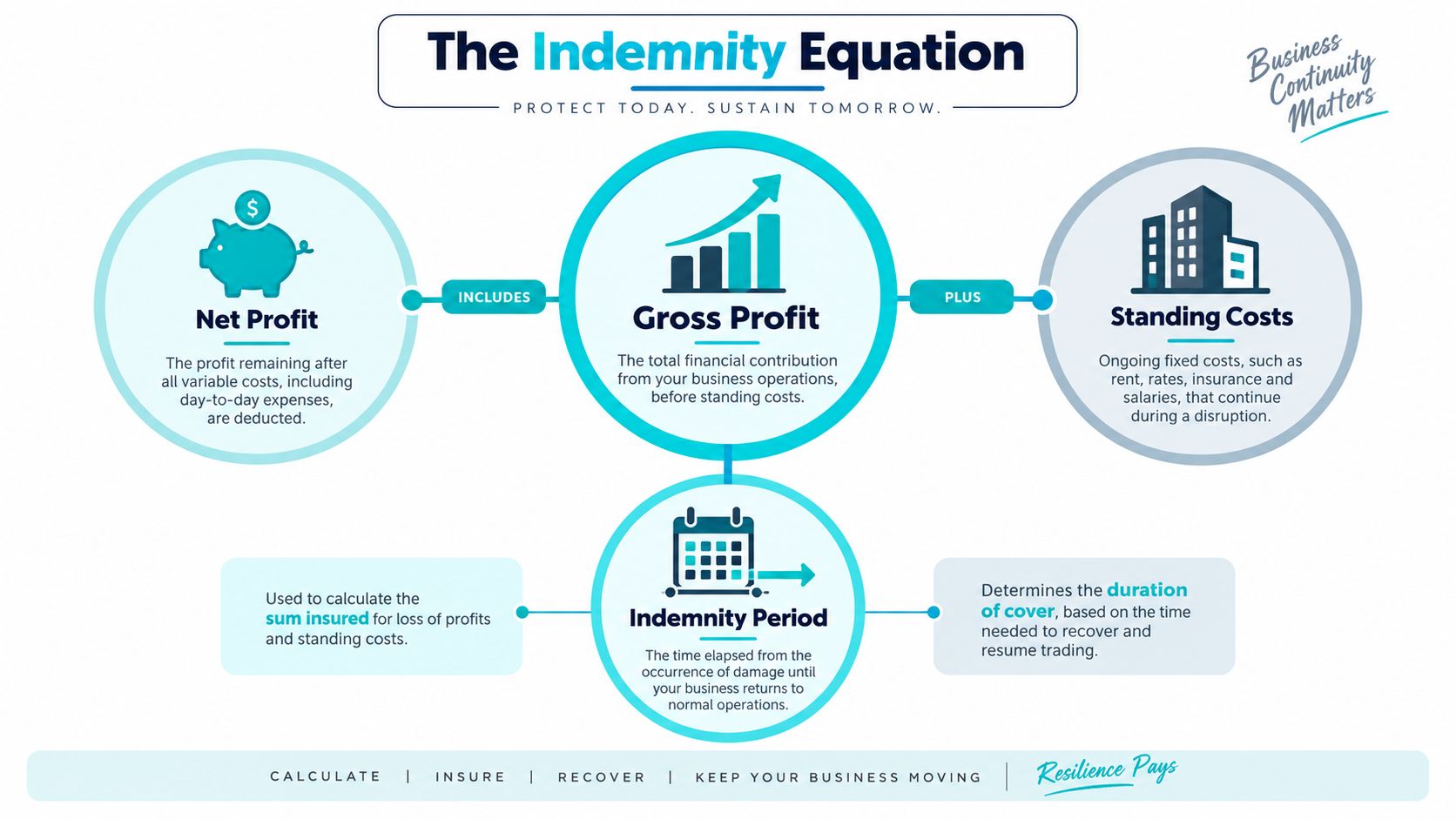
If a fire closes a retailer for months, the claim will not be based solely on the sales shown in last year's accounts. It will depend on the policy's definition of insured gross profit, the expenses that continue, and the time required to restore trading. Owners who insure revenue without checking that formula can pay for cover that does not match the loss.
A business may generate substantial sales while passing much of that money directly to suppliers. If trading stops, stock purchases may fall, while rent, core wages, finance costs and other standing expenses continue. Insuring too little gross profit leaves a funding gap. Insuring an inflated figure can raise premiums without improving the protection the policy is intended to provide.
Gross profit is a policy calculation
Read the policy schedule with its definitions of gross profit, uninsured working expenses and adjustments for business growth. The review should answer five questions:
- Revenue forecast: Does the forecast reflect current trading, planned expansion and realistic customer demand?
- Variable costs: Which costs would fall if sales stopped, and does the wording treat them as deductible?
- Standing costs: Which expenses continue during closure, including rent, essential wages, utilities, finance and professional commitments?
- Net profit: What profit would the business have earned during the interruption if the insured event had not occurred?
- Extra costs: Could temporary premises, expedited freight, equipment hire or alternative production protect turnover?
The sum insured must reflect the loss the business could suffer across the full recovery period, not just the previous year's accounting result. It must also allow for the time needed to rebuild trading capacity, which may extend well beyond the date repairs begin.
The indemnity period sets the survival window
The indemnity period is the time during which the policy can respond while the business works back towards pre-loss trading levels. Australian policies commonly offer periods of 12, 18, 24 or 36 months. An Australian explanation of gross profit and indemnity periods explains how this period interacts with the insured calculation.
A shorter period may reduce the premium, but it can end before recovery is complete. Planning approvals, specialist equipment, contractor availability, recruitment, testing, supplier requalification and the gradual return of customers can all extend the interruption. Reopening the premises does not mean the business has returned to normal financially.
Choose the period by mapping the slowest realistic recovery pathway. Allow for approvals, asset replacement, stock procurement, system restoration, output recovery and the return of sales. Test that pathway against a severe but credible interruption, not the quickest possible reopening.
Check the treatment of lost gross profit against additional increased costs of working. Temporary premises or urgent stock may reduce the overall loss, yet the wording determines whether those costs qualify and how reimbursement is calculated.
The final review should compare the policy schedule with current management accounts, budgets, supplier dependencies and recovery plans. Any mismatch is a claim risk. Update the sums insured and period before outdated assumptions determine the payout.
The Hidden Danger of Underinsurance
A claim can expose a gap that the policy schedule concealed. The business may have expanded, costs may have risen, and recovery may now take longer than the assumptions behind the original sum insured. Having cover does not prove that the cover is adequate.
Inflation affects wages, rent, replacement equipment and supplier pricing. Labour shortages can prolong repairs, while supply-chain disruption can delay machinery and stock. If the business has grown but its insured gross profit still reflects older forecasts, the policy may not fund the interruption it was meant to address.
An Australian industry case study published in 2026 described a policy that looked adequate three years earlier but was underinsured by $560,000 against the actual exposure. The Specialist Risk case study on outdated business interruption cover shows why an old calculation can become a material claim problem.
The average clause changes the result
Many policies include an average clause or similar underinsurance mechanism. If the declared amount is below the business's actual exposure, the insurer may reduce the claim proportionally instead of paying the full measured loss.
The result can be severe. The owner may have paid premiums on time and lodged a genuine claim, yet still have to fund a substantial shortfall because the sum insured was not recalculated as the business changed.
Review the policy by asking, “What would this cover pay against today's exposure?” The question “Do we have business interruption insurance?” is not enough.
Australian claims observations reinforce the need to treat interruption risk as a practical financial issue. Business interruption claims represented 15% of total business insurance claims in 2022, with an average cost of $17,000 per claim, according to an industry source citing Insurance Council of Australia data. Australian business interruption underinsurance and claims observations
The same source reported that QBE found more than 5% of businesses had recurring business interruption claims over five years, averaging $10,000 per claim. It also reported that only 17% of small businesses held a BI policy in research commissioned by QBE, while CGU found 27% of SMEs had one. These figures do not determine an individual business's needs, but they show why owners should examine both whether cover exists and whether its settings remain accurate.
Recheck revenue, gross profit, standing costs, growth assumptions and the indemnity period after any material change. Review the policy before renewal if the business has expanded, changed premises, added major contracts or become more dependent on a particular supplier.
Triggers and Exclusions That Dictate Payouts
Business interruption insurance responds to a covered cause of interruption, not to financial pain in isolation. The policy may require physical damage to insured property, or it may contain specific extensions for prevention of access, supply-chain disruption or other defined events. The exact trigger and causal chain matter more than the label on the schedule.
Start with four questions:
- What insured event occurred? Identify the peril and the damaged or affected property.
- Does the wording require physical damage? Many policies link interruption cover to damage that would trigger the underlying property section.
- What causal connection must be proved? Show how the insured event caused the loss of turnover and continuing expenses.
- Do exclusions or conditions alter the response? Read endorsements, waiting periods, limits, sub-limits and exclusion wording together.
COVID-19 exposed drafting weaknesses
Australia's COVID-19 test case process demonstrated that similar-looking clauses can produce very different outcomes. The courts considered disease, prevention of access, hybrid and catastrophe clauses separately, rather than treating all pandemic wording as interchangeable. Prevention of access, hybrid and catastrophe clauses were unlikely to cover the relevant COVID-19 losses, while disease clauses could respond depending on the facts and the cause of the loss. (Clayton Utz analysis of the COVID-19 business interruption test case)
Causation was central. Government orders made in response to a broad pandemic risk didn't necessarily establish the required connection to a specific outbreak at or near the insured premises for several clause types.
The NSW Court of Appeal also held that insurers couldn't rely on exclusion clauses referring to the repealed Quarantine Act 1908 to deny pandemic-related losses where the policy hadn't captured its replacement, the Biosecurity Act 2015. The High Court left that outcome in place. (Clifford Chance summary of Australian COVID-19 insurance judgments)
That result doesn't mean every pandemic claim succeeds. It means outdated legislative references can undermine an exclusion, while the remaining trigger, causation and policy conditions still decide the claim.
Read the wording before the crisis
Owners should obtain the full policy wording, endorsements and schedules, not rely on a broker summary or a familiar product name. If a claim is disputed, maintain a written chronology, preserve all insurer correspondence and seek specialist advice before accepting a reduced settlement. A practical guide to fighting lowball offers can help explain the issues that arise when an insurer's valuation doesn't reflect the evidence.
For an Australian review of the broader cover required by a business, use Wealth Collective's guide to small business insurance requirements. The objective is to match the policy trigger with the actual way the business could be interrupted.
Navigating the Claims and Complaints Process
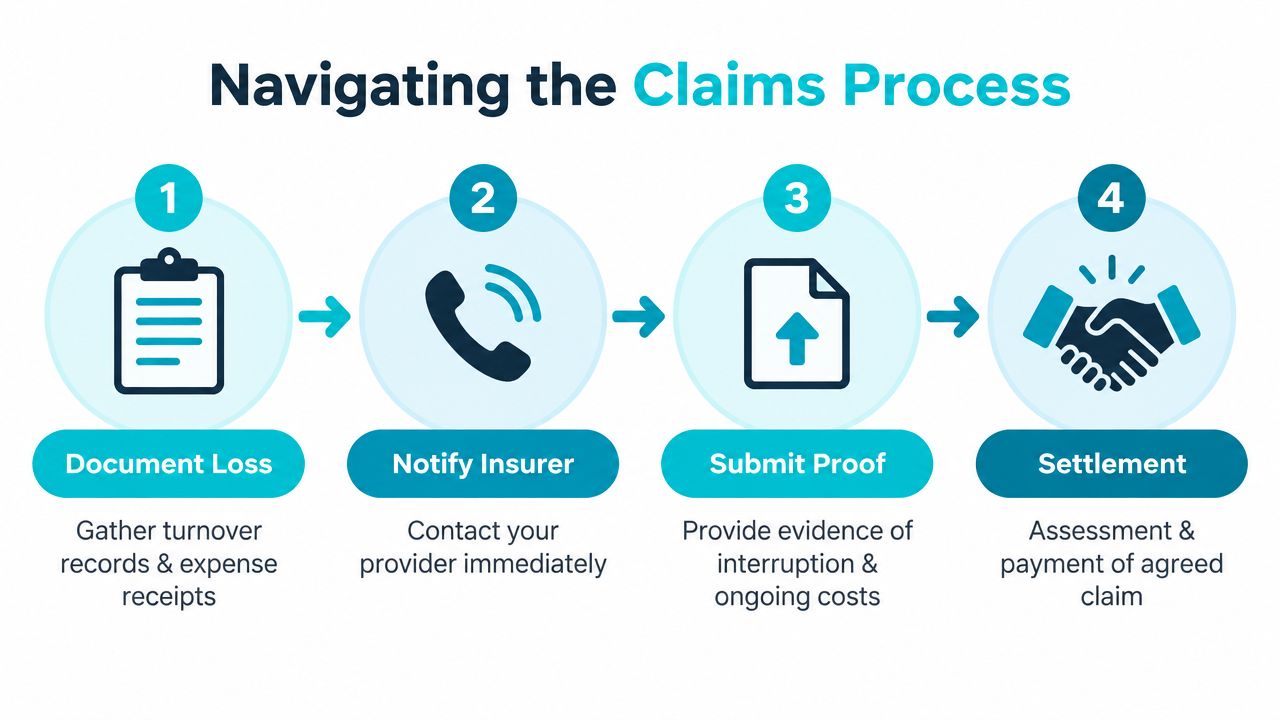
The strongest claim begins before the loss. Insurers need evidence showing what the business would have earned, what it earned, which expenses continued and how the insured event caused the difference. Poor records can turn a valid interruption into a prolonged argument about estimates.
Build the evidence file immediately
Notify the insurer promptly and follow the policy's claim conditions. Then create a dedicated file containing:
- Financial baselines: Management accounts, tax records, budgets, sales reports and reconciliations that establish normal trading.
- Interruption evidence: Photographs, repair reports, closure notices, supplier correspondence and timelines linking the event to the shutdown.
- Continuing expenses: Invoices and payroll records showing the costs that continued during the interruption.
- Mitigation costs: Receipts for temporary premises, urgent freight, equipment hire or other reasonable measures taken to reduce the loss.
- Trading recovery: Daily or weekly sales information showing when operations resumed and whether turnover returned to normal.
Don't alter records to make them fit an expected claim. Keep original documents, record assumptions and explain unusual trading movements. Your accountant, broker, loss adjuster and insurer should be working from the same factual timeline.
Complaints now require active escalation
The pathway for COVID-era claims has changed. The final Federal Court class-action route has closed, leaving affected businesses to use insurer complaint processes or AFCA. AFCA had received 418 COVID-related business interruption complaints since 2020, with 161 still open and about 110 on hold at its latest published update. (Report on the closure of the Federal Court COVID-19 business interruption class-action era)
A court-ordered notification process recorded 4,133 registrations of interest from potential group members, which the court described as a significant disparity compared with the total policyholder base. That gap matters because businesses can abandon claims when the process becomes complicated or deadlines are misunderstood.
Escalate in writing through the insurer's internal dispute resolution process first. Track every date, response and requested document, then consider AFCA if the complaint remains unresolved and the matter falls within its jurisdiction. Time limits matter, so obtain advice promptly rather than allowing an unresolved claim to sit unattended.
Integrating Business Cover with Personal Wealth
A business interruption claim protects the enterprise, but the owner's personal balance sheet can still suffer. If the business cannot fund drawings, debt repayments or family commitments, the owner may divert personal savings into the company, suspend superannuation contributions or sell investments at an unsuitable time.
That's why business cover belongs inside a broader risk strategy. The business needs appropriate interruption, property, liability and key-person arrangements. The owner may also need personal income protection, life insurance, total and permanent disablement cover and a clear plan for business debt.
Separate the business shock from the family plan
Consider the consequences across three layers:
- Trading continuity: Can the entity fund standing costs and recovery expenses?
- Owner income: Can the household meet its commitments if business drawings stop?
- Ownership and succession: Can remaining owners fund a transfer or manage the loss of a critical person?
A buy-sell arrangement can become difficult to fund precisely when an owner dies or becomes seriously disabled. Insurance linked to a properly drafted buy-sell agreement insurance strategy can support continuity, but the ownership structure, policy ownership and agreement wording must align.
The same principle applies to physical risk controls. For businesses in Perth, reviewing commercial security for Perth businesses may reduce the likelihood or severity of an event, but security measures don't replace financial protection. Prevention and transfer work together.
Wealth Collective's Protection Plus service can be considered as part of this wider review, bringing business risk protection into the same conversation as personal insurance, debt reduction, superannuation and long-term wealth objectives. The adviser's role isn't to point to a policy. It's to test whether a business disruption would derail the owner's family, retirement or investment plan.
Your Policy Audit and Next Steps
Audit your business interruption insurance before renewal, while there is still time to correct outdated sums insured and exclusions. Place the policy schedule, full wording, current financial statements and recovery plan together, then test them against the business operating today.
Use this audit checklist
-
Confirm the trigger. Check whether cover requires physical damage, a defined access event, supply-chain damage or another insured peril. A revenue loss alone may not activate the policy.
-
Recalculate gross profit. Use current revenue, variable costs, net profit and standing expenses. Confirm that the policy definition matches the way your accountant reports the business.
-
Review the indemnity period. Test whether 12, 18, 24 or 36 months allows enough time to repair, replace, restart and recover. Base the choice on the slowest realistic pathway, rather than an optimistic estimate. As noted earlier, the indemnity period must reflect the full recovery process.
-
Check for underinsurance. Compare the declared amount with current turnover, wages, rent, supplier costs and growth plans. Ask how an average clause would reduce a partial claim if the sum insured is too low.
-
Read exclusions and endorsements. Check legislative references, disease wording, access restrictions, supply-chain conditions, sub-limits and waiting periods. Drafting details can determine whether an exclusion applies, so have unclear wording explained before renewal.
-
Test the evidence trail. Organise and back up monthly accounts, payroll records, sales reports, supplier invoices and expense receipts. A claim requires records that support the calculation, not only a plausible account of what happened.
-
Connect the policy to personal wealth. Review owner income, personal debt, superannuation contributions, key-person exposure and succession arrangements. Business continuity fails if the household must fund the disruption.
The practical test is simple: could the business prove its loss and fund recovery under the current wording? If the answer is unclear, update the policy before an event exposes the gap. Underinsurance often begins with an old turnover figure, then becomes a claim problem when wages, rents and recovery costs have increased.
Book a free 10-minute introductory call with Wealth Collective to stress-test your current business interruption cover, personal protection and wider wealth plan. Bring the policy schedule and recent financial information, so the discussion focuses on gaps that could affect the business and household.
Wealth Collective helps Australian business owners translate insurance wording into practical protection for business and personal wealth. Its review can cover triggers, sums insured, indemnity periods and connected personal risks. Visit Wealth Collective to arrange your free 10-minute introductory call and test whether current cover supports the financial life you are building.