Business hours
Monday to Friday (8.30AM - 5PM)
Weekend (Closed)


You've finished work, the mortgage is gone, and your super balance looks reassuring on paper. Then the practical questions arrive. How much can you spend this year? Should you start an account-based pension now? What happens to your Age Pension if you take more from super, and how much flexibility can your investments withstand when markets fall?
A sound retirement drawdown strategy answers those questions together. It doesn't treat super as a separate bucket from your Age Pension, other investments, tax position, health needs and plans for the rest of your life. That's the approach I use with clients in Perth: establish the income you need, understand the rules that affect it, then build a drawdown process you can review rather than a percentage you blindly follow.
When the Paycheque Stops and the Plan Begins
A Perth couple, both aged 65, finish their last working week with $900,000 in combined super, a paid-off home and a Target Income figure scribbled on the back of an envelope. They've done the hard part, or so it feels. Their next decision is where many retirement plans become vague: how do they turn that capital into dependable income without spending too quickly or becoming unnecessarily cautious?
Before drawing a single dollar, they need to settle three decisions.
- How much to withdraw each year. Their target must cover essential costs, enjoyable spending and irregular expenses, not just the monthly bills.
- When to start the account-based pension. Starting can create an income stream, but timing affects administration, investment choices, tax and the interaction with government support.
- How to flex spending when markets move. A fixed withdrawal can be easy to understand, but it may force asset sales after a fall. A flexible plan may protect the portfolio, but only if the household knows what spending can change.
The number is only the starting point
A drawdown plan isn't a set-and-forget instruction such as “take four per cent and forget about it”. Your minimum payment is governed by age, your balance changes with markets, and your overall income may include an Age Pension, dividends, interest or other assets. The Australian account-based pension guide is useful background, but the decision still needs to fit your personal numbers.
The home matters too. The principal residence can sit outside the assets test, while financial assets can affect both Age Pension eligibility and the amount received. Deeming can also influence the income-test result, even if the actual return on an investment is different. That means the amount leaving super isn't the same thing as the amount available to spend.
Practical rule: Your real retirement income is the combined result of super withdrawals, Age Pension entitlements, tax and investment income. Model all four before choosing a withdrawal rate.
The Retirement Roadmap view
The Retirement Roadmap process starts with the destination. We define the lifestyle you want, map every income source and liability, test your plan against longevity and market conditions, then decide how your assets should work together. That sequence stops you from making a super decision in isolation.
The rest of this guide follows the same order. First, understand the legal floor. Then compare fixed and dynamic withdrawals, decide which assets should fund which expenses, and stress-test the result against two very different retiree profiles.
The Australian Minimum Drawdown Rules You Need to Know
An account-based pension has a legislated minimum annual payment. The relevant age is generally your age at 1 July, and the minimum is calculated using the account balance at that date, or the commencement value if the pension begins later in the financial year. The ATO's current super payment rules confirm that the applicable table depends on the income year and pension arrangements, not one fixed percentage for life.
| Age | Minimum % | Typical Target % | Notes |
|---|---|---|---|
| Under 65 | 4% | Set from spending plan | Legal minimum for the relevant age band |
| 65–74 | 5% | Set from spending plan | Recheck against Age Pension effects |
| 75–79 | 6% | Set from spending plan | Later-life spending needs may differ |
| 80–84 | 7% | Set from spending plan | Minimum rises with age |
| 85–89 | 9% | Set from spending plan | Longevity and care costs need review |
| 90–94 | 11% | Set from spending plan | Higher floor can accelerate withdrawals |
| 95 or more | 14% | Set from spending plan | Highest legislated minimum |
The schedule is set out in AustralianSuper's minimum drawdown rate table. You can withdraw more than the minimum, but you generally can't withdraw less. During COVID-19, the government temporarily reduced these minimums by 50% for the 2019/20 and 2020/21 financial years, demonstrating how policy can change retirement income behaviour at scale. The regulatory framework is also described as a key requirement for account-based pensions in Treasury-linked modelling of drawdown behaviour.
Put three figures on one page
I want clients to see three separate figures, not one misleading percentage.
- The legal floor is the age-based minimum. It tells you the least you must pay.
- The comfortable ceiling is the amount your assets and income sources can support without undermining your objectives.
- The target rate is the planned withdrawal that funds your lifestyle while recognising longevity and market risk.
A target can sit above the legal floor, particularly when you have a clear spending need or other capital available. But calling a rate “sustainable” without testing the portfolio, Age Pension and spending pattern is poor advice. The minimum becomes especially important as balances fall because a rising age-based percentage can require larger withdrawals relative to the remaining capital.
Check the Age Pension before adding to your income
Your account-based pension balance can affect the assets test. Withdrawals reduce the account balance, but the cash you withdraw may then sit in a bank account or another investment and remain assessable. The income test and deeming rules can also change the result, so an extra withdrawal doesn't automatically improve your total income.
Use this practical process:
- Choose a target annual income.
- Calculate the minimum payment for your age and balance.
- Model the Age Pension under the income and assets tests.
- Record the effect of any additional withdrawal.
- Review the result each financial year.
The FINSIA-linked drawdown analysis reported that success over a 30-year horizon varied sharply with the initial rate and portfolio mix. That's why the target needs to be tested, not selected from a generic rule of thumb.
Static Versus Dynamic Withdrawal Rates
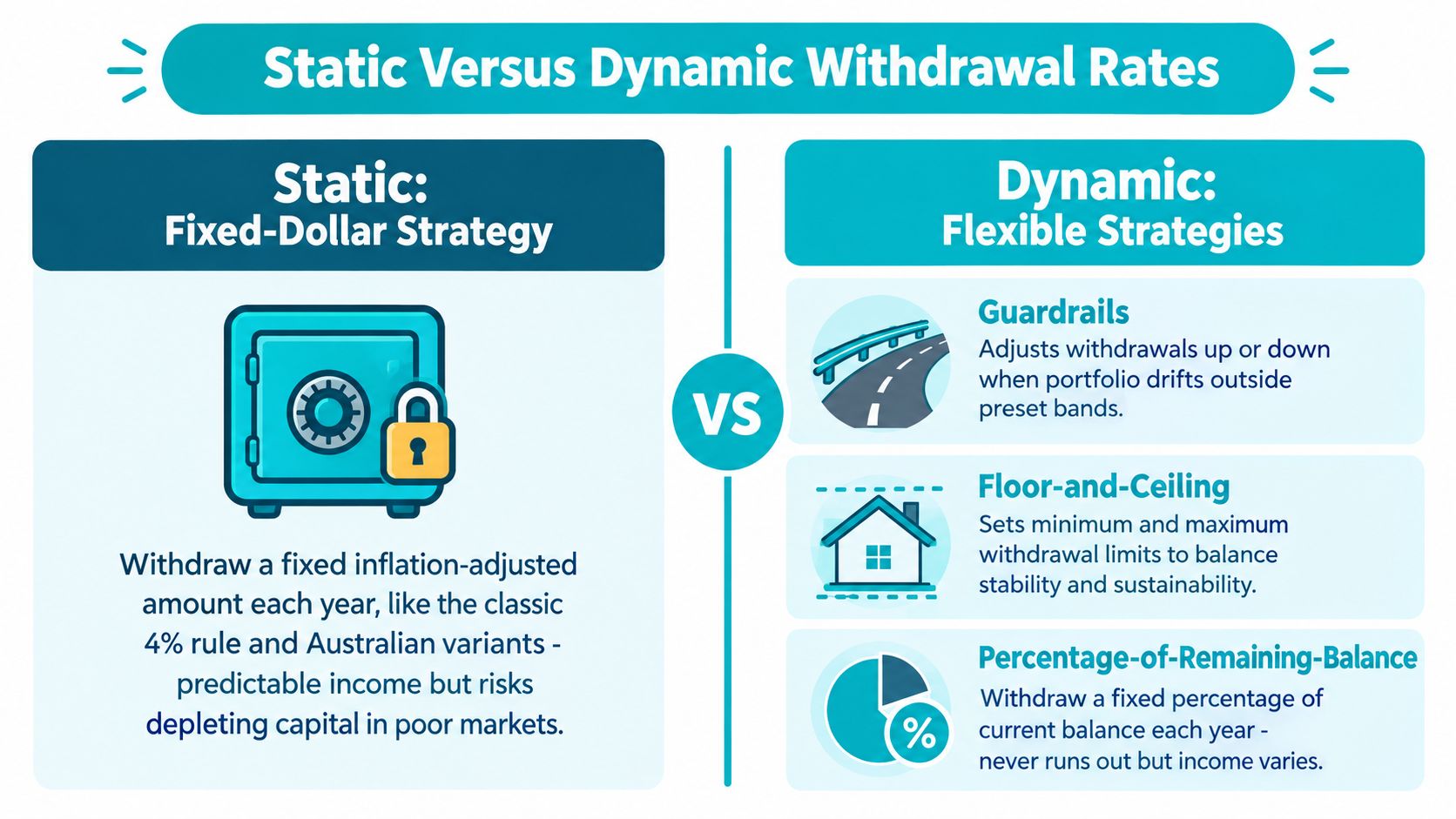
A fixed-dollar strategy gives you a predictable spending amount. You choose an initial rate, increase the payment as planned and leave it alone while markets rise and fall. That simplicity is attractive, especially when your essential costs are stable, but it can become fragile when a poor market arrives early and you keep selling assets at depressed values.
A dynamic strategy accepts that income can change. You set a starting amount, a minimum spending floor and a maximum level, then review the payment when the portfolio moves outside the agreed range. The objective isn't to predict markets. It's to stop your spending plan from pretending that every market environment is identical.
What the Australian modelling tells us
For a 30-year retirement horizon, the FINSIA-linked study found the following outcomes:
| Portfolio mix | Initial draw | Reported success rate |
|---|---|---|
| 50% growth, 50% defensive | 3% | 99% |
| 50% growth, 50% defensive | 4% | 82% |
| 50% growth, 50% defensive | 5% | 60% |
| 75% growth, 25% defensive | 4% | 95% |
| 75% growth, 25% defensive | 5% | 77% |
The result is clear. A higher initial draw creates more pressure, while a larger growth allocation improved the reported success rate in the tested scenarios. That doesn't mean every retiree should hold 75% growth assets. It means the portfolio mix and withdrawal rate must be assessed together.
The same research highlights an important modelling distinction. Some retirement models annuitise the drawdown and exhaust assets by death, while the retirement income covenant asks trustees to balance income, sustainability risk and flexible access. Your plan therefore needs more than a single success number. It needs a spending response when conditions change.
Use guardrails rather than guesswork
I recommend starting with a base rate and attaching clear rules to it.
- Base income: Set the amount needed for core living costs and the lifestyle you've chosen.
- Lower guardrail: If the portfolio falls through the agreed band, pause discretionary increases and review the next payment.
- Upper guardrail: If the balance rises materially relative to the plan, consider additional travel, gifting or a higher lifestyle payment.
- Annual review: Recalculate the rate using the current balance, Age Pension result and upcoming expenses.
A practical guardrail can be set at around plus or minus 10% to 20% of the starting income, with the exact band chosen for your circumstances. That figure is a planning parameter, not a promise of safety. Your minimum pension payment still applies, and essential spending may not be easy to reduce.
Read more about the broader question of how long retirement savings may last, but don't rely on a calculator result alone. The right approach is to make your flexibility explicit before a downturn tests your discipline.
My recommendation: Keep essential spending stable, make discretionary spending flexible, and write the adjustment rule while markets are calm.
Sequencing Withdrawals Across Super and Other Assets
Withdrawal sequencing is an order-of-operations problem. Before deciding which account pays for a new car, a renovation or a regular income payment, check how the withdrawal changes your Age Pension position under both the income test and the assets test.
Start with the binding test
Your first task is to identify which test is doing the work. A household can be affected by assessable assets, deemed income or both. The result determines whether moving money from super to cash, paying down debt or selling an investment improves the overall position, leaves it unchanged or reduces government support.
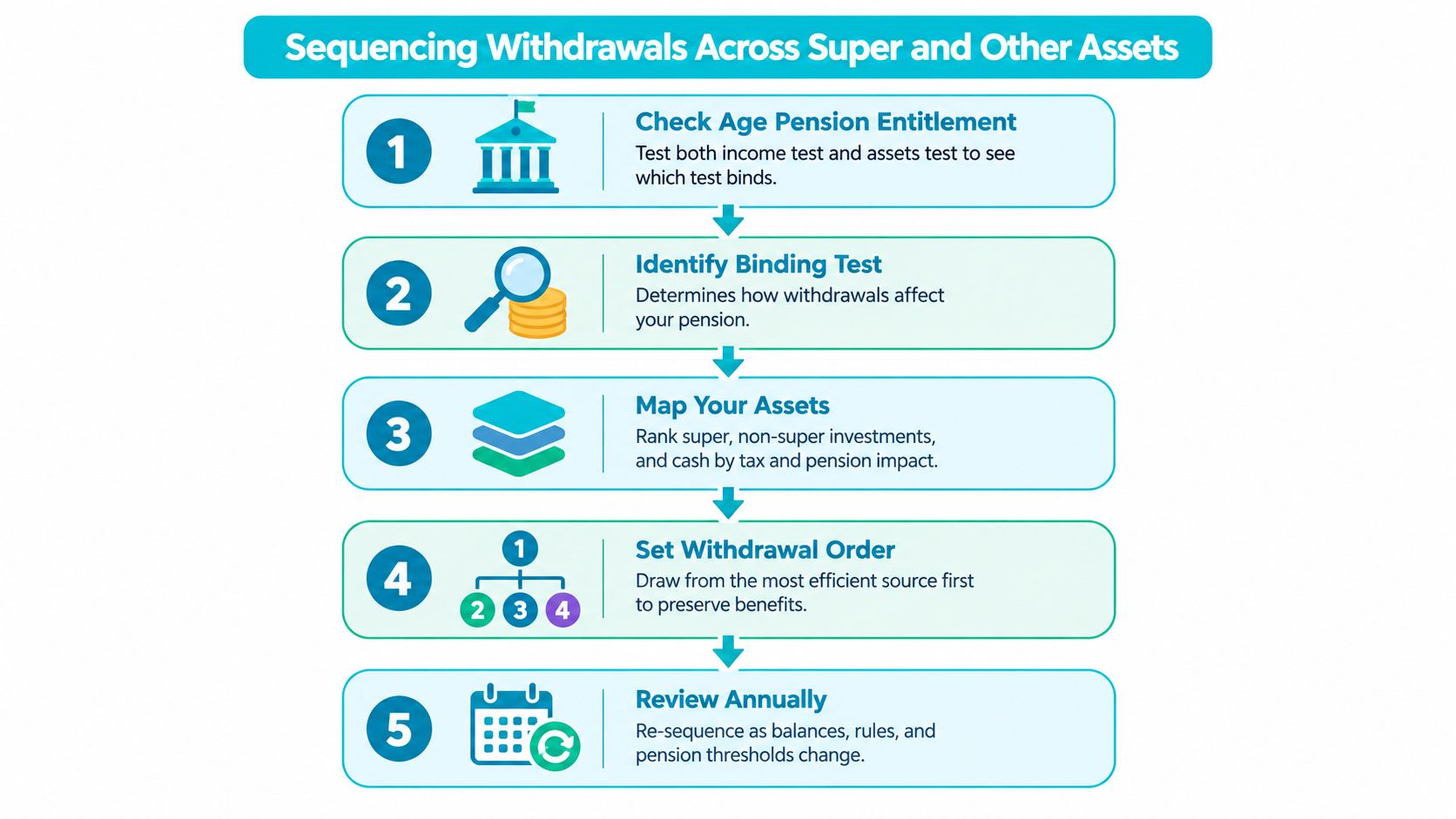
Follow this order:
- Check Age Pension entitlement. Run the income and assets tests using current balances.
- Identify the binding test. This tells you whether the next withdrawal is more likely to affect assets, deemed income or neither.
- Map every asset. Include super, bank accounts, shares, managed investments, vehicles and the home's treatment under the rules.
- Set the withdrawal order. Consider tax, liquidity and pension impact together.
- Review annually. Balances, spending and circumstances change.
Don't assume super should always come first
A taxable investment account may create tax consequences when you sell, but leaving it untouched while drawing heavily from super may not be optimal either. Conversely, preserving an account-based pension to delay withdrawals can be counterproductive if your Age Pension result or spending needs point in another direction.
The principal residence is treated differently under the assets test, while financial assets generally need to be considered. That's why the home, cash reserves and investment portfolio belong in the same model. A sequence-of-returns risk review can help you examine whether early withdrawals would force sales after a market fall, but it should sit alongside Age Pension modelling.
An extra super withdrawal can also alter the position in ways that surprise people. If the money becomes assessable cash or another financial asset, the pension result may change under deeming or the assets test. The effect can exceed the face value of the withdrawal once the combined calculation is applied. Don't treat a withdrawal as “extra income” until you've checked the net result after pension changes and tax.
Make major withdrawals deliberate
For a substantial one-off expense, run the numbers before selling investments or increasing pension payments. Check whether spending, gifting, debt reduction, a downsizer contribution or restructuring assets changes which test binds. Gifting also has rules and should never be used casually to chase an Age Pension outcome.
The sensible instruction is simple: test the combined system before each major withdrawal, then choose the source that preserves the most useful mix of cash flow, pension support, tax efficiency and investment flexibility. The answer may change from year to year.
Two Real Scenarios Worth Stress Testing
The following examples are planning illustrations, not personal recommendations. They show why the same withdrawal rule can produce very different decisions depending on the household's assets, goals and Age Pension position.
Scenario A focuses on a part pension
A couple, both aged 67, have $450,000 in combined super and a $650,000 paid-off home. Their priority is to make their resources last while using an Age Pension as a top-up. They don't rush to withdraw every available dollar from super. Instead, they review the income and assets tests, confirm how their home is treated, assess their other financial assets and consider whether planned spending or permitted gifting changes the result.
Their cash-flow worksheet separates three sources:
- Super drawdown: The amount required to meet the target after considering the Age Pension.
- Age Pension: The entitlement calculated under the applicable income and assets tests.
- Net income: The combined amount available after relevant tax and investment effects.
They might preserve more super than a self-funded retiree would, using the pension as a stabilising income source. The point isn't to maximise the Age Pension at any cost. It's to compare the value of retaining super against the value of receiving government support, while keeping enough liquidity for real expenses.
Scenario B prioritises capital preservation
A self-funded retiree, aged 67, has $1.8 million in super and $900,000 in shares outside super. Their priority is to preserve capital, retain growth exposure and fund spending from a mix of dividends and a modest non-super withdrawal. They may choose to take the required minimum from the account-based pension while allowing the remaining assets to compound, subject to the investment risk they can tolerate.
That approach has its own vulnerabilities. Shares outside super can fall, dividends can change and a minimum pension payment still needs to be coordinated with the broader income plan. The retiree might hold a cash reserve for near-term expenses, but shouldn't assume that moving everything to defensive assets removes longevity risk.
Apply the same market shock to both
A proper stress test applies a 15% fall in year one and keeps withdrawals flat, then examines a recovery overlay. The first scenario may have more support from the Age Pension, which can reduce reliance on super during a weak market. The second may have greater capital capacity but carries more exposure to investment returns and sequence risk.
| Profile | Assets & Super | Base Year Income Split | Bear Year Outcome | Strategy Focus |
|---|---|---|---|---|
| Part-pension couple | $450,000 super, $650,000 paid-off home | Super drawdown plus Age Pension top-up | Review withdrawals, pension entitlement and cash reserves after the fall | Coordinate tests, spending and preservation |
| Self-funded retiree | $1.8 million super, $900,000 external shares | Minimum super payment plus dividends and modest portfolio withdrawal | Keep essential spending funded, reassess discretionary withdrawals and asset sales | Capital preservation with continuing growth exposure |
The lesson is not to copy either set of figures. Identify which profile resembles you, then borrow the logic. A household relying on an Age Pension needs a different sequencing decision from a self-funded retiree, even if both are the same age.
Your Annual Drawdown Review Checklist
A retirement drawdown strategy needs a calendar. Without one, retirees tend to review the plan only after a market fall, a tax bill or a major life event. The Wealth Collective Retirement Roadmap approach gives the review a fixed rhythm, with a clear action attached to each checkpoint.
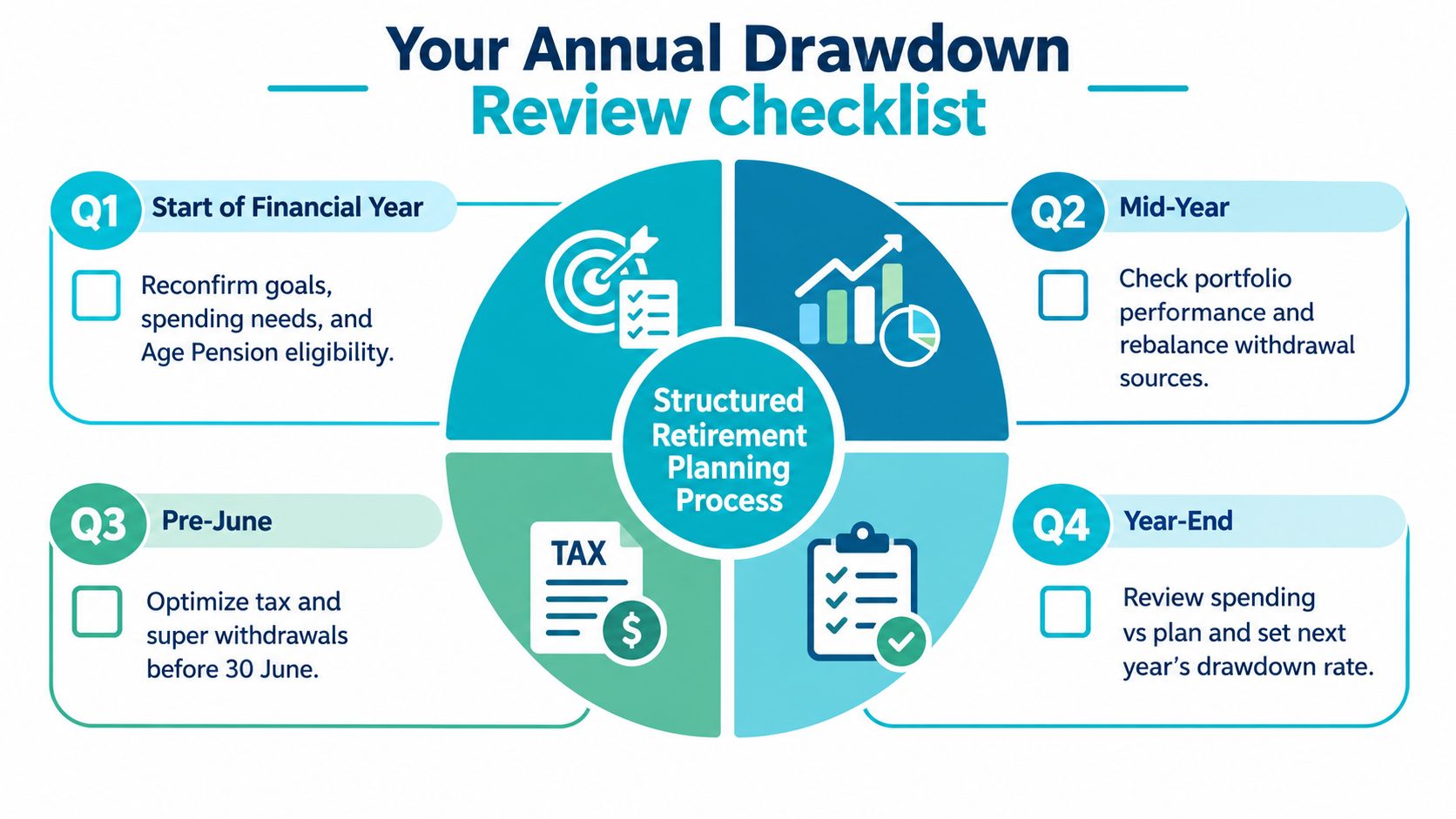
Start of the financial year
Reconfirm what the money needs to do. Review essential spending, discretionary plans, large upcoming costs, account-based pension payments and Age Pension status. Compare the planned income with the previous year's actual spending.
Trigger to act: Your spending target has changed, your relationship status has changed, or your pension circumstances no longer match the previous model.
Move to make: Update the target income, confirm the minimum payment and rerun the income and assets tests.
September quarter
Review the investment mix and withdrawal sources. If the portfolio has drifted from its intended allocation, rebalance rather than allowing market movements to make the decision for you. Check whether the current drawdown rate still fits the portfolio and the household's flexibility.
Trigger to act: The portfolio no longer matches the agreed risk level, or withdrawals are being funded from an asset that creates an avoidable tax or pension consequence.
Move to make: Rebalance, replenish the cash reserve if appropriate and update the withdrawal order.
December quarter
Focus on tax and super administration. Check whether an additional drawdown is useful, whether unused concessional contribution capacity is relevant for someone still working, and whether crystallising a capital gain in the current financial year fits the wider plan.
Trigger to act: A taxable income change, a large realised gain, a contribution opportunity or a planned one-off payment.
Move to make: Have the tax consequences modelled before acting. Don't create a tax problem by chasing a small planning benefit.
March quarter
Run the life check. Review health, aged care preferences, beneficiary nominations, insurance held through super and any change in family support or estate intentions.
Trigger to act: A health event, a new care requirement, a death or birth in the family, or a change to your intended beneficiaries.
Move to make: Update the Retirement Roadmap, estate documents and cash-flow assumptions.
Two events justify an out-of-cycle review. The first is a market fall of more than 10% that breaches your dynamic spending floor. The second is a sharp balance increase that creates room to consider gifting, additional contributions or higher lifestyle spending without putting the core plan at risk.
Recreate this one-page summary
Keep these fields in a spreadsheet or printed folder:
- Target income: Essential and discretionary amounts.
- Minimum payment: Age-based requirement and account balance used.
- Income sources: Super, Age Pension, dividends, interest and other payments.
- Binding test: Income test, assets test or both.
- Withdrawal order: Which account funds the next planned expense.
- Portfolio position: Current mix compared with the intended mix.
- Guardrail action: What changes if the portfolio falls or rises outside the agreed band.
- Life updates: Health, beneficiaries, insurance and aged care considerations.
- Next review date: The person responsible for each action.
A review should leave you with decisions, not just updated balances.
Wealth Collective's Retirement Roadmap helps Perth and Dunsborough clients coordinate super drawdowns, Age Pension interactions, investment risk and changing spending needs in one practical plan. Visit Wealth Collective to book an initial call and start testing your retirement income before the paycheque stops.