Business hours
Monday to Friday (8.30AM - 5PM)
Weekend (Closed)



For 2026–27, the non-concessional contributions cap is $130,000, up from $120,000 in 2025–26 because of AWOTE indexation. That's the maximum after-tax super contribution you can generally make for the year without creating an excess contribution problem.
You may be planning to sell an investment, receive an inheritance, or move cash savings into super before retirement. The opportunity can be valuable, but the headline cap is only the starting point. Your total super balance, measured at the relevant date, determines whether you can use the ordinary cap, access the bring-forward rule, or make any non-concessional contribution at all.
Understanding the Non-Concessional Contributions Cap
A $900,000 total super balance can change the answer before you transfer a dollar. For example, if you plan to contribute $130,000 in July 2026, your eligibility depends on your total super balance at the relevant 30 June, not only on the cash available. The Australian Taxation Office's explanation of the non-concessional contributions cap sets out the rules that apply.
Non-concessional contributions are after-tax contributions. You make them from money for which you have not claimed a tax deduction. Employer contributions, salary sacrifice, and personal contributions claimed as deductions generally fall under the concessional rules instead.

Why the limit matters
The cap restricts how much personal wealth can enter super under the after-tax rules. The annual amount is only one part of the decision. Your total super balance can determine whether you can use the ordinary cap, start or use a bring-forward arrangement, or make a non-concessional contribution at all.
This creates a common trap for high earners. A person may have enough cash for a large contribution, yet a high total super balance can restrict access to the bring-forward rules. A contribution made without checking that interaction can produce an excess contribution and additional tax consequences.
Practical rule: Confirm your available cap and bring-forward position before transferring money.
Gather records from every super account, including older accounts and self-managed funds. Confirm that the proposed payment is after-tax, review contributions already made during the financial year, and check your total super balance from the relevant prior 30 June. Treat the annual cap as a limit subject to eligibility rules, not as an automatic personal allowance. For a large contribution, obtain personalised advice from Wealth Collective before acting.
How the Cap Applies to Your Superannuation
The cap applies to you as an individual, not separately to each super fund. If you hold an industry fund, a retail super account and a self-managed super fund, the ATO aggregates your non-concessional contributions across those accounts.
Splitting a contribution between funds doesn't create additional capacity. For example, directing part of an after-tax contribution to one fund and the remainder to another still counts towards your combined cap. The ATO's contribution caps guidance confirms that non-concessional contributions are aggregated across all super funds.
The practical calculation
Before making a payment, review:
- Every super account: Include funds you no longer actively monitor. An old account can still contain contributions relevant to your cap.
- Contribution type: Confirm that the payment is after-tax and therefore treated as non-concessional rather than concessional.
- Financial year timing: Check when the fund receives and records the contribution. Timing can affect which year's cap applies.
- Existing contributions: Include earlier after-tax payments made during the same financial year.
- Bring-forward status: Check whether an earlier large contribution has already started a bring-forward period.
The cap is also indexed to average weekly ordinary time earnings, or AWOTE. The ATO reviews the threshold annually, so the amount can change as wage levels change. For 2026–27, that indexation produces the $130,000 cap, compared with $120,000 for 2025–26.
This annual adjustment means you shouldn't build a long-term contribution strategy around one fixed dollar amount. Recalculate your position when preparing each major contribution, particularly after a property sale, business transaction or other liquidity event.
The most common operational mistake is relying on one fund's statement. Fund records may show what that fund received, but they won't necessarily show the complete picture across your superannuation interests. Use consolidated records and obtain advice when the amount is material.
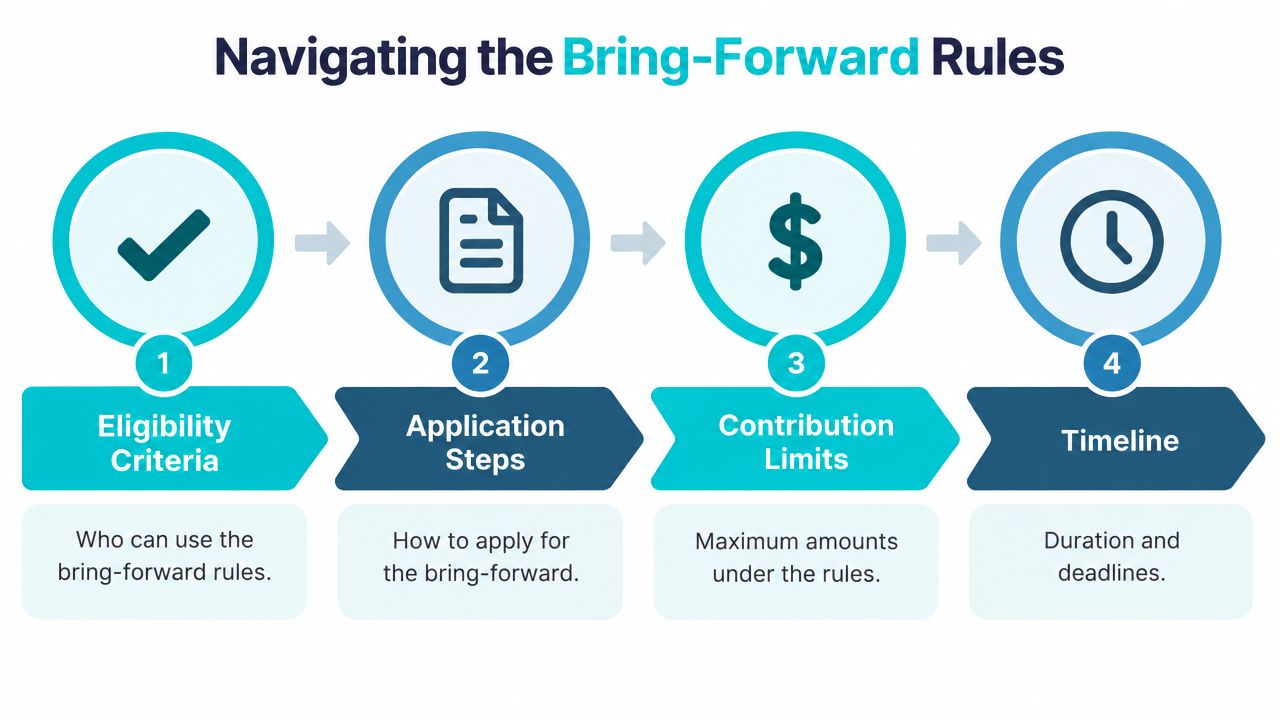
Navigating the Bring-Forward Rules
The bring-forward rule allows an eligible person to use up to three years of non-concessional contribution capacity in one financial year. For 2026–27, the full three-year amount is $390,000, subject to the relevant total super balance threshold.
This rule suits someone with a large amount of available cash who wants to make a substantial contribution now rather than contribute gradually. It can also help a pre-retiree position personal savings inside super before retirement, provided the contribution fits their balance, cash-flow and broader retirement plan.
Follow the rule in the right order
Check eligibility first. Your total super balance at 30 June of the previous financial year determines whether you can use the rule. Don't assume a large balance automatically qualifies for the full amount.
Confirm the available amount. The standard annual cap and your balance threshold determine how much you can contribute. The full three-year amount isn't available to everyone.
Understand the timing effect. Using future capacity early affects what you can contribute in the following financial years. A large contribution today can reduce flexibility later.
Record the decision. Keep contribution confirmations, fund statements and advice documents. Your accountant or adviser needs accurate records to assess later contributions.
The ATO-linked bring-forward rule guidance for non-concessional contributions can help you understand the mechanics, but a general explanation can't determine your personal available capacity. Your records, age, total super balance and previous contribution history all matter.
Don't contribute first and investigate later. The fund may accept the money even when the contribution creates an excess. Acceptance by the fund doesn't mean the contribution complies with the rules.
Your Total Super Balance and Cap Eligibility
Your total super balance is the key gatekeeper for the bring-forward rule. The relevant figure is measured at 30 June of the previous financial year, not on the day you decide to contribute. For 2026–27, that means the balance measured at 30 June 2026 determines eligibility.
The thresholds create three distinct outcomes:
| Total super balance at the relevant 30 June | 2026–27 contribution position |
|---|---|
| Under $1.84 million | May access the full three-year bring-forward amount of $390,000 |
| $1.84 million to under $2.1 million | The annual $130,000 cap applies |
| $2.1 million or more | The non-concessional cap is effectively nil |
These thresholds are set out in the 2026–27 bring-forward threshold information from QSuper. The important point is that a person with a balance just below a threshold can have a materially different contribution option from someone just above it.
The trap for high earners
High earners often focus on available cash and overlook the balance test. Someone may have enough money to contribute $390,000, but a total super balance between $1.84 million and $2.1 million means only the annual cap applies. A balance of $2.1 million or more makes the non-concessional cap effectively nil for the relevant year.
Check all super interests when determining the balance. The same person's accounts are combined for this purpose, so a large balance isn't hidden by holding money across several funds.
You should also review whether an earlier bring-forward period is already active. For a broader discussion of contribution timing and superannuation strategy, see this guide to unused super cap and carry-forward considerations. It addresses a different contribution mechanism, but the underlying lesson is the same: capacity depends on your complete records and personal position.
Tax Consequences of Exceeding the Cap
An excess contribution can result from an ordinary administrative oversight. A payment may leave your bank account while another contribution has already been processed, leaving the combined amount above your personal capacity. Fund acceptance does not confirm that the contribution fits within your cap.
The key decision is what happens after the ATO identifies the excess. You may be offered the option to release the excess amount and associated earnings from super. The associated earnings are included in your personal income tax assessment, with a tax offset applying to those earnings. You can instead leave the excess in super and pay excess non-concessional contributions tax. Compare both outcomes before choosing, because the better option depends on your assessment and personal circumstances.

What to do if a payment may be excessive
Stop further after-tax contributions until you know your position.
- Gather the evidence: Collect transaction receipts, fund confirmations and statements from every super account.
- Check the classification: Confirm which payments were treated as non-concessional and whether any payment was intended to be concessional.
- Review your balance: Recheck the total super balance used for eligibility and bring-forward purposes, including whether an active bring-forward period affects your available capacity.
- Wait for formal direction: The ATO determines the relevant excess and presents the available options through its assessment process.
The release option requires careful review. Releasing the excess can return money to you, but associated earnings are dealt with through your income tax assessment. Leaving the amount in super avoids a release request, but excess non-concessional contributions tax applies. Do not choose based only on the contribution amount. Consider the earnings calculation, tax result and effect on your retirement savings.
Do not move the money between funds to try to correct the issue. A transfer does not erase the original contribution or create new capacity. Obtain advice before requesting a release, accepting an excess assessment or making another payment. The interaction between your total super balance and bring-forward status makes a personalised Wealth Collective review worthwhile for high earners.
Strategic Planning for Pre-Retirees and High Earners
The right strategy starts with purpose, not the maximum contribution. A pre-retiree may want to move surplus cash into super, while a high earner may need to coordinate after-tax contributions with employer payments, investment structures and future liquidity needs. In both cases, contributing the largest permissible amount isn't automatically the best decision.
For someone approaching retirement
Use the bring-forward rule only when the funds are surplus to near-term needs. Keep enough liquidity for living costs, debt repayments, property expenses and unexpected commitments. Super is a long-term structure, so an attractive tax setting doesn't remove the need for accessible cash.
A large contribution also needs to fit your investment plan. Review how the money will be invested, whether the fund structure remains suitable and how the contribution interacts with retirement income planning. The contribution is one decision within a broader Retirement Roadmap, not a standalone transaction.
For high earners
High earners should coordinate records across employers, funds and personal accounts. Contributions can arrive through different channels, and an after-tax payment made at the same time as other super activity can be overlooked.
Use a written decision process:
- Confirm the total super balance at the relevant 30 June.
- Calculate the available non-concessional capacity.
- Identify any existing bring-forward period.
- Check the proposed payment against cash-flow requirements.
- Document the contribution date, amount and destination fund.
Wealth Collective helps clients assess superannuation optimisation alongside investment strategy, debt reduction and retirement planning. Its Protection Plus, Guided Growth and Retirement Roadmap service pillars provide a framework for connecting the contribution decision with broader wealth priorities. The value lies in making the numbers, timing and personal objectives work together.
Taking Action with Wealth Collective
Start by listing every super fund, recording your recent after-tax contributions and obtaining your total super balance at the relevant 30 June. Then ask whether the proposed contribution supports your retirement income needs, investment plan and access to cash.
An adviser can help test your eligibility, identify whether the bring-forward rule applies and document the steps before money moves. If you want help finding an appropriate specialist, use this guide to find a superannuation financial adviser.
Wealth Collective can review your superannuation position and connect contribution decisions with protection, investment growth and retirement planning. Book an initial call before making a large after-tax contribution, especially if your total super balance is near a threshold.
Visit Wealth Collective to arrange an initial call about your non-concessional contributions capacity and retirement strategy. Their advisers can help you turn the cap, balance thresholds and bring-forward rules into a documented plan suited to your circumstances.