Business hours
Monday to Friday (8.30AM - 5PM)
Weekend (Closed)


You've worked hard, built up super, paid down some debt and perhaps accumulated investments. Yet as retirement approaches, a basic question can still feel impossible to answer: how much can you spend without running out of money? That uncertainty is common in Western Australia, particularly for pre-retirees who have assets but no clear sequence for turning those assets into income.
A personalized financial plan closes that gap. It connects your cashflow, superannuation, investments, insurance, debt, tax position, retirement income and estate wishes into one practical decision-making system. The aim isn't to predict the future perfectly. It's to give you a clear plan for making better decisions as your circumstances change.
Why You Need a Personalized Financial Plan
A couple in their early sixties might have a substantial super balance, a mortgage that's nearly cleared and no immediate income problem. Still, they hesitate before booking a holiday, helping an adult child or replacing an ageing car. They're worried that every dollar spent today could reduce their security later.
That's the confidence-to-spend gap. The problem isn't always the size of the balance. Often, it's the absence of a clear retirement-income plan showing what can be spent, when withdrawals should come from super, how long savings need to last and what happens in an adverse market.
ASIC reports that 48% of Australians aged 50 to 66 worry they'll run out of money in retirement, while 32% feel behind in their preparation and only 18% have a clear retirement plan. The same ASIC release says 85% of non-retired Australians who receive advice feel they're on track to reach their retirement goals. Those figures point to a planning problem, not merely an investment problem. (ASIC's retirement planning findings)

The advice shortage changes the way you plan
Australia's advice system has a structural capacity problem. The number of qualified financial advisers fell from about 28,900 in late 2018 to roughly 15,135 by 12 March 2026, a decline of 48% in less than eight years. At the same time, 10.2 million Australian adults planned to seek financial advice, and 16.4 million said they need financial help or guidance, including 30% who want help making money last through retirement. (Super Members Council research)
That shortage means you need a plan that remains useful whether you work with an adviser, use a limited-scope service or manage many decisions yourself. Start with written assumptions, separate essential spending from discretionary spending, and record why you chose each contribution, investment and withdrawal decision.
A clear explanation of the broader process is available in this guide to what financial planning involves. For specialist lending situations, readers may also find this resource on hard money lender financial advice useful, although property finance should sit within a wider plan rather than drive it.
Practical rule: If your plan can't tell you what to do next month, next year and when markets fall, it isn't finished.
A personalized financial plan should answer four questions: what are you trying to achieve, what resources do you have, what risks could derail you, and what decisions must happen in what order? That structure gives you confidence to spend because every withdrawal has a purpose and a contingency behind it.
Setting Your Financial Goals and Reviewing Your Cashflow
Start with goals, not products. A plan built around super funds, managed investments or insurance policies before defining the outcome usually becomes a collection of accounts rather than a strategy.
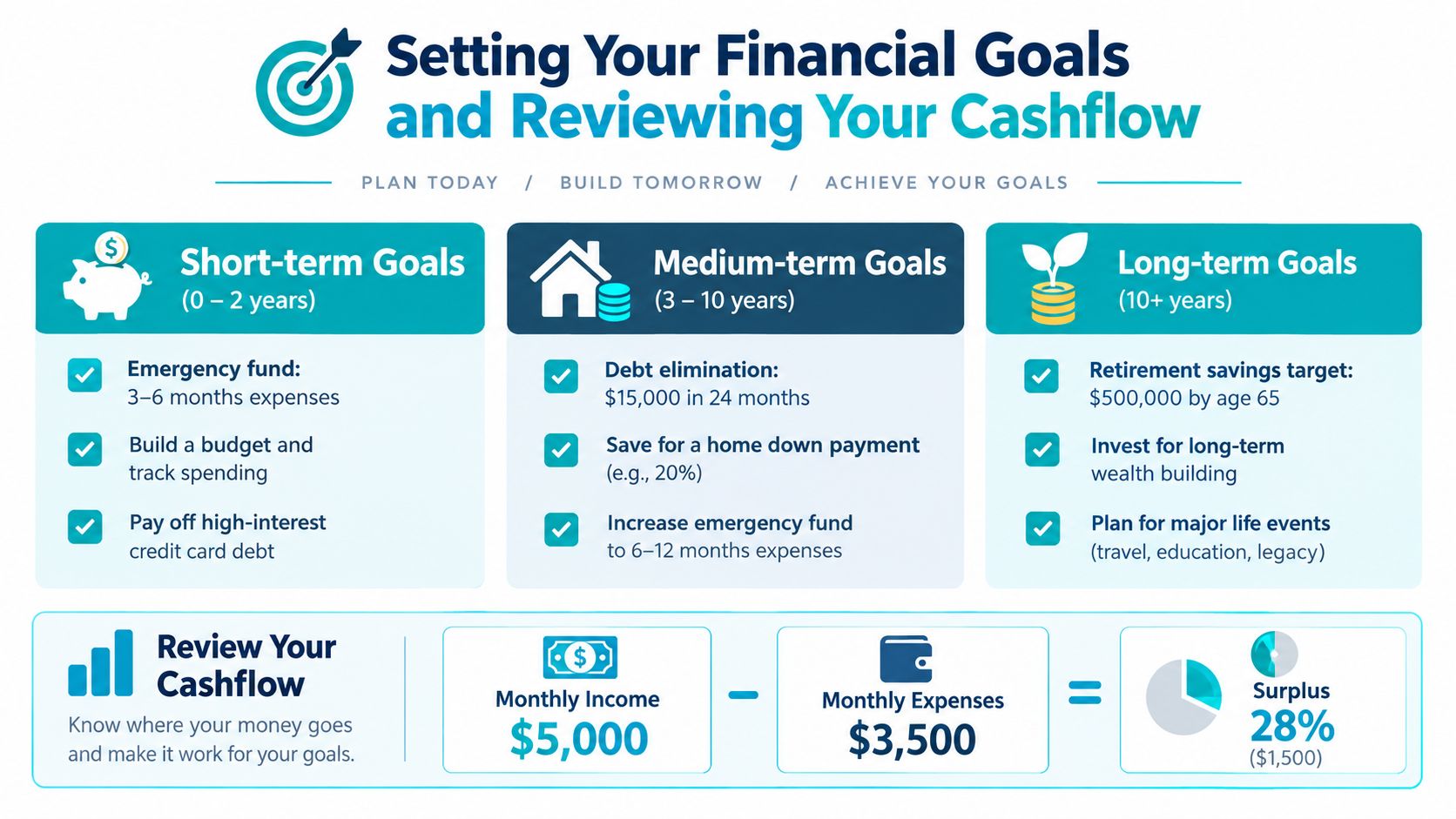
Write down what you want your money to do across three time horizons:
- Short term: Build a cash reserve, replace a vehicle, take a planned trip or remove an expensive liability.
- Medium term: Reduce the mortgage, fund education costs, support family or prepare for a business transition.
- Long term: Stop work on your preferred timetable, maintain a chosen lifestyle and leave assets in the way you intend.
Give each goal a cost, a timeframe and a priority. You don't need false precision. You do need to know which goals are essential, which are flexible and which should be delayed if cashflow tightens.
Turn cashflow into a decision tool
Review at least several months of bank and credit-card transactions. Sort spending into essential costs, lifestyle choices, irregular commitments and wealth-building transfers. Annualise expenses that arrive less frequently, such as insurance, registration, school costs or travel, so they don't surprise your monthly budget.
Then calculate your reliable surplus. If income rises but spending absorbs the increase, your plan won't improve. Redirecting even a modest recurring amount towards debt reduction, salary sacrifice or an investment account can strengthen your position, but the amount must be sustainable. A contribution strategy that causes repeated cashflow stress isn't a good strategy.
Use cashflow management to connect daily decisions with larger goals. The useful question isn't “Where did all the money go?” It's “Which spending creates value for us, and which spending is blocking the next priority?”
Protect the plan before you optimise it
Insurance is the defensive layer of financial planning. Review personal life cover, total and permanent disability cover, income protection and relevant health insurance against your debts, dependants, employment arrangements and available assets.
Check whether cover is held inside super or outside it, who owns the policy, how premiums affect cashflow and whether exclusions or waiting periods matter. A household that relies heavily on one income has a different risk profile from a household with diversified income and substantial liquid reserves.
Your first practical actions are straightforward:
- Write three priority goals: Give each one a timeframe and a consequence if it isn't met.
- Review your transactions: Separate essential spending from choices and irregular costs.
- Check your protection: Confirm that a serious illness, disability or premature death wouldn't destroy the strategy.
Those steps create the base for decisions about super, investments and retirement income.
Optimizing Superannuation and Investment Strategy
Superannuation is the centre of most Australian retirement plans, but a large balance alone doesn't guarantee a workable income. The strategy must address contribution timing, fees, investment risk, tax treatment, beneficiary arrangements and how the balance will eventually be converted into spending.
Australia's superannuation system held $4.5 trillion in assets at the end of the December 2025 quarter. Employer contributions totalled $156.3 billion for the year to December 2025, up 8.6% year on year, while member contributions rose 19.2% to $64.5 billion. These figures show the scale of the system and the importance of making deliberate decisions about contributions rather than treating super as an automatic outcome. (ASFA superannuation statistics)
Improve the contribution engine
For employed professionals, salary sacrifice can redirect pre-tax income into super, subject to applicable contribution limits and personal circumstances. Catch-up contribution rules may also help eligible people use unused concessional capacity, but this needs to be checked against prior contributions and current income.
Start by comparing three positions:
- What your employer contributes.
- What you contribute personally.
- What contribution level supports your retirement target without damaging near-term cashflow.
The right amount depends on your age, income, existing balance, investment mix, debt and intended retirement date. A young professional with decades to invest may prioritise regular contributions and growth exposure. Someone approaching retirement may need more attention on sequencing, liquidity and income testing rather than just maximising accumulation.
This guide to maximising superannuation provides a useful starting point for reviewing the main levers. Readers comparing Australian arrangements with overseas workplace pension concepts can also consult this auto enrolment pension rules guide, while remembering that UK rules aren't a substitute for Australian advice.
Match investments to the job each dollar must do
Investment strategy should follow time horizon and purpose. Money needed soon shouldn't carry the same risk as money intended to fund later retirement years. A diversified portfolio may include defensive and growth assets, but the allocation needs to reflect your ability to tolerate losses, not just your preferred return.
Consider dividing the plan into functions:
- Near-term spending: Cash and defensive assets for expected withdrawals.
- Medium-term funding: A balanced allocation designed to replenish spending reserves.
- Long-term growth: Diversified growth assets intended to support later-life income and inflation protection.
Don't choose an investment option because it performed well recently. Review fees, asset allocation, liquidity, insurance settings and how the option behaved during difficult markets. A plan also needs a rebalancing rule, because an unmonitored portfolio can gradually become more aggressive or defensive than intended.
A super strategy is incomplete until it explains both how money enters the account and how money will leave it.
That second question is where many plans fail. Contribution optimisation may build wealth, but retirement-income testing determines whether you can use it confidently.
Managing Debt and Building a Retirement Roadmap
Debt competes directly with wealth building. A household paying high interest on consumer or personal debt has less capacity to invest, contribute to super or build a cash reserve. The solution isn't to eliminate every liability automatically. It's to rank debt by cost, risk and strategic importance.
Use a repayment method you'll follow
List each liability with its balance, interest rate, minimum repayment, loan term and security. Then choose a method:
- Avalanche method: Direct extra repayments to the highest-interest debt first while maintaining minimums elsewhere. This usually reduces interest most efficiently.
- Snowball method: Clear the smallest balance first to create visible progress and free a repayment sooner.
- Strategic offset method: Where an offset account is available, compare the guaranteed interest benefit with investment opportunities and the need for accessible cash.
Avoid making extra repayments without keeping enough liquidity for emergencies and known commitments. Once a debt is cleared, redirect the old repayment immediately. Otherwise, lifestyle spending will absorb the surplus.

Build retirement income in the right order
Begin with essential annual spending. Separate housing, food, utilities, transport and healthcare from travel, gifts and discretionary upgrades. Then test how those costs could change across retirement, rather than assuming today's spending pattern will remain fixed.
Next, map the likely income sources:
- Superannuation pension payments.
- Personal investments and cash reserves.
- Employment or business income during a transition.
- Potential Age Pension eligibility.
- Property income or other reliable sources.
ASFA's published Retirement Standard gives a reference point, not a personal answer. For a comfortable retirement at age 67, it lists $730,000 in super for a couple and $630,000 for a single person. Its modest retirement estimates are $120,000 for a couple and $110,000 for a single person. (ASFA Retirement Standard)
Use those figures to start a conversation about lifestyle, then model your own spending, assets and likely Age Pension position. A retirement roadmap should also test inflation, longevity, market falls, health costs and the possibility that one partner needs care.
A practical retirement plan sets a withdrawal sequence and review triggers. Review it after a major market movement, a change in health, a relationship change, a property sale, an inheritance or a decision to work longer. A short guide on retiring at 60 can offer general ideas, but your retirement date should follow your cashflow and risk capacity, not a generic age.
Estate Planning and Protecting Your Wealth
A financial plan shouldn't stop at the date you retire. It must also explain what happens if you lose capacity, die unexpectedly or need to transfer assets between generations.
Start with the legal foundations. Keep your will current, appoint appropriate decision-makers for financial and medical matters, and make your wishes clear to the people who may need to act. If you have children or dependants, consider guardianship arrangements and the practical support they'd need, not just the assets they may inherit.
Superannuation requires special attention because it generally doesn't pass through a will automatically. Review binding or non-binding beneficiary nominations, the tax implications for different beneficiaries and whether your nomination still reflects your relationship and family circumstances.
Match structures to the family
Trusts, companies, joint ownership, testamentary arrangements and insurance can each play a role, but none should be added just because they sound impressive. The structure must solve a real problem, such as asset protection, control, continuity, tax treatment or support for a vulnerable beneficiary.
Coordinate your financial adviser, solicitor and accountant. Your adviser can model the financial consequences, but legal documents need to be prepared and reviewed by an appropriately qualified legal professional.
Review the plan after marriage, separation, a birth, a death, a major asset purchase, a business change or a significant inheritance. Beneficiary nominations and ownership records should be checked alongside the will, because a technically valid document can still produce an outcome you didn't intend if the wider arrangement is inconsistent.
Legacy check: Your estate plan should answer who receives each asset, who controls the process and what happens if you can't make decisions yourself.
Wealth protection also includes liquidity. A family may own valuable property and investments yet lack accessible funds for tax, legal costs, repairs or immediate support. Keep the estate plan connected to cash reserves, insurance and the retirement-income strategy.
Taking the Next Step with Professional Guidance
A personalized financial plan should leave you with more than a list of recommendations. It should show your priorities, cashflow, contribution strategy, investment settings, debt actions, insurance needs, retirement income sequence and estate planning issues in one organised framework.
Professional advice is particularly valuable when decisions interact. Increasing super contributions may affect cashflow. Paying down debt may change investment timing. Retiring earlier may alter insurance needs, pension withdrawals and Age Pension eligibility. These are sequencing questions, and they're difficult to resolve by looking at one product at a time.
The advice shortage makes a hybrid model practical. You can gather documents, track spending, consolidate your questions and learn the basics yourself, then use an adviser for modelling, implementation and review. This approach gives you control without forcing you to solve every technical decision alone.
For younger households, the first priorities may be protection, debt reduction, super consolidation and a sustainable investing habit. For high-income earners, executives and business owners, the focus may shift towards tax-effective contributions, investment structure, risk management and succession. For WA pre-retirees, the central issue is often converting super and savings into a spending plan that feels safe enough to use.
Wealth Collective's process starts with a discovery conversation about your circumstances, goals and concerns, followed by research, modelling and a written strategy. Its service pillars cover Protection Plus, Guided Growth and Retirement Roadmap, connecting personal insurance, superannuation, investments, debt and retirement planning in one advice process.
Book an initial call when you're ready to replace uncertainty with decisions. Bring your latest super statements, debt details, income information and a rough picture of the retirement lifestyle you want. You don't need perfect records. You need a clear starting point and the willingness to act on the next step.
Wealth Collective helps Australians build a personalized financial plan covering cashflow, insurance, superannuation, investments, debt and retirement income. Visit Wealth Collective to arrange an initial call and discuss the decisions that matter most to your financial future.