Business hours
Monday to Friday (8.30AM - 5PM)
Weekend (Closed)


Are you comparing agreed value and indemnity income protection by the monthly premium, or by the amount you could keep after tax when your income has already fallen? That distinction matters because a policy can look generous on paper and still leave your household short when illness or injury stops you working.
For Australian professionals, contractors, executives, small-business owners and pre-retirees, the key decision is about payout certainty, income evidence and cash flow under pressure. A cheaper policy isn't automatically better value if the benefit is reassessed against a temporarily depressed income at claim time.
Why Agreed Value vs Indemnity Income Protection Matters More Than Premiums
Income protection sounds simple until you need to claim. The important question isn't just whether the policy pays. It's how the insurer decides what to pay.
Under agreed value cover, the insurer assesses your income when the policy begins and establishes the monthly benefit in advance. Under indemnity cover, the insurer tests your eligible income around the time of claim. If your salary, business revenue or working hours have fallen, the amount payable can fall with them.
| Feature | Agreed value | Indemnity |
|---|---|---|
| Income assessment | Generally completed when the policy begins | Verified around claim time |
| Benefit certainty | The insured benefit is generally established upfront | The final benefit depends on current eligible income |
| Main exposure | Higher premium and the need for accurate application evidence | A lower payout after an income decline |
| Common fit | Volatile or difficult-to-document earnings | Stable income with clear records |
| Claim focus | Whether the policy terms and disability definition are met | Disability terms plus proof of income at claim time |
Australia's move away from new agreed-value income protection followed serious deterioration in individual disability income insurance. APRA material published through ASIC reported approximately A$3.4 billion in insurer losses over the five years to December 2019, after products were priced too low for the generosity and duration of benefits. Sustainability reforms applied from 2020, with broader benefit and product requirements taking effect by 1 October 2021, and insurers stopped issuing new agreed-value policies.

The decision is about timing
Agreed value moves the key income assessment to the start of the contract. Indemnity moves that assessment to the claim. That timing difference creates very different risks for someone whose income changes because of a career move, business slowdown, reduced hours, parental leave, sabbatical or transition into self-employment.
Existing agreed-value policies may remain in force under their terms, but new applicants generally encounter indemnity products. That makes an old policy more than a historical curiosity. It may be a contractual asset that can't be recreated on equivalent terms.
For broader context on how policies are assessed and compared, the 2026 income protection policy guide provides a useful reference point. Australian readers still need to check their own policy wording, because the claim outcome depends on definitions, evidence requirements, offsets and benefit terms.
Practical rule: Never choose income protection by premium alone. Start with the question, “What income will be available to my household if my earnings fall before I claim?”
How Each Policy Type Calculates Your Benefit
What matters at claim time is not the benefit printed on the schedule. It is the income the policy can replace after the insurer applies its calculation method, tax treatment, superannuation provisions and payment timing.
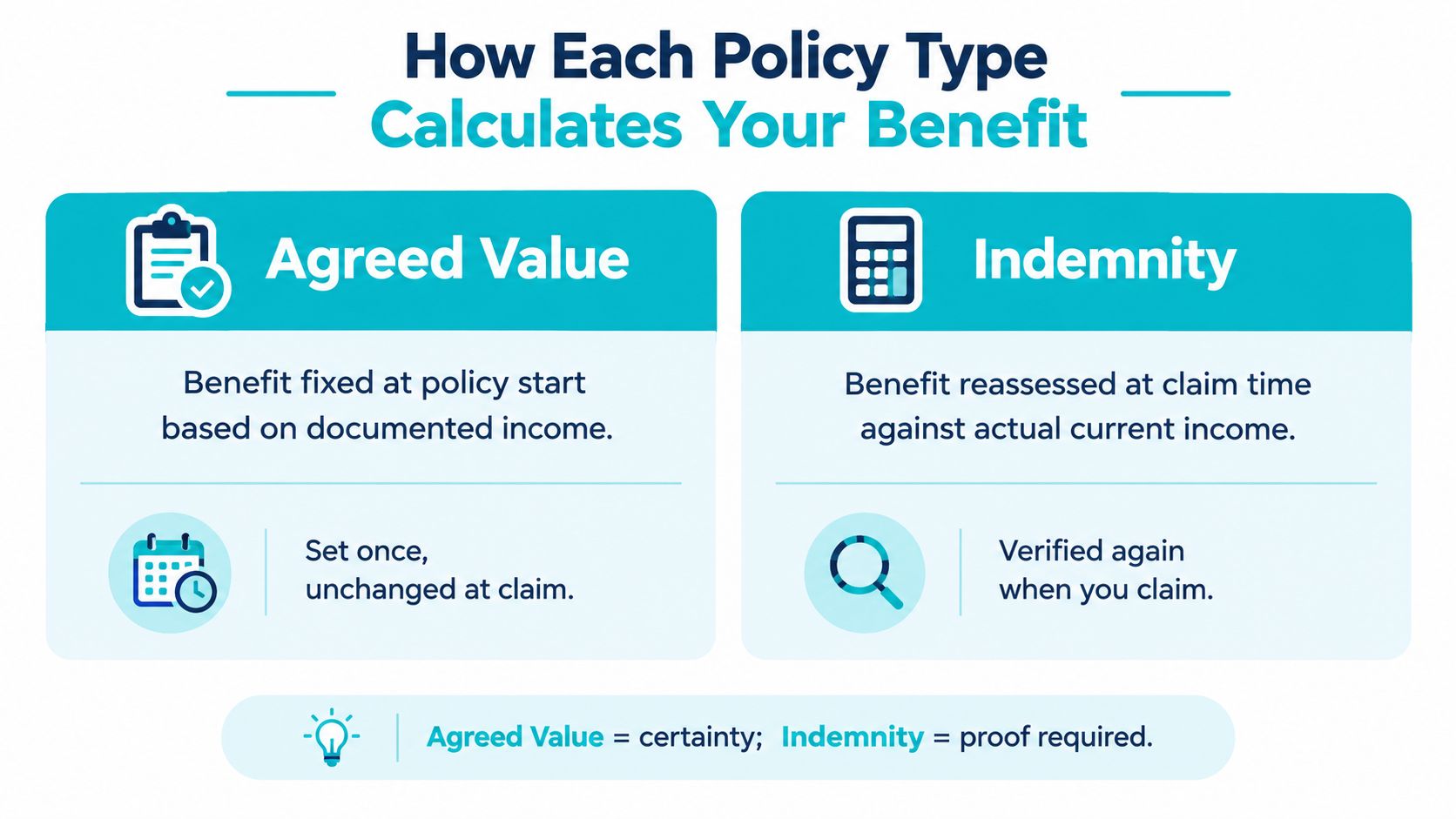
With agreed value, you provide financial evidence when you apply. The insurer assesses that evidence and generally sets the monthly benefit at policy commencement. If your income later becomes uneven or falls, that established benefit generally remains available, provided you meet the policy's disability and claim conditions.
The benefit is still subject to the policy schedule and its other terms. Indexation, offsets, benefit limits, waiting periods, definitions of disability and partial incapacity can all change the amount or timing of payment. Monthly benefits may also be paid in arrears, so your household needs enough cash to cover the period before money arrives. Agreed value reduces one major uncertainty, but it does not remove every claim condition.
The key advantage is that the income assessment happens earlier. The benefit is not ordinarily recalculated just because your earnings later declined. That can protect the intended replacement income when a career change, business slowdown or reduced workload affects your records before a claim.
Agreed value fixes the income assessment earlier
A contractor may have well-documented income when the policy begins, then face irregular work later. Under agreed value, the established monthly benefit generally provides greater certainty, assuming the claim satisfies the policy requirements.
That certainty matters when mortgage repayments, school costs and business commitments continue during an income interruption. It also makes cash-flow planning clearer. You can compare the expected after-tax benefit with essential spending, rather than relying only on the headline amount or assuming superannuation contributions will be included.
Indemnity checks the financial position at claim time
With indemnity, the amount shown on the schedule is not an automatic promise of that payment. The insurer verifies eligible income when you claim and applies the policy's calculation method. APRA defines indemnity value as cover where the insured salary value is verified when the claim is made, as set out in its income insurance definitions.
This can suit a stable PAYG employee with clear, consistent salary records. It creates more pressure for business owners, whose retained profits, dividends, commissions, unpaid work or quiet trading periods can complicate the evidence. A nominal benefit may exceed the amount the insurer can justify from current income.
An ASIC example of income protection mechanics uses a selected monthly benefit of $5,483, plus $783 in superannuation contributions, and explains that a claimant whose income has reduced could receive 70% of the reduced amount under the example's terms. The practical test is simple: calculate the after-tax replacement income, confirm how super contributions are handled, and stress-test the result against a temporary income drop before choosing indemnity cover.
Agreed Value Versus Indemnity Cover – The Real Differences
The premium is only one line in the comparison. The more useful test is whether the policy behaves predictably when your income and capacity to work are under stress.
| Decision point | Agreed value | Indemnity |
|---|---|---|
| Benefit calculation | Generally based on documented income at policy commencement | Based on eligible income verified around claim time |
| Income volatility | More resilient when earnings later fluctuate | More exposed to a low salary, reduced hours or weaker business revenue |
| Application evidence | Requires accurate financial verification upfront | Requires a credible income basis at application and claim-time proof |
| Payment certainty | Greater certainty about the nominated benefit, subject to policy terms | Final amount may remain uncertain until the claim assessment |
| Premium position | May carry a higher premium | May be more economical |
| Main claim risk | The cover may no longer fit if circumstances, terms or affordability change | The benefit may reduce when current earnings are lower |
| Best comparison method | Assess the value of contractual certainty | Assess whether current records will support the intended payment |
The practical trade-off is straightforward. Agreed value buys more certainty earlier, while indemnity places more weight on proof later. Neither label guarantees a satisfactory outcome if the policy has poor disability definitions, unsuitable offsets, an inadequate waiting period or a benefit period that doesn't match your financial obligations.
Indemnity can be sensible where your income is stable, your records are clean and the premium saving has a genuine purpose. It becomes dangerous when someone treats the sum insured as a guaranteed monthly payment despite having a fluctuating income structure.
Agreed value can be economically rational even when the premium is higher. A contractor or company director may be paying for protection against the exact situation indemnity cover handles least comfortably, a claim following an income decline that doesn't reflect the household's ongoing expenses.
Use the income protection policy comparison to structure the review, but don't stop at the product label. Read the calculation basis, income definition, partial disability formula, offsets, indexation, waiting period, benefit period and ownership arrangements.
The cheapest cover is often the cover that assumes your future income will look like your past income. That assumption needs to be tested, not accepted.
Who Each Option Really Suits in Australia
A stable PAYG employee and a company director can hold the same nominal monthly benefit while facing completely different claim risks.
Take a professional employee with consistent salary records and no major change in role. If that person remains on a predictable salary, indemnity verification may be relatively straightforward. The policy can align the payment with actual income loss, and a lower premium may be useful if the household has other reserves or competing financial priorities.
Now consider a contractor whose earnings move between strong and weak periods. The contractor may have a healthy annual income, but the income available around a claim can look very different from the longer-term picture. If the policy relies on claim-time verification, a temporary reduction in projects or billings can affect the payment while rent, debt repayments and household costs continue.
The business owner problem
Company directors face an additional layer of complexity. Personal income may include salary, commissions, dividends or profits retained in the business. A business can remain valuable while the owner's personally assessable income changes, and the documents that demonstrate economic value aren't necessarily the same documents used to calculate an indemnity benefit.
A professional moving from employment into contracting can face a similar mismatch. The person's skills and earning capacity may remain strong, but the early contracting period can produce irregular records. Agreed value may provide more certainty if the existing policy is suitable and affordable. A new indemnity policy needs a careful review of what income the insurer will recognise.
For pre-retirees, declining earnings can create a particularly harsh result. A person may deliberately reduce hours or move into a less demanding role, yet still carry debt and retirement funding obligations. Under indemnity cover, a lower current income can reduce the benefit even though the household's fixed costs haven't reduced in proportion.
| Income profile | More natural starting point | What must still be checked |
|---|---|---|
| Stable PAYG salary | Indemnity may be practical | Salary definition, bonuses, partial disability and tax |
| Contractor with uneven billings | Agreed value may offer greater certainty | Policy terms, affordability and evidence accepted at application |
| Company director | Existing agreed value deserves close attention | Salary, dividends, business revenue and ownership structure |
| Commission-based professional | Either basis requires detailed modelling | How commissions and variable earnings are treated |
| Pre-retiree with tapering income | Avoid cancelling legacy certainty without analysis | Benefit affordability, retirement contributions and claim-time income |
| Dual-income family | Match cover to the actual household gap | Waiting-period liquidity, debt servicing and offsets |
Self-employed readers should also review the guidance on income protection insurance for self-employed people. The right answer depends on how income is generated and documented, not on whether the policy was marketed as simple or affordable.
The Case for Keeping Existing Agreed Value Policies
An existing agreed-value policy isn't automatically obsolete because it was issued years ago. In some circumstances, cancelling it is the most expensive mistake a policyholder can make.
APRA's reforms stopped insurers issuing new agreed-value benefits from 2020, which means many existing policies can't be recreated on equivalent terms. Aptus material on income protection highlights why cancellation needs a policy-specific comparison. The decision involves the value of the existing contractual benefit, not just the premium charged for a replacement indemnity policy.
What cancellation can give away
A legacy agreed-value policy may be especially valuable if your income has since become:
- More variable, because you've moved into contracting or commission-based work.
- Harder to document, because business income is split across salary, dividends and retained profits.
- Lower than before, because you've reduced hours, changed careers or approached retirement.
- Less predictable, because your business or profession has changed direction.
Replacing the policy can also bring a new application and fresh underwriting. Your health, occupation, financial evidence, ownership structure and policy terms may all be assessed again. If the replacement isn't accepted on equivalent terms, the cheaper premium is irrelevant because you've surrendered certainty and received something materially different.
That doesn't mean every old policy should be kept. A policy can be unaffordable, poorly structured or unsuitable for your current objectives. The existing benefit may also be too small, the waiting period may be wrong, or offsets and definitions may create gaps that were acceptable earlier but aren't acceptable now.
Use a replacement test, not a premium test
Before cancelling, compare the following in writing:
- Benefit certainty: What contractual benefit could the existing policy provide if the claim is accepted?
- Income evidence: What would the replacement insurer require at claim time?
- Policy terms: How do disability definitions, partial benefits, offsets, indexation and benefit periods differ?
- Affordability: Can you maintain the existing premium without compromising essential goals?
- Future flexibility: What happens if your earnings fall, your occupation changes or you move fully into retirement?
Do not cancel a legacy agreed-value policy until a qualified adviser has compared the existing contract with an accepted replacement. A generic product summary can't reveal the value of your specific wording.
Stress-Testing Your Policy as Cash-Flow Cover
What would your household have available after tax if you could not work? A headline monthly benefit does not answer that question. Test income protection as a cash-flow and liquidity plan, particularly if you have substantial debt, irregular income or retirement obligations.
Model a 20% to 30% fall in income before the claim, then account for the period without payments. Include a 90-day waiting period, benefits paid monthly in arrears, tax, superannuation contributions and policy offsets. ASIC guidance on income protection and cash flow (INFO 267 attachment) also highlights the need for accessible savings or offset funds during the waiting period and before the first payment arrives.
Build the test around take-home income
Premiums are generally tax deductible, while income-protection benefits are generally assessable as taxable income. A benefit that looks sufficient on the policy schedule can leave a much smaller amount for household spending after tax.
Assess the result in this order:
- Waiting-period liquidity: Can savings or an offset account cover essential commitments before the first payment?
- After-tax replacement income: What amount remains available after tax?
- Debt servicing: Can the household keep meeting mortgage and other debt obligations?
- Retirement funding: Can superannuation contributions continue without exhausting cash reserves?
- Offsets: Could other payments reduce the income-protection benefit?
- Partial disability: What happens if you can work in a reduced capacity rather than stop entirely?
Monthly arrears matter. A policy may look adequate in total, yet fail to cover bills during the gap between the claim starting and the first payment. The same risk applies where the benefit depends on income evidence and your business has experienced a weak period.
If premiums are paid through superannuation, include the effect on the retirement balance. A premium deduction can reduce the amount invested for retirement, so compare the protection gained today with the capital available later.
Use this income protection needs guide to start the cash-flow discussion. Then test the policy against your actual expenses, debt, tax position, income structure and wording. The right comparison is after-tax replacement income, not the largest figure shown on a schedule.
What Wealth Collective Recommends for Your Situation
My recommendation is simple. Choose the valuation basis that protects your real financial risk, not the one with the lowest initial premium.
For a pre-retiree with tapering income, don't assume indemnity is harmless because the current salary is lower. First establish whether an existing agreed-value policy still provides useful contractual certainty, whether the premium remains affordable and whether the benefit period supports the transition into retirement.
For a dual-income family, calculate the income gap that remains if one person can't work. The second income may keep the household functioning, but it shouldn't be used as an excuse to ignore waiting-period liquidity, childcare, debt servicing or ongoing superannuation contributions.
High-income earners need to examine the difference between gross cover and after-tax replacement income. Bonuses, commissions and business-derived income may not fit neatly into a headline salary percentage, and a large nominal benefit can still produce an inadequate result after tax and offsets.
Small-business owners should treat income evidence as a central part of policy design. Keep organised records showing how you are paid, how revenue is generated and how the business supports your personal income. If your income changes materially, review the cover before a claim, not after one.
The terms I want reviewed
A proper comparison should address:
- Income definition: What earnings count, and over what period?
- Disability test: Does the policy cover total and partial incapacity in a way that matches your occupation?
- Benefit calculation: Is the amount fixed or reassessed against claim-time income?
- Offsets: What other payments could reduce the benefit?
- Waiting period: How will the household fund the gap before payments start?
- Benefit period: How long could payments continue if the incapacity lasts?
- Tax and super: What is the after-tax result, and how do premiums affect retirement savings?
- Legacy cover: Is an existing agreed-value contract worth preserving before any replacement is considered?
The Protection Plus process provides a practical setting for that review. An initial call can identify whether you need a detailed comparison of agreed value and indemnity income protection, a cash-flow stress test, or a broader review of personal insurance and superannuation arrangements.
Wealth Collective helps Australians review personal insurance, superannuation and cash-flow protection through practical, bespoke advice. Visit Wealth Collective to book an initial call and compare your existing cover against the income your household would need at claim time.