Business hours
Monday to Friday (8.30AM - 5PM)
Weekend (Closed)



You're sitting at the kitchen table with your partner, retirement no longer feels distant, and one question keeps returning: should you move your super into an account-based pension, or keep taking lump sums when you need them? The decision affects more than how money reaches your bank account. It can influence your tax position, Centrelink assessment, investment strategy and how long your savings last.
Superannuation pension payments are regular withdrawals from retirement savings through an eligible income stream. They're different from a one-off lump-sum withdrawal because the pension structure carries ongoing rules about eligibility, minimum payments, tax and administration. The right choice depends on your age, balance, spending needs, other income and expectations about longevity.
Understanding Superannuation Pension Payments
A pension payment is designed to turn accumulated super into a continuing source of income. You might arrange payments monthly, quarterly, half-yearly or annually, depending on your fund and cash-flow preferences. An account-based pension generally lets you choose the investment strategy and draw more than the required minimum, although the account balance can rise or fall with investment returns and withdrawals.
Lump sums can be useful for a major purchase, debt repayment or a deliberate restructuring decision. They don't, however, automatically create a reliable income stream. A pension arrangement asks a different question: how much should leave the account, how often should it be paid, and how much capital should remain invested?
For the year ending June 2025, superannuation entities with more than six members paid $132.5 billion in total benefits, up from $117.5 billion in the previous year. Pension payments accounted for $59.2 billion, increasing from $53.3 billion, while lump-sum payments were $73.3 billion. Pension payments represented approximately 44.7% of total benefits, showing how regularly Australians are now drawing retirement income from super. These system-wide figures come from APRA's superannuation statistics for June 2025.
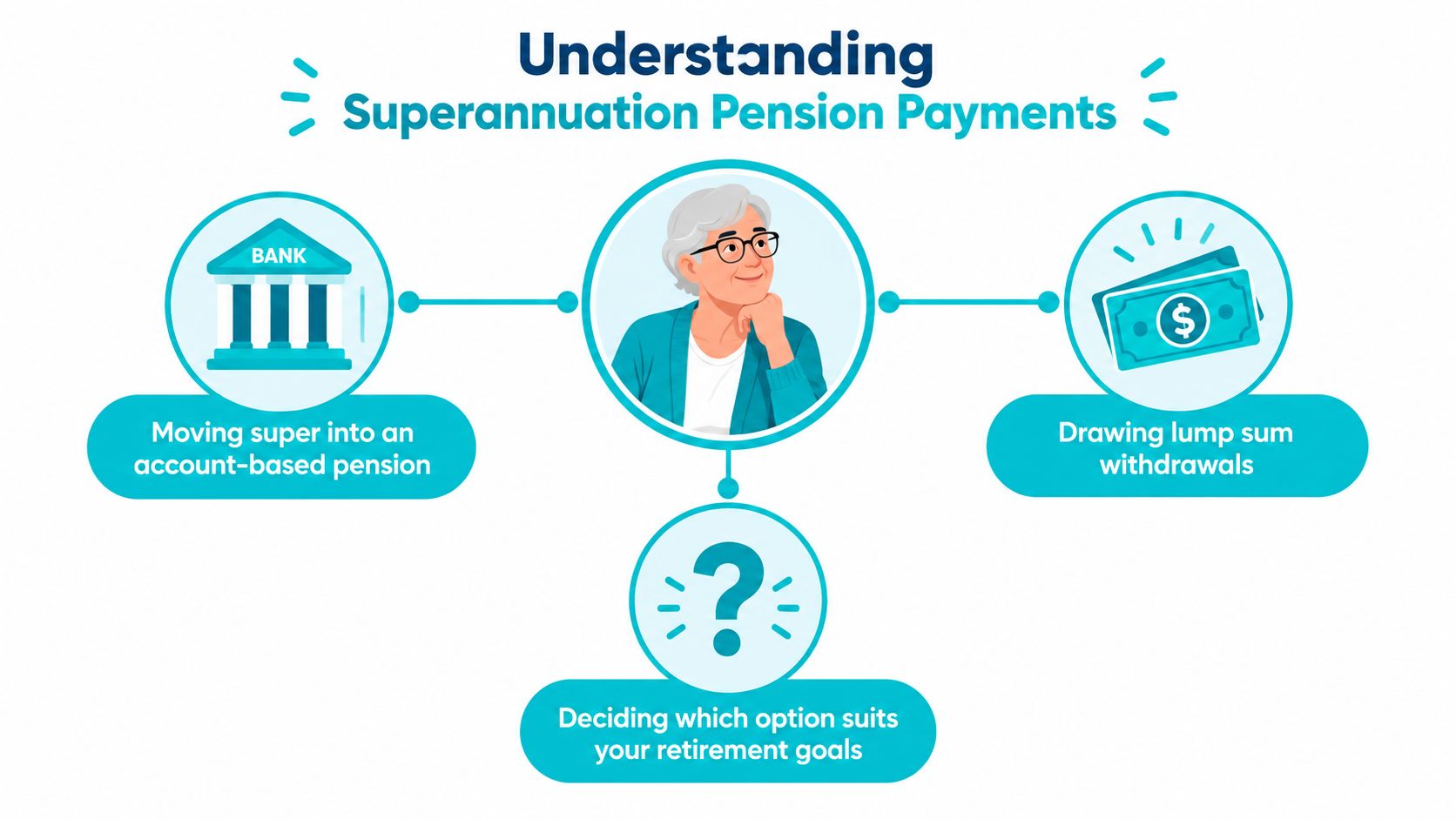
The practical lesson is straightforward. Retirement income isn't just about the balance shown on your final payslip. It's about converting that balance into dependable cash flow while managing market movements, inflation, tax and the possibility of living longer than expected. For a broader introduction to retirement planning with Fintrack, it helps to think of a pension as a structured income decision rather than an automatic withdrawal.
Types of Superannuation Income Streams
Retirement income streams resemble familiar banking choices, but superannuation rules make the comparison more nuanced. An account-based pension is similar to a flexible deposit account. You retain access to the balance, select investments and generally choose when payments arrive, subject to the annual minimum. The account doesn't have a fixed term, so it can eventually run out if withdrawals and investment losses exceed the money entering the account.
An annuity is closer to buying certainty. You exchange some capital for payments under an agreed structure. A lifetime annuity can provide income for life, while a fixed-term annuity pays for an agreed period. The trade-off is usually reduced flexibility compared with an account-based pension, so the product needs to match the role you want it to play.
A transition-to-retirement income stream, or TRIS, is intended for someone who has reached preservation age but hasn't fully retired or met another condition of release giving unrestricted access to super. It can support reduced working hours or help reshape cash flow while employment continues. Once a full condition of release is met, the arrangement may be treated as a retirement-phase pension, subject to the relevant rules.
| Structure | How payments work | Balance behaviour | Typical role |
|---|---|---|---|
| Account-based pension | Variable payments chosen within the applicable rules | Can rise or fall with investments and withdrawals | Flexible retirement income |
| Transition-to-retirement income stream | Regular payments while working or approaching retirement | Balance remains exposed to investment performance | Bridge between work and retirement |
| Fixed-term annuity | Payments follow an agreed term | Capital is committed under the contract | Income certainty for a defined period |
| Lifetime annuity | Payments continue according to the product terms, potentially for life | Less flexible, with longevity protection | Guaranteed base income |
Some older arrangements, including allocated pensions commenced before 1 July 2007, may have grandfathered features. They need to be reviewed on their own terms rather than assumed to work exactly like a new account-based pension.
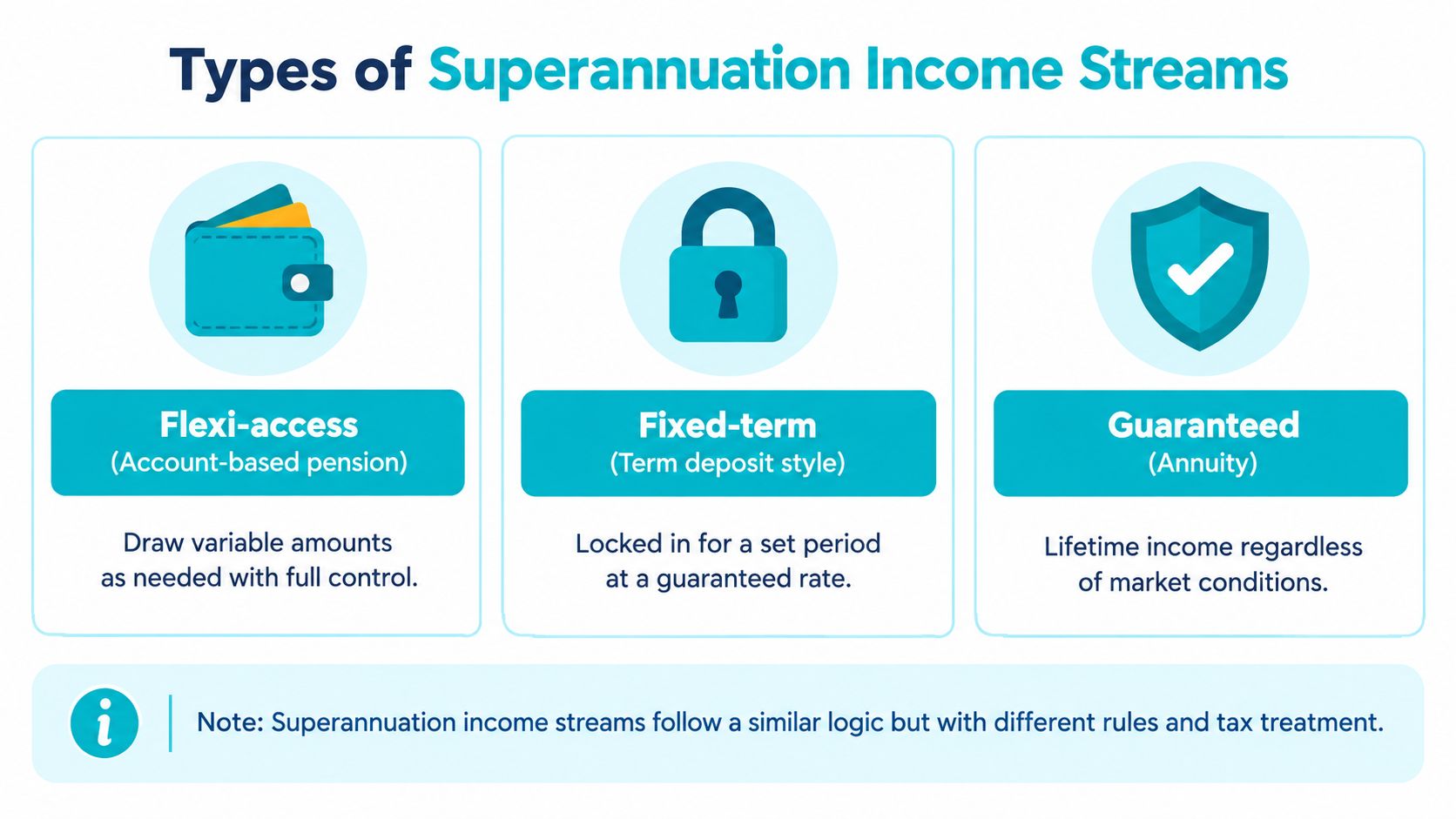
APRA's historical series records pension payments by superannuation entities from December 2004 onward, capturing the long-term movement from accumulation towards retirement drawdown across the Australian system. If you're comparing product structures, Wealth Collective's account-based pension guidance can help clarify how flexible payments differ from more guaranteed income options.
When You Can Start and Who Qualifies
You can't just rename a super account and start withdrawing whenever you choose. Superannuation is preserved until you meet the relevant access conditions, which commonly involve reaching preservation age and retiring, or satisfying another condition of release. The exact pathway depends on your age, employment circumstances and the type of income stream you want to establish.
A TRIS can provide limited access once you reach preservation age, even if you're still working. It isn't the same as unrestricted retirement-phase access. Full access generally follows when you retire or meet another condition of release, and a person who reaches age 65 can generally access super without needing to continue proving retirement.
Starting a pension also requires administration. A retail or industry fund may ask you to select the pension type, investment option, payment frequency, nominated bank account and beneficiary instructions. An SMSF requires trustees to document the commencement, establish the pension interest and ensure the fund's records support the arrangement.
Practical rule: Treat pension commencement as a structural decision, not an app setting. The date, product type and amount transferred can affect later tax and Centrelink outcomes.
The first financial year can require special attention. An account-based pension must generally pay at least the minimum annual amount by 30 June, and a pro-rata calculation applies when the pension begins part-way through the financial year, as explained by the Australian Taxation Office's retirement withdrawal guidance. That timing should be coordinated with your fund before the first payment is scheduled.
Minimum and Maximum Drawdown Rules
The minimum drawdown is calculated using the account balance at 1 July and an age-based percentage. The percentage increases as you get older, reflecting the need to draw a larger proportion of retirement savings over time. If the pension begins part-way through a financial year, the first calculation is generally adjusted to reflect the shorter period.
| Age at 1 July | Minimum drawdown rate |
|---|---|
| Under 65 | 4% |
| 65 to 74 | 5% |
| 75 to 79 | 6% |
| 80 to 84 | 7% |
| 85 to 89 | 9% |
| 90 to 94 | 11% |
| 95 or older | 14% |
These standard rates are set out in MoneySmart's account-based pension guidance. Payments may be arranged monthly, quarterly, half-yearly or annually. The important date is usually the end of the financial year, not the day you happen to check your balance.
A simple calculation
Suppose a 70-year-old has an account-based pension balance of $400,000 at 1 July. The applicable rate is 5%, so the minimum annual payment is $20,000, not $24,000. A $24,000 payment would represent 6% of that balance, which is the rate shown for ages 75 to 79. The calculation demonstrates why both the account balance and age bracket must be checked before setting the payment schedule.
There generally isn't a maximum withdrawal limit for a standard account-based pension. A retiree might choose to draw more than the minimum to fund travel, provide a gift, pay for aged care or meet a large one-off expense. The flexibility comes with a cost: larger withdrawals leave less capital invested, and a falling balance may reduce future income capacity.
Investment losses create another complication. A withdrawal during a weak market can lock in the sale of assets at depressed prices, while continuing withdrawals can make it harder for the account to recover. A payment plan should therefore consider cash reserves, investment liquidity and the possibility of poor returns early in retirement.
Avoid the deadline trap: Schedule the required amount early in the financial year, then review it before 30 June. If the minimum isn't paid, the income stream may be treated as having ceased for tax purposes.
The transfer balance cap and pension structure also need to be considered when deciding how much super should move into retirement phase. Drawdown rules govern the payments, while the cap governs the amount that can support a retirement-phase pension.
How Superannuation Pension Payments Are Taxed
Retirement doesn't make every super payment automatically tax-free. The result depends on your age, whether the income stream is taxed or untaxed, and the tax-free and taxable components of the super interest.
For someone aged 60 or over, payments from a taxed superannuation income stream are generally not assessable and aren't subject to income tax. The taxed element is generally treated as neither assessable income nor exempt income. This can make an eligible retirement-phase pension an efficient way to create spending money, but the income stream still has to satisfy the relevant superannuation rules.
Someone who has reached preservation age but is under 60 faces a different outcome. The taxable component is generally taxed at marginal tax rates, with a 15% tax offset available for the taxed element. The tax-free component isn't included in assessable income. These rules are summarised in the ATO's explanation of tax on super benefits.
Why the account components matter
Your pension payment usually reflects the proportions of tax-free and taxable components in the underlying super interest. That means two people of the same age receiving the same gross payment can have different tax outcomes if their component mixes differ.
Consider the decision at pension commencement. You may be choosing not only how much to transfer, but also which super interest to use and how to coordinate pension payments with employment income, investment income and any lump-sum withdrawals. A tax calculation should be completed before implementation, especially if you're under 60 or have an untaxed component.
The transfer balance cap places a limit on how much super can be transferred into retirement phase. Amounts above the cap can create additional tax consequences for earnings, so a pension strategy needs to record prior transfers, commutations and other relevant credits rather than focusing only on today's account balance.
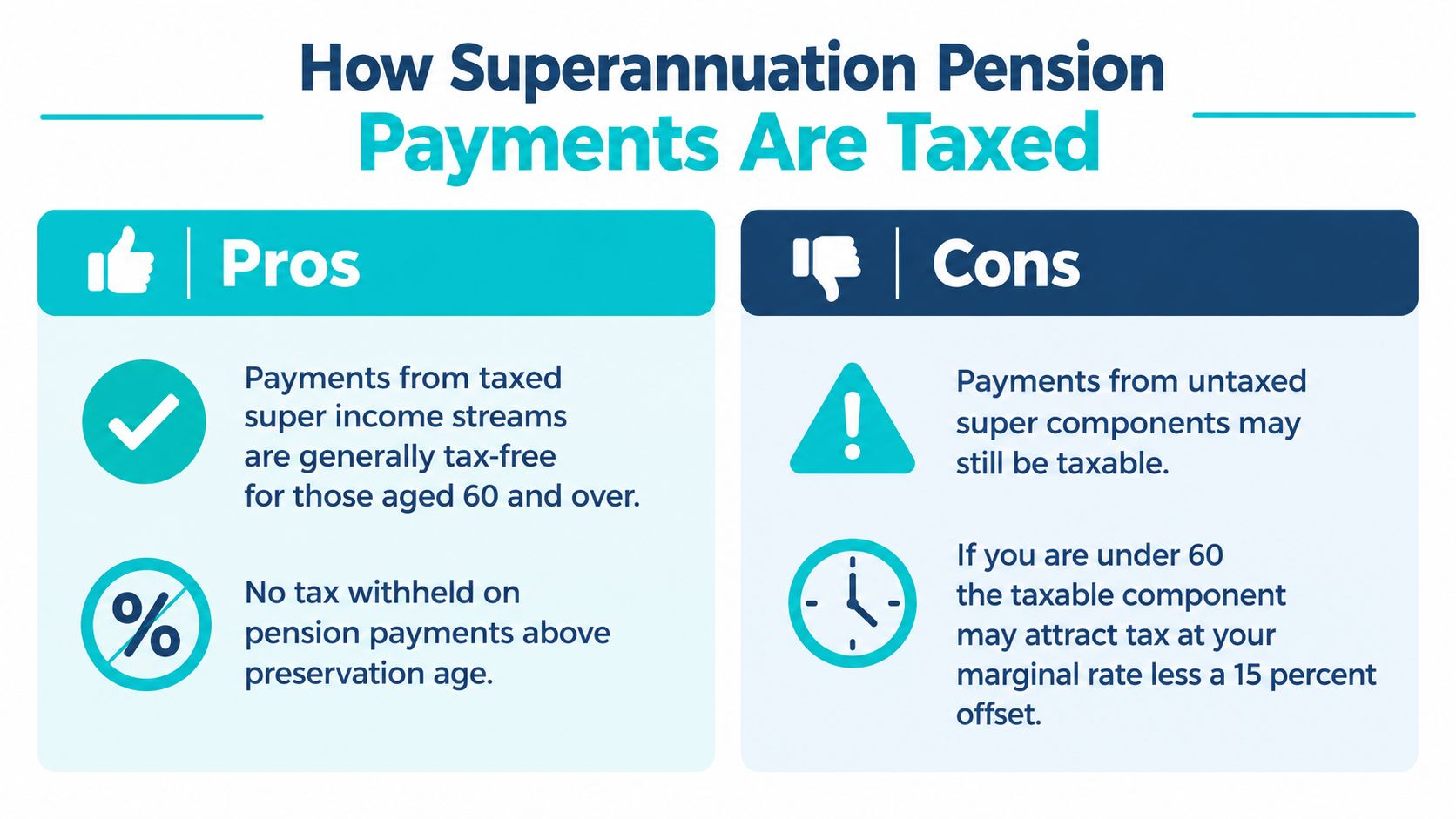
The useful question isn't this: “Are my super payments tax-free?” Ask instead: How old am I, what components make up my account, what type of pension am I receiving, and how much has been transferred into retirement phase? Those details determine the after-tax cash flow.
Centrelink and Age Pension Implications
A pension payment can be tax-free and still affect your Age Pension entitlement. Centrelink applies separate rules, so tax treatment and social security treatment must be modelled independently.
For an income stream with an account balance, Services Australia assesses the balance as an asset. The income-stream treatment then depends on the product type. Relevant lifetime income streams receive a specific concession, with 60% of gross payments assessed as income under the income test, according to Services Australia's income-stream guidance.
The three questions to ask
- What remains in the account? The account balance can count under the assets test, even if the money is invested and not sitting in cash.
- What type of income stream is it? An account-based pension and a lifetime income stream aren't assessed in exactly the same way.
- When did payments start? A super-funded income stream generally doesn't count in the income test until payments begin, while an income stream purchased with savings is treated as a financial asset before assessment day and is subject to deeming rules.
Deeming can create confusion. It doesn't necessarily matter whether your account earned that exact amount of income during the period. Centrelink may apply its assessment method to financial assets, which means the payment decision must be tested against the broader household position.
A larger withdrawal can increase bank-account balances or fund spending that changes other assets. A lifetime annuity can provide security but may be assessed differently from an account-based pension. The decision affects both cash flow and entitlement, so it belongs in the same plan.
A tax-free super pension is not necessarily Centrelink-free.
Before commencing or restructuring an income stream, review the interaction with Age Pension eligibility at Wealth Collective. Centrelink rules can change the apparent value of one payment structure compared with another, particularly when one partner has different super, savings or income arrangements.
Two Examples of Structuring Pension Payments
Consider a 67-year-old retiree with $600,000 in super who starts an account-based pension and draws $30,000 a year. The payments cover ordinary household costs, and the retiree qualifies for a part Age Pension. The account provides flexibility, but the adviser must still test whether the withdrawal rate, investment mix and spending plan can support a long retirement.
The tax outcome may be favourable because the retiree is over 60 and receiving payments from a taxed superannuation income stream. Centrelink still assesses the remaining balance and applies its own income and assets rules. A modest annual payment may support day-to-day spending without forcing unnecessary lump-sum withdrawals, but the plan needs regular reviews as the balance and household circumstances change.
Now consider a 72-year-old with $900,000 in super. This retiree takes a modest payment above the required minimum, directs part of the balance into a lifetime annuity and keeps the remainder in an account-based pension. The annuity creates a guaranteed income base, while the account-based portion preserves access to capital for irregular expenses and discretionary spending.
The second arrangement may reduce some longevity and market risk, but it also gives up flexibility over the capital committed to the annuity. The Centrelink assessment may differ from the first retiree's position because product type, account balances and payment treatment all matter. Neither strategy is automatically superior. Each solves a different problem.
APRA reported $63.8 billion in pension payments from entities with more than six members in the 12 months to March 2026, up 11% from $57.7 billion a year earlier. The same reporting period included lump-sum payments, reinforcing that Australian retirement cash flow is being delivered through a combination of income streams and one-off withdrawals. The figures are reported in the ATO payments from super information.
The planning question is therefore personal: do you need flexibility, certainty, or a deliberate blend of both?
Building a Retirement Roadmap With Wealth Collective
A workable retirement income plan brings several moving parts into one decision. Your age sets the minimum drawdown rate. Your balance and investment mix influence how much income the account can support. Your tax-free and taxable components affect the after-tax result, while the transfer balance cap limits how much can move into retirement phase.
Centrelink adds another layer. The remaining account balance may be assessed as an asset, and the income-stream structure can affect the income test. Longevity expectations matter too. Drawing the minimum may preserve capital, but it may not meet your lifestyle needs. Drawing substantially more may improve your current standard of living while reducing future flexibility.
A Retirement Roadmap should model these factors together:
- Payment design: Choose the amount, frequency and account receiving each payment.
- Tax structure: Check your age, component mix and retirement-phase position.
- Social security: Test the likely effect on the Age Pension income and assets tests.
- Investment resilience: Keep enough liquidity to avoid unnecessary asset sales during weak markets.
- Review points: Recalculate the plan when spending, health, markets or family circumstances change.
Wealth Collective's Retirement Roadmap service can bring minimum drawdowns, tax, Age Pension interaction and payment scheduling into one modelling process. The firm works with Australians on retirement-income structures, including account-based pensions, Transition to Retirement arrangements and broader superannuation decisions.
Retirement planning isn't a one-off switch on the day work ends. It's an ongoing process of checking whether the income structure still supports your life, your partner and the years ahead. A free 10-minute introductory call can help you clarify whether starting an account-based pension, adjusting drawdowns or combining flexible income with an annuity deserves closer attention.
Wealth Collective helps Australians model superannuation pension payments, coordinate tax and Centrelink considerations, and build a practical income strategy through its Retirement Roadmap service. Visit Wealth Collective to book an initial call and discuss the next step for your retirement income.