Business hours
Monday to Friday (8.30AM - 5PM)
Weekend (Closed)


You're 59, still working, and wondering whether you can finally use the superannuation you've spent decades building. A colleague the same age says they've already started drawing an income from theirs. Both statements can be correct because superannuation access rules depend on more than your current age. Your birth date, employment status and the specific condition of release all affect the answer.
That's why a useful retirement plan doesn't begin with memorising one magic number. It maps the layers together, then tests how different access dates affect your income, tax position and remaining retirement capital.
Why Superannuation Access Rules Confuse So Many Australians
Consider two Perth professionals who are both turning 59 in 2026. One was born before 1 July 1964 and may already have reached preservation age, depending on the exact birth date. The other was born from 1 July 1964 onward, so preservation age is 60 under the ATO's preservation age rules.
That birth-date difference changes the first answer, but it does not settle the whole access question. If either person is under 65 and still working, reaching preservation age alone generally does not provide unrestricted access. Retirement or a transition-to-retirement income stream may be relevant, depending on the circumstances.
Three questions shape the result
When a client asks, “Can I access my super yet?”, I check three separate layers:
- Have you reached preservation age? Your date of birth determines this, not the age shown on your birthday card.
- What is your employment status? Before 65, retirement can affect eligibility. Continuing to work may instead point towards a transition-to-retirement strategy.
- Which condition of release applies? Retirement, a transition-to-retirement income stream, age 65, severe financial hardship and compassionate grounds each have different requirements.
Age 65 operates as a separate threshold. From that age, super can generally be accessed even while you remain employed. As a result, two people with similar balances and the same chronological age can have different choices if their birth dates, work arrangements or release conditions differ.
Practical rule: Treat access as a sequence of gates. Your age opens one gate, your work status opens another, and the condition of release determines what you can actually take.
This layered view is more dependable than copying a friend's experience or relying on a fund advertisement. It also keeps eligibility separate from tax treatment. Being allowed to withdraw does not, by itself, determine how the payment will be taxed. Modelling the timing can therefore matter more than memorising a single threshold.
Understanding Preservation Age and Why It Works
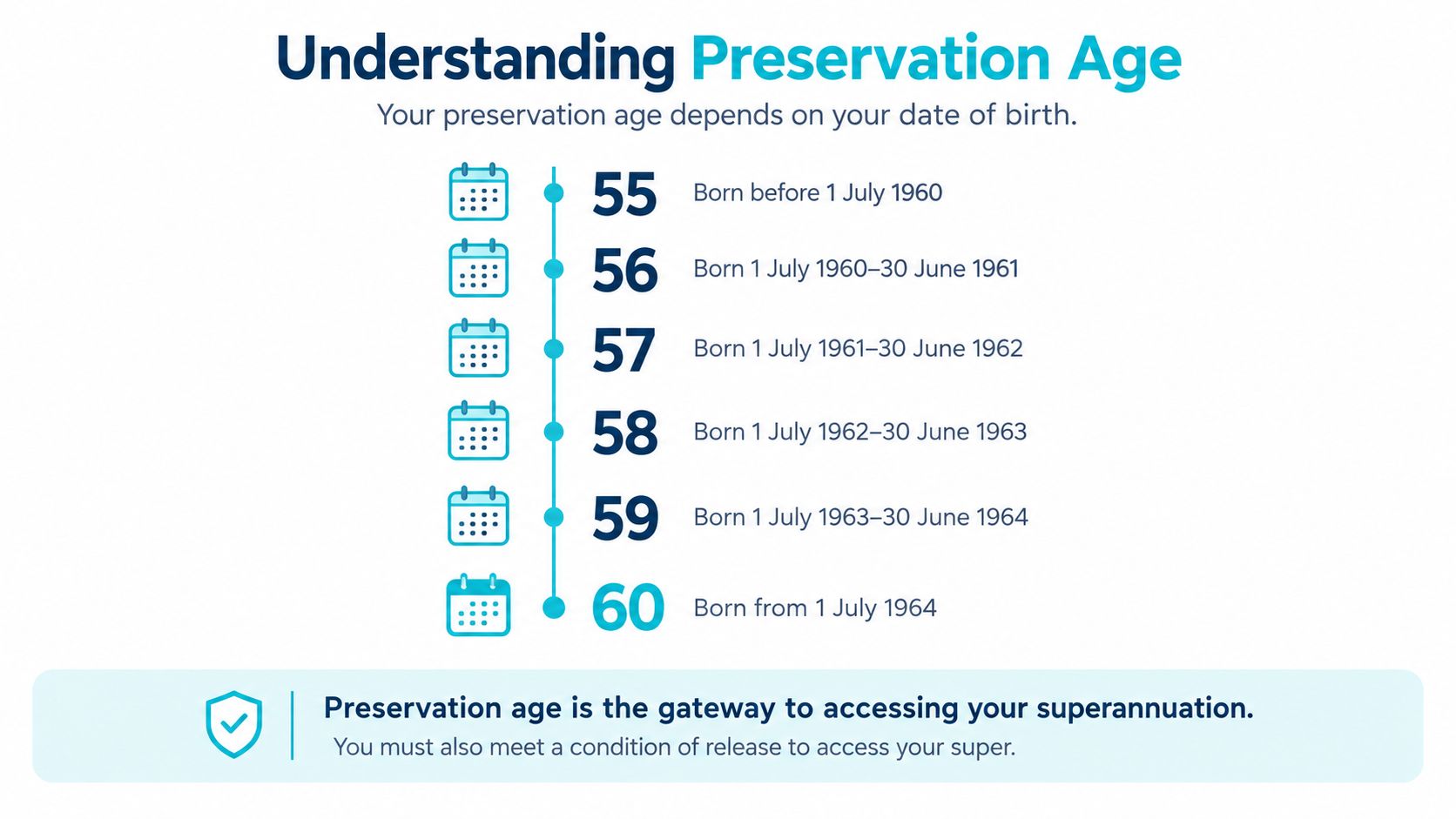
A person born in one date range may reach preservation age years before someone born in another. That birth-date rule is the first layer in deciding when super can be accessed. It reflects superannuation's purpose: keeping retirement savings for retirement, rather than making them available whenever household cash flow becomes tight.
| Date of birth | Preservation age |
|---|---|
| Before 1 July 1960 | 55 |
| 1 July 1960 to 30 June 1961 | 56 |
| 1 July 1961 to 30 June 1962 | 57 |
| 1 July 1962 to 30 June 1963 | 58 |
| 1 July 1963 to 30 June 1964 | 59 |
| From 1 July 1964 onward | 60 |
Reaching preservation age is necessary but not sufficient
Reaching your preservation age confirms that you have met the age requirement. Before age 65, it does not by itself provide unrestricted access to your whole balance. Your employment status and the condition of release still determine what you can do.
The practical formula is:
Preservation age + an applicable condition of release = access pathway
For example, turning 60 does not automatically mean every payment option is available immediately. A person who has reached that age may still need to meet the relevant retirement or income-stream requirements. Someone with a preservation age of 59 has crossed the age threshold, but may need to retire before unrestricted access applies.
The answer belongs to your circumstances. Your partner's age, a colleague's experience or a general internet search may offer context, but none can replace checking your own birth date, work status and intended payment type.
Eligibility and tax treatment are separate questions. Permission to withdraw tells you whether access is available. It does not, by itself, determine how the payment will be taxed.
That is why timing deserves attention. Rather than memorising one threshold, model how your birth date, employment plans and chosen condition of release interact. The same balance can produce different choices for two people who appear to be the same age.
Retirement, Transition to Retirement, and the Age 65 Rule
Once you reach preservation age, your employment status becomes part of the access decision. Stopping work, reducing your hours and remaining employed at age 65 can lead to different outcomes. Birth date sets one layer of the rules, while work status and the condition of release add others.
| Pathway | Must retire? | Payment cap | Retirement phase? |
|---|---|---|---|
| Retire after preservation age | Generally, yes, before age 65 | Depends on the payment structure and condition of release | May begin when the relevant condition is satisfied |
| Transition-to-retirement income stream | No, you can keep working | No more than 10% of the opening account balance each financial year | Not automatically |
| Reach age 65 | No | No TRIS cap applies to access based on age 65 | A TRIS can move into retirement phase at age 65 |
Retiring after preservation age is often the most direct pathway for someone who plans to stop working. Your super fund may require evidence and declarations, and the payment structure needs to match the condition of release and your retirement plans.
A transition-to-retirement income stream, or TRIS, allows you to draw an account-based income stream while continuing to work. It must meet minimum pension standards. Under the ATO's conditions of release guidance, payments cannot exceed 10% of the account balance measured at the start of each financial year.
That limit generally makes a TRIS a tool for reducing work gradually, rather than replacing all employment income. For example, you could work fewer hours and use pension payments to help cover the fall in wages. A useful model should allow for investment returns, new contributions, living costs and the reduction in capital caused by withdrawals.
You can read more about transition-to-retirement pensions before comparing the likely cash-flow result with continuing to work.
Retirement phase isn't automatic
A TRIS remains subject to its access and payment restrictions until you reach age 65 or meet another relevant condition of release. While those cashing restrictions apply, it generally cannot be converted into a lump sum. Reaching preservation age alone does not place the income stream in retirement phase.
Age 65 is a separate milestone. From that age, you can generally access super without retiring, even if you remain employed. This may affect decisions about reduced hours, salary sacrifice, pension payments and investment risk.
The useful question is not only whether you can access the money. Model how much to take, which payment form fits, and when the account should move into retirement phase. The right answer depends on the interaction between your birth date, employment plans and chosen condition of release.
Early Access Exceptions Beyond the Standard Conditions
Early access before preservation age is deliberately narrow. Financial preference alone usually isn't enough. The Australian Government identifies specific pathways, each with its own eligibility rules and application process.
The main categories include:
- Severe financial hardship: You may qualify if you've received an eligible government income-support payment continuously for at least 26 weeks and can't meet reasonable and immediate family living expenses.
- Compassionate grounds: This can cover defined expenses such as particular medical, disability, housing or funeral needs, subject to the relevant requirements.
- Terminal medical condition: A qualifying terminal condition can create a separate release pathway.
- Temporary-resident departure: Some temporary residents may be able to apply when permanently leaving Australia, subject to the applicable rules.
- Very small account balances: A small balance may qualify under a specific condition, rather than through general financial need.
The Services Australia guidance on applying for early release sets out the hardship evidence and eligibility framework.
The hardship test has more than one version
The standard severe hardship test combines two requirements. You generally need the required period of continuous eligible income support, and you must show that you can't meet reasonable and immediate family living expenses.
A different rule applies after you reach preservation age plus 39 weeks. In that situation, you generally need to have received income support for at least 39 weeks in total since reaching preservation age, and you must not be gainfully employed when applying.
These are not informal guidelines. The super fund assesses hardship applications under the legislative requirements, while Services Australia may provide evidence about income-support eligibility. Compassionate-release applications are made to the ATO.
Eligibility doesn't settle the financial decision
Approval only answers whether the money may be released. It doesn't tell you whether taking it is the most suitable option, how the payment will be taxed or how the withdrawal may affect insurance and future retirement income.
If you're weighing an application, the guide to how to withdraw super early can help you identify the relevant pathway before you submit documents.
Tax and Penalty Implications of Drawing Up Your Super
A pre-retiree may qualify to withdraw super, then find the payment is smaller than expected after tax. Eligibility and tax are separate layers. The result can depend on the payment type, taxable and tax-free components, your age, and the condition of release.
A lump sum and an income stream can receive different tax treatment. Preserved and unrestricted components may also produce different outcomes. The timing of retirement-phase status matters, as does the way the payment fits with your other income.

Separate the release decision from the tax decision
Before applying, ask two questions:
- Can I legally access this amount under a condition of release?
- What tax and reporting consequences follow if I receive it?
The answers can differ. A hardship payment may be allowed while still creating personal tax to pay. A transition-to-retirement income stream, or TRIS, can provide income while you work, yet its payment limits and non-retirement-phase status may lead to a different result from a retirement-phase pension.
The super fund's records also matter. Tax treatment can vary between taxed and untaxed components, so check the payment summary and member information before taking a large lump sum or moving from accumulation to pension arrangements.
Before you apply, calculate the net amount you'll receive, not just the gross amount shown on the release form.
The fund's calculation is a starting point, not a complete personal tax assessment. For a practical explanation of whether superannuation withdrawals are taxed, check how age, payment structure and component types may affect the amount you keep.
A withdrawal does not automatically mean you have started or converted a pension. The transfer balance position may matter when an income stream enters retirement phase, so model the withdrawal's timing and structure together.
Why Early Access Is Rarely the Simple Fix Australians Hope For
Early access can solve an urgent problem, but it can also remove money from the account that would otherwise help fund many years of retirement. The immediate cash is visible. The future cost is easier to overlook.
A withdrawal reduces the capital available for investment returns. It may also mean losing future employer contributions or changing the balance that supports insurance arrangements inside the fund. The effect depends on your circumstances, but the direction is clear: money taken out can't continue working inside super.
Look beyond today's bill
Hardship access should therefore be treated as a last-resort decision, not a routine budgeting tool. Before applying, compare the withdrawal with alternatives such as renegotiating expenses, reviewing debt repayments, checking available insurance benefits or seeking targeted financial counselling.
Centrelink is another consideration. Depending on how the released money is held and spent, it may affect future assessments under the income and assets tests and could influence later Age Pension entitlements. That interaction deserves a separate check rather than an assumption that super withdrawals sit outside the social security system.
A useful decision compares:
- Immediate relief: What essential expense does the payment address?
- Retirement impact: How much capital leaves the account, and what future income does that capital support?
- Protection impact: Will insurance cover, contributions or account settings change?
- Government support impact: Could the withdrawal alter future Centrelink assessments?
- Alternative options: Can another strategy address the problem without permanently reducing retirement savings?
The right answer isn't always “never withdraw”. It's “understand the full trade-off before withdrawing”.
Planning Your Own Access Timeline
A practical access plan starts with dates and decisions, not an application form. Write down your birth date, preservation age, current work arrangements and the point at which you expect to stop working or reduce hours.
Then define the cash-flow problem precisely. Are you trying to fund a permanent retirement, bridge a short period between jobs, replace income after reducing work, or meet an urgent expense? Each objective points to a different access pathway.
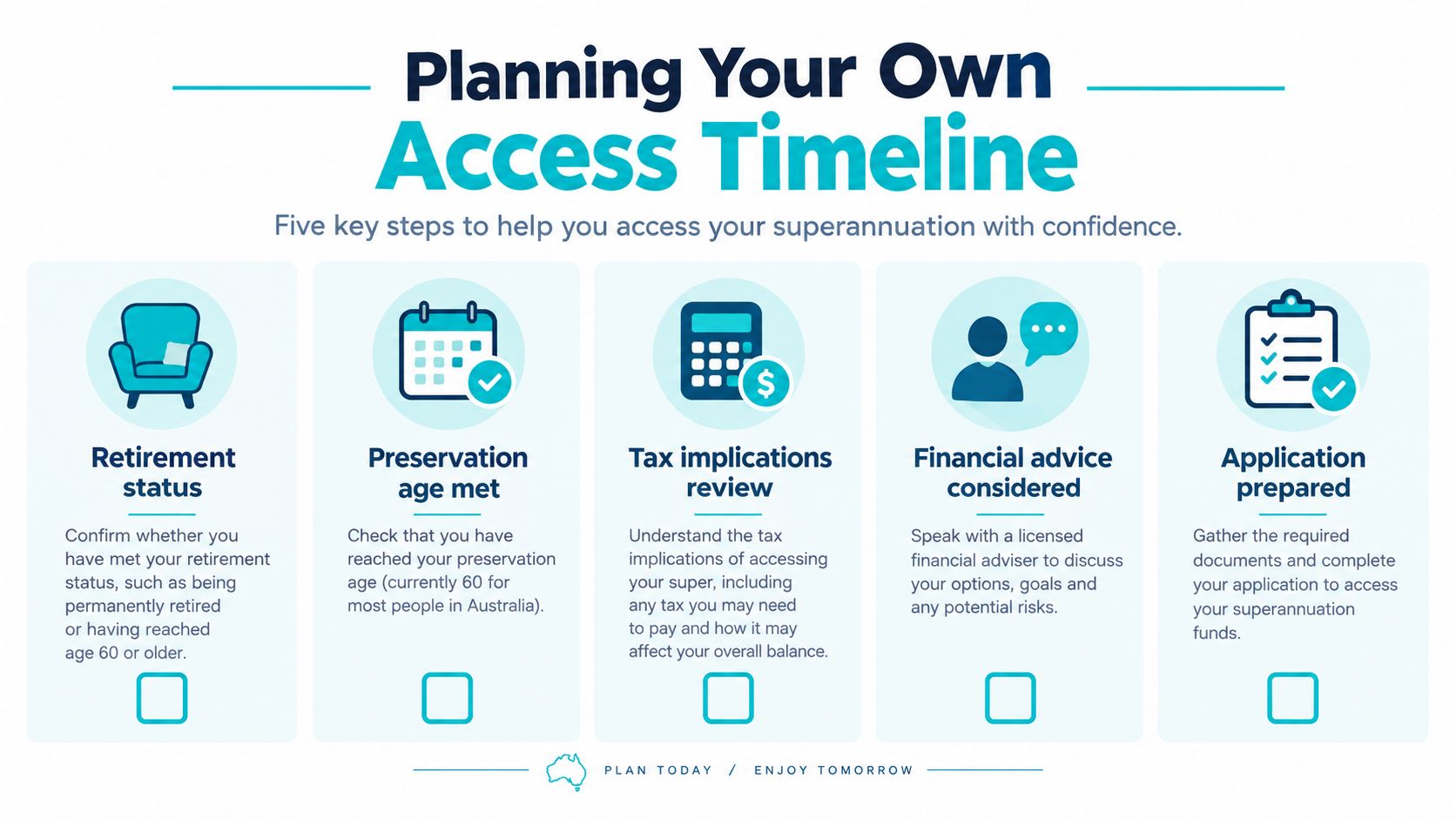
Use this pre-application checklist
- Confirm your birth date and preservation age. Don't rely on your current age alone.
- Record your employment status. Note whether you're working, reducing hours, retiring or planning to continue beyond age 65.
- Identify the condition of release. Separate retirement, TRIS, age 65, hardship and compassionate grounds.
- Estimate the required cash flow. Calculate the amount and duration of the gap rather than withdrawing an arbitrary sum.
- Test the tax and retirement result. Compare lump-sum access, pension payments and leaving the money invested.
Model the timing, not just the eligibility
Someone who has reached preservation age and wants to reduce work may find a TRIS more suitable than a full withdrawal. Someone approaching 65 may achieve a different result by waiting and coordinating the transition into retirement phase. A person facing hardship may need a broader cash-flow review before deciding that super is the only available source.
A retirement model should compare income needs with remaining capital, investment settings, contributions and tax. It should also show what changes if you retire earlier, work longer, draw a smaller income or wait until age 65.
Wealth Collective's Retirement Roadmap process brings these decisions together with superannuation optimisation and retirement-income planning. A personalised review can help you coordinate preservation age, employment changes, retirement-phase timing and the wider investment strategy rather than treating access as an isolated transaction.
Frequently Asked Questions About Superannuation Access
Can I access super without retiring once I'm over 60?
Turning 60 does not automatically mean unrestricted access. Before 65, your preservation age and employment status still affect eligibility. If you keep working, a transition-to-retirement income stream (TRIS) may provide income, but payment conditions apply. From 65, you can generally access super without retiring.
How is the TRIS payment cap calculated?
The cap is 10% of the account balance at the start of each financial year. The ATO conditions of release guidance sets out this rule. Ask your fund or adviser how the cap affects your payment schedule.
Can a super withdrawal affect the Age Pension?
Yes. The outcome depends on whether the money is received, retained or spent, and on how Centrelink applies its income and assets tests. Include a social security review if you may rely on the Age Pension later. A withdrawal can change the result even when the super access itself is allowed.
How long does a hardship application take?
There is no single timeframe. Your fund must assess the evidence against the relevant legislative requirements. Processing can take longer if documents are missing or more information is needed. Ask the fund what to provide before applying, then consider the tax and retirement effects if the request is approved.
Wealth Collective helps Australians model preservation age, retirement, TRIS payments, early-access options and retirement-phase timing together. Visit Wealth Collective to book an initial call about an access timeline that fits your work, cash flow and retirement goals.