Business hours
Monday to Friday (8.30AM - 5PM)
Weekend (Closed)


Only 18% of Australians aged 45 to 75 have a clear financial plan for retirement, and that's the problem you need to fix before you stop work. In 2025, 45% of Australian working adults said they weren't financially prepared for retirement, according to UniSuper and YouGov research on retirement readiness. Good financial advice for pre retirees doesn't start with your super balance. It starts with the income you need, then works backwards.
Why Most Pre-Retirees Feel Unprepared
Confidence isn't competence. ASIC commissioned research of 2,065 Australians aged 45 to 75 and found only 18% had a clear financial plan and just 26% demonstrated strong understanding of retirement finances, yet 41% said they felt confident managing their money in retirement, as reported in ASIC's release on helping Australians plan for their financial future.
That same research found 46% reported both low financial literacy and low confidence. If that's you, you're the person who benefits most from getting numbers on paper now. Confidence without a quantified income target is just hope, and hope doesn't survive a market fall, a tax bill or a Centrelink assessment.
Worry Is Widespread and Often Justified
ASIC also reported 48% of Australians aged 50 to 66 worried they'd run out of money, 32% felt they were already behind, and 58% of pre-retirees wanted to learn more about superannuation and retirement. Those aren't abstract fears. They reflect real decisions about drawdowns, investment risk, debt, tax and Age Pension eligibility that compound for decades if you get them wrong.
Retirement is a relay, not a finish line. Super, home equity, tax and Centrelink each pass the baton to the next, and a dropped handover can cost you years of income.
This guide is for Australians within about ten years of stopping work, including dual income households still carrying a mortgage. The Perth examples are illustrative, not a regional limit, because the rules are national. Work through five decisions in order, your income target, super, withdrawals and longevity, Age Pension, home and tax, and when to get advice, starting with the timing table below.
The Five Money Decisions to Settle Before You Stop Work
| Decision | Core question | Start by | First number to find |
|---|---|---|---|
| Retirement income target | How much do I need each year? | About 10 years out | Annual spending in today's dollars |
| Super contributions | Can I lift my balance before I stop work? | 5 to 10 years out | Concessional cap of $30,000 and any unused carry-forward |
| Housing and debt | Repay, keep or restructure the loan, or downsize? | 5 to 7 years out | Loan balance, interest rate and term running into retirement |
| Drawdown and longevity | How much can I draw, and for how long? | 3 to 5 years out | Withdrawal rate tested under poor early returns |
| Age Pension and tax | How do means tests and tax change my income? | 2 to 3 years out | Assessable assets and taxable income |
Timing matters because the final decade compresses your choices. A contribution or downsizing decision at 58 gives you years to adjust if markets, health or work change. The same decision at 64 often becomes a single, irreversible transaction with tax and Centrelink consequences you can't unwind.
Why the Order Is Not negotiable
It's like booking a long-haul flight. The cheapest and most flexible fares go first, and late bookers pay more for worse seats. Contribution caps expire, downsizer windows close after a sale, and investment risk you could absorb at 55 can damage you at 65.
The income target comes first because every other row depends on it. You can't judge whether extra contributions are worth the cash flow sacrifice, or whether keeping a mortgage is safe, until you know the annual spending those decisions must fund. Guessing the target makes every later decision a guess too.
Do this week: Total the last 12 months of spending from your bank statements. Don't categorise it yet and don't tidy it up. That one honest number is the foundation for everything that follows.
How to Turn Retirement Worry Into an Income Target
Many Australians have never done this calculation. A 2025 Australian Government survey found 68% of respondents had never estimated how much money they'd need in retirement, and among those who had, 61% expected to require between $30,000 and $90,000 a year in current dollars, as detailed in the government's retirement planning and saving attitudes survey. That range is too wide to plan against. You need your own figure.
Six Steps to a Number You Can Use
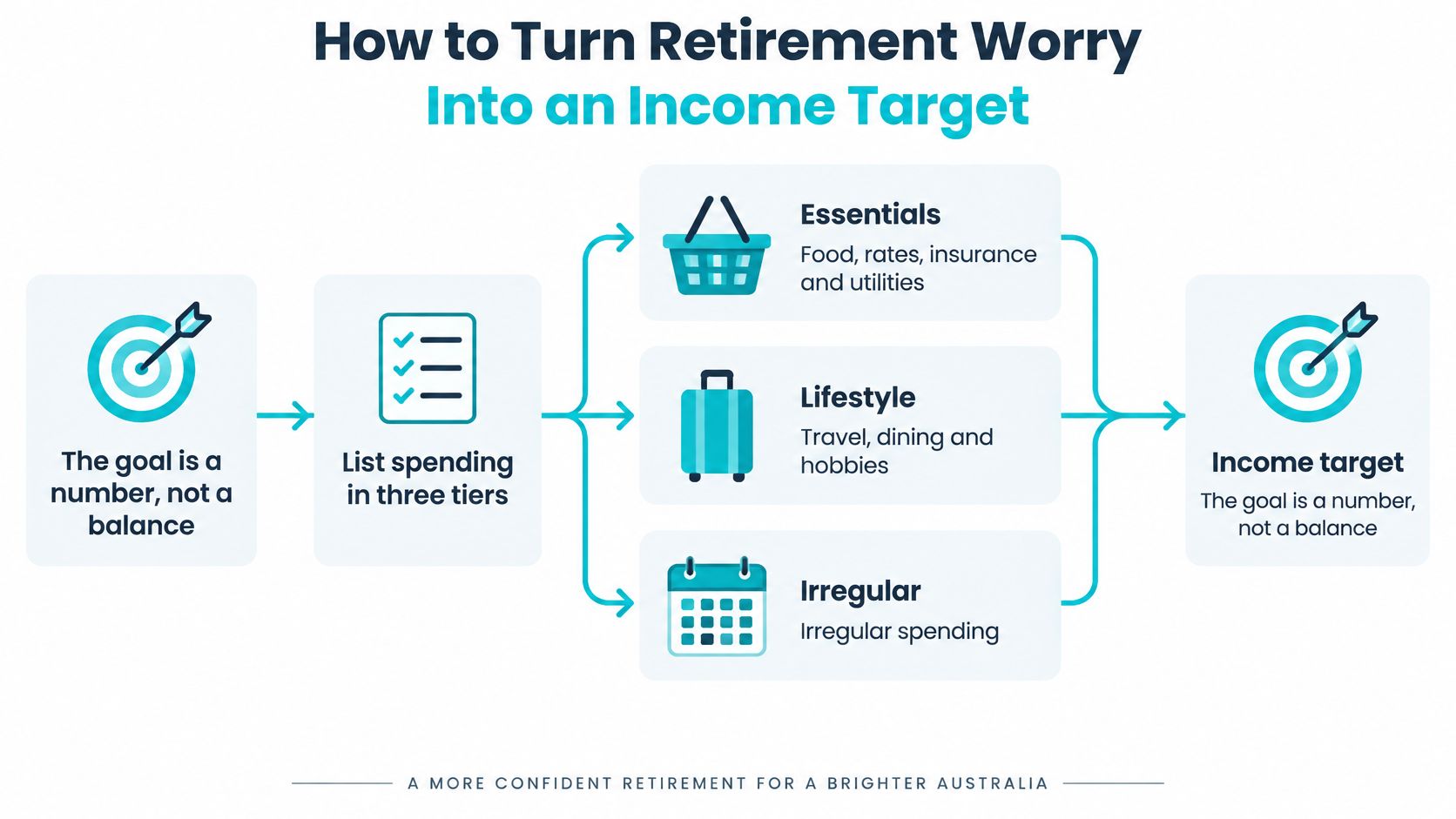
- List spending in three tiers. Essentials cover food, rates, insurance and utilities. Lifestyle covers travel, dining and hobbies. Irregular costs cover car replacement, home repairs, health and care. Tiers show you what you can cut in a bad year and what you can't.
- Convert the total to an annual after-tax figure expressed in current dollars. Current dollars keep the number honest, because you can compare it directly with what you spend now.
- List dependable income. Include an estimated Age Pension if you're likely to be eligible, any defined benefit pension and reliable rental income. Don't include hoped-for inheritances or irregular work.
- Subtract dependable income from spending. The result is the gap your super and savings must fund every year. This gap, not your balance, is the number that drives the plan.
- Convert the gap into a capital need. As an illustration, a $12,000 annual gap needs roughly $300,000 invested at a 4% sustainable draw. It's a rough conversion, but it turns an abstract shortfall into a savings target.
- Stress test the result. Model a 20% fall in the first two years and a plan that runs to age 95. If the plan only works with smooth returns and a short retirement, it doesn't work.
A Perth Couple Example
Take a couple who work through their tiers and land on $4,300 a month to live the way they want. Their projected income from super and a part Age Pension comes to $3,300 a month. That's a $1,000 monthly gap, or $12,000 a year, which step five converts into roughly $300,000 of additional capital, or an equivalent mix of working longer, spending less or restructuring assets.
Don't assume spending stays flat, either. It often rises early in retirement with travel while you're fit, settles in the middle years, then health and care costs lift it later. Model those phases separately rather than forcing one number across thirty years, because a plan built on average spending can fail in the expensive years. This is the modelling a Retirement Roadmap builds into one plan, so your income target, super and pension assumptions all use the same figures.
Super Moves to Test Before You Retire
A contribution can cut your tax bill now, but the same money may be unavailable when you need it or affect your Age Pension later. Test each super move against your cash flow, access to savings, housing plans and likely retirement income.
| Lever | 2025–26 rule | Best suited to | Watch-out |
|---|---|---|---|
| Concessional contributions cap | $30,000 a year in total, including employer super guarantee, salary sacrifice and deductible personal contributions | Workers with spare cash flow | Contributions above the cap can be taxed as excess |
| Carry-forward unused cap | Eligible unused cap amounts from the previous five years, subject to total super balance rules | People with career breaks or variable income | Unused amounts expire after five years |
| Non-concessional contributions | After-tax contributions subject to total super balance rules | People with surplus savings | Not available if your total super balance is $2 million or more |
| Downsizer contribution | Up to $300,000 each from a qualifying home sale, for eligible people aged 55 or over | Homeowners selling a property held for at least 10 years | Does not count towards the non-concessional cap |
For the 2025–26 financial year, the concessional contributions cap is $30,000. It is one shared annual limit covering employer super guarantee contributions, salary sacrifice and deductible personal contributions, as set out in the ATO guidance on personal super contributions. See 2026 super caps explained by EndureGo Tax for how the contribution limits work together.
Trap One Is the Shared Cap
Your employer contributions count towards the same $30,000 annual concessional cap as salary sacrifice and deductible personal contributions. Check your year-to-date contributions before setting a salary sacrifice amount. Going over the cap can result in extra tax.
Carry-forward rules may give you room to contribute above the annual cap. If you had career breaks, part-time years or variable business income, eligible unused cap amounts from the previous five years may help in a higher-income year. Check your balance in myGov and confirm your eligibility before contributing. Unused amounts expire after five years.
Higher earners should also check Division 293 tax. If your income plus concessional contributions exceeds the relevant threshold, extra tax may apply to some contributions. Factor that cost into your decision before making a contribution.
Trap Two Is Confusing Preservation Age With a Condition of Release
For people born after 1 July 1964, preservation age is 60. Reaching preservation age does not, by itself, give you unrestricted access to super. You must also meet a condition of release, such as retiring after reaching preservation age or turning 65. A transition to retirement pension may be available after preservation age while you continue working, but it has specific rules and does not provide unrestricted access to your super. Review how transition to retirement pensions work for pre-retirees before changing how you draw income.
If you may stop work before you can access your super, keep enough money outside super to fund the gap. Contributing too much can leave you short of accessible cash, even if your overall assets look healthy.
A downsizer contribution follows separate rules. An eligible person aged 55 or over may contribute up to $300,000 from the sale of a qualifying home. Each eligible member of a couple may be able to contribute up to that amount, according to the ATO's downsizer contribution eligibility rules. Downsizer contributions do not count towards the non-concessional cap. Check how the sale proceeds could affect your Centrelink assessment, since your home and cash or super may be treated differently.
Withdrawal Strategies That Guard Against Longevity Risk
A retirement income plan should start with the spending target, then show how super withdrawals, other income and investment risk will fund it. The legislated minimum drawdown is a compliance floor for a super pension, not a guide to what your household can afford to spend. Set the withdrawal amount against your essential and discretionary costs, expected time in retirement, health needs and any bequest goals.

Sequence Risk in Plain Terms
Two retirees each start with an illustrative $500,000 and withdraw the same percentage each year. One has strong returns early; the other faces a sharp market fall and sells investments to cover spending. Even if returns later average out similarly, the second retiree has fewer units left to benefit from a recovery. That is sequence-of-returns risk. Read more about how sequence-of-returns risk affects retirement income sustainability before setting your withdrawals.
| Approach | How it works | Main strength | Main risk |
|---|---|---|---|
| Legislated minimum only | Withdraw the statutory minimum each year | Simple and meets the minimum requirement | May not provide enough income for your spending target |
| Fixed percentage | Withdraw the same share of the balance each year | Adjusts withdrawals as the balance changes | Income falls when markets fall |
| Fixed inflation-adjusted amount | Withdraw a set dollar amount that rises with inflation | Makes budgeting more predictable | Early market falls can put pressure on the balance |
| Guardrails | Set a spending range and adjust when the balance crosses set limits | Balances income with preserving capital | Requires regular reviews and willingness to change spending |
| Staged buckets | Keep two to three years of spending in cash and defensive assets, with growth assets for later years | Reduces the need to sell growth assets during a downturn | Cash may earn less and the buckets need rebalancing |
Match the Strategy to a Long Life
Use an age 95 planning horizon as a stress test, not a prediction. Then choose a withdrawal approach based on your spending flexibility, tolerance for fluctuating income, investment risk and willingness to review the plan.
A fixed inflation-adjusted amount can suit households that need steady spending and have enough assets to withstand market falls. A fixed percentage may suit retirees who can reduce spending when their balance drops. Guardrails work for people willing to set clear limits and act on them. Staged buckets can help those who value a cash reserve and accept the cost of holding defensive assets. The legislated minimum alone is simple, but use it only if the resulting income meets your target.
Account-based pensions, annuities and lump sums can each play a part in one income plan. An account-based pension offers flexibility; an annuity can provide guaranteed income for a chosen term or for life, subject to its terms. Decide how much of your essential spending needs reliable income, then weigh that against the flexibility and investment risk of the rest.
Write down three answers before you retire: How much will I withdraw each year to meet my spending target? What will I sell or cut after a market fall? How will the plan change if my partner dies? If you cannot answer clearly, revise the strategy before relying on it.
How the Age Pension, Home and Tax Interact
Set your retirement spending target first, then map how super, the Age Pension, housing and tax can fund it. The Age Pension is means tested, so estimate your likely entitlement rather than treating it as a bonus. Use the current Age Pension eligibility rules and means tests to check how your income and assets may affect payments.
| Household | Homeowner asset limit | Non-homeowner asset limit |
|---|---|---|
| Single | $333,000 | $600,000 |
| Couple combined | $499,000 | $766,000 |
These Services Australia figures show the asset limits above, with assets over the applicable limit reducing the pension. The family home is generally treated differently from assessable assets. The limits are indexed, so check the Services Australia assets test for the Age Pension before making a decision.
Small Asset Changes Can Move Your Entitlement
Consider a single homeowner with $380,000 in assessable assets outside the home. That is $47,000 above the listed homeowner limit, so the assets test may reduce their pension. A car purchase, a change in investments or planned spending could alter the assessment.
Selling, downsizing or shifting money between your home, super and investments can affect both your cash flow and pension eligibility. Model the consequences before acting. Gifting money to family may not reduce your assessed assets: deprivation rules can count some gifts as assets you still hold. If you sell an investment property, check the capital gains tax consequences first with property tax explained by David Beshay.
The Asset Rich and Cash Poor Trap
A valuable home does not pay everyday bills. COTA's State of the Older Nation research summary reports that 36% of older Australians had less than $100,000 in combined savings and investments. Housing security also needs a clear definition before comparing years: a percentage without a named measure does not show what changed.
Weigh mortgage repayments against the need for accessible cash. Paying off debt cuts interest costs and gives you certainty, but using too much savings can leave little for repairs, health costs or unexpected bills. Keeping a mortgage preserves cash, but means carrying interest and repayment risk without wages. Clear expensive debt first. Pay down the mortgage faster only if you will still have enough liquid money to cover your planned spending and a buffer.
Tax affects how much of your super can support that spending. Earnings in retirement phase are generally tax-free within the transfer balance cap, and super pension income is generally tax-free from age 60. Accumulation-phase earnings are taxed differently. Decide when to start a pension and how much to transfer as part of the same income plan, not as a separate tax exercise.
Book a Free Call to Confirm Your Retirement Plan
You don't always need full advice. You do need it when several of these apply, because the interactions between them are where money gets lost.
- Balances approaching $2 million: Contribution eligibility and pension phase limits need checking before you add more.
- Contributions near the cap: Carry-forward space may be available, but it expires and ordering matters.
- A home sale on the table: A downsizer contribution may help, provided Centrelink and liquidity still work.
- Partners in different positions: Different ages, balances or Centrelink status change the best structure for both of you.
- Irregular or business income: Contribution timing and tax planning need to match uneven cash flow.
- Retiring before you can access super: You need a bridging plan with accessible money outside super.
- A part Age Pension likely: Small asset changes can move entitlement, so structure matters.
- Care costs ahead: Health and aged care spending should be in the model, not added as a shock later.
What Happens on the Call
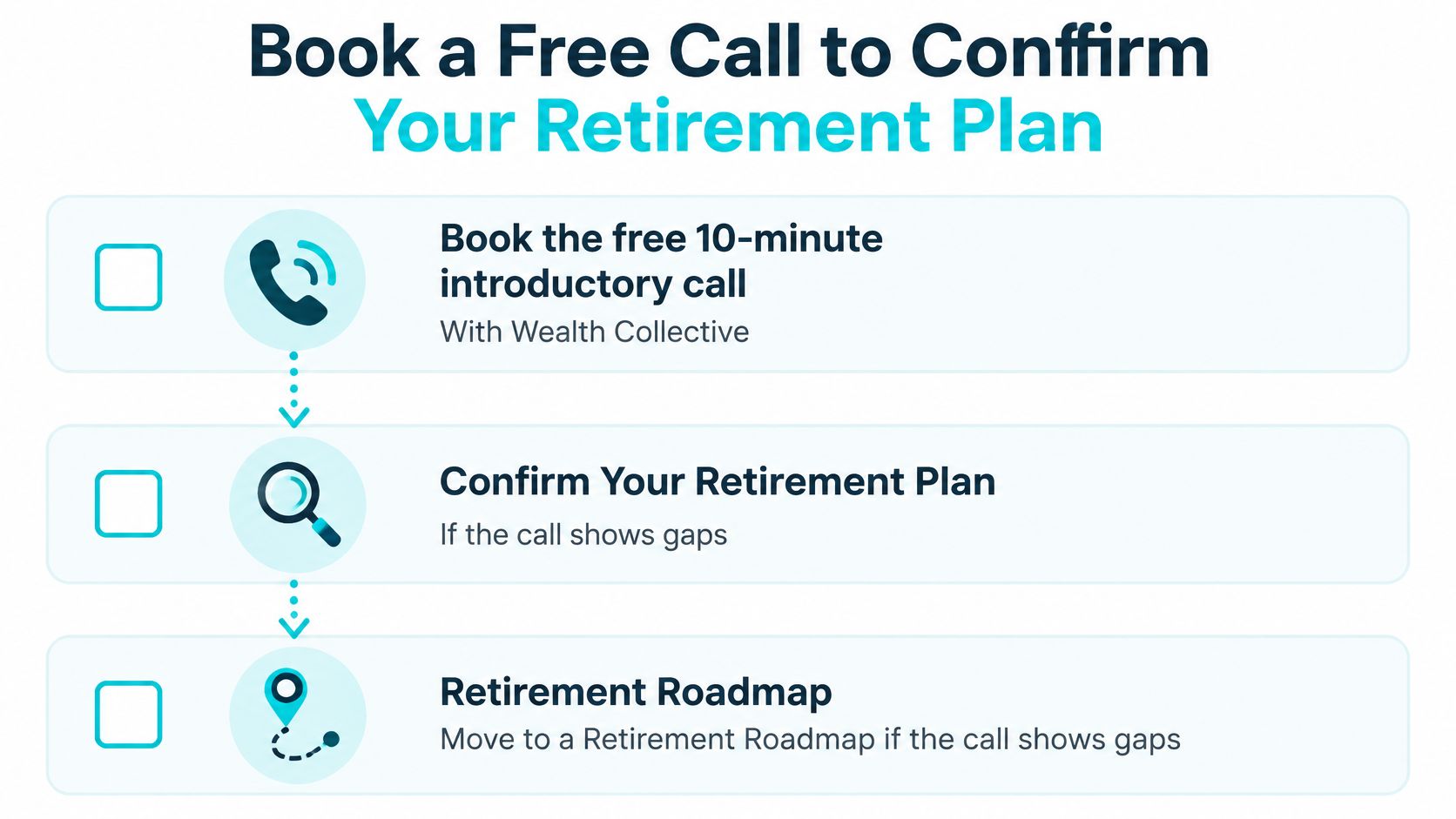
Start with the free 10 minute introductory call with Wealth Collective. If that conversation shows gaps, you move to a Retirement Roadmap that models your income target, super positioning and assets test outcomes in one plan. The work sits across three pillars, Protection Plus for insurance that protects the plan if health intervenes, Guided Growth for contributions and investment strategy while you're still working, and the Retirement Roadmap itself for income design and drawdown decisions.
Expect transparent communication about what advice will cost and what it covers, backed by a satisfaction guarantee. You're not committing to a full plan on a ten minute call. You're finding out whether your numbers hold up and what to fix first.
Come prepared and you'll get far more from it. Bring 12 months of spending, your latest super statements for both partners, loan statements showing balance and rate, any Age Pension estimate you've obtained, and a short list of retirement goals with the date you'd like to stop or reduce work.
You'll leave with two things most pre-retirees don't have, a clear annual income target based on your actual spending, and a prioritised list of decisions in the order they need to be made. That's what useful financial advice for pre retirees should give you, numbers first and products second.
If you're within ten years of stopping work and you still can't state your annual income target, your sustainable withdrawal rate and your likely Age Pension position, book a free introductory call and get those three numbers confirmed before you make irreversible contribution, downsizing or retirement date decisions. Visit Wealth Collective to start with a Retirement Roadmap conversation that turns your super, home, tax and pension into one coordinated income plan.