Business hours
Monday to Friday (8.30AM - 5PM)
Weekend (Closed)


Critical life insurance, usually called trauma insurance in Australia, pays a lump sum when the insured person meets the policy definition of a serious illness or injury while still alive.
You might be reviewing your mortgage, checking your super statement or wondering how your family would manage if treatment interrupted work. The difficult question isn't just whether you have insurance. It's whether the policy would pay what you expect, for the event you're worried about.
A serious diagnosis and an accepted insurance claim aren't necessarily the same thing. Understanding that distinction helps you choose cover that supports your household rather than relying on a reassuring policy name.
What Critical Life Insurance Pays For
Say a father of two has a heart attack that meets his trauma policy's definition. During recovery, he takes time away from work, while his partner reduces her hours to help with appointments and childcare.
The mortgage still needs paying. There are also travel expenses, rehabilitation appointments and everyday bills. His trauma benefit provides a lump sum he can allocate across those needs, rather than replacing his salary month by month.

Match the name to your policy documents
If you've searched for critical life insurance, look for trauma insurance, critical illness insurance or recovery insurance in your documents. These names describe the same broad category of protection, but they don't mean every contract offers identical benefits.
The Australian Securities and Investments Commission's Moneysmart trauma insurance guide names cancer, a heart condition, major head injury and stroke as examples of covered conditions, and states that mental-health conditions aren't covered. It also explains that medical definitions differ between insurers, making the Product Disclosure Statement, or PDS, essential reading.
Give the payout a practical job
For the family in this example, the priority might be keeping the home and maintaining a manageable routine. Another household might place greater importance on accessing rehabilitation or paying for support at home.
Common uses include:
- Treatment expenses: Out-of-pocket medical costs and rehabilitation.
- Household support: Family living costs, nursing care and transport.
- Changes at home: Housing modifications that support recovery or ongoing care.
- Debt repayment: Reducing a mortgage or other debts to lower regular commitments.
The payment doesn't make the recovery decisions for you. It provides money so you have more room to make them.
There's also a difference between having health insurance and having cash available for household expenses. Check each policy's purpose rather than assuming that protection for medical treatment also protects your mortgage or your partner's ability to take leave.
Start with a concrete question: what does the money need to do? A useful answer might be to reduce the mortgage, fund rehabilitation and let your partner step away from work without exhausting your savings.
How It Differs From Life, TPD and Income Cover
Critical life insurance compared with other personal insurance
| Cover | Pays out when | How it is paid | Main purpose |
|---|---|---|---|
| Life insurance | Death of the insured | Lump sum to beneficiaries | Replace income and clear debts for dependants |
| Critical life insurance (trauma) | Diagnosis or event that meets the policy definition, while the insured is alive | Lump sum to the insured | Fund recovery, medical costs and debt repayment |
| Total and permanent disability (TPD) | Permanent inability to work or perform daily tasks, as defined in the policy | Lump sum to the insured | Replace capital after a permanent loss of work |
| Income protection | Temporary or long-term inability to work due to illness or injury | Monthly benefit after a waiting period | Replace part of monthly income |
These policies answer different questions. Who needs the money, what has happened, and when should payment begin? The table describes their general purposes; policy ownership and the contract determine the actual recipient and payment conditions.
Life insurance supports the people left behind after death. Trauma cover is designed for a qualifying event during life. TPD addresses a permanent disability under its particular definition, while income protection addresses an eligible interruption to earnings.
Recovery isn't the same as permanent disability
Consider a professional who undergoes cancer treatment and eventually returns to work. A qualifying trauma claim can support the recovery period without requiring the person to establish permanent inability to work.
Income protection may address another part of that household's problem: regular earnings lost during an eligible absence. But a monthly benefit serves a different purpose from capital intended for debt reduction or substantial recovery expenses.
The distinction matters when comparing premiums. A cheaper policy in a different insurance category isn't necessarily a substitute for the protection you're considering.
Don't count linked benefits twice
Trauma and life cover can appear together on the same policy schedule. That doesn't always mean you have separate, fully independent pools of money.
Zurich's life insurance documents explain that trauma may be standalone or structured as an acceleration of another benefit, where a trauma claim can reduce the remaining life or TPD sum insured. Ask for a before-and-after illustration of the benefits, not just a list of their starting amounts.
For a broader comparison, use the guide to different types of life insurance to identify which financial problem each policy addresses.
A single-income family may have a substantial ongoing earnings gap. A self-employed professional may also need readily available recovery capital while work stops. The right mix starts with the largest uncovered financial risk, not with buying every available insurance label.
Medical Definitions That Decide Whether a Claim Pays
The diagnosis is the knock on the door. The policy definition is the lock that determines whether payment opens.
Your doctor diagnoses and treats your condition. The insurer assesses whether the medical evidence satisfies the contract. Those are different decisions, so a medically serious event can still fall outside a particular benefit.
The definitions for common claim causes deserve close attention. The Financial Services Council's detailed claims release, drawing on KPMG analysis and APRA data, reported that cancer represented 58% of trauma claims paid, while circulatory-system conditions represented 24%.
Full payment, partial payment or no payment
The Australian Prudential Regulation Authority's life claims definitions describe trauma as payment after a predefined illness or traumatic event and explain that many contracts allow partial payments for less severe conditions while remaining cover continues.
Say someone receives an early-stage cancer diagnosis. Under one contract, the pathology may satisfy a partial-benefit definition but not the full-benefit definition. Under another, the particular diagnosis may fall outside the covered wording altogether.
That difference can leave a household short if it budgeted for the advertised sum insured. A partial benefit is not the full benefit paid early. Its amount, limits and effect on remaining cover need checking separately.
What trauma definitions usually test for the main conditions
| Condition | What the definition usually tests | Common gap |
|---|---|---|
| Cancer | Stage or pathology threshold; many policies pay a partial benefit for early-stage cancer | Early-stage or non-invasive cases may pay less than expected |
| Heart attack | Evidence of heart-muscle damage meeting the policy's medical definition | Milder cardiac events may not meet the definition |
| Stroke | Persisting neurological deficit after a specified survival period, where required | Temporary symptoms often don't qualify |
| Major head injury | Severity of injury and persisting impairment | Milder head injuries may not qualify |
These are comparison prompts, not universal definitions. Read the actual wording, including evidence requirements, exclusions and any survival period.
Check what continues after payment
Standalone trauma cover has its own benefit structure. Accelerated cover draws against linked protection, so the consequences extend beyond the immediate recovery payment.
Continuation and reinstatement provisions also matter. Don't assume that receiving a partial payment leaves every benefit unchanged or that a claimed benefit automatically returns.
Ask these questions before choosing:
- Early-stage events: Would the relevant diagnosis trigger a full benefit, a partial benefit or neither?
- Linked protection: Would payment reduce death or TPD cover?
- Medical requirements: Must the insured survive a specified period or have ongoing symptoms?
A useful policy comparison explains those outcomes in ordinary language, with the relevant clauses beside them.
Premiums, Exclusions and Policy Features That Change Cost
Cost drivers and what to check for each
| Cost driver | Effect on premium | What to check |
|---|---|---|
| Age at entry | Generally increases with age; level pricing uses entry age as a basis | Entry age against stepped or level structure |
| Smoking and health history | Can add loadings or exclusions | Full and accurate disclosure at application |
| Sum insured | A higher benefit generally means a higher premium | Whether the amount matches debts and recovery costs |
| Stepped or level premium | Stepped generally starts cheaper and rises with age; level generally starts higher and stays steadier | Affordability across the whole holding period |
| Cover term | Longer terms mean more years of premiums and protection | Whether cover ends before major debts do |
| Partial benefit percentage | Can affect both product pricing and payout | The percentage and any cap for less severe events |
| Occupation risk class | Higher-risk jobs can attract loadings or exclusions | The occupation rating recorded in the application |
A personalised quote needs more than your preferred benefit amount. Your age, health disclosures, smoking status, work and chosen policy features help determine the terms an insurer offers.
Be careful with the word level. It doesn't mean the total premium can never change. Insurer repricing, benefit increases and other contractual adjustments can still affect what you pay.
Compare the cost over your intended holding period
Stepped premiums can suit a household that needs a lower starting cost, but affordability later deserves equal attention. Level premiums generally require more money upfront in exchange for a steadier age-based pricing structure.
Ask for a projection over your intended holding period. A hypothetical comparison across 10 to 20 years can be useful if that matches your plans, but it isn't a promise of future premiums.
Compare equivalent benefits and exclusions. Otherwise, a lower quote may buy less useful protection.
Read what the premium doesn't buy
Exclusions and application terms need a separate check:
- Mental-health conditions: Trauma cover isn't designed to pay for these conditions.
- Pre-existing conditions and disclosure: Check specific exclusions and answer application questions fully and accurately. Non-disclosure can affect a claim.
- Self-inflicted injury: Check whether and how the contract excludes it.
- Carved-out events: Read exclusions within the medical definitions as well as the general exclusions section.
Don't assume every previous condition is automatically excluded, or that every disclosed condition will be accepted. The insurer's written offer determines the terms.
Affordability test: Choose protection you can maintain, not just a starting premium you can manage today.
A cheap policy with a narrow trigger or a small partial benefit may leave a substantial claim gap. Equally, full-scope cover won't help if you've had to cancel it because the ongoing premium became unaffordable.
How a Trauma Claim Gets Paid, Step by Step
A claim is easier to manage when you organise the evidence around the policy's requirements. You don't need to interpret pathology yourself, but you do need to know which documents the insurer is requesting and why.
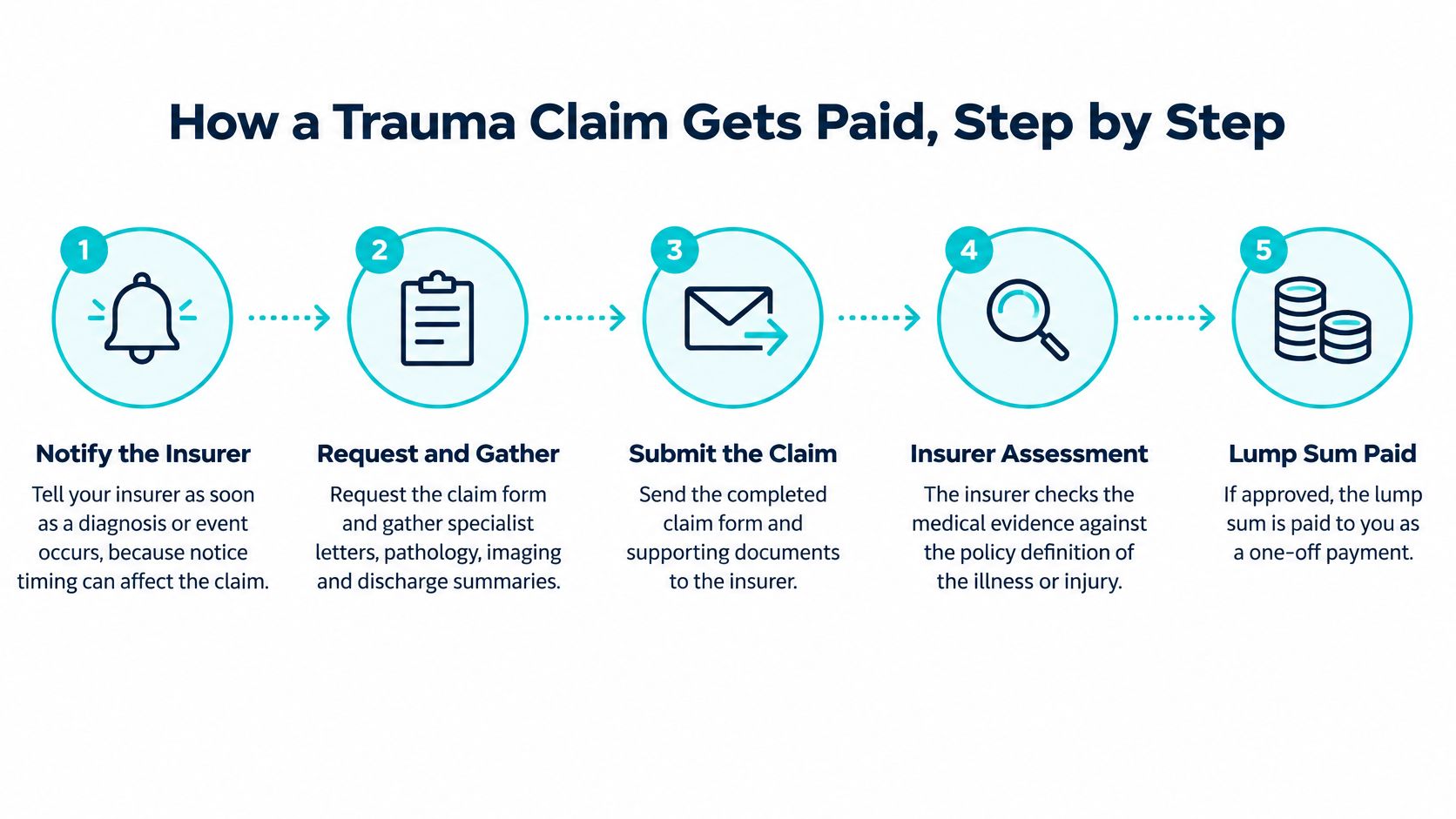
Follow the claim from notification to payment
Notify the insurer promptly. Tell the claims team when the diagnosis or event occurred, and ask about notice requirements so you don't create avoidable delays.
Request the forms and gather evidence. Collect specialist letters, pathology results, imaging and discharge summaries relevant to the definition, then submit them with the completed claim form.
Confirm the assessment details. The insurer checks the evidence against the definition and exclusions; also check its recorded claim-event date, which APRA's explanatory notes and glossary identify as when the event occurred or was first diagnosed.
Respond to further requests. Additional medical records or an independent medical review may be needed, so ask what remains outstanding and how it affects the assessment.
Get the decision in writing. The outcome may be full acceptance, a partial benefit or a decline, and the explanation should identify the relevant evidence and policy clauses.
Confirm the payment recipient and amount. An accepted benefit is paid as a lump sum to the entitled recipient under the ownership arrangement, which may be the insured person or another policy owner.
Review the remaining protection. Confirm what death, TPD and trauma benefits remain, check applicable continuation provisions, and update beneficiary arrangements where appropriate.
Keep a clear record
Save copies of submitted forms, medical documents, emails and decision letters in a secure folder. Keep a short contact log recording who you spoke to, what they requested and the next agreed action.
If a partial payment is offered, ask the insurer to identify the exact provision used and explain the balance of cover. Don't infer those details from the payment amount alone.
If you disagree with the outcome, request the reasons and the insurer's review or complaints process in writing. A useful challenge addresses the specific definition and medical evidence rather than relying only on how serious the diagnosis feels.
You can also ask your adviser for help coordinating documents and understanding correspondence. Keep the treating specialist focused on accurate clinical evidence, rather than asking them to promise an insurance outcome they don't control.
How Much Trauma Cover Different Households Need
A practical starting formula is:
Debts you intend to clear + 12 months of lost net income + a medical and rehabilitation reserve.
The period in this formula is a hypothetical planning assumption, not a recommended recovery time or a policy rule. Adjust it to your household, then subtract accessible resources you've deliberately allocated to the same needs without counting them twice.
The result is a capital target, not a replacement salary. Test it against what you'd otherwise cut, borrow or sell, and whether those actions would undermine your longer-term plans.
Trauma cover amounts by household type, illustrative
| Household | Debts and costs to cover | What moves the figure |
|---|---|---|
| Single renter, no dependants | Living costs and rehabilitation for an illustrative 12 months | Income protection may cover part of the gap; check any proposed access to super rather than assuming it's available |
| Young dual-income family | Illustrative $650,000 mortgage plus $90,000 income gap, producing a $740,000 subtotal before a treatment reserve | Childcare, school costs and the stability of the second income |
| Pre-retiree couple | Remaining mortgage, an illustrative 12 months of one partner's lost income and rehabilitation costs | Super balances, access conditions and planned working years |
| Small business owner | Business loans, personal debts and an illustrative 12 months of household income | Business debt structure and the partner's income |
These are hypothetical examples, not recommendations. Without actual debts, expenses and available resources, a specific suggested sum for each household would create false precision.
Work through the family example
Suppose the young family wants to clear its $650,000 mortgage and allow $90,000 for an income gap. Those assumed amounts produce a $740,000 subtotal, before adding a medical reserve or deducting savings allocated to recovery.
That doesn't automatically mean the family should buy that amount. It should test whether full mortgage repayment is necessary, whether income protection addresses some earnings loss, and whether the premium is sustainable.
The family should also model an early-stage event separately. If that event qualifies only for a partial benefit, the available payment could be much smaller than the recovery budget.
Plan what the full benefit is intended to fund, but don't assume every disruptive diagnosis will trigger it. Treat partial benefits as a fallback and identify how you'd meet the remaining shortfall.
Adjust for life stage and business obligations
A pre-retiree may prefer to protect retirement savings rather than draw them down earlier than planned. A business owner needs to distinguish personal recovery costs from obligations that belong in a separate business protection strategy.
Use the guide to working out how much life insurance you need to organise the broader household calculation. Keep death, disability and recovery scenarios separate so the same savings or insurance proceeds aren't allocated repeatedly.
How Super and Your Estate Plan Affect Trauma Cover
Where is the policy held? Who owns it? Who gets paid on death? These questions connect your insurance decisions to superannuation, control of money and the people you intend to support.
Trauma cover is usually held through a retail policy outside super. Don't assume that the insurance listed on your super statement includes it.
APRA's reporting distinguishes trauma across insurance channels, as discussed in Insurance News' coverage of trauma claims. Your own fund's PDS and policy schedule, however, determine what protection you hold, including any older arrangements.
Separate cover location from access to money
If insurance premiums are deducted from super, they reduce the money remaining in your retirement account. That makes premium funding a retirement-planning decision as well as a current cash-flow decision.
The guide to life insurance through super can help you frame the questions. Check the benefit type, ownership, payment conditions and any requirements for accessing proceeds.
A trauma payment received personally becomes part of your own assets. It isn't a death benefit distributed to your estate at the time of the trauma claim, although any unspent money you still own can become relevant to your estate later.
Check the effect on the people you leave behind
For accelerated cover, ask for an updated schedule after a claim. Your estate planning should use the death benefit that remains, not the amount that appeared on the original application.
For life cover held in super, a valid binding death benefit nomination can direct payment under the fund's rules. Your will alone doesn't necessarily control that benefit.
Check these arrangements together:
- Death benefit nomination: Confirm intended recipients, validity requirements and any expiry.
- Will: Review how personally owned assets should pass after death.
- Enduring power of attorney: Confirm who can manage financial affairs during incapacity under the applicable rules.
These documents perform different jobs; they should support consistent intentions, not necessarily contain identical directions.
Tax treatment also depends on ownership, purpose and structure. Confirm it with an appropriately qualified adviser rather than assuming every insurance payment receives the same treatment.
Check Your Cover Gaps and Book a Free Call
You don't need to memorise medical definitions before seeking advice. You need your documents, a realistic household budget and a clear account of what you want the money to protect.
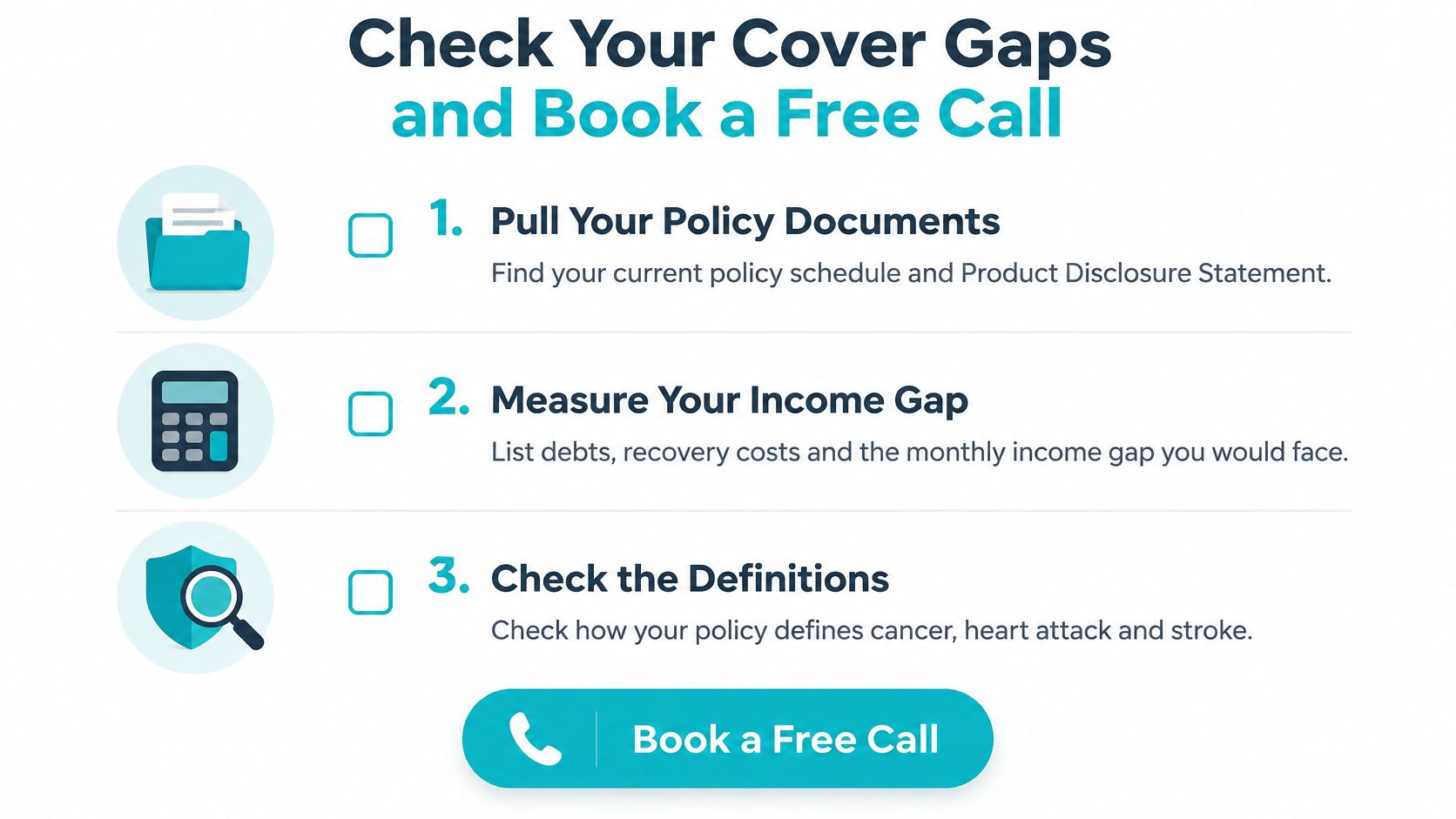
Prepare for a useful cover review
- Find your documents. Pull together the current policy schedule, PDS and any personalised exclusions or endorsements.
- Measure the financial gap. List debts, recovery costs and the monthly income shortfall your household would face.
- Read the main definitions. Check cancer, heart attack, stroke and major head injury against their full and partial claim triggers.
- Check benefit interactions. Record partial-benefit percentages and whether payment accelerates death or TPD cover.
- Test ongoing affordability. Use a hypothetical budget projection for the next 10 years, allowing for changing household commitments and uncertain premiums.
- Check your intentions. Review your super death benefit nomination, will and enduring power of attorney together.
Turn the documents into a decision
The Protection Plus personal insurance service can bring these questions into a coordinated advice process. It starts with a free introductory call, followed, if you proceed with advice, by assessment of your circumstances, a written recommendation and a plain-English explanation of the options.
A useful recommendation should explain what to retain, change or leave uninsured, alongside premiums, exclusions and ownership consequences. Sometimes the priority is a different policy structure; sometimes it's a more affordable benefit or a larger cash reserve.
There's no need to arrive with a preferred insurer or a finished calculation. Bring the uncertainties you want resolved, especially any difference between the payment you expect and the wording you currently hold.
Wealth Collective offers personal insurance advice through Protection Plus, including help assessing trauma cover, policy structures and ongoing review needs. Visit Wealth Collective to book a free introductory call and discuss how critical life insurance could fit your household's recovery budget and broader financial plan.