Business hours
Monday to Friday (8.30AM - 5PM)
Weekend (Closed)


The usual advice is to find an independent financial adviser and book a meeting. That skips the hardest part: proving what independent means, what the adviser is authorised to do, and what you'll pay. A polished website and a fee-for-service promise aren't enough.
If you're working out how to get independent financial advice, start with a licence, ownership and dollar-fee test. Then buy the smallest sensible scope of advice for the decision you face. For many people, the better choice is a focused engagement, not a full financial plan or no advice at all.
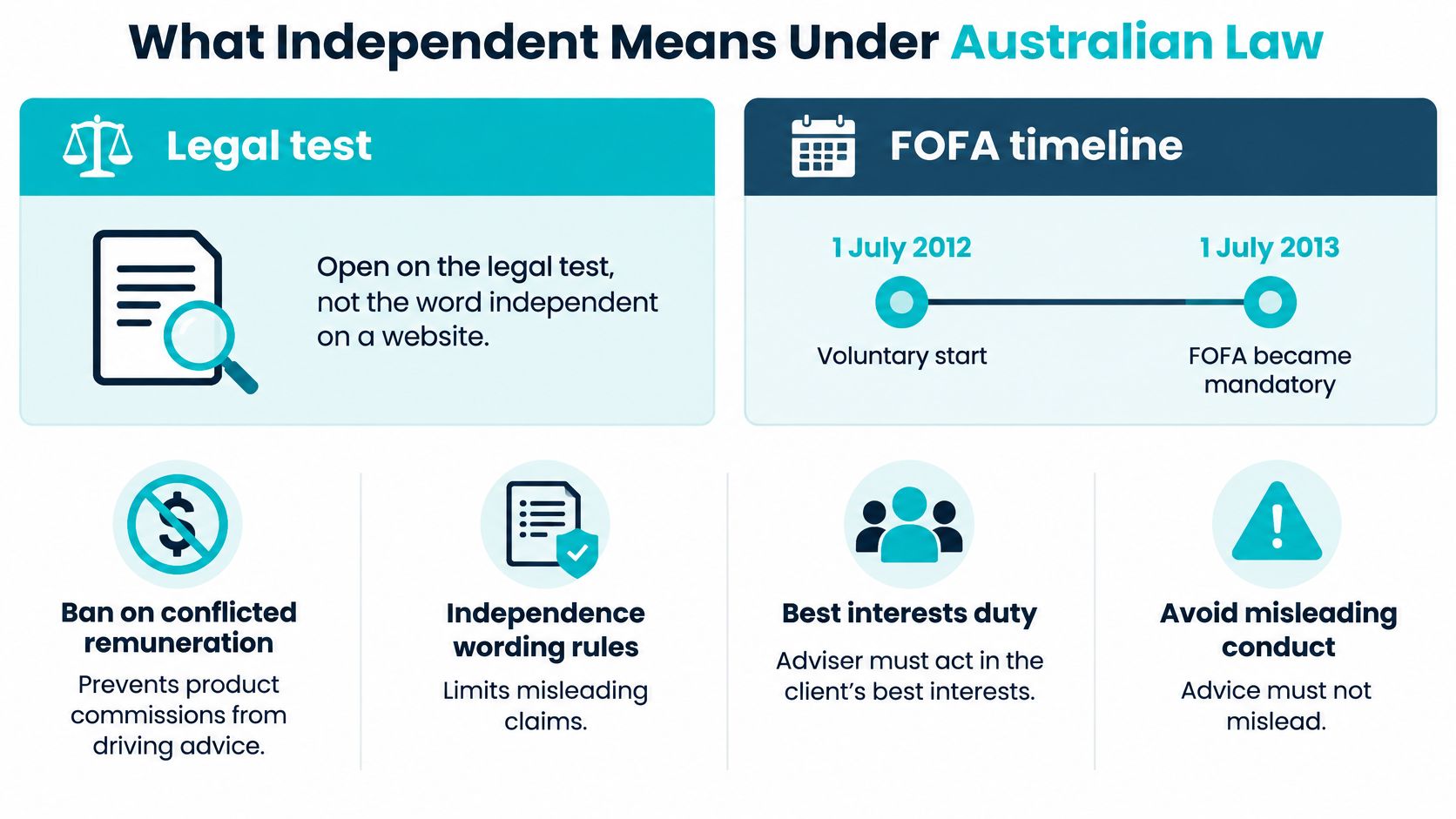
What Independent Means Under Australian Law
The word independent on a website proves nothing by itself. It's a claim to verify, not a substitute for checking authorisation, ownership and remuneration. Equally, an Australian financial services licence doesn't certify that every recommendation is independent or suitable for you.
The ASIC explanation of the Future of Financial Advice reforms records their voluntary start on 1 July 2012 and mandatory commencement on 1 July 2013, followed by amendments in 2014 and 2015 aimed at reducing compliance costs. Those reforms established foundational protections: a prospective ban on conflicted remuneration, including certain commissions and volume-based payments; a best-interests duty; and a requirement to prioritise the client's interests when giving personal advice to retail clients.
The original framework also included ongoing-fee renewal and annual fee-disclosure requirements. Don't mistake those historical arrangements for today's consent process, or assume that complying with general advice obligations automatically establishes independence.
Three adviser setups and what to verify
Ownership, payment and product access answer different questions. Use them together, rather than treating any single feature as proof.
| Setup | How they are paid | Product limits | Verify this |
|---|---|---|---|
| No issuer ownership and no restricted list | Advice fee disclosed in dollars | Products the AFSL authorises | FSG ownership, FAR authorisation, written conflicts |
| Fee-for-service inside an approved list | Advice fee, possible platform benefits | Approved-product list or platform menu | APL, platform ties, referral arrangements |
| Commission or volume-linked | Commission or volume payment | Often tilted to products that pay | Dollar value of the commission and the best-interests rationale |
The last row identifies an incentive to investigate, not a declaration that every commission or volume payment is permitted. Ask the adviser to explain the arrangement, its legal basis and its effect on the recommendation.
An adviser with no product-issuer ownership may have broader choice, but still needs appropriate authorisation. A fee-for-service adviser working within an approved-product list, or APL, may be competent while offering a narrower menu.
Practical rule: Treat independence as an evidence test. Don't award it on the strength of a payment label.
Ask these questions directly:
- Payment: How are you paid, including benefits beyond my advice fee?
- Influence: What ownership, referral or platform relationship could sway this recommendation?
- Service: What work does the ongoing fee cover?
- Consent: When must I renew written permission for those fees?
General information on our website isn't personal financial advice. Consider your own circumstances and consult one of our qualified Financial Advisers before acting.
Where to Find Genuinely Independent Advisers
Start with sources that help you identify who an adviser works for, not who pays for advertising. A referral can open the search, but it shouldn't close the investigation.
Ask your accountant, solicitor or someone who has used an adviser for a similar decision. A retirement-income referral is more useful to a prospective retiree than a recommendation based solely on friendly service.
Build a shortlist around the job
- Search the official register: Use the ASIC Financial Advisers Register to verify whether an individual is registered and authorised to provide personal advice to retail clients.
- Use professional directories selectively: Treat membership as a way to find candidates, not proof of independence.
- Filter for relevant experience: Look for the work you need, whether that's retirement income, superannuation, investments, insurance or debt.
- Request the licensee's name: Establish who authorises the adviser and whether the firm works within product restrictions before arranging paid work.
For local context, our guide to finding financial advisers in Perth can help you frame the search. Keep the shortlist broad enough to compare approaches rather than committing to the first appealing profile.
A personal recommendation earns an adviser a place on your shortlist. It doesn't earn them access to your super.
Be wary of unsolicited approaches that turn an introduction into an urgent transaction. You're looking for someone who can explain a decision, not someone who needs your signature before you've checked their credentials.
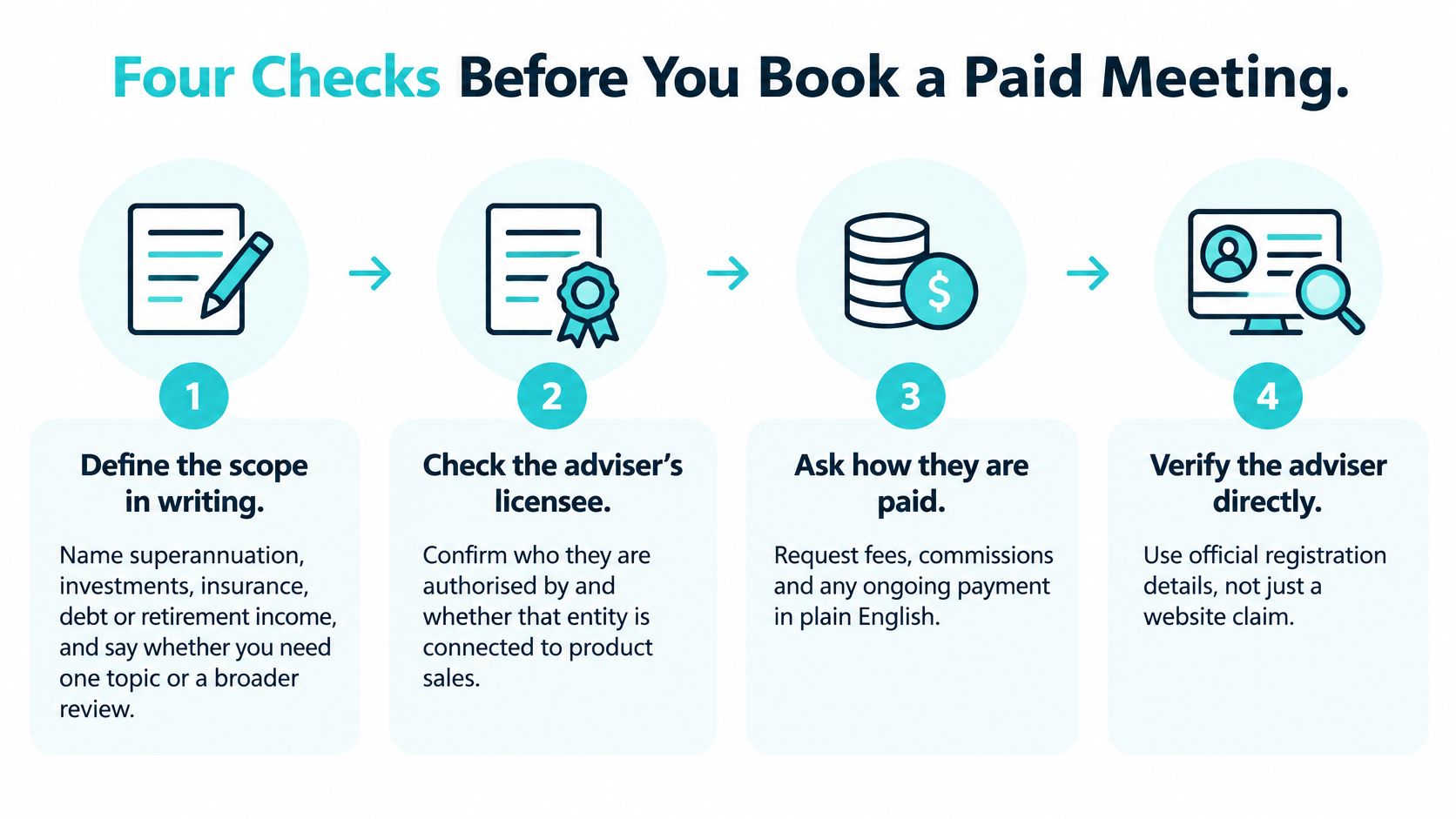
Four Checks Before You Book a Paid Meeting
Run these checks before paying for a meeting. You don't need to understand every investment product to apply them, but you do need documents rather than verbal reassurance.
Moneysmart's financial advice cost guidance supports checking the adviser's disclosures, authorisation, fees and services, and comparing the proposal with at least two alternatives. Make that comparison about the work being purchased, not just the headline price.
Run the screening gates in order
Define the scope in writing. Name the issue: superannuation, investments, insurance, debt or retirement income. State whether you want a single decision assessed, a broader plan or ongoing support. For example, asking whether additional super contributions suit your circumstances is a different job from rebuilding your investment portfolio.
Obtain the Financial Services Guide before paying. The FSG should identify the Australian financial services licence, authorised product areas, ownership, remuneration, commissions or other benefits, complaints process, and relevant fees and services. Read it alongside the engagement proposal. A disclosure document isn't a substitute for a clear description of your particular job.
Verify the individual and licensee. Search the Financial Advisers Register by name, ABN, suburb or postcode. Match the adviser's product authorisations to your scope, then examine qualifications, professional-body memberships and employment details. Don't assume everyone working under the same brand has identical authority or specialist experience.
Compare written proposals. Put scope, deliverables, implementation and ongoing service side by side. If a proposal includes portfolio management while another only answers a contribution question, they aren't competing quotes for the same task.
Pass or fail before the first paid meeting
| Check | Pass | Fail |
|---|---|---|
| Written scope | Names the topics and whether advice is one-off or ongoing | Vague full review with no deliverable |
| FSG before you pay | AFSL, ownership, fees, commissions and complaints | Guide refused or supplied only after payment |
| Financial Advisers Register | Authorised for the products in your scope | No record, or authority does not match the job |
| Comparison with alternatives | Written fees and services you can compare | Pressure to sign at the first conversation |
Walk away if the register doesn't cover the products relevant to the engagement, the FSG is withheld until after payment, or the adviser won't explain remuneration and conflicts in dollar terms. An impressive office doesn't offset a failed screening gate.
Separately inspect ownership, the approved-product list, platform relationships and referral arrangements. Paying an advice fee doesn't remove those connections.
For the advice engagement itself, ask for a written Statement of Advice. Test each recommendation against your objectives, risk tolerance, access-to-cash needs, tax position and total cost. If you can't explain why the recommendation suits you after the adviser has presented it, don't authorise implementation yet.
Fees to Demand Before You Say Yes
The affordability gap is substantial: the 2024 Australian Financial Advice report found that 68% of Australians believed professional advice provided benefits, but only 6% were willing to pay more than $2,500, while 67% wanted to pay no more than $500, according to IFA's coverage of advice-market research.
That reporting also put the median advice fee at $2,510 in 2018 and $3,960 in 2023, a 58% increase, and identified approximately 2.3 million unadvised Australians considering advice. Its separate market averages were $2,500 upfront and $3,500 ongoing for simple advice, compared with $4,400 upfront and $5,800 ongoing for full advice.
Typical Australian advice fees by scope
These reported averages provide a comparison point, not a quote or a promise that a single-topic engagement will attract the simple-advice average.
| Scope | Upfront | Ongoing | Quote must show |
|---|---|---|---|
| Simple or single topic | About $2,500 | About $3,500 | The one issue, the deliverable and any implementation cost |
| Comprehensive plan | About $4,400 | About $5,800 | Topics covered, product costs and what each annual review does |
| Market median, 2023 | $3,960 | Not split in the source | Whether the fee is fixed, hourly or a percentage of assets |
Don't accept a bundled price without understanding what's inside it. Our guide to financial advice fees in Australia provides context for assessing how an engagement is priced.
A fixed fee should identify the included work and what triggers an additional charge. An hourly quote needs an estimate, a clear treatment of preparation time and a process for approving extra work. A percentage-based fee needs a dollar equivalent and an explanation of which assets attract the charge.
Buy the decision you need
For those starting with a defined problem, I'd recommend asking for limited-scope advice first. A full investment plan isn't automatically the right purchase when your immediate question concerns insurance affordability, super contributions or debt repayment.
Limited scope must still be safe scope. An adviser may need to examine related circumstances before answering a narrow question, especially where tax, cash flow or insurance could change the outcome.
Request a written breakdown covering:
- Advice: The question being answered and the document you'll receive.
- Implementation: Applications, transfers and other execution work.
- Product costs: Investment, platform and insurance charges separate from advice.
- Reviews: The decisions assessed and actions delivered through ongoing service.
Don't compare an advice fee only with the balance being discussed. Compare it with the consequences of getting the decision wrong and the practical improvement the adviser can explain.
A large super balance alone doesn't justify an expensive plan. The engagement should help you make a consequential decision more safely or effectively. A cheap introductory conversation can establish fit, but neither a low price nor a high price proves independence or quality.
Questions That Expose Conflicts and Pressure
Someone calls about improving your super and wants you to switch quickly. The right response isn't to debate investment performance on the phone. Stop the transaction and verify who benefits.
ASIC's consumer alert in 2025 warned about pushy sales tactics encouraging quick superannuation switches and urged consumers to seek guidance from someone independent of the sales call. Treat that scenario as a test of judgement, not an opportunity you'll lose by taking time.

Ask questions that require evidence
- Staying put: Why is the proposed product better for me than keeping my existing arrangement?
- Commercial connections: Who owns the licensee, and which approved-product restrictions apply?
- Useful work: What will you do during the engagement that I couldn't reasonably do myself?
- Switching consequences: What are the advice fees, tax consequences, exit costs and effects on existing insurance?
- Accountability: What is the internal complaints process, and is the provider a member of the Australian Financial Complaints Authority?
For background on how commercial relationships can influence recommendations, Kons Law's an investor's guide to advisor incentives provides another perspective. Use it to sharpen your questions, not as an explanation of Australian legal requirements.
Pause before granting authority
Request the FSG and written recommendation through a channel you can independently verify. Check whether the person making contact is the person who will provide the advice, and whether the recommendation comes from an independent or product-restricted business.
Before permitting a super or pension change, insist on a written comparison with your current position. It should explain the strategy, the alternatives considered, the costs and why the outcome suits your circumstances.
Urgency is a reason to slow down. Other warning signs include a script that skips your goals, a generic risk questionnaire presented as a complete assessment, missing exit-cost information and recommendations outside the adviser's verified authority.
Independence is not suitability. A restricted adviser can be skilled within a narrow product list, and a technically independent adviser can still recommend the wrong risk, liquidity or tax outcome.
Judge competence, conflicts, communication and fit together. You should be able to challenge the recommendation without the adviser becoming defensive or turning the discussion into a closing exercise.
If concerns remain, keep the documents and use the licensee's formal complaints process. Informal assurances aren't a substitute for a recorded response.
What Changes for Your Life Stage
Your life stage changes the job you should buy, not the standard of evidence you should expect. Start with the decision that would materially affect your household, rather than asking an adviser to review everything by default.
Pre-retirees and retirees
Say you're approaching retirement in Western Australia and considering moving super into a pension arrangement. Ask for the proposed retirement-income assumptions, tax and Centrelink implications, and the cost of leaving your current fund in writing.
The useful questions are specific:
- Income resilience: What changes if investment returns disappoint or household spending rises?
- Access to cash: Which money remains available for unexpected expenses without disrupting the retirement strategy?
Bring your latest super statement. The adviser needs to understand what you already hold before recommending a replacement.
Younger households and high earners
For young professionals and dual-income families, a narrower brief often makes sense: affordable personal insurance, an appropriate super investment choice and a debt repayment order. A portfolio rebuild can wait if you haven't established reliable household cash flow.
Ask whether proposed insurance premiums remain affordable during parental leave or reduced working hours. Then ask which debt should receive surplus cash and how much should stay accessible. Bring a budget and insurance schedule, not just an investment account balance.
High earners and executives face a different coordination problem. Contributions, borrowing and investment ownership can interact, so buying separate recommendations without checking the combined effect can leave gaps.
- Contribution strategy: How does the proposal fit my existing contributions and expected cash needs?
- Investment structure: What changes in after-tax cash flow, risk and administration, and what does the percentage fee cost in dollars?
Bring a contribution summary and the details of any employer arrangements. Judge the proposed work by changes to tax, risk and cash flow, not whether markets performed well last year.
Small business owners
Separate business cash needs from household goals. Money earmarked for business obligations shouldn't become the funding source for a personal investment strategy.
Ask how personal insurance would support the household during a period when the business couldn't pay you. Then ask what happens to loans and family spending if you stop working.
Bring business and personal loan balances, with a clear distinction between the borrowers and purposes. The resulting plan should address those real obligations, not reduce your circumstances to a generic risk label.
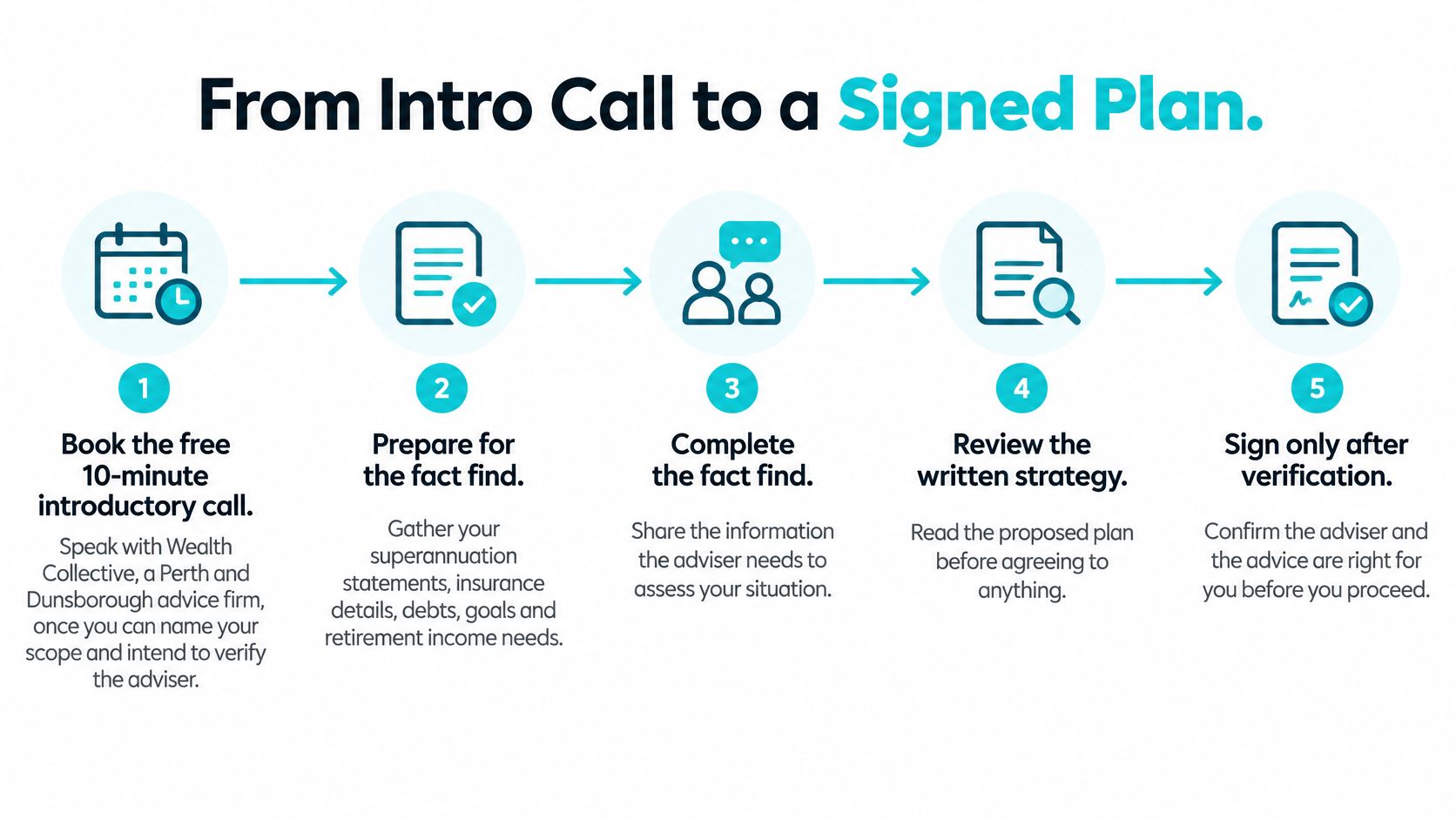
From Intro Call to a Signed Plan
Once you can name the decision you need help with, book a free 10-minute introductory call with Wealth Collective, our Perth and Dunsborough advice firm. Use that conversation to test fit and scope, not to choose a product.
We're a Corporate Authorised Representative of Wealth Collective Adviser Services Pty Ltd, AFSL 538833. Confirm the individual adviser's registration and relevant authority before paid work, and ask us to explain how conflicts are disclosed.
Prepare the information that makes advice personal
Before the fact find, gather the documents that let us assess your starting position:
- Superannuation: Your latest statement and relevant account details.
- Insurance: Current policy schedules and premiums.
- Tax: Your notice of assessment or tax return summary.
- Debt: Loan balances, repayments and interest details.
- Identification: Photo ID for the relevant verification steps.
- Goals: A short note covering priorities, dependants, timing and retirement-income needs.
Don't make the goals note complicated. Explain what you want to change, what you're worried about and which decisions you're not ready to make.
Our financial planning process involves understanding your circumstances, researching and modelling options, and presenting a personalized plan. The quality of the information you provide matters because our advice draws on that information and our professional expertise.
Move from scope to implementation deliberately
Start with the fact find. We examine your goals, super, investments, debts, insurance, tax circumstances and dependants within the agreed engagement. If an important detail is missing, resolve it before relying on the recommendation.
Read the written strategy. Ask how each recommendation addresses your objectives, risk tolerance, liquidity, tax position and total cost. The Statement of Advice should help you understand the decision, not leave you dependent on a verbal summary.
At the plan presentation, we guide you through the recommendations and answer your questions. Ask what happens if you delay, retain an existing product or choose not to proceed with part of the strategy.
Agree implementation only when you're comfortable. We then take care of the paperwork, products if required, and end-to-end implementation. Signing should confirm an understood decision, not substitute for understanding it.
For an appropriate engagement, Guided Growth helps turn income and assets into a custom engine for building wealth based on your goals and life circumstances, while Retirement Roadmap simplifies retirement planning and provides a clear path towards financial security. If the proposed scope is broader than your immediate need, ask whether a smaller engagement can answer the question safely.
Make ongoing service an active decision
Ongoing support shouldn't continue through inertia. ASIC's guidance on advice fees explains the annual written-consent framework and changes applying from 10 January 2025, with the services and fees for the coming year documented.
Before renewing, identify what work you need next: contribution adjustments, insurance changes, retirement-income modelling or a strategy review after changed circumstances. Assess delivered actions and documented improvements rather than relying on investment returns alone.
You should finish the process with a checked adviser, a written dollar fee and a plan you can explain in your own words. If any of those is missing, hold off signing.
Wealth Collective offers advice on insurance, superannuation, investments, debt and retirement planning, with a process that starts by understanding your circumstances and priorities. Visit Wealth Collective to book a free 10-minute introductory call, explain the decision you need help with and discuss the right scope before committing to paid advice.