Business hours
Monday to Friday (8.30AM - 5PM)
Weekend (Closed)



You're at the kitchen table in Perth, trying to reconcile a mortgage, two super statements, insurance options and everyday spending. The spreadsheet keeps growing, but the decisions don't get clearer. One partner wants to invest, the other wants to pay down debt, and neither is sure whether the family would remain financially secure if an income stopped.
That uncertainty is common, and it's exactly where a structured financial planning process helps. Good advice isn't a hunt for one perfect fund or insurance policy. It's a sequence that connects your cash flow, goals, protection, super, investments and retirement decisions, then reviews them as your circumstances change.
ASIC's MoneySmart describes a practical pathway that starts with identifying goals, checking an adviser's register entry, reviewing the Financial Services Guide, checking qualifications and fees, and deciding whether to proceed. It also provides 26 calculators and tools, including budget and retirement planners, to support structured decisions (ASIC MoneySmart). The process below turns that idea into six practical stages and shows how each stage can connect with Wealth Collective's three service pillars.
Why a Clear Process Matters Before You Talk to an Adviser
A WA household can make sensible choices independently and still end up with a disconnected financial life. The mortgage gets extra repayments, super sits in a default option, income protection is accepted because it came with a workplace package, and investments begin before anyone has checked whether the family has enough cash reserves or suitable cover.
The problem isn't a lack of effort. It's that each decision answers a different question. A mortgage decision focuses on interest and flexibility. Super involves tax, investment selection and retirement timing. Insurance deals with events nobody wants to plan for. Without an organised sequence, one choice can undermine another.
The six steps that bring order
A sound process normally follows this path:
- Discover the facts, including income, expenses, debts, assets, super, insurance, dependants and priorities.
- Define goals in practical terms, rather than leaving them as broad intentions.
- Test the current direction through cash flow, debt and retirement analysis.
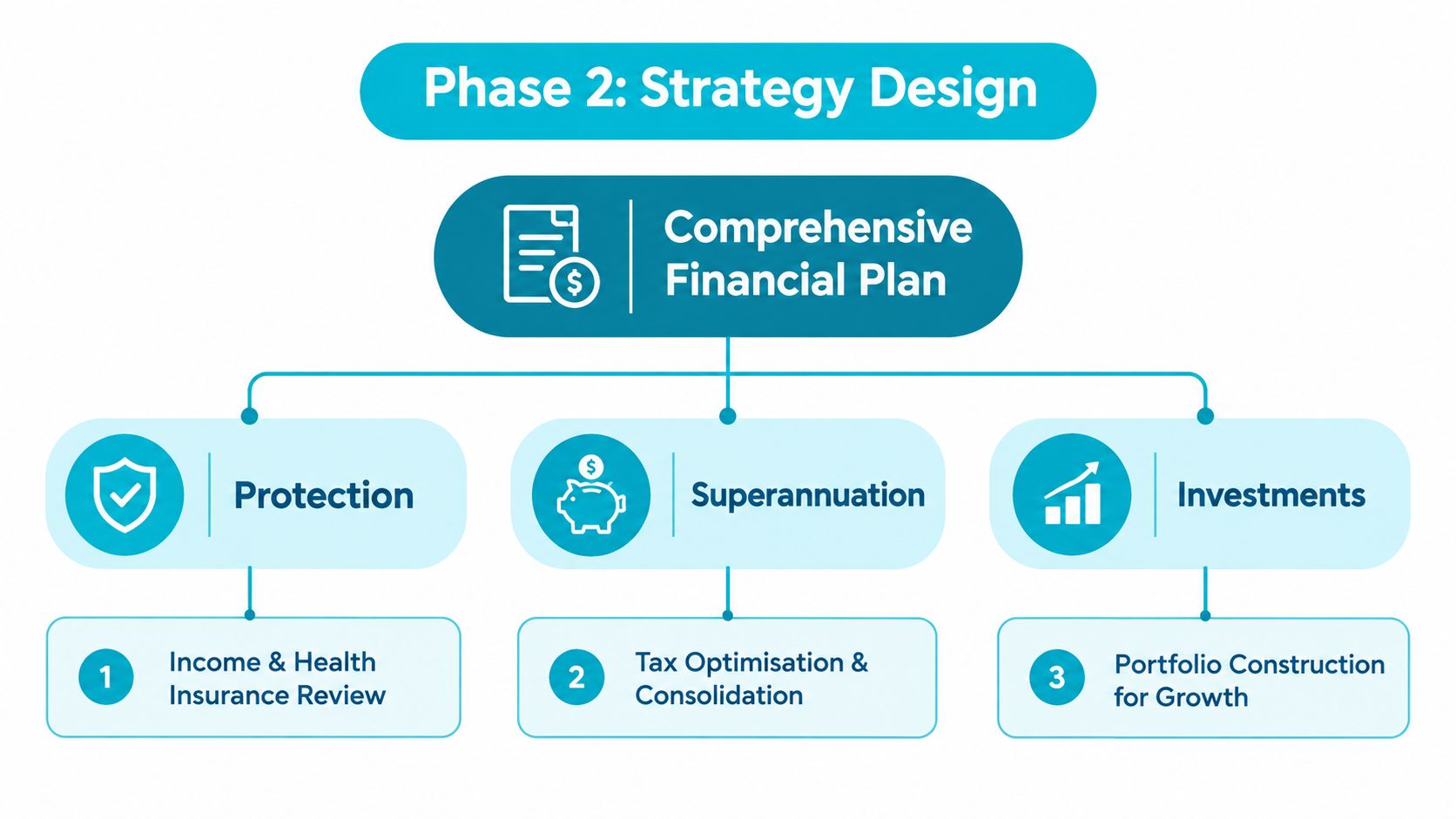
- Design the strategy across protection, super, tax and investments.
- Implement the agreed actions with clear responsibilities and documentation.
- Monitor and adjust when life, markets, work or legislation changes.
The value sits in the order. An adviser who recommends investments before understanding your debts, dependants and risk tolerance may be solving the wrong problem. An adviser who starts with discovery can identify which decisions matter now, which can wait, and which need coordination with an accountant, solicitor or lending specialist.
Practical rule: A product should answer a documented need. It shouldn't create the need.
That principle also applies to business owners, whose personal and business finances often overlap. A useful resource on building a winning financial plan for 2026 can help business operators think about cash flow, priorities and forward planning before they enter an advice conversation.
Before meeting anyone, review how to choose a financial adviser and focus on licensing, the scope of advice, fees and ongoing service. The right process should leave you clearer about your choices, not pressured into making a decision before the facts are understood.
Discovery, Goals and the Cashflow Reality Check
The early phase of the financial planning process is about replacing assumptions with evidence. Consider a young Perth couple earning a combined $165,000 and carrying a $620,000 mortgage. Those figures tell an adviser something, but not enough to recommend a strategy.
Start with the complete picture
Discovery gathers the information behind the headline numbers:
- Income: Salary, bonuses, business income, government payments and irregular earnings.
- Spending: Mortgage repayments, rent or childcare, utilities, subscriptions, transport, holidays and discretionary purchases.
- Liabilities: Home loans, credit cards, personal loans and guarantees.
- Assets: Property, savings, shares, business interests and valuables.
- Superannuation: Fund names, balances, investment options, beneficiaries, fees and insurance held through super.
- Protection: Life, total and permanent disability, trauma and income protection.
- Family circumstances: Dependants, future education costs, caring responsibilities and shared financial commitments.
- Preferences: Comfort with investment risk, debt reduction priorities and the lifestyle they want to protect.
The adviser isn't collecting paperwork for its own sake. Each item helps determine whether a recommendation is affordable, suitable and connected to the couple's actual life.
Turn intentions into decisions
“Build wealth” is an ambition, not yet a plan. The couple might instead define a short-term goal of creating a reliable cash buffer, a medium-term goal of reducing mortgage pressure while investing consistently, and a long-term goal of funding retirement without depending entirely on employment income.
The next step is to compare those goals with the current course. Cash flow analysis shows what arrives, what leaves and what remains available for debt reduction, super contributions or investments. Debt analysis then considers repayment structure, interest costs, fixed and variable arrangements, redraw access and the risks of relying on one income.
A clear view of spending often changes the conversation. Tools that assist with making sense of bank statements can help organise transactions, but an adviser still needs to interpret what those transactions mean for priorities and behaviour. Wealth Collective's cash flow management service is relevant when the challenge is not only earning more, but directing available money deliberately.
The most valuable moment often comes when the couple sees the gap between their present trajectory and their retirement target. That gap isn't a verdict. It gives the adviser and clients something specific to work on, whether the answer involves spending, debt, contributions, investment risk, retirement timing or a combination.
Designing the Strategy Across Protection, Super and Investments
Once the facts and priorities are clear, the adviser can design a coordinated strategy. The three Wealth Collective pillars provide a practical way to separate responsibilities without treating them as isolated products.
Protection Plus covers the risks that could interrupt the plan
The first question is simple: what happens to the household plan if one person dies, becomes permanently disabled, suffers a serious medical event or can't work for a period?
Protection Plus addresses the insurance layer. The review may consider life, total and permanent disability, trauma and income protection, with cover assessed against debts, dependants, future costs and ongoing living expenses. The purpose isn't to buy the largest policy available. It's to identify the financial consequences of a major event and decide which risks the household can retain, reduce or transfer.
Insurance ownership also matters. New trauma cover generally can't be held inside superannuation because SIS Regulation 4.07D restricts super funds from issuing insurance that doesn't align with a condition of release. Trauma cover pays a lump sum on diagnosis, rather than on death, disability or retirement, so this structure needs careful consideration (Zurich explanation of trauma cover and superannuation).
For readers comparing policies, a plain-English overview of life insurance types can help distinguish the purpose of each form of cover.
Retirement Roadmap coordinates super and tax
Retirement Roadmap handles the superannuation and retirement structure. That can include reviewing fund costs and investment settings, considering salary sacrifice or personal deductible contributions, assessing spouse contributions and checking how accumulation choices connect with future retirement income.
The relevant contribution limits change over time. From 1 July 2026, the concessional contributions cap increases to $32,500, according to the ATO's indexed superannuation rates (ATO contributions caps). From the same date, the non-concessional cap increases to $130,000, and eligible people with a total super balance below $1.84 million at 30 June 2026 may use the bring-forward rule to contribute up to $390,000 over three years (ATO non-concessional contributions cap).
These rules aren't a reason to contribute more automatically. The adviser must check affordability, contribution history, balance thresholds and the client's wider strategy.
Guided Growth builds the investment structure
Guided Growth addresses investments after the earlier decisions are understood. The portfolio should reflect the goals, timeframe, cash needs and tolerance for loss identified during discovery.
That could mean a diversified portfolio designed for long-term growth, with cash and defensive assets considered for nearer-term needs. The key is that investments support the plan rather than dictate it. A portfolio that looks attractive in isolation may be inappropriate if the client needs liquidity for a home purchase, has insufficient protection or is carrying expensive debt.
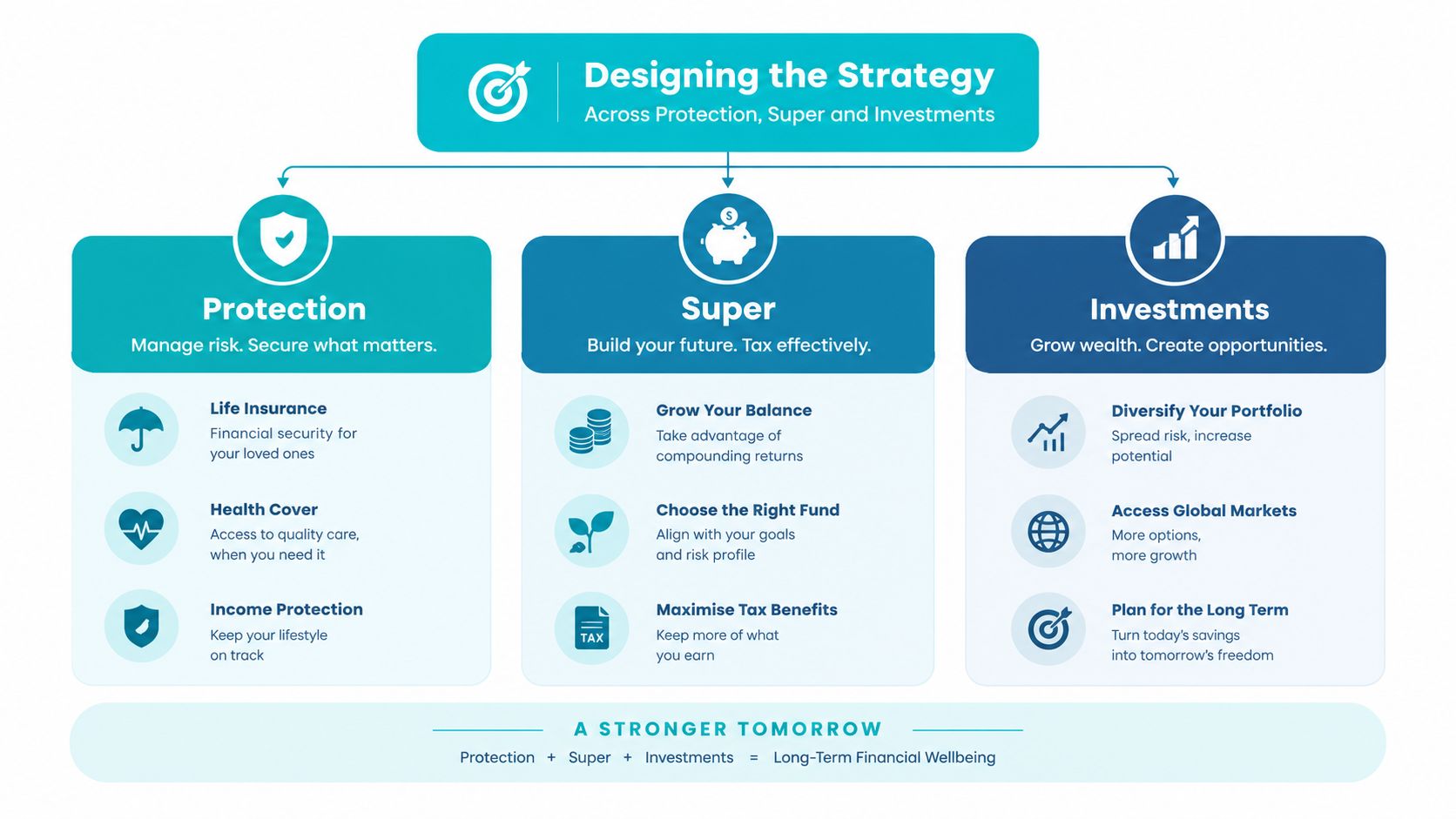
All three pillars use the same cash flow and goals data. That's why sequencing matters. Protection affects affordability, super affects tax and retirement income, and investments need to fit what remains after those foundations are addressed.
The Numbers Behind Smart Sequencing in 2026
A retirement strategy needs to begin with timing and readiness, not product selection. The Australian Bureau of Statistics reported 4.2 million retirees in 2022–23, an average retirement age of 56.9 years and an intended retirement age of 65.4 years (ABS retirement data cited by ASIC). The same release found that most retirees rely on the pension as their main income source.
WA households are also confronting a readiness gap. A 2026 report cited fewer than four in ten WA respondents as already planning for retirement, 17% as rarely checking their super balance, 23.3% as having reduced super contributions because of living costs, and 45% as not believing they'll have enough for retirement. Respondents estimated they'd need $1.99 million to retire comfortably, compared with a national average of $1.91 million (MoneySmart financial advice information).
Those figures explain why a 35-year-old couple shouldn't automatically start with shares. An investment-only path may overlook income protection, dependants, contribution limits and the effect of debt. A sequenced path first checks whether the household can withstand disruption, then uses available super structures appropriately, and finally invests according to the remaining goals and risk capacity.
| Metric | Investment-Only Path | Sequenced Wealth Collective Path |
|---|---|---|
| Starting point | Select investments first | Establish facts, goals and cash flow |
| Income interruption | May leave a protection gap | Income and personal risks are reviewed before implementation |
| Super strategy | May be treated as a later decision | Contributions, investment settings and retirement timing are coordinated |
| Portfolio role | Can become the entire strategy | Supports defined goals alongside debt and super |
| Review trigger | Often driven by market movements | Driven by life changes, goals and agreed monitoring |
| 25-year outcome comparison | Cannot be reliably projected without personal inputs | Cannot be reliably projected without personal inputs |
The table deliberately avoids a made-up balance comparison. No adviser can responsibly promise a higher retirement balance without knowing contributions, fees, returns, tax, spending, timing and future circumstances. The useful comparison is the quality of decisions: a sequence reduces the chance that an investment choice has to be undone after a death, illness, job loss or retirement transition.
Two Real Journeys Through the Process
The same six-step process can look very different across households. The Hendersons, a young Perth family with two children under five and a Cottesloe mortgage, began with competing priorities. They wanted to consider private school fees, retain the option of a future sabbatical and reduce financial pressure without abandoning long-term wealth building.
Discovery brought their income, spending, debts, super and existing cover into one view. Goal setting separated school costs from the sabbatical ambition, while the cash flow review exposed where debt consolidation could simplify repayments and create more predictable capacity. Protection Plus then assessed income cover against the mortgage and family commitments.
Guided Growth was considered only after those foundations were addressed. The investment approach matched their timeframes rather than chasing whatever had performed recently. Their first monitoring conversation followed a salary increase, which changed their contribution capacity and required the plan to be adjusted. A practical family money plan can help households start discussing priorities before that professional conversation.
A review doesn't belong on the calendar only because a year has passed. It belongs there when the family's financial reality has changed.
Robert's situation was different. At 58, working in Karratha and six years from his intended retirement, he held three super accounts and hadn't updated his will since 2019. His Retirement Roadmap engagement focused less on building an aggressive portfolio and more on organising the transition ahead.
The work included reviewing and potentially consolidating super accounts, modelling a transition-to-retirement strategy, testing age pension eligibility and considering future aged-care needs. Each decision needed to fit his expected retirement income, spending requirements and family arrangements.
Both journeys pause at monitoring because implementation isn't the finish line. A new child, salary change, redundancy, inheritance, business sale, health event, relationship change or retirement date can justify a review sooner than planned. The adviser's job is to keep the strategy connected to the life it's meant to support.
Common Mistakes That Derail Good Plans
Most financial mistakes don't come from carelessness. They come from solving one part of the picture while ignoring the others.
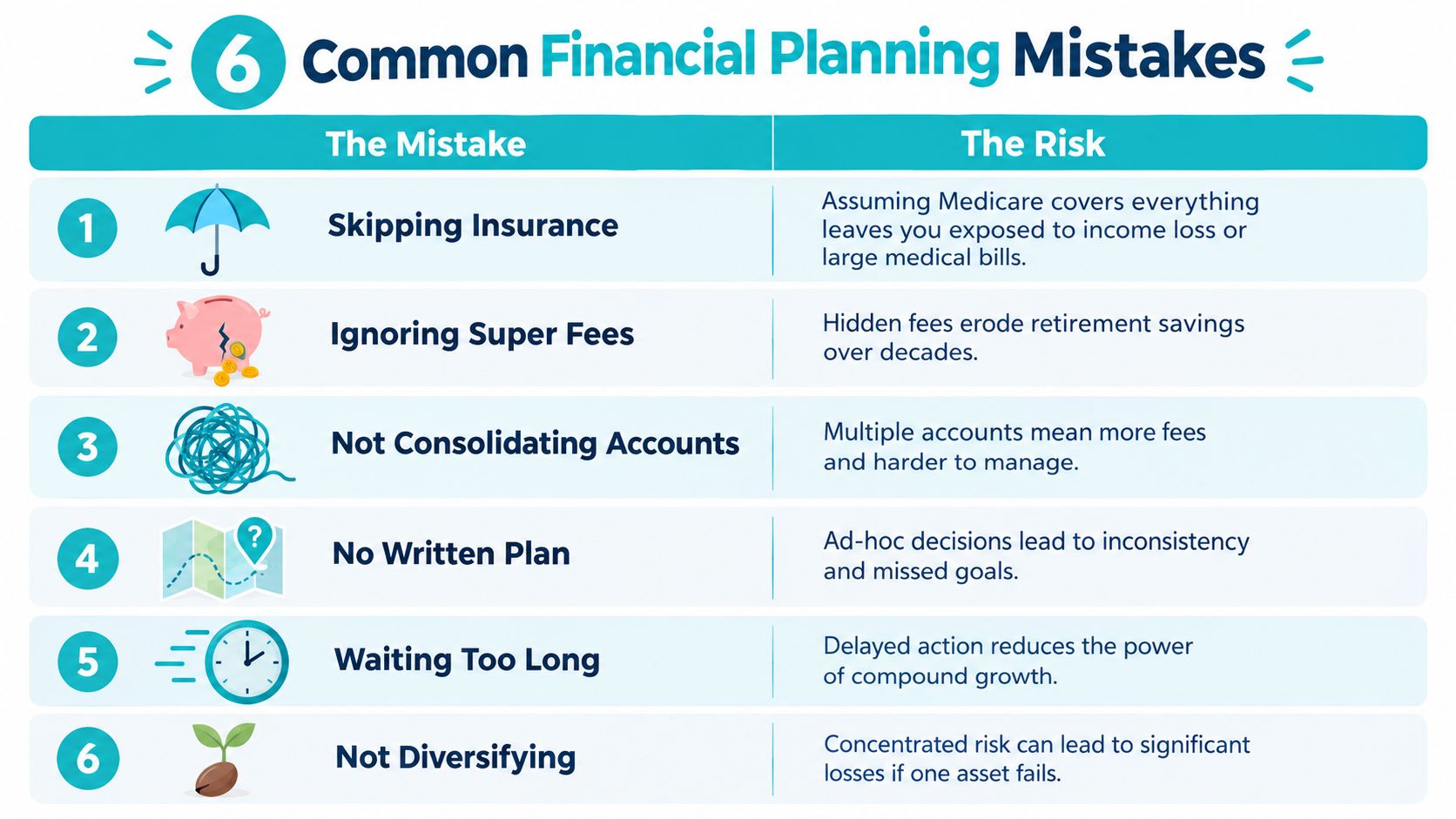
Six traps worth challenging
Skipping insurance: Medicare doesn't replace lost income or remove every financial consequence of serious illness. The alternative is to assess the household's obligations and decide what cover is appropriate.
Treating super as an afterthought: Waiting until close to retirement can leave less room to adjust contributions, investment settings and retirement income arrangements. A planner reviews super as part of the broader strategy, not as a statement opened once a year.
Paying off the home loan before investing anything: Debt reduction can be valuable, but making it the only priority may leave long-term wealth building underdeveloped. The better question is how repayment, liquidity and diversified investing can work together.
Chasing last year's winner: Past performance doesn't tell you whether an investment suits your timeframe or capacity for loss. A diversified portfolio based on goals is more disciplined than reacting to rankings.
Keeping multiple legacy super accounts: Several accounts can mean duplicated administration and insurance arrangements, and they're harder to monitor. Consolidation should be checked carefully because fees, benefits, investment options and insurance can differ.
Reviewing only during a market fall: A plan needs attention when income, family, health, debt or retirement intentions change, not only when headlines become alarming. Monitoring creates room for deliberate decisions rather than emergency reactions.
ASIC's advice framework links personal advice to a client's objectives, needs and financial situation. Its review of personal SMSF establishment advice, published as REP 824, highlights why suitability checks, documented rationale and compliance controls matter before high-consequence recommendations are implemented (ASIC financial advice framework).
Questions to Ask and How to Take the First Step
A first meeting should give you useful clarity, even if you decide not to proceed. Take a short list of questions and group them by the decisions you need to make.
Adviser credentials and fees
Ask whether the adviser is licensed to provide the type of personal advice you're seeking, what qualifications they hold, and how fees are disclosed in writing. Request the Financial Services Guide and check the adviser register before sharing sensitive information.
Takeaway: You should understand who can advise you, what they charge and what you'll receive before agreeing to anything.
Scope of advice
Ask whether the advice covers protection, super, investments, debt and retirement, or only a limited issue. Confirm what the Statement of Advice will address and what falls outside the engagement.
Takeaway: A narrow engagement can be appropriate, but you need to know its boundaries.
Ongoing service
Ask how often reviews occur, what events trigger an earlier review, how portfolios are rebalanced and who handles the annual review. Find out whether implementation support is included or treated separately.
Takeaway: A plan should explain how it changes when your life changes.
Documentation and reporting
Ask how recommendations, assumptions, risks and trade-offs will be recorded. Confirm how you'll receive reports and whether the advice team will help coordinate information with your accountant, lender or solicitor.
Takeaway: Clear records make decisions easier to understand and revisit.
Personal fit
Notice whether the adviser listens before recommending. You should be able to explain your top concerns in plain language and leave with a clearer idea of the next step.
Have a rough outline of your income, debts, super balance, insurance details and main financial concerns ready for Wealth Collective's free 10-minute introductory call. It's a no-obligation scoping conversation, not a commitment to a full plan.
Wealth Collective helps Australians coordinate personal insurance, cash flow, superannuation, investment strategy and retirement planning through Protection Plus, Guided Growth and Retirement Roadmap. Visit Wealth Collective to book your free 10-minute call and bring the kitchen-table questions into a calm, practical conversation.