Business hours
Monday to Friday (8.30AM - 5PM)
Weekend (Closed)



Regulatory action over misleading communications with super members is a reminder that reviewing super means checking more than investment returns, and the FirstChoice member outcomes assessment shows how the product's results are reported.
For anyone reviewing First Choice superannuation, the useful question is how your particular mix of investment options, insurance cover and contribution settings fits your life now. Those settings shape fees, tax and how smoothly you can access income or make a claim in retirement.
First Choice Super at a Glance
A large workplace super arrangement serves a broad mix of members, and averages hide that variety. FirstChoice Employer Super covers many employer plans and accumulation stage members, while FirstChoice Wholesale Personal Super serves individuals who choose their own settings. The brand is shared. The settings are not.
FirstChoice works like a set of switches rather than a single product. Your investment option mix sets growth potential and volatility. Your insurance settings set what happens if you cannot work. Your contribution pattern sets tax outcomes and the balance you carry into retirement access. Change one switch and the other two respond differently at claim time or at retirement.
FirstChoice Employer Super in broad terms
| Area to check | What it tells you |
|---|---|
| Membership scale | Size of the member base and workplace reach |
| Funds under management | Size of assets across the arrangement |
| Contributions flow | Money moving into member accounts during the year |
| Employer plans | Number of workplace plans using the arrangement |
| Member age profile | Whether most members sit in accumulation or near retirement |
| Account balances | Typical starting point for a personal review |
| Insurance claims record | Reported history for handling insurance claims |
These points describe Employer Super only, not Wholesale Personal Super. They point to a mainstream workplace arrangement, not a product built only for retirees.
Your investment option matters more than the label
Wholesale Personal Super is a choice structure. Members select investment options with different asset allocations, risks, costs and investment approaches.
Two accounts with the same brand name can hold very different portfolios. One member might hold a single diversified option. Another might combine share investments with defensive assets across several options.
Your review should start with the exact product name on your annual statement. Record the product name, current balance and option mix. Include how much sits in each option, not just the names, because a small costly holding affects your account differently from a large costly holding.
That mix then shapes the three decisions that matter most. Which options suit your timeframe and tolerance for losses. Which insurance level you can sustain inside super. Which contribution pattern keeps fees, tax and retirement access aligned.
Fees, Costs and Performance to Check
The headline administration fee isn't necessarily your total cost. FirstChoice's investment options can carry their own charges, so an account-level comparison can miss what you're paying for the portfolio itself.
The FirstChoice Wholesale Personal Super PDS identifies performance-fee amounts ranging from 0.00% to 0.47% for some options and performance-fee rates of up to 25% of relevant outperformance under some methodologies. Those figures describe different fee measures, not interchangeable charges.
FirstChoice cost components and where to find them
| Cost Component | Value or Range | What It Covers |
|---|---|---|
| Administration fee | Use the account's published PDS fee schedule | Ongoing charge for running the super account |
| Investment fee | Use the selected option's published investment fees and costs | Charge for managing the chosen investment option |
| Transaction costs | Use the selected option's disclosed transaction costs | Costs incurred when the option buys and sells assets |
| Buy/sell spread | Use the selected option's published entry and exit spread | Cost of moving money in or out of an option |
| Performance fee | 0.00% to 0.47% for some options; up to 25% of relevant outperformance under other methods | Charged when the option meets its performance-fee conditions |
Understand the calculation before adding costs
As a hypothetical arithmetic example, applying a 0.47% annual charge to a constant $100,000 balance produces $470 before other charges. That isn't a FirstChoice fee quote, and it doesn't mean every option charges that amount.
A performance fee may apply to relevant outperformance rather than the whole balance. Check the benchmark, measurement period and whether a high-water mark requires the manager to recover earlier losses before earning another fee.
Also check whether a disclosed investment-fees-and-costs figure already includes performance fees. Adding the same component again would overstate the total.
Compare returns on a consistent basis
Use each held option's PDS and current performance report. Compare returns net of fees with that option's own benchmark and strategic asset allocation, using matching periods and checking how the report treats tax.
An option holding mostly shares shouldn't be judged as though it has the same job as one holding mostly defensive assets. A higher return may reflect greater investment risk rather than better management.
Past returns do not guarantee future results. Write down each option's published cost components, benchmark and allocation, then flag any holding whose cost seems difficult to justify for the exposure it provides.
Insurance Inside Your Super and When to Replace It
It's easy to assume that insurance attached to your super account is enough. The better test is whether the benefit would protect your household if you couldn't work or died.
Premiums deducted from super leave less invested for retirement. But reducing premiums without checking the protection you're giving up can expose your family to a much larger financial loss.
Test the cover against your obligations
Use your policy schedule and insurance guide to answer these questions:
- Who relies on your income? Include a partner, children and anyone else whose living costs you support.
- What debt would need attention? Separate the mortgage from other liabilities and identify what repayments could continue without your earnings.
- What happens to the business? A small-business owner's household needs and business commitments aren't necessarily covered by the same policy.
- What changes near retirement? Check whether benefits, premiums or eligibility change as your employment and age change.
For example, a household might be able to meet everyday costs from a partner's salary but struggle with the mortgage during a prolonged illness. The appropriate response may be to change the type or amount of cover, rather than seek a cheaper premium.
Our guide to life insurance through super explains the funding arrangement. For a replacement decision, compare definitions, exclusions, waiting periods and benefit periods, not just the monthly deduction.
Don't cancel existing insurance until replacement cover is confirmed and you understand any exclusions or gaps.
Health changes can make replacement cover more expensive or unavailable. Obtain written confirmation of acceptance and the commencement date before ending an existing policy.
Keep evidence when something goes wrong
Moneysmart's super complaints guidance identifies delays, incorrect fees, poor service, incorrect information and mishandled insurance claims as complaint issues, with internal responses generally required within 45 calendar days and escalation available through the Australian Financial Complaints Authority.
Keep dated claim forms, medical requests, emails, call references and statements showing deductions. State what happened, what remains unresolved and what outcome you want, then ask for a written response.
Your insurance review should finish with a reasoned decision: keep the cover, adjust it or replace it safely. A lower premium alone isn't enough to choose between them.
Who Benefits Most and Who Should Look Closer
Fit and checks by client type
| Client Type | Main Advantage | Main Risk | Check Before Deciding |
|---|---|---|---|
| Pre-retirees | Investment choice and retirement income features | Access depends on conditions of release, and a withdrawal can reduce future income | Preservation age, employment status and an Age Pension model |
| High-income earners | Options that can be matched to risk tolerance | Option costs can differ materially, and contribution caps and Division 293 tax can apply | Total cost per option, all concessional contributions and wider income |
| Small business owners | Can support employer-linked contributions | Owner cover and business obligations may not align with super cover | Insurance needs, contribution channels and business cash flow |
Pre-retirees need an access and spending plan
The ATO's super withdrawal guidance explains that preservation age is 60 for people born from 1 July 1964, while earlier birth dates have preservation ages ranging from 55 to 59. Before age 60, retirement-based access generally requires reaching preservation age, ceasing paid employment and having no intention of returning; from age 60, leaving a job can generally satisfy an access condition, while age 65 permits access even if you're still working.
Reaching an access age doesn't mean you must withdraw everything. The ATO's retirement access guidance confirms that eligible members may use a lump sum, an income stream or a combination, and eligible workers may consider a transition-to-retirement income stream.
- Lump sum: May meet a specific expense, such as mortgage repayment, but model the effect on remaining savings, tax and Age Pension assessment.
- Income stream: Can support regular spending, with the withdrawal level considered alongside tax treatment and household benefits.
- A combination: May suit a household needing both an upfront payment and ongoing income, provided the remaining portfolio supports future spending.
The FirstChoice retirement product material also describes a Retirement Income Optimiser election involving a lifetime pension. Its intended Age Pension benefits require modelling against eligibility, partner assets, tax and spending needs, rather than assuming the feature improves every household's outcome.
Higher earnings and business ownership require different checks
For high-income earners, the ATO's contribution tax guidance states that concessional contributions are generally taxed at 15%, with additional Division 293 tax potentially applying when income plus concessional contributions exceeds $250,000. Salary sacrifice, employer payments and deductible personal contributions all matter; use step 5 of the review to reconcile them.
Business owners should distinguish household protection, business obligations and retirement funding before choosing settings. Identify your closest fit in the table, and use our guide on how to choose a super fund if you're comparing FirstChoice with alternatives.
How to Review Your First Choice Super Membership
A useful review produces decisions, not just a folder of statements. Start with the documents that let you establish what you hold and what the arrangement really costs.
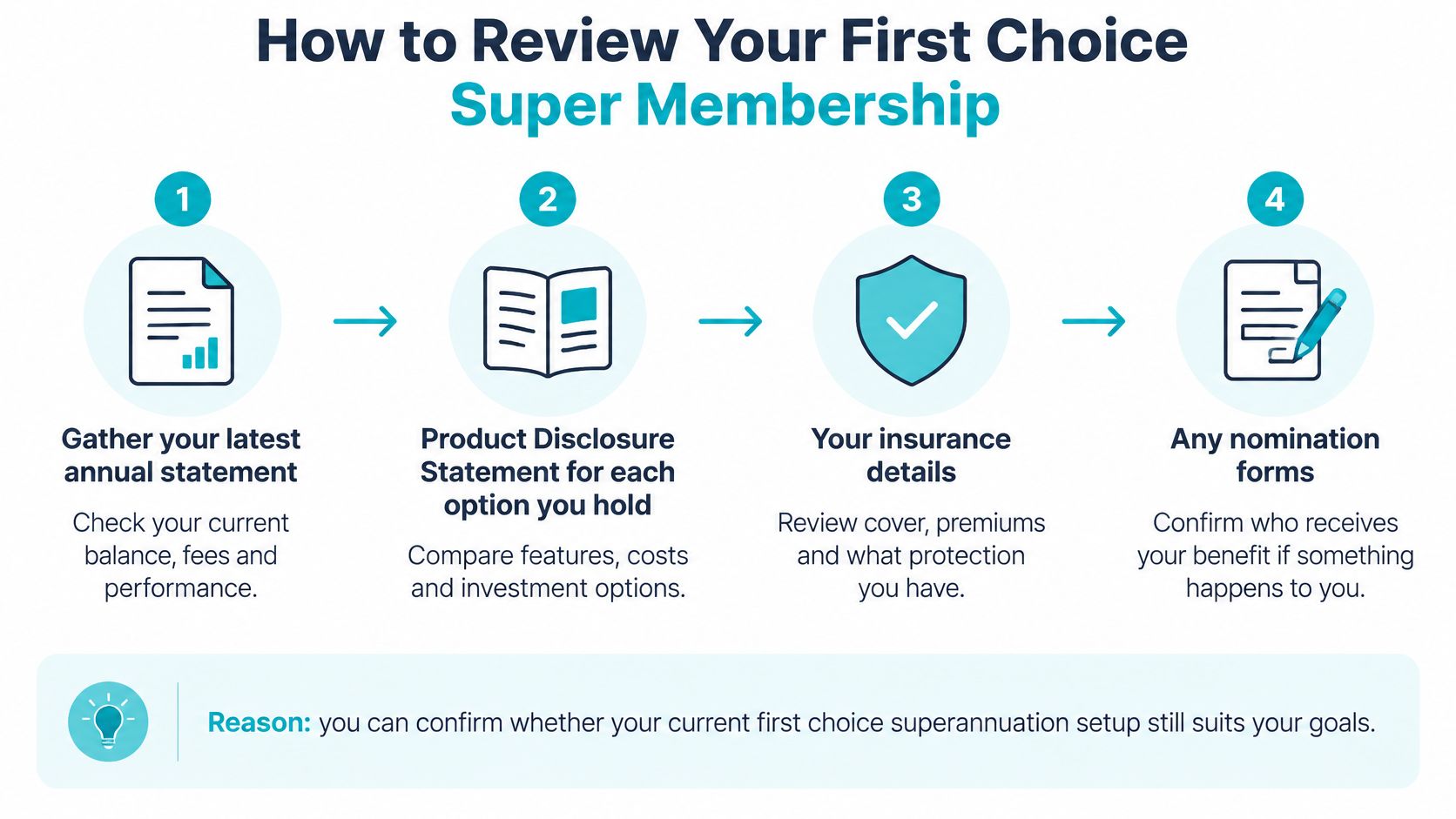
Work from documents to decisions
Gather the evidence. Collect your latest annual statement, the PDS and relevant investment information for each option, insurance details and nomination forms. You need the current disclosures to distinguish historical deductions from the charges and conditions that apply now.
Confirm what you hold. Record the product, balance and allocation across options, including where new contributions are directed. Check that the arrangement still reflects your intentions rather than an old election you've forgotten.
Build an option-level cost comparison. Use a spreadsheet to record each cost component, checking for amounts already included in another disclosed figure. Compare the option's net performance with its benchmark, rather than comparing a fee percentage directly with a return.
Review the protection you're paying for. Record insurance type, benefit amount, premiums and material policy restrictions. Match the benefits to your current household commitments so you can identify a specific shortfall or unnecessary overlap.
Reconcile concessional contributions. The ATO's personal super contribution guidance sets the 2025–26 concessional cap at $30,000, including employer super guarantee payments, salary sacrifice and personal contributions claimed as a deduction, with excess contributions potentially attracting additional tax. Add these channels together before making another contribution, because overlooking employer payments is an easy mistake.
Check beneficiary nominations. Confirm who is nominated, the nomination type and any renewal requirements. Don't assume your will alone determines who receives your super benefit on death.
Write an action record. Give each possible decision, keep, switch options or consolidate, a reason and an action date. Record any unresolved issue that must be settled before you authorise a change.
Test the longer-term implications
Once your records are accurate, you can explore superannuation projections using AI2Fin to compare assumptions about contributions and retirement timing. Treat calculator results as illustrations, not predictions, and check the assumed fees, investment returns and inflation before relying on them.
Useful review question: Which unresolved issue could change your decision most?
That question helps focus a personal review on what matters. Through Guided Growth, we can research and model the choices around superannuation optimisation rather than treat every member's account as the same problem.
How to Roll Over or Consolidate Your Super
Consolidation can reduce duplicate account fees and make forgotten accounts easier to manage. The trap is closing an account before checking whether it contains insurance or another benefit you want to retain.

Check what would move and what would end
Say a member has several small accounts, but only one carries insurance they can no longer replace on equivalent terms. Moving every balance into the account with the lowest administration charge could leave them worse protected.
The better approach may be to retain the insured account while consolidating others. Our super consolidation guide provides context for deciding whether fewer accounts would improve your arrangement.
Put the transfer in a controlled order
List your accounts through ATO online services. Record each fund, balance and insurance arrangement, then investigate any account you don't recognise. This establishes what you're considering moving rather than relying on old paperwork.
Choose the receiving account deliberately. Compare its investment options, total costs and insurance with each existing account. A familiar brand or convenient login isn't enough reason to make it your main fund.
Check transfer consequences. Identify applicable transaction or switching costs, buy/sell spreads and benefits that would end. If an exit fee appears in paperwork, query its basis rather than assume it is payable.
Confirm insurance continuity in writing. Establish whether the receiving account provides the cover you need and whether acceptance is complete. If retaining an old account for insurance, confirm the funding and eligibility requirements for keeping that cover active.
Use the receiving fund's rollover process. Complete the requested personal information and tax file number details, and supply identification through the fund's secure process where required. Accurate matching helps avoid unnecessary follow-up.
Submit and track the request. Save the confirmation and monitor both accounts until the transfer is resolved. Processing takes time, so don't treat submission as evidence that the money has arrived.
Reconcile the receiving account. Check the transferred balance, investment allocation and any remaining old-account balance. Update your employer's contribution details where necessary so future payments reach the intended account.
Don't authorise a rollover while a material benefit remains unclear. Once you're 100% comfortable with the outcomes, we take care of the paperwork, products if required, and end-to-end implementation.
Book a Free Intro Call to Review Your Super
FirstChoice is a set of investment options and account settings, not a single investment decision. Each setting should earn its place against your income, debts, insurance needs and retirement timing.
A free 10-minute intro call is a practical starting point. Have your latest statement, the PDS for each option you hold, your insurance details and any rollover quotes available so you can explain what you're considering and where you're uncertain.
Understand the advice process
If you proceed with advice, we research and model your options and create a detailed financial plan that balances financial structure, money success and lifestyle. We then guide you through the plan and answer your questions, so you understand the proposed changes before deciding whether to act.
The outcome needn't be a new fund. It may be a clearer reason to retain your existing arrangement, adjust selected settings or coordinate super with the rest of your finances.
Our satisfaction promise is straightforward: if you're not 100% satisfied, we'll make it right or refund your money, with no questions asked.
The general information on this page isn't personal financial advice. Consider your own circumstances and consult one of our qualified Financial Advisers before acting, particularly where a decision affects insurance, tax or access to retirement savings.
Wealth Collective offers advice that connects your FirstChoice investment settings with insurance, contributions and retirement planning. Visit Wealth Collective to book a free 10-minute intro call and identify which part of your super arrangement needs a closer look.