Business hours
Monday to Friday (8.30AM - 5PM)
Weekend (Closed)


The advice you'll find almost everywhere is that life insurance without a medical exam is the shortcut: apply online, answer a few questions, get covered by tomorrow. For a healthy 34 year old with a mortgage and a clean medical history, that's often true. It's also the framing behind most of the expensive mistakes people make with Australian personal insurance, because it treats the missing exam as the main event.
The exam was never what decided whether a family got paid. What decides it is the wording of pre-existing condition clauses, the length of a waiting period, and how much medical evidence the insurer can ask for years later. A policy can be issued in ten minutes without a blood test and still decline a claim for a condition that showed symptoms before the policy started.
What follows is the version I'd give a friend: what the label means, which route suits which situation, and the questions worth asking before anything is signed.
What No Medical Exam Really Means
Life insurance without a medical exam describes an application process, not a level of protection. In Australia it generally means the insurer won't send you for a physical examination or blood test before it issues cover. It does not mean the insurer learns nothing about your health. ASIC's review of direct life insurance found that insurers may replace detailed upfront medical underwriting with exclusions for pre-existing conditions, shifting part of the assessment to the claims stage, and that 35% of surveyed consumers said they were told they did not need a medical test.
The application still asks. A no-exam application can require health declarations, lifestyle information, and disclosure of previous symptoms and diagnoses. If a claim later relates to a pre-existing condition, the insurer can pull your medical records and test whether that condition was known or symptomatic before the policy began. ASIC's review also found that consumers who were told no medical was required were less likely to understand pre-existing condition exclusions.
Under the one label sit four routes that behave very differently.
- Guaranteed issue: no health questions at all. Approval is close to certain, the sum insured is capped, and the payout is restricted if death happens in the early years.
- Simplified issue: a short health and lifestyle questionnaire, then a decision. People describing their cover as "no medical" are here.
- Graded benefit: a reduced payout during an initial grading period, then the full sum insured afterwards.
- Group or super default cover: automatic cover inside a fund, within the fund's rules and a set amount. Nobody examines you because nobody individually assesses you.
Fully underwritten cover sits outside that group as the benchmark: a longer questionnaire, sometimes an exam, and clearer terms in return.
The exam is a data-collection step. Remove it and you haven't removed the questions, you've moved them somewhere less visible, usually into the wording that decides claims.
If you want a plain-English walk through how that trade-off is presented to applicants, this guide to skipping the medical exam requirement covers similar ground from a consumer's point of view.
By the end of this piece you'll be able to match each route to your health history, your budget and your timeline, and you'll see fast approval as a trade-off rather than a guarantee of broader protection.
Non-Exam Policy Types Compared Side by Side
The table below puts the five routes side by side. The middle columns decide your outcome far more than the headline on the product page.
| Policy route | Health questions at application | Typical waiting period | Typical cover limit | Main trade-off |
|---|---|---|---|---|
| Guaranteed issue | None | Often 12 to 24 months for non-accidental death | Usually lower; confirm in PDS | Accepted regardless of health, but early payouts are restricted |
| Simplified issue | Short health and lifestyle questionnaire | Pre-existing condition exclusions may apply | Often lower than full underwriting | Faster approval, but undisclosed or pre-existing conditions may be excluded |
| Graded benefit | Usually none | Reduced payout in the first one to two years | Often lower; confirm in PDS | Full benefit only after the grading period ends |
| Group or super default cover | None for the default amount | Set by fund rules | Set by fund rules; increases need health questions | Automatic, but often less than a family needs |
| Fully underwritten (benchmark) | Full medical questionnaire, possible exam | Usually none for accepted conditions | Highest, individually assessed | Slower and more questions, but clearer terms |
Read it from the middle outward. The first column tells you what the insurer asks, and the third and fourth tell you what you give up for a shorter form. Where an insurer asks nothing, it hasn't assessed you individually, so the payout rules have to do the work underwriting would otherwise do.
Moneysmart makes the same point in plainer terms: when an insurer doesn't ask about medical history, the policy may carry more exclusions or narrower definitions, so the wording matters more than the application speed (see life insurance cover explained).
What a graded benefit looks like in practice
A common graded structure pays the sum insured for an accidental death from day one, but for a death from illness in the first year it returns only the premiums paid plus interest. The full sum insured applies once the grading period ends, usually after two years. That's not a technicality. It's the difference between a policy that clears a mortgage and a policy that refunds a few thousand dollars.
Group and super cover is usually the first no-exam cover you hold
Most Australian adults with no-exam cover never applied for it. Default cover inside a super fund is granted automatically within the fund's rules and a set amount, which is why the amount tends to be modest next to a mortgage. Nothing about it was individually assessed, and the sum insured reflects that.
Guaranteed issue is rarer than overseas sites suggest
Guaranteed acceptance products exist in Australia but are far less common outside group arrangements than US-focused content suggests. When you do find one, the cap and the early-payout restriction make up the core of the product. Read those before you read the premium.
Practical rule: when a page leads with "no medicals", find the maximum sum insured and the waiting period first. If either is missing from the page, it's in the product disclosure statement, and that's the reason the page is short.
Each row answers a different question. Guaranteed issue answers "will anyone take me". Simplified issue answers "can I get a decision this week without a needle". Graded benefit answers "what if my health is uncertain but I need something in force". Group cover answers "what do I already have". Fully underwritten answers "what will be there at claim time".
If you're still working out which structure suits your household, this overview of the main types of life insurance cover is worth reading before you compare a specific quote.
The waiting periods and limits above are general guides, not product rates. Confirm every figure, definition and exclusion in the product disclosure statement before you rank two offers on price.
Who Qualifies for Each Non-Exam Route
Eligibility for non-exam cover comes down to four things: your age, the amount you're asking for, what you disclose, and the route you choose. The benchmarks below show how that has played out in the Australian market.
| Eligibility factor | Benchmark or rule | Source and meaning |
|---|---|---|
| Average lump-sum non-exam policy | About $235,000 over the reported 12 months | Productivity Commission submission, industry estimate rather than official market data |
| Average trauma policy amount | About $165,000 | Productivity Commission submission |
| Age below which most applicants need no automatic medical test | Under 51 | Productivity Commission submission, initial application stage only |
| Default super life cover | Many funds automatic for members aged 25 or over | Moneysmart, subject to fund rules and a set amount |
| Increasing super cover | Health questions; a medical exam may be required | Moneysmart |
| Maximum sum insured on guaranteed or graded routes | Capped by the insurer, with the cap stated in the PDS | No legislated maximum; check the product disclosure statement |
Averages describe what was issued, not what you'll be offered. A market average tells you that plenty of ordinary policies get written without an exam; it says nothing about the cap on the product you're looking at. The age benchmark works the same way. It describes the initial application stage, and a disclosed condition such as diabetes, asthma, depression, cancer history or back problems can still trigger a request for further medical information.
The super rows are the ones most readers already sit inside, and they're covered in more detail below. What matters here is that the default amount and the fund's age threshold set your baseline, and lifting the amount above that baseline is a fresh underwriting event.
Before you apply, run this short check.
- Confirm your age band, because it sets both the medical requirements and the maximum sum insured on most products.
- List the amount you need and the default cover you already hold, so you're comparing a gap rather than a total.
- Write down every condition, medication and recent symptom you'd have to disclose, including anything you've been told is minor.
- Ask the insurer for the maximum sum insured on the route you're considering, in writing, before you fill in anything.
Do that first. The answers decide whether you're looking at a five-minute form or a fortnight of paperwork, and they're much easier to establish now than to argue about at claim time.
Waiting Periods, Exclusions and Claim Evidence
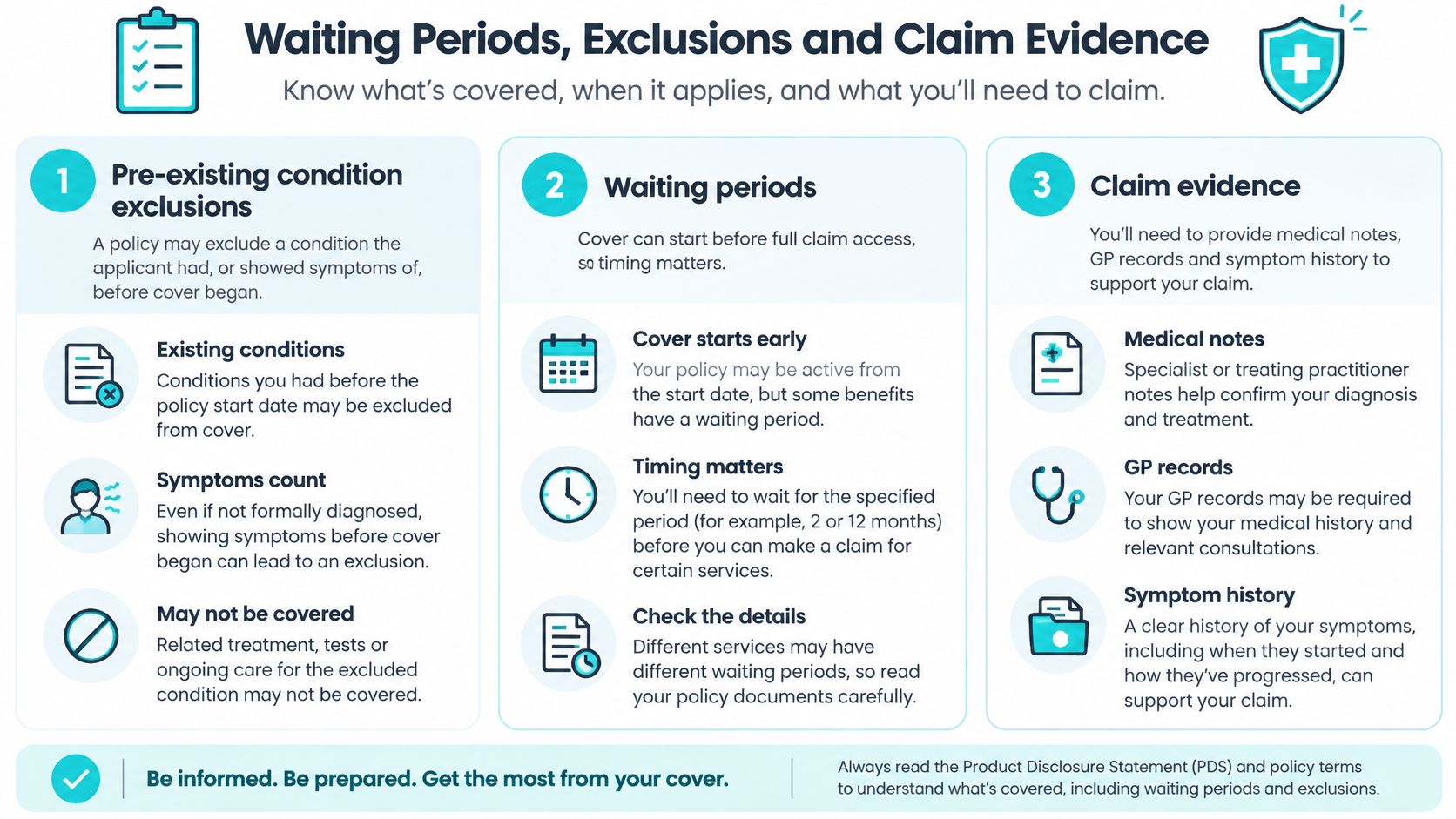
The costs of skipping the exam don't appear on the quote. They appear on three lines of the policy: what's excluded, how long you wait, and what the insurer can ask you to prove.
Here's where those three terms sit inside a typical contract.
Pre-existing conditions surface through your own medical records
Say a man mentions nothing about the chest pain he raised with his GP eight months before applying, because it was investigated and nothing came of it. He dies of a heart attack in year three. The insurer requests the GP notes, sees the consultation, and applies the pre-existing condition exclusion. That's the mechanism ASIC described when it found insurers may replace detailed upfront underwriting with exclusions and shift the assessment to the claims stage. Nothing improper happened. The questions moved.
Waiting periods change when the money arrives
Waiting periods and survival periods sit alongside exclusions and are often confused with them. A graded policy may pay only premiums plus interest for a non-accidental death in the first year. Trauma and terminal illness benefits usually require the condition to meet a specific definition and, in some contracts, a survival period measured in days or weeks after diagnosis.
What the insurer can ask for at claim time
The absence of testing at application doesn't mean medical evidence is never needed. When you claim, the insurer may ask for permission to contact your doctor and may require an independent medical examination by a specialist who reports to the insurer rather than to you.
That's normal, and it's not a reason to avoid claiming. It is a reason to be precise at application. ASIC's review of direct life policies found that only 17% of respondents recalled being told they did not need to answer questions about their medical history, and reported that product design varies most in exclusions and additional benefits. In other words, "no medical" is a feature of the application, not evidence of equivalent protection.
Work through this list in the PDS before you commit.
- The exclusion list, read in full, with particular attention to any condition you've ever had a consultation about.
- Every waiting period, including any survival period attached to terminal illness or trauma benefits.
- The key definitions, especially terminal illness, trauma events and total and permanent disability wording.
- Your duty of disclosure, because an inaccurate answer is the most common reason a claim becomes a dispute.
- Whether premiums are guaranteed or reviewable, which decides how much the policy will cost you by year fifteen.
If the definitions read like a legal document, this explanation of how life insurance works translates the mechanics before you go back to the wording.
What Non-Exam Cover Costs Over 10 to 20 Years
The premium on the quote is the price of one year. The number that matters is what you pay across the years you need cover, adjusted for the things that can move underneath you.
Run the arithmetic first
Two steps are enough to see the shape of it.
- Multiply the annual premium by the years you expect to hold the policy, at 10 and at 20.
- Adjust for the three variables that change the total: a premium review, a reduced payout from an exclusion or waiting period, and a lapse that leaves you uninsured after years of payments.
A premium of $150 a month is $1,800 a year, which is $18,000 over ten years and $36,000 over twenty before any review. If the insurer raises the rate in year four, the twenty-year total climbs while the sum insured stays exactly where it started. That's the arithmetic the entry price hides.
Then check what changes the total
Claims performance is the other half of the calculation. ASIC's review of life insurance claims, covering 15 insurers and more than 90% of the market, found materially higher denial rates for some direct-to-consumer policies sold without financial advice than for adviser-distributed and group policies, with reported denial rates reaching as high as 37% for TPD and 25% for trauma for certain insurers or cover types. ASIC cautioned that differing definitions and data limits make simple comparisons unreliable, which is why public reporting now covers acceptance rates, payment time, disputes and cancellations rather than a single headline number.
Then go through the terms that change what you get: guaranteed versus reviewable premiums, what triggers a rate review, how exclusions reduce the payout, the cancellation risk when affordability tightens, and the reinstatement window if a payment is missed. A policy that lapses in year eight has cost you eight years of premiums for nothing.
Put these three questions in writing: Can the premium increase? What specifically triggers a rate review? What happens to the terms if the policy lapses and is later reinstated?
Add a fourth: whether a change in your health after the policy starts can alter the premium or the terms. If the answer isn't written down, treat it as a no.
Check Super Cover Before Buying New Cover
Before you compare a single quote, open your super account and find the insurance statement. Plenty of Australians already hold default life cover they never applied for, granted without a medical check inside the fund's rules and a set amount. In a 2025 Budget Direct survey of more than 950 Australians, 52% held cover through superannuation and 48% held a stand-alone policy.
Moneysmart's guide to insurance through super explains that most funds offer life and total and permanent disability cover, and that many provide it automatically to members aged 25 or over, subject to fund rules and a set amount. The same source cautions that increasing cover usually requires health questions and may require medical examinations.
That's the trap in the label. Your existing cover may be exam-free precisely because nobody assessed you, and the amount may fall well short of a mortgage and twenty years of income.
Four checks before you change anything
- Find the insurance statement in your super account, or the annual statement that lists your cover and its cost.
- Note the sum insured and any exclusions, including whether the cover is units-based and shrinking as you age.
- Write down the needs, which means every debt, the income your household would lose, and the long-term costs of any dependants.
- Compare the gap between what you hold and what those needs require, in dollars rather than in feelings.
That comparison is the first step in Protection Plus, which brings personal insurance and superannuation into a single plan instead of a set of separate products. If you want the background on how fund cover and stand-alone policies interact, read this overview of life insurance through super before you touch either.
One rule holds regardless of what you decide. Don't cancel existing cover until the replacement is confirmed in writing. A new application may be assessed on your health today rather than your health five years ago, and cover you already hold can be difficult to rebuild once it's gone.
Which Cover Route Fits Your Situation
The fastest application is not always the best fit. Match the route to the cover you need, your health history and the terms you could live with at claim time.
| Situation | Usually better fit | Reason |
|---|---|---|
| Healthy, needs cover quickly, moderate amount | Simplified issue | A short questionnaire may allow faster approval |
| Known pre-existing condition | Fully underwritten, with the condition disclosed | The insurer can assess it and set specific terms |
| Large sum needed to repay debt or replace income | Fully underwritten | Non-exam products often cap the sum insured |
| Holds default super cover and wants more | Fully underwritten top-up | Increasing cover usually involves health questions |
| Self-employed or small business owner | Fully underwritten, with advice | Business and income risks need individual assessment |
| Older applicant with limited options | Guaranteed or graded as a last resort | Early payouts may be limited, but these routes may be available when others decline |

A known condition can make a simplified application seem appealing because it asks fewer questions. But fewer questions do not mean the condition is covered. Check the policy wording for exclusions, and compare that with fully underwritten cover, where the insurer assesses your disclosed condition and may offer specific terms.
A large sum can also change the decision. If your family needs cover to repay a mortgage and replace income, a cap on non-exam cover may leave a significant shortfall. Approval speed matters less if the benefit cannot meet the need.
Price is another part of the comparison. APRA's work on premium increases in life insurance reported that Australians paid approximately $9.4 billion annually for individual life insurance obtained through financial advisers as at December 2024, and identified premium practices, re-rating, marketing and disclosure as areas needing stronger attention. APRA and ASIC's published claims data compares acceptance rates, claim times, disputes and cancellations across direct life insurers. Use it as a comparison tool, not a verdict on any single insurer.
Before choosing, ask:
- What happens if my health deteriorates after the policy is issued?
- Can the insurer change the premium or terms, and how much notice will it give?
- What happens if the policy lapses and is later reinstated?
- How might the exclusions and waiting periods affect my family's cash flow during the first two years?
The right route is the one whose limits, costs and claim conditions match your needs. Wealth Collective does not push products or use a hard sell, so you can compare the options before deciding.
Book Your Initial Call Before You Apply
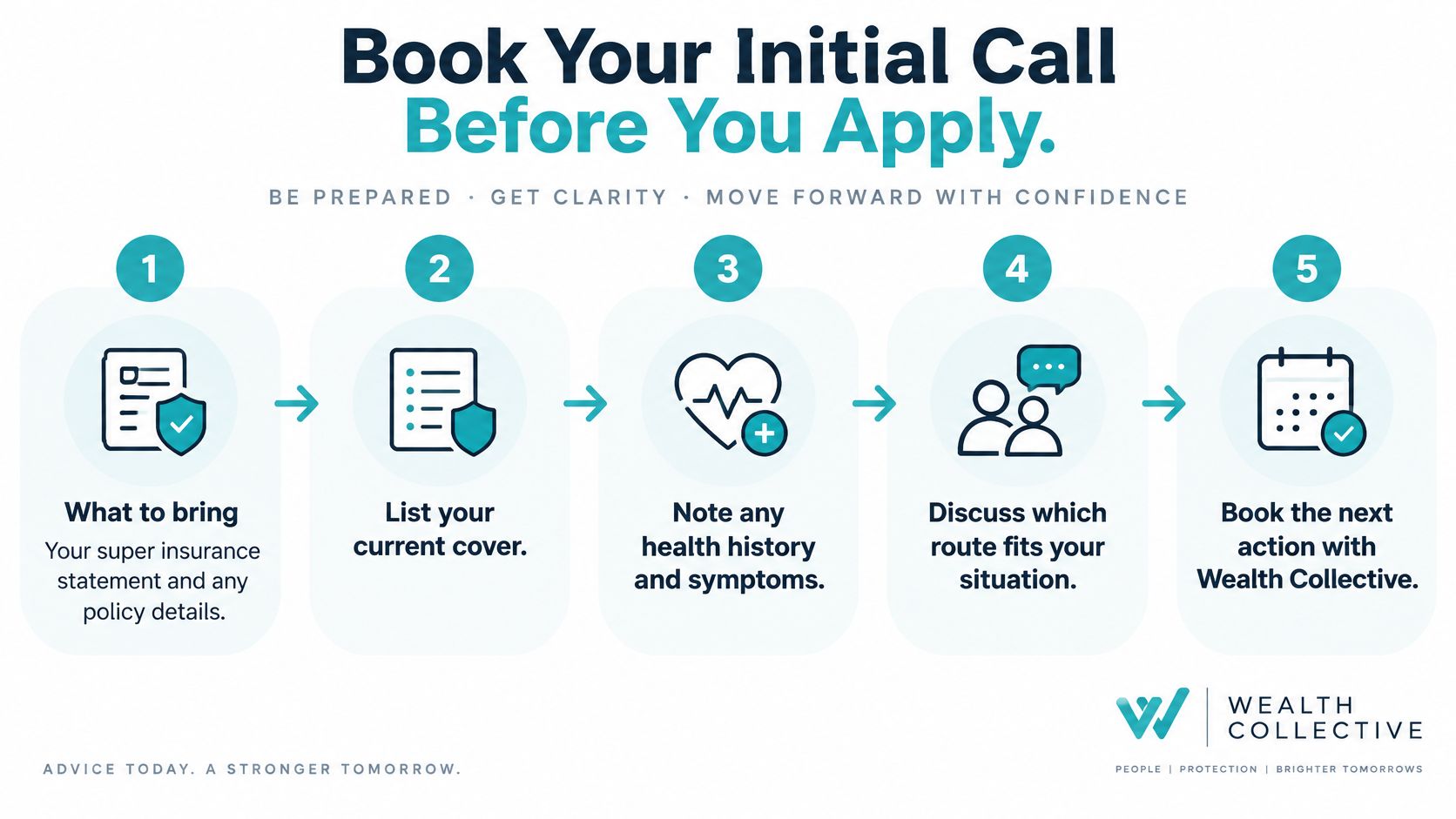
A short conversation before applying can help you work out which cover route may suit your circumstances. Gather a few details first, so you can explain what you already have and what you need.
What to bring to the call
- Your super insurance statement and any personal policy schedules, to show your existing cover.
- A list of debts and the monthly income your household would need to replace.
- A plain-language health history, including conditions, medications and recent doctor visits.
- Your target cover amount and monthly budget, to help keep the discussion grounded in what you need and can afford.
What happens on the call
On a free 10-minute introductory call, you can discuss which non-exam route might fit your situation. Have your health history and current cover details handy. They can help make the conversation more specific, but you do not need to have every answer prepared.
Wealth Collective does not push products or use a hard sell. Once you are 100 per cent comfortable with the outcome, the team takes care of the paperwork, any products needed and implementation end to end.
For a first conversation, your super statement and debt list are a useful starting point. You can book a free 10-minute intro call with Wealth Collective to talk through your options.