Business hours
Monday to Friday (8.30AM - 5PM)
Weekend (Closed)


How much super do you need to retire? Many people answer that with a single number, then spend a decade chasing it. The number isn't useless, but it hides the part that decides whether the money lasts. What matters more is when each dollar is needed, and what you'll be selling on the day you need it.
A retirement portfolio isn't one pot earning one return. It's several pots with different deadlines. Money you'll spend in two years has a completely different job from money you'll spend in twenty, and treating them the same is where plans come apart.
What follows is a step-by-step guide to investing for retirement in Australia, built around that timing problem rather than last year's performance tables. By the end you'll know your own asset-mix band, your real contribution headroom, the three ways to draw income, and the questions to bring to a first conversation.
Asset Mix by Years Until Retirement
Start with the table. It gives you a defensible position before any product discussion, and you can hold your current super option against it today.
| Years Until Retirement | Growth Assets | Defensive Assets | Main Goal |
|---|---|---|---|
| More than 20 years | 80-90% | 10-20% | Maximise long-term growth |
| 10-20 years | 70-80% | 20-30% | Growth with some stability |
| 5-10 years | 55-65% | 35-45% | Begin reducing volatility |
| 0-5 years | 40-55% | 45-60% | Protect near-term spending reserves |
| In retirement (drawing income) | 30-50% | 50-70% | Fund withdrawals and manage sequence risk |
Growth assets are shares and property. Defensive assets are cash and fixed interest. Growth assets do the long-term heavy lifting and fall further in bad years. Defensive assets earn less and hold their value when shares drop, which is the entire reason to own them.
These ranges are general reference points, not a recommendation. Your own band shifts with your spending needs, your other income, your health, and how you behave when markets fall.
Finding your row inside a super fund menu
Most funds offer pre-mixed options labelled growth, balanced and conservative. The label is a rough guide only, because every fund sets its own ranges. Read the published asset allocation for each option and choose the one closest to your band.
Check it again after a strong market run. A rising share allocation looks like success and becomes a risk decision you didn't make.
Three questions that test your row
- When will I need this money? Not "someday". Pick the year.
- How much loss could I hold through a bad year without selling? A diversified growth option can still fall sharply. If a fall would push you to switch, your allocation is too aggressive regardless of your timeline.
- How much of my super is sitting in cash today? A default option set years ago may not match the position you'd choose now.
Answer those three and you have your band plus the question that will test it: if the growth share you've chosen fell a third next year, would you still hold it? If the honest answer is no, the band is too aggressive, whatever the table says.
Superannuation Contributions and Caps to Check First
How much you can add this year matters more than chasing a higher return. The money only helps if it is inside super in time for the years you will spend it.
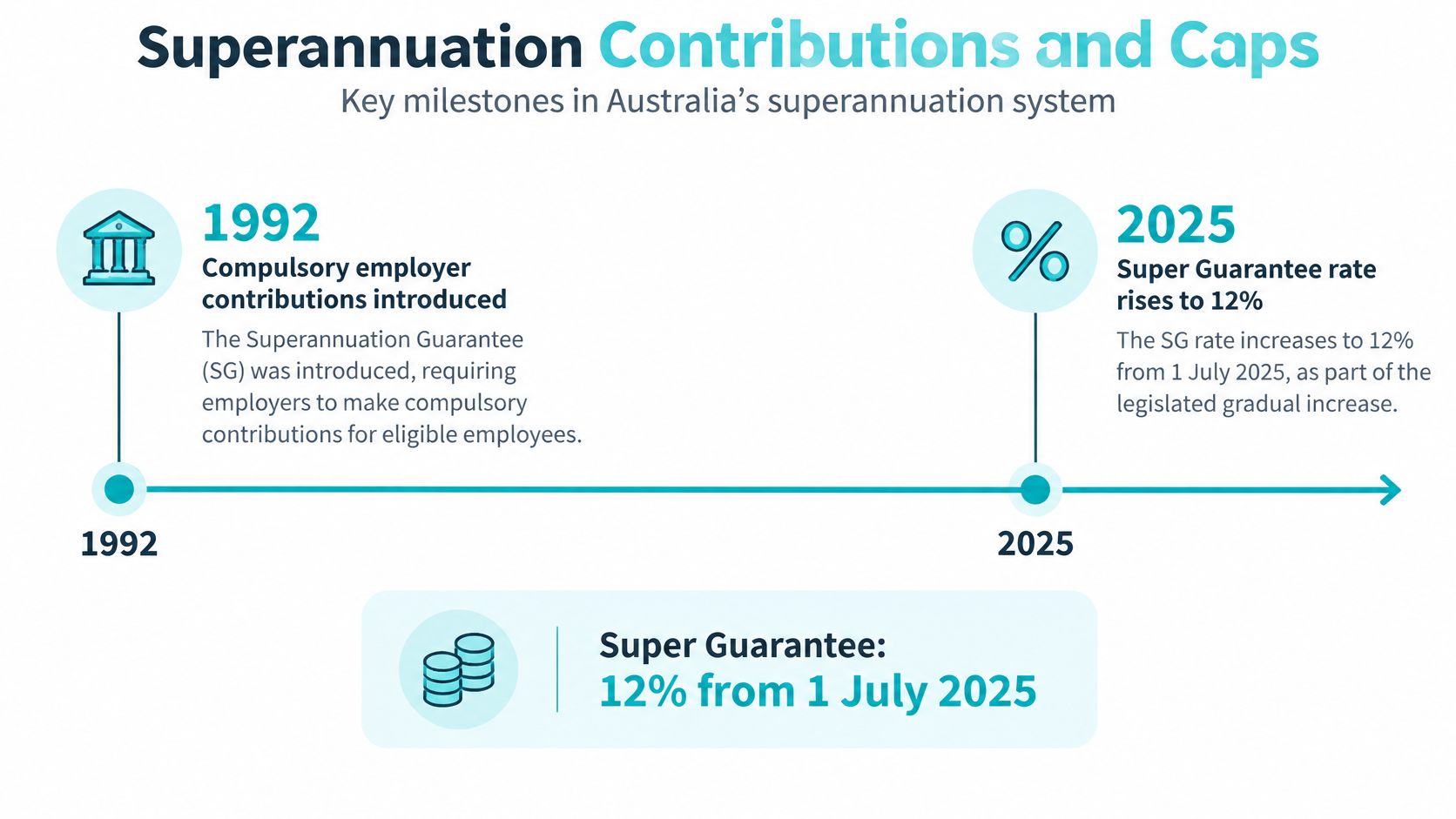
Compulsory employer contributions are why superannuation holds most Australians' retirement money. Employer contributions became a legal requirement in 1992. A staged increase was announced in 2010, as the Treasury review of compulsory superannuation documents. Regular contributions across a full working life usually move the final balance more than any single investment pick.
Four things decide the balance you retire with: the contribution rate, the fees you pay, the investment option you hold, and the number of years those contributions compound. Fees and the option change the ride. The contribution amount is usually the only one you can change this financial year, and people miscalculate it when they count only the salary sacrifice they chose.
A cap works like a yearly speed limit on the road into super. Picking a later retirement year does not raise this year's limit.
| Measure | 2025-26 | Who It Affects |
|---|---|---|
| Concessional contributions cap | $30,000 | Employer super, salary sacrifice and deductible personal contributions |
| Non-concessional contributions cap | $120,000 | After-tax contributions; nil where total super balance is $2 million or more |
| Superannuation Guarantee rate | 12% | Compulsory employer contribution on eligible earnings |
The concessional cap is $30,000 in 2025-26. It counts employer contributions, salary-sacrificed amounts and personal contributions claimed as a tax deduction, not only the amount you elect to sacrifice. After-tax money sits under a separate limit of $120,000, which drops to nil once your total super balance is $2 million or more, per the ATO's key superannuation rates and thresholds. Unused cap from earlier years may be carried forward where you are eligible, which can lift the ceiling above the standard figure.
That nil threshold matters for an inheritance, a bonus or business sale proceeds. Check the balance before you contribute, not after. The financial year you choose is the year whose limit applies.
Employer contributions already use part of the concessional cap. The Superannuation Guarantee is 12% for 1 July 2025 to 30 June 2026, calculated on a maximum quarterly earnings base of $62,500, which caps compulsory contributions at $7,500 a quarter, per the ATO's super guarantee thresholds. Anyone adding salary sacrifice or a deductible contribution starts from that number, not from zero.
Four steps to find your real headroom
1. List the employer contributions for the full year. Use payslips or the fund's year-to-date figure, not one quarter multiplied roughly.
2. Subtract from the $30,000 cap. What remains is your genuine room this financial year. A walkthrough of concessional contribution limits covers how the accounting works across a year.
3. Check carry-forward eligibility. Look at your total super balance at 30 June of the prior year and your unused cap amounts from earlier years.
4. Then choose between salary sacrifice and an after-tax contribution. Deductible contributions suit high marginal rates. After-tax contributions suit different goals and a different limit, including money you will not draw until later retirement years.
Write down your super balance, your employer contribution rate and your current investment option. Add the headroom figure from step two. Those four numbers set the rest of the plan: how much goes in now, and how much of that money is timed for the years you will spend it.
Matching Money to Time Horizons and Spreading Risk
Splitting one balance into jobs is easier to picture than one big portfolio earning one return.

Three buckets, three jobs
- Spending reserve, years zero to five. Cash and short-term fixed interest covering the income you'll draw in the next few years. Its job is liquidity, not return.
- Core bucket, years five to fifteen. A balanced spread across Australian and international shares, property and bonds. This is the middle of the portfolio and it can absorb a bad year.
- Growth bucket, beyond fifteen years. Mostly shares and property, left alone to compound. This is the money that has time to recover from a fall.
The buckets are an allocation method, not three separate accounts. You can hold them inside one super account by combining a cash option with a balanced or growth option in the proportions your band requires.
Why the growth share still matters near retirement
The long-term record supports keeping meaningful growth exposure while you're still accumulating, provided you can tolerate the ride. ASFA data to 30 June 2024 reports average superannuation investment returns of 7.0% per year over 10 years and 6.8% over 20 years, against annual CPI growth of 4.2% and 4.0% respectively, implying historical real returns of about 2.8 percentage points a year in both periods, per ASFA's superannuation statistics.
Compounded over 20 years, 2.8% a year above inflation lifts purchasing power by roughly 1.7 times, before fees and tax. Results vary by asset allocation, fees, taxes and the order markets arrive in, so treat the figure as a planning input rather than a promise.
That last point deserves its own weight. A model output is a description of average conditions, not a commitment from the market, which is why it helps to read about treating model outputs as evidence, not guarantees before you build a plan on a spreadsheet figure.
Moving the whole portfolio to cash after a market fall locks in the loss and cuts the odds of keeping pace with inflation. The fall is temporary on paper only while you still hold the assets.
Diversification is a set of decisions, not a slogan
Spread money across Australian shares, international shares, property, bonds and cash so that no single company, sector or country drives your outcome. A concentrated portfolio can beat a diversified one for years and then lose a decade of gains in a single holding.
Hold your mix against the asset allocation strategy you've written down, not against the latest quarterly return. Then ask the uncomfortable question for each bucket: how big a fall could I watch without selling? If the answer is smaller than the fall a growth option can deliver, the bucket needs more defensive assets, not more optimism.
Managing Sequence Risk Once Withdrawals Start
Drawing income from a falling portfolio is like taking water from a bucket that's also leaking. Every withdrawal made while prices are low sells units that would otherwise have been sitting there for the recovery.
What the modelling actually showed
Historical ASFA modelling cited a $510,000 balance and found that a defensive portfolio of 75% cash and fixed income and 25% Australian equities could fund withdrawals until approximately age 90 with a reasonable degree of certainty. The same analysis found that including growth assets can extend the income stream, per ASFA and State Street Global Advisors' retirement savings modelling.
That's the trade-off in one sentence. Defensive assets protect the near term and shorten the income stream. Growth assets lengthen it and add volatility along the way. The modelling is historical and isn't a safe withdrawal rule; your outcome depends on balance size, spending, fees, tax, returns and how long you live.
Four steps that put reserves first
- Hold two to five years of essential spending in cash or term deposits. Essential means groceries, utilities, insurance and housing. Not travel.
- Draw from those reserves during a market fall. Leave the growth assets untouched while prices are down.
- Keep later-year capital in growth assets. The money you won't touch for a decade has time on its side.
- Review annually. Withdrawal rate, inflation assumptions, Age Pension interaction and spending flexibility all move.
Three ways to take the income
A fixed percentage withdrawal takes a set share of the balance each year. It never runs out on paper, but the dollar amount moves with markets, which some people find hard to live with. An account-based pension at the minimum payment keeps the most flexibility and the largest estate value, at the cost of drawing less than you could safely spend. A guaranteed income product trades flexibility and estate value for a known payment for life.
None of these is correct in isolation. Many households combine them: minimum pension payments plus a cash reserve plus, where longevity risk is the main worry, a partial guarantee.
If you want to see how withdrawal percentages behave across a long retirement, Mega Income Stream's guide to withdrawal rules works through the arithmetic behind each approach. A licensed adviser can then model the options against your own figures rather than a generic example.
What Income You Will Need and Who Helps in Year One
Start with spending, not the balance. The gap between what people expect and what a comfortable lifestyle costs is usually the main planning problem.
Pre-retirees surveyed in 2025 expected a median retirement income of $3,300 per month but believed $4,300 was needed for a comfortable lifestyle, a shortfall of $1,000 a month, or 23%, according to ASFA's December 2025 superannuation statistics. That gap doesn't announce itself. It shows up in year three, when the travel budget disappears.
Divide your spending into two columns. Essential spending covers housing, food, utilities, insurance, health and transport. Discretionary spending covers everything you'd like rather than need. Then subtract the Age Pension and any other income. What's left must come from your portfolio, and that number, not the balance, drives the withdrawal plan.
The first-year decisions most people leave blank
The uncomfortable finding: 55% of retirees received no guidance at all when moving into retirement, with only 24% getting it from their main super fund and 15% from an independent adviser, per a recent survey on retirement preparedness. The same survey reported that 29% of pre-retirees didn't know what they'd do with their super at retirement.
A workable first-year checklist looks like this:
- Confirm the total super balance across every account, and choose your account-based pension structure.
- Set the annual drawdown amount in dollars, not as a percentage you'll reinterpret later.
- Map the defensive bucket to essential spending. Two to five years of essentials in cash is the anchor.
- Confirm the Age Pension interaction, including how reportable income and assets are assessed.
- Name who reviews the plan each year. A plan with no owner drifts.
Only 6% of retirees used a lifetime-income product, the same survey found. That's low adoption, not proof the products are wrong for everyone. Treat a guaranteed income option as something to test against your plan, particularly if your main risk is living longer than your money.
Our guide to retirement income streams goes further into how the drawdown options compare. It's also worth clearing away one common assumption, that a portfolio throws off income without decisions, which Readymerce's breakdown of passive income myths handles plainly.
Three Worked Examples of Retirement Investing
Three households, three different answers to the same question. Each is hypothetical and built to show the decision, not to forecast a return.

Priya and Daniel, both 45, combined super of $420,000
Starting point: a dual-income Perth couple, both receiving compulsory employer contributions, mortgage partly paid, two children in high school.
Decision: they hold an 80-85% growth mix and keep the defensive share in cash inside super. Before any salary sacrifice, they add up their combined concessional headroom so one partner's contributions don't crowd out the other's.
Outcome: twenty years of compounding does the work, and they review the mix every two years rather than every market move.
What would change it: a redundancy, a planned career break, or redirecting surplus cash to the mortgage instead of super while rates are high.
Helen, 62, single, $400,000 in super
Starting point: planning to retire at 65, needing about $60,000 a year gross to live the way she wants.
Decision: she moves roughly $180,000 into cash and fixed interest, covering three years of spending, and keeps about $220,000 in growth assets. Before choosing a withdrawal method she checks how her intended drawdown interacts with the Age Pension.
Outcome: a market fall in her first two years of retirement doesn't force her to sell shares at low prices.
What would change it: working part-time past 65, a larger balance than expected, or a health event that shifts spending earlier.
Marcus, 52, earning $250,000
Starting point: a senior executive with unused concessional cap from earlier years and a bonus due next financial year.
Decision: he uses carry-forward where eligible, spreads the contribution across two financial years, and checks his total super balance against the threshold where the non-concessional cap drops to nil before making any lump-sum contribution.
Outcome: headroom used across two years instead of one, without an excess contributions tax bill.
What would change it: a business sale, a larger bonus, or the scheduled cap increase from 1 July 2026 changing the timing arithmetic.
These are illustrations, not forecasts. Your own numbers will differ, and so will the sequence of returns you meet.
Book a Free Call to Map Your Retirement Plan
You now have most of what a first conversation needs. What's usually missing is someone to run the numbers against your actual statements and tell you which of the decisions above matters most.
The next step is a free 10-minute introductory call with Wealth Collective, and we take care of the rest from there. It's short by design. You describe where you are, we tell you what a plan would need to cover, and you decide whether it's worth continuing.
We research and model your options and create a detailed financial plan that balances financial structure, money success and lifestyle. A plan presentation then walks you through it and answers every question. Once you're comfortable with the outcomes, we handle the paperwork, any products required, and implementation from start to finish. Our Retirement Roadmap exists for exactly this stage, coordinating superannuation, investments, retirement income, tax and Centrelink decisions so they don't contradict each other.
Bring four things to the call: your super statements, your contribution figures, your current asset mix against the bands in the first section, and a rough estimate of the spending you expect in retirement. That's enough to move from general principles to your situation.
General information here isn't personal financial advice, so consider your own circumstances and speak with one of our qualified Financial Advisers before acting on it. Three questions worth asking on the call: Does my asset mix match the year I'll need each dollar? Have I used my concessional headroom correctly this financial year? And what's my withdrawal order if markets fall in year one?
Wealth Collective works with pre-retirees and retirees across Perth, Dunsborough and the rest of Western Australia on exactly this sequence, starting with your superannuation and contribution settings, then building an asset mix matched to the years you'll need the money, then implementing it end to end. A free 10-minute introductory call is the simplest way to test whether your current plan holds up, and you'll leave knowing which decisions to make first. Visit Wealth Collective to book the call and bring your numbers with you.