Business hours
Monday to Friday (8.30AM - 5PM)
Weekend (Closed)



You've spent years building super, paying down debt and investing where you can. Yet a market fall, a job change or an approaching retirement can make one question difficult to answer: is your money positioned for the life you want, or spread across products?
Consider two Australians who earn similar long-term returns. One keeps most of their savings in assets that can move sharply but has little accessible cash. The other holds a broader mix, with enough defensive assets to fund near-term needs. Their average return might look alike, but their experience during a downturn, and their ability to stay invested, could be very different.
That's the practical purpose of an asset allocation strategy. It decides how much of your portfolio belongs in growth assets such as shares, property and infrastructure, and how much belongs in defensive assets such as cash and fixed interest. The decision shapes the risks you take before any individual fund or ETF enters the conversation.

Australian investors also face a distinctive reality. Superannuation is already a large, globally invested pool, so diversification is no longer just a matter of adding international shares to Australian shares. You need to understand your exposure to private assets, infrastructure, property, liquidity and currency as well.
The ideas behind Dealmaker Wealth Society's strategy provide useful context for thinking about wealth as a long-term system rather than a collection of isolated investments. This guide then turns that broad idea into a practical process, moving from the basics to personal design, model allocations, maintenance and implementation.
You'll see how goals, time horizon, debt, insurance and cash flow change the right mix. You'll also learn why a “balanced” label may not tell you enough about the risks inside your super. If you'd like to discuss your circumstances before making changes, Wealth Collective offers a free introductory call to help you decide what should happen next.
Introduction to a Smarter Way to Grow Wealth
What an Asset Allocation Strategy Really Means
Think of your portfolio as a crew sailing from Perth to a distant destination. Growth assets are the sails. They help the boat travel further over time, but they also make it respond strongly to changing winds. Defensive assets are the ballast and supplies. They may not propel the boat as quickly, but they can help you manage rough water and meet expenses without selling growth assets at an unsuitable moment.
Shares, property and infrastructure generally sit on the growth side because their values can fluctuate and their long-term returns depend on economic growth, business profits, rents or infrastructure use. Cash and fixed interest sit on the defensive side because investors commonly use them for stability, income and access to capital. The categories aren't perfectly risk-free or perfectly predictable, but they help you understand what each holding is meant to do.
Risk and return work together
Higher expected growth usually comes with a greater chance of short-term loss. That doesn't mean you should avoid risk altogether. It means the level of risk should match when you'll need the money, how much loss you can withstand and whether your income can cover expenses while markets recover.
Diversification adds more than a longer investment list. It spreads exposure across different companies, countries, economic drivers and types of assets. If every holding responds to the same event, the portfolio may look diversified while behaving like one large bet.
Australia's super system shows why the distinction matters. ASFA's March 2026 statistics show funds with more than six members held 31% in international listed shares and 23% in Australian listed shares, with listed equities together representing 54% of the $2.973 trillion tracked in that segment. The same data showed 7% in cash and 18% in fixed interest combined, illustrating how heavily equity-oriented many pooled retirement portfolios have become. ASFA's March 2026 super statistics also reported total superannuation assets of $4.5 trillion at the end of the December 2025 quarter, up 0.8% over the quarter.
Strategic versus tactical choices
Strategic allocation sets the long-term structure. It answers questions such as how much global equity, Australian equity, fixed interest, property, infrastructure and cash you want under normal conditions.
Tactical allocation makes shorter-term adjustments around that structure. It can be useful in some professional settings, but it introduces judgement, timing risk and the possibility of reacting emotionally. For most households, a clear strategic framework and disciplined reviews are more valuable than constant changes.
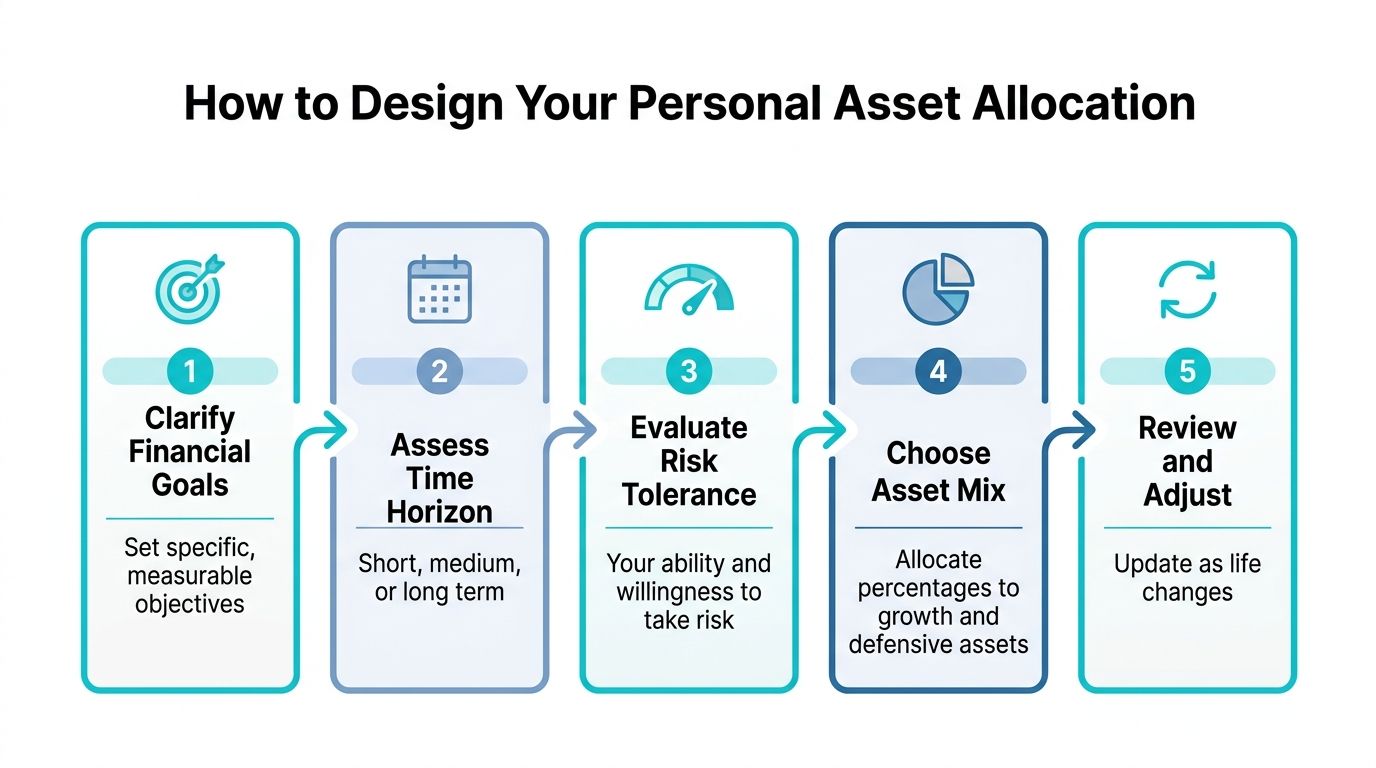
How to Design Your Personal Asset Allocation
A sound allocation begins with the life you're funding, not with a list of popular investments. Start by writing down the purpose of each pool of money. A home deposit, school expenses, a retirement income reserve and a legacy goal may all need different time horizons and different levels of access.
Practical rule: Money needed soon shouldn't carry the same market risk as money intended to support you decades from now.
Start with goals and time horizon
Separate goals by timing and importance. Ask:
- What must be funded: Which expenses are essential, and which are flexible?
- When will the money be needed: Is the date fixed, approximate or unknown?
- What happens if markets fall: Can you delay the goal, reduce spending or use another reserve?
A long time horizon can support a larger growth allocation because you may have more opportunity to remain invested through market cycles. A shorter horizon usually calls for more attention to liquidity and capital stability. Age is relevant, but it's only one input.
Test risk tolerance against risk capacity
Risk tolerance describes how you feel about volatility. Risk capacity describes what your finances can absorb. Someone may feel comfortable with market swings but have limited capacity because they're relying on investments for near-term living costs. Another person may dislike volatility yet have strong employment income, low debt and a long horizon.
Write down how you reacted during the last significant market decline. Did you want to sell, stop contributions or change funds? Your answer can reveal more than a questionnaire alone, but it shouldn't be the only test.
Map cash flow, debt and protection
Your allocation needs to work alongside your household balance sheet. A mortgage, variable income, business commitments and personal insurance all affect the amount of investment risk you can reasonably carry. A portfolio can't compensate for an emergency reserve that's too small or protection that leaves your family exposed.
Super deserves its own review. APRA-linked analysis cited by industry sources found average MySuper growth assets at 61.7% in March 2026, with property, infrastructure and alternatives adding 19.5% combined. This industry summary of MySuper data helps explain why a default option can contain more growth and private-market exposure than the name suggests.
For a broader planning lens, review how your super fits with long-term investment planning, especially if you're building assets outside super as well.
Alternative assets can also create confusion. A small allocation to digital assets, for example, may carry very different volatility and liquidity characteristics from a diversified share fund. Anyone considering crafting a well-diversified crypto portfolio should assess it as part of the whole household portfolio, not as a separate experiment.
Model Allocations for Real Australian Life Stages
Model allocations can clarify trade-offs, but they aren't personal recommendations. The examples below use the same building blocks, yet the emphasis changes according to income, liquidity, debt, retirement timing and the need for ongoing growth.
| Client Segment | Growth Assets | Defensive Assets | Key Tilt |
|---|---|---|---|
| Young professional | Higher | Lower | Global and Australian shares for long-term accumulation |
| Dual-income family | Moderate to higher | Moderate | Growth diversified with liquidity for family commitments |
| High earner or executive | Moderate to higher | Moderate | Global exposure, tax-aware investing and risk control |
| Small business owner | Moderate | Moderate to higher | Liquidity and protection alongside diversified growth |
| Pre-retiree and retiree | Moderate | Higher for near-term spending | Income reserves, sequence-risk management and continued growth |
A young professional may have decades before drawing on super and stable employment income outside the portfolio. That can make a higher growth orientation appropriate, provided the investor understands the volatility and doesn't need the money soon.
A dual-income family often has stronger cash flow but more competing demands. Their allocation may retain meaningful share exposure while keeping accessible reserves for home repairs, parental leave, education costs or a mortgage buffer. The goal isn't to eliminate risk. It's to avoid selling long-term assets to solve a short-term problem.
High earners and executives need to look beyond salary. Concentrated employer shares, deferred bonuses and future equity awards can create a large exposure to one company or industry. Their investment portfolio may need more diversification and liquidity, even when their income appears secure.
Small business owners face a different concentration risk. Their business may already represent a substantial share of their wealth, and its value may depend on the same economic conditions affecting their investments. Defensive assets, insurance and a clear exit plan can matter as much as the growth allocation.
Pre-retirees and retirees shouldn't assume that selling all growth assets automatically creates safety. APRA's December 2025 data showed retirement-product assets in Choice products reached $555 billion across 1.4 million accounts, while transition-to-retirement assets were $17 billion across 0.1 million accounts. APRA's accessible quarterly superannuation publication highlights the scale of the cohort needing an approach that balances spending, longevity and sequence risk.
Your super option is only one part of the decision. Compare its actual mix, fees, liquidity and investment menu with your broader assets using superannuation investment options as a starting point for questions to take to an adviser.
Keeping Your Allocation on Track With Rebalancing and Tax
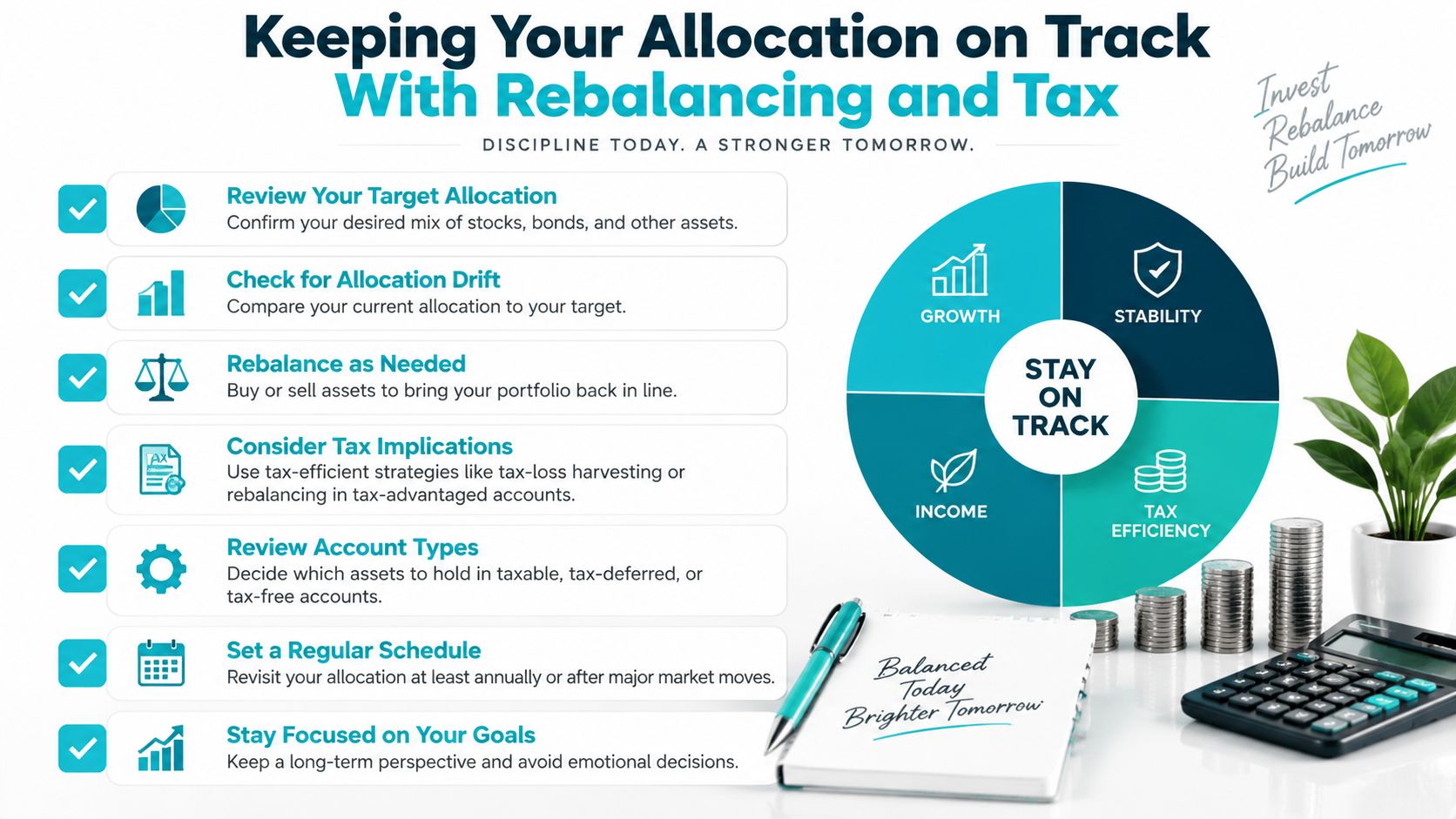
A portfolio can drift while you are busy with work, family and everyday decisions. Shares may rise, property values may change, contributions may enter one option while withdrawals leave another. Over time, that quiet movement can make the portfolio riskier than the plan you originally chose.
Rebalancing brings the mix back towards its intended structure. You can review on a set calendar, or act when an asset class moves outside a defined range. Calendar reviews are simple to administer. Threshold rules may reduce unnecessary trades, provided you monitor them and decide in advance what action each trigger requires.
Rebalance with purpose
Use new contributions, distributions and withdrawals to correct the mix before selling investments. That approach can limit trading and may reduce immediate tax consequences. If a sale is needed, check unrealised gains, the ownership structure and the cost of making the change.
Rebalancing can feel counterintuitive. It often means trimming an asset that has grown and adding to one that has lagged. That discipline helps prevent a strong recent performance from becoming an oversized bet.
For Australians, the review also needs to account for super rules, investment options, capital gains tax and franking credits. The outcome depends on the account type, ownership, income and transaction, so general information cannot replace personal tax advice.
Look through the label
A fund's option name can hide the exposures that matter. APRA's SRS 550.0 reporting standard requires super funds to report asset allocation on an APRA-look-through basis, tracing strategic exposure through underlying investments rather than relying only on wrapper labels. APRA's SRS 550.0 asset allocation standard provides a framework for comparing equities, duration, property and infrastructure.
That matters in Australia's super-heavy, equity-tilted system. Diversification is not only a question of shares versus bonds. Check how much exposure sits in Australian shares, global shares, private markets, property and infrastructure, and whether those holdings can be sold when you need the money. A label such as “balanced” does not describe the full risk or liquidity profile.
Private property and real estate investments deserve separate checks on valuation, borrowing, liquidity and exit conditions. A guide to safer real estate deals can help structure those questions before you treat property as automatically defensive or diversifying.
Outside super, tax-loss harvesting strategies may help manage a tax outcome, but only when they fit the investment plan and Australian rules. Do not sell an asset solely to create a deduction. Consider the future portfolio, transaction costs and tax advice together.
Putting Your Strategy Into Action and Avoiding Costly Mistakes
Implementation turns the allocation into real holdings. Depending on your circumstances, that may involve a default MySuper option, a choice super menu, managed funds, ETFs or direct assets. Each route has trade-offs involving fees, control, diversification, administration, liquidity and the quality of the underlying exposure.
A default option can be convenient, but convenience doesn't guarantee that its mix matches your retirement income needs. A direct portfolio offers control, but it also gives you responsibility for research, rebalancing and avoiding concentration. ETFs can provide broad market exposure, while managed funds may offer access to specialist strategies, including unlisted assets.
The common mistakes are usually behavioural or structural:
- Home bias: Holding too much Australia-based exposure because it feels familiar.
- Recency bias: Buying what has recently performed well and abandoning assets after a fall.
- Single-asset concentration: Treating an employer share plan, property, business or private investment as separate from the portfolio.
- Liquidity neglect: Owning assets that can't be sold easily when spending needs arrive.
- Protection gaps: Taking investment risk without adequate personal insurance or an estate plan.
Australia's allocation has changed materially over time. ASFA's 2026 paper says institutional international asset allocation rose from around 35% in 2015 to around 50% by September 2025, while international listed equity increased from 17% to 31%. The paper also says listed equities overall reached 55% in September 2025, up from 46% in 2015, and that international listed equity grew in dollar value from $184 billion to $942 billion, an average annual growth rate of 15%. The ASFA international investment summary supports a more useful diversification question: how much global and private exposure do you already own?
Wealth Collective's Guided Growth, Protection Plus and Retirement Roadmap services bring investment selection, personal protection and retirement income into one planning conversation. That matters because an allocation that suits you before a business sale, family change or retirement may need to be revised afterwards.
Your Next Steps to a Confident Asset Allocation Strategy
A confident decision doesn't require you to predict the next market move. It requires a clear record of what you own, why you own it, when you'll need it and what could force you to sell at the wrong time.
Before an initial advice conversation, gather:
- Your super details: Current funds, investment options, balances and beneficiaries.
- Your household position: Income, regular spending, debts, cash reserves and major upcoming costs.
- Your protection arrangements: Life, total and permanent disability, income protection and relevant business cover.
- Your investment picture: Shares, ETFs, property, managed funds, private assets and employer interests.
- Your priorities: Retirement timing, desired income, family support, travel, business succession and estate intentions.
Ask the adviser to show your current allocation on a look-through basis, explain the role of each asset class and identify where concentration or liquidity risk may sit. You should also understand how contributions, withdrawals, rebalancing and tax interact before you approve changes.
For a Perth or Dunsborough household, the right plan may involve a super review, debt strategy, insurance adjustment, diversified investments or a retirement income framework. The answer depends on the whole balance sheet, not a generic age-based label.
Wealth Collective's process begins with a free 10-minute introductory call, followed by advice, transparent communication and a satisfaction guarantee. The aim is practical: to help you build wealth, protect your household and transfer assets in a way that remains aligned with your life.
Book a free introductory call with Wealth Collective to review your current asset allocation strategy, super exposure, protection needs and retirement priorities. Their advisers can help turn a scattered set of investments into a clear plan designed to build, protect and transfer wealth at every life stage.