Business hours
Monday to Friday (8.30AM - 5PM)
Weekend (Closed)



Australians held A$4.4855 trillion in superannuation assets at December 2025, according to APRA's quarterly superannuation statistics. Yet the decision that shapes how your share behaves often comes down to a label such as growth, balanced or conservative. A useful superannuation investment strategy looks past that label to what you own, how readily it can fund withdrawals and whether you can afford the losses it might experience.
Why Your Super Strategy Matters More Than You Think
Your super fund is the account that holds your retirement savings. Your investment option determines how those savings are invested. Choosing a fund while the option stays vague is like choosing a vehicle without checking its suspension: you know the destination, but the ride can turn rough when the road does.
Asset allocation means the split between different types of investments. Growth assets, including shares and property, offer long-term growth potential and can fall sharply. Defensive assets, including fixed interest and cash, generally provide greater stability, although defensive still carries some risk.
The decisions within your control
Two practical levers deserve your attention:
- Your investment mix. This sets much of your exposure to market falls and your opportunity for long-term growth.
- Your fees and costs. These reduce the amount left in your account to support retirement spending.
A single strong year can flatter an option with more growth assets, while the longer-term pace tells a different story. An annualised return expresses a multi-year result as an equivalent yearly compound rate, which helps smooth the effect of one unusually good or bad year. Read both figures together: the recent year shows what happened lately, and the annualised figure shows the rhythm your balance experienced.
Practical rule: Choose a strategy you can maintain through disappointing markets, even when a recent strong year makes a bolder option look tempting.
Super also needs to fit your mortgage, savings outside super, family commitments and retirement expectations. Toya AI's resource on how to build a lasting wealth plan gives broader context for connecting those moving parts.
A sensible starting point is the label translated into plain terms: what you own, how easily it can be sold, what spending it must fund and which losses you can carry. This is general information, so weigh it against your circumstances before acting.
Asset Mix Across Growth, Balanced and Conservative Options
An option's asset mix works like a recipe: change the proportions and you change the result. Growth, balanced and conservative labels give a rough sense of how much sits in shares and property relative to bonds and cash, but each fund sets its own proportions.
Typical asset mix and suitability by super option
| Option | Typical growth assets | Typical defensive assets | Short-term loss risk | Suits this member |
|---|---|---|---|---|
| Growth | 70–80% | 20–30% | Highest of these options; large falls are possible | Long time to retirement and capacity to ride out falls |
| Balanced | 60–70% | 30–40% | Moderate, with meaningful losses still possible | Mid-term horizon and moderate tolerance for loss |
| Conservative | 0–40% | 60–100% | Generally lowest of these options, but not zero | Near-term withdrawals or low tolerance for capital loss |
These ranges are typical guideposts, since each fund decides its own split. The defensive figures are the arithmetic remainder of a simplified growth-and-defensive mix. Conservative options generally sit inside the lowest growth banding used in APRA's classification, which is where the 0–40% figure comes from.
Why the name isn't enough
A balanced label doesn't guarantee the same balance of risks across funds. One option might hold readily traded shares and bonds, while another includes substantial unlisted property or infrastructure.
Listed assets trade on an exchange. Unlisted assets don't, and their sale arrangements and valuations deserve closer attention. Liquidity means how readily an investment can be turned into cash without accepting a substantial price reduction.
APRA's 2025 methodology paper groups strategic growth allocations into six bands, from 0–40% to more than 100%. For its classification, listed equities, listed property and listed infrastructure count as 100% growth, while unlisted property and infrastructure count as 75% growth and 25% defensive.
Those rules classify assets. They say nothing about how the assets will behave. An asset partly classified as defensive can still lose value or be difficult to sell during stress, which is why the label on the option tells you less than the holdings beneath it.
APRA's 2025 performance insights paper also examines whether asset-allocation decisions add value against appropriate benchmarks. The lesson is practical: diversification alone doesn't establish that an option offers suitable value.
Before choosing, make these checks:
- Find the underlying allocation. Read the investment-option dashboard and product disclosure statement, so you see the actual split rather than the option name.
- Inspect harder-to-sell holdings. Identify unlisted exposure, valuation arrangements and any withdrawal restrictions.
- Match access to spending. Check that money needed for foreseeable expenses can be reached through the option's withdrawal arrangements.
Two similarly named options can suit different people. The right comparison is between their actual exposures, liquidity and role in your retirement plan, not between their past returns or the words on the label.
How to Build Your Strategy Around Your Timeline
Your retirement date matters, but it isn't the date every dollar must become cash. Some savings may fund immediate expenses, while other savings may remain invested well into retirement.
The useful question is when each part of your balance will be needed. This turns a broad risk preference into a practical spending and investment plan.
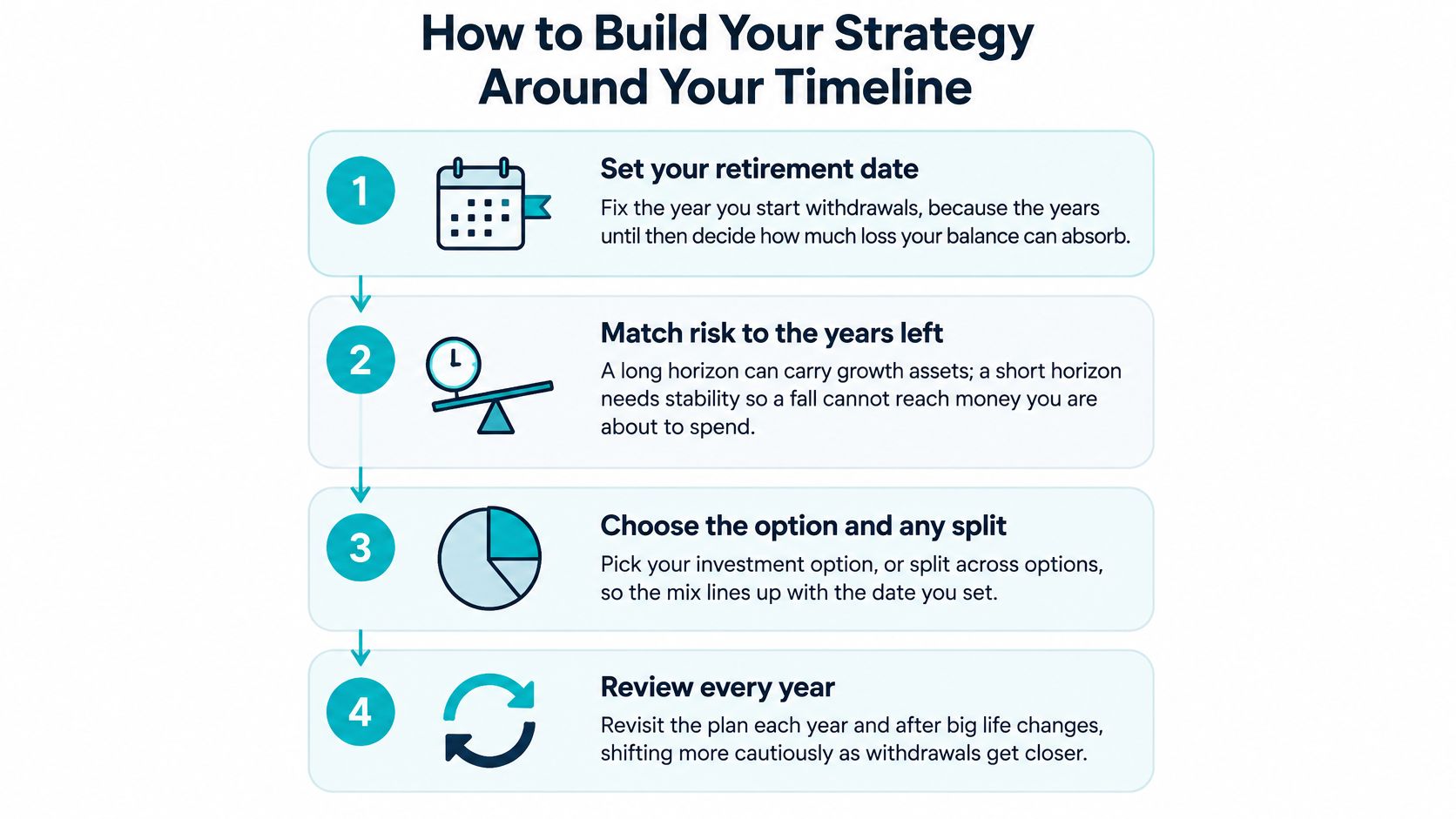
Turn your timeline into decisions
Set your retirement and withdrawal dates. The time before you need income affects how much opportunity you have to recover from losses. Write down when you expect to stop work and when super withdrawals will begin, since those dates may differ.
Estimate spending and a liquid reserve. Reliable withdrawals require money that's accessible when bills arrive. Prepare a retirement budget, subtract dependable income from other sources and decide how much of the remaining spending should sit in liquid assets rather than relying on selling growth investments.
Test your capacity for risk. Comfort with fluctuating balances isn't the same as financial capacity to absorb a loss. ASIC's guidance on superannuation investment strategies identifies six design variables: objectives, diversification, expected risk and return, liquidity, consistency with governing rules, and tolerance for capital loss, market risk, inflation risk and longevity risk.
Choose a workable growth-to-defensive mix. Your allocation needs to survive a difficult market without making essential spending unaffordable. Use the option comparison to identify a suitable starting band, then consider whether you'd maintain it after a substantial fall.
Check your current selection and switching arrangements. You may already be in a default option without having actively selected it. Before changing anything, check your member portal for processing rules, switching costs and whether you can split your balance or direct future contributions separately.
Diversify deliberately. Spreading investments across asset types and countries reduces reliance on a single company, sector or economy. Owning several options doesn't necessarily achieve this if they hold much the same underlying investments.
Set review dates and triggers. Your plan needs reassessment when your retirement date, health, employment, pension withdrawals or ability to absorb losses changes. Schedule a regular review as well, so the strategy doesn't drift because nothing urgent has happened.
Separate willingness from capacity
Inflation risk is the risk that rising prices reduce what your money can buy. Longevity risk is the risk that your savings won't support you for as long as you live. Both matter alongside the more visible risk of a falling account balance.
Say you're comfortable watching shares fluctuate, but your household needs regular withdrawals and has little spare cash. Your willingness to take risk may be high while your capacity is limited. Conversely, someone with reliable outside income may have greater financial flexibility but still need an allocation they can hold without panic.
A completed strategy should state your target mix, your liquid reserve, what each part is for and when you'll review it.
Our guide to investing for retirement provides further context for connecting investment decisions with retirement income. At Wealth Collective, we research and model your options so that these choices reflect your circumstances rather than an isolated risk-profile score.
Measuring Performance Against Benchmarks, Not Headlines
A benchmark is a yardstick used to assess investment performance. For a diversified super option, it generally reflects the markets and asset types against which the strategy is being measured. It works like the par score on a golf course: a round of 75 tells you very little until you know whether par was 72 or 68.
APRA's performance-test analysis applies this idea across the super system. Its published results show that median performance relative to benchmark differed by product type, rather than being uniform across the market.
Typical performance relative to benchmark
| Product type | Typical result vs benchmark | What it signals |
|---|---|---|
| MySuper products | Slightly ahead of benchmark | Positive relative to benchmark |
| Non-platform trustee-directed products | Ahead of benchmark | Positive relative to benchmark |
| Platform trustee-directed products | Behind benchmark | Negative relative to benchmark |
| Failed products in APRA's analysis | Investment component materially below the yardstick in most cases | Investment underperformance contributed to most failures |
These findings describe the test's results, not forecasts or returns earned by every member. The failed-product row describes the investment component of the test, so it does not mean every failure arose from that component alone.
A good return can still be disappointing
Suppose an option rises during a strong sharemarket. That sounds encouraging, but if comparable markets rose more, the option may have delivered less than its investment exposure would suggest. A positive return and a competitive return aren't necessarily the same thing.
There's another layer: the benchmark itself. A fund might perform well against the yardstick constructed around its chosen allocation, yet trail a simpler investment mix.
APRA's analysis found that the large majority of trustee-directed products performed more poorly against its Simple Reference Portfolio than against their stated strategic asset-allocation benchmark. The Simple Reference Portfolio is a simple, low-cost comparison portfolio intended to help identify the value added or lost through asset-class decisions.
Beating an option's own yardstick doesn't, by itself, establish that its overall investment design was a good choice.
Make your comparison useful
Use a consistent set of questions when reviewing performance:
- What period am I measuring? Prefer a meaningful multi-year record over the latest annual ranking.
- Am I comparing similar exposures? A more share-heavy balanced option may behave quite differently from another option carrying the same label.
- What return am I reading? Check whether the published figure includes investment costs, administration charges and the relevant tax treatment.
- What explains the result? Separate the effect of market exposure from investment implementation and costs.
ASIC recommends assessing performance over an extended period and comparing like-for-like options. Even then, a long record isn't a guarantee of future results, and a recent change in strategy can reduce its relevance.
For someone approaching withdrawals, persistent underperformance matters because there's less flexibility to rebuild savings through employment income. Your review should therefore finish with a precise question: What is this option's benchmark, and does it match what I hold?
Fees and Costs That Compound Against Your Balance
Consider a hypothetical A$200,000 balance with a 1% annual fee. On an unchanged balance, that fee would take A$2,000 in the first year. This is an illustration, not a quoted fund charge, and the money deducted is also no longer available to earn future investment returns.
ASIC's fee and cost disclosure guidance explains why retirement outcomes depend on both investment earnings and costs. Some charges appear directly on your statement; others are reflected in the investment return before you see it.

Identify what you're paying
Costs to look for include:
- Administration charges. The cost of operating and maintaining your account.
- Investment fees. Charges for managing the underlying portfolio, often reflected in returns.
- Transaction costs. Expenses associated with buying and selling investments.
- Brokerage and settlement expenses. Costs of executing and completing transactions.
- Stamp duty. A transaction-related tax where applicable.
- Switching or withdrawal fees. Any disclosed charges associated with changing options or accessing money.
Don't assume every category applies to your account. The task is to identify the charges that do apply and understand how they're disclosed.
Reconcile the documents
- Read the product disclosure statement. Find the fee structure for your account and selected investment option, including any additional investment-cost disclosure.
- Match your annual statement. Identify direct deductions and distinguish them from costs already included in reported returns.
- Separate the charging methods. Record fixed-dollar fees, percentage-based charges and performance or transaction costs so you can see what changes with your balance.
- Compare net outcomes. Use returns after disclosed costs, with consistent periods and comparable investment exposures.
- Check the broader fit. Assess whether the option still meets your risk, liquidity and service needs.
Lower cost isn't automatically better. A cheaper option may provide different diversification or risk management, and a fund change can affect insurance arrangements. Equally, a higher charge needs a clear explanation rather than an assumption that expensive means better.
Our super fund fees comparison guide helps frame that review. Investigate unexplained cost differences before switching or consolidating accounts, and avoid subtracting an embedded fee again from a return that's already reported after that cost.
Shifting Your Strategy from Saving to Withdrawing
A hypothetical retiree aged 64 stops work just as markets fall. Their living expenses continue, so they sell investment units, the small portions of a fund they own, to fund spending. At lower unit prices, they must sell more units to obtain the same cash.
If markets subsequently recover, those sold units no longer participate. The retiree may therefore have less capital available to generate future income, even though the market itself has recovered.
This is sequencing risk: the order of investment returns matters when money is entering or leaving a portfolio. A poor period around the start of withdrawals can be harder to recover from than the same market experience without withdrawals.
Check retirement suitability, not just availability
The retirement transition affects a substantial population. APRA's December 2025 industry infographic records A$2.83 trillion in superannuation assets and 23.4 million member accounts within its reported coverage.
Availability still doesn't establish suitability. Translate the option label into what you hold: how much remains in growth assets such as shares, how much sits in cash or bonds, how readily units can be turned into pension payments, and whether the mix can support both near-term spending and later-life needs. An option needs to work with your payment arrangements, spending needs and intended investment horizon, not merely appear on a retirement-product menu.
Before commencing income payments, answer these questions:
- Investment risk. How much exposure can remain invested for longer-term needs once regular withdrawals begin?
- Liquid spending reserve. How much accessible money is appropriate after allowing for other dependable income?
- Withdrawal flexibility. Which expenses could be reduced or deferred after a market fall, and which must continue?
- Payment requirements. What flexibility does the pension arrangement permit, including any applicable minimum payment obligations?
- An uncertain lifespan. How will the strategy support spending if retirement lasts longer than expected?
Stability isn't the only objective
Moving everything into defensive assets can feel reassuring after leaving work. It may reduce short-term fluctuations, but it can also leave you more exposed to rising living costs and the possibility of outliving your savings.
The retirement objective is to fund required spending while retaining an appropriate opportunity for future growth.
A liquid reserve can create flexibility, but it doesn't guarantee that growth assets will recover before the reserve is spent. Your plan also needs a practical approach to replenishing that reserve and adjusting discretionary spending.
Our retirement drawdown strategy guide considers these income decisions in more detail. Arrange a formal review when retirement begins and whenever withdrawals change materially, rather than treating the move from saving to spending as a simple account switch.
Book Your Initial Call to Test Your Strategy
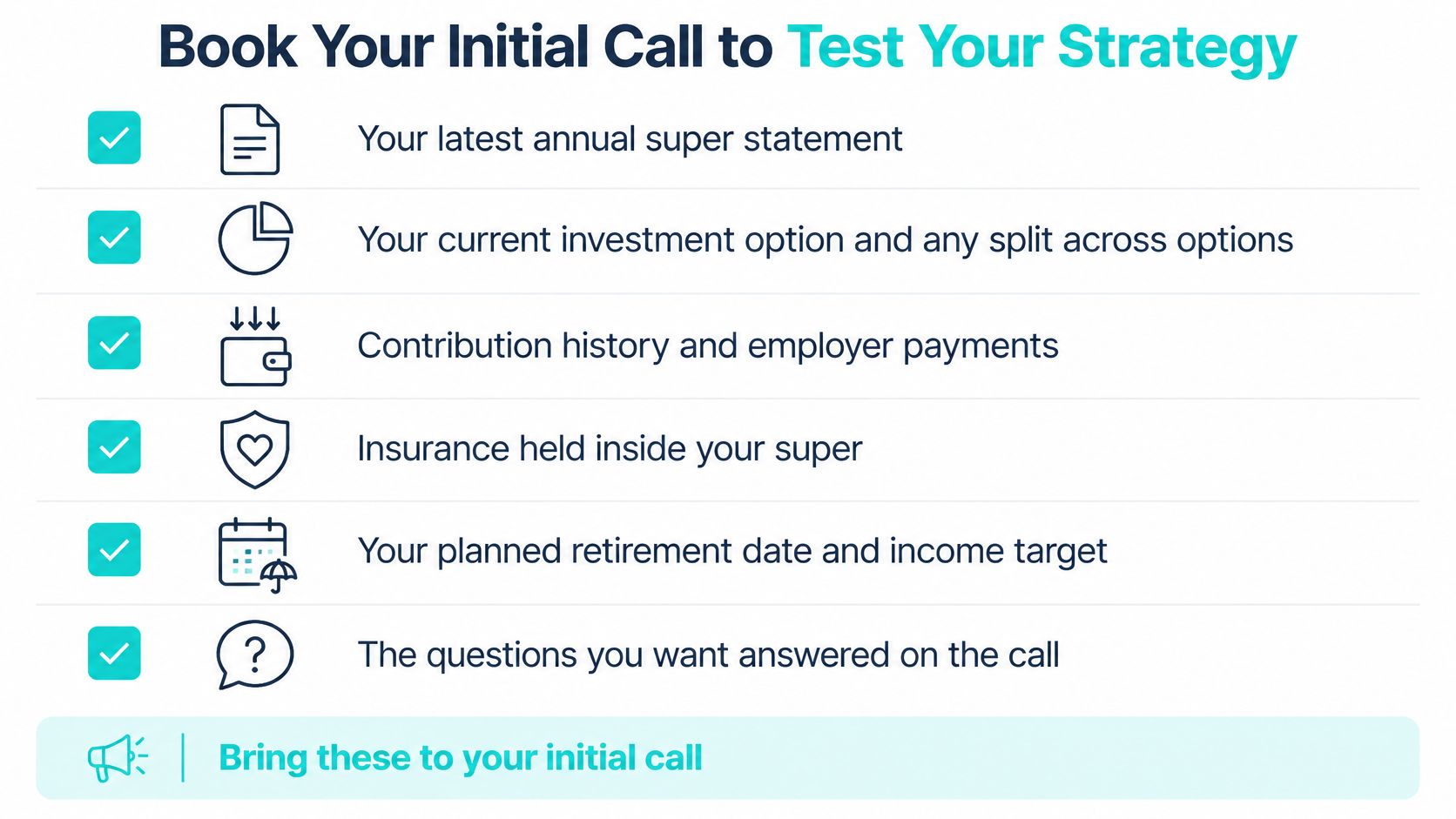
Bring the following information so the discussion starts with your actual position:
- Your latest annual statement. Include account details, disclosed fees and recent transactions.
- Your current investment option. Note any split across options and where new contributions go.
- Contribution history and employer payments. These help establish how money is entering your super.
- Insurance inside super. Include the cover and premiums shown on your statement.
- Your retirement date and spending estimate. Separate essential expenses from flexible lifestyle spending.
- Your questions. Highlight anything you don't understand or feel uncertain about.
What happens after the introduction
At Wealth Collective, we research and model your options, then create a detailed financial plan balancing financial structure, money success and lifestyle. During the plan presentation, we guide you through the recommendations and answer your questions.
Once you're 100% comfortable with the outcomes, we take care of the paperwork, any products required and end-to-end implementation. Guided Growth supports investment strategy and wealth building, while Retirement Roadmap helps connect retirement planning with withdrawals and income needs.
The free 10-minute introductory call is a low-pressure first step to discuss your priorities and whether our advice can help. You don't need to have every document organised before making contact.
General information on our website isn't personal financial advice. Consider your circumstances and speak with a qualified Financial Adviser before acting.
We help you turn your super's investment labels, costs and withdrawal needs into a strategy that fits your life. Visit Wealth Collective to book your free 10-minute introductory call, and bring the checklist so we can discuss the decisions that matter to you.