Business hours
Monday to Friday (8.30AM - 5PM)
Weekend (Closed)


You may be sitting at the kitchen table with a super statement in one hand and an income estimate in the other, wondering whether taking a lump sum will give you freedom or create problems later. For many Western Australians approaching retirement, the difficult part isn't understanding that the money belongs to them. It's deciding when to take it, how much to take, and what the choice means for tax, Age Pension eligibility and the lifestyle they want to protect.
A lump sum can be useful, but it isn't automatically the smarter option. The right decision depends on the source of the money, your age, your fund's tax treatment, your spending needs, your health and longevity expectations, and what you hope to leave behind. The following guide translates those moving parts into practical questions you can use before signing a withdrawal form.
The Retirement Decision Most Australians Get Wrong
Margaret is 62 and lives in Perth. After years teaching, she has reached the point where retirement feels close enough to touch. Her super fund has shown her two projections based on a $400,000 balance. One involves withdrawing the money as a lump sum. The other establishes a regular account-based pension.
She has placed both quotes beside her morning coffee. The lump sum looks reassuring because she can see the capital and decide what to do with it. The income stream feels safer because it could provide regular payments. Neither document answers the questions that matter most to her.
Will one option protect her day-to-day lifestyle? Could either choice affect her future Age Pension? What happens if she needs help around the home later? And what would her late husband have wanted her to do with the money they spent decades building together?
Margaret's uncertainty is understandable. The Australian retirement system has long allowed people to withdraw superannuation as a lump sum rather than requiring every retiree to convert their balance into an income stream. Treasury research found that, among retirees covered by superannuation, 86% took at least part of their benefit as a lump sum in 2000, with around 65% taking only a lump sum. By 2007, around 74% had received lump sum benefits, including 47% who received only a lump sum and 27% who received both a lump sum and an income stream, according to Treasury's retirement income research.
The choice is common, but the framework isn't
This behaviour doesn't mean a lump sum is wrong. It means the decision is familiar, yet many people reach it without a clear process for comparing the consequences.
Margaret also needs to think beyond investment returns. A withdrawal could change the way Centrelink assesses her assets. Money left in super may continue in a tax-advantaged environment, while money moved into a bank account or investments outside super may be taxed differently. Her spending pattern, health and family plans matter just as much as the account balance.
Retirement decisions can also overlap with housing and care decisions. If Margaret later needs to assess whether a move is appropriate, a practical resource such as how Life Senior Placement helps with senior can help her understand the broader lifestyle considerations involved in senior living.
The useful question isn't, “Should I take the lump sum?” It's, “Which structure gives me enough access to money today while protecting income, flexibility and future choices?”
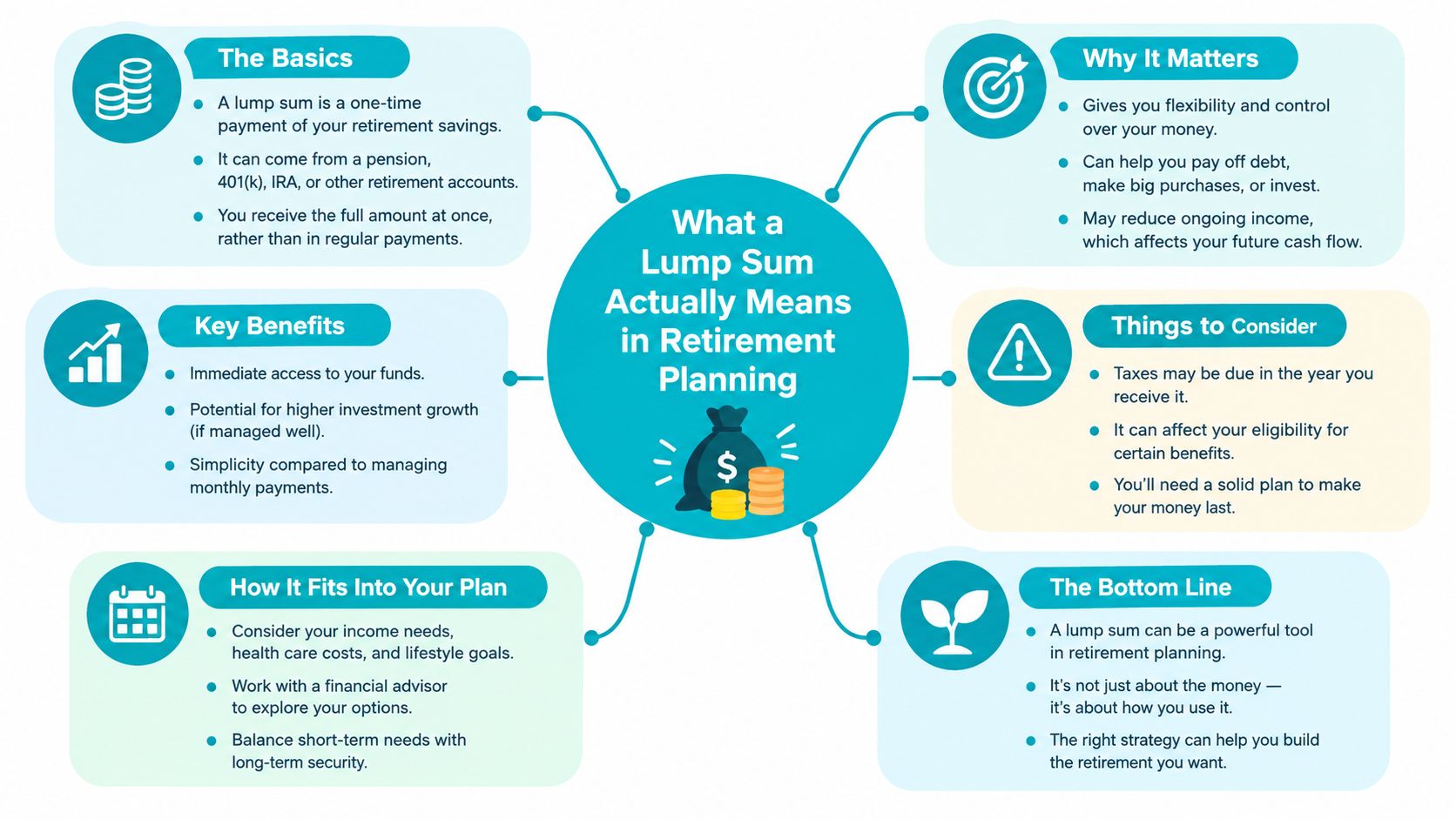
What a Lump Sum Actually Means in Retirement Planning
A lump sum is one bucket of money received at once. An income stream is more like a dripping tap, sending regular payments over time. The amount may come from the same underlying savings, but the way you receive it changes how you manage spending, investment risk, tax and government benefits.
That simple analogy works across several areas of Australian financial life:
- Super withdrawal: You take some or all of your super as a single payment after meeting a condition of release.
- TPD insurance: An insurer may pay a single benefit when an illness or injury leaves you permanently unable to work, subject to the policy terms.
- Trauma insurance: A major medical diagnosis may trigger a one-off payment under the policy.
- Life insurance: A death benefit may be paid to eligible beneficiaries as a lump sum.
- Inheritance: An estate may distribute cash or assets in one allocation rather than as regular income.
- Compensation: A settlement may include a payment intended to compensate for economic loss or another recognised loss.
The core idea stays the same, but the rules don't. A dollar paid from super isn't automatically treated like a dollar from an insurer, an estate or a compensation settlement. The origin of the payment often determines its tax label and how another organisation, such as Services Australia, assesses it.
The same balance can produce different decisions
Suppose two retirees each have the same amount in super. One needs funds to renovate a home and replace a vehicle. The other wants a dependable payment to cover groceries and utilities for as long as possible. The balance is identical, but their priorities point in different directions.
A lump sum can provide control. You choose how much to spend, invest or gift. The trade-off is that you also carry more responsibility for preserving the money and creating future income. An income stream can make regular spending easier to organise, but it may feel restrictive when a large, unexpected expense appears.
The phrase “tax-free” also needs care. A payment may be tax-free because of the recipient's age, the type of fund, the component of the benefit or the identity of the beneficiary. It isn't a universal description of every lump sum.
Plain-English test: Before deciding what to do with a lump sum, ask where it came from, why it was paid, who receives it and what happens to the money afterwards.
Where Lump Sums Come From in Australian Retirement
Western Australian retirees can encounter lump sums through several pathways. Each pathway has its own triggering event, payer and tax treatment, so the amount alone doesn't tell you how the payment should be handled.
| Source | Triggering event | Payer | Typical ATO treatment |
|---|---|---|---|
| Super withdrawal | Retirement or another valid condition of release | Super fund | Treatment depends on age, fund type and taxable or untaxed components. A taxed-fund lump sum is fully tax-free from age 60. |
| TPD or trauma insurance | Permanent incapacity or a qualifying medical diagnosis | Insurer or super fund | Treatment depends on the policy, ownership and payment pathway. Review the policy and tax position before accepting the benefit. |
| Death benefit | Death of the member | Super fund or insurer | A lump-sum death benefit paid to a dependant is wholly tax-free. If beneficiaries aren't dependants, taxable elements can be taxed differently. |
| Inheritance | Estate distribution after death | Executor or estate | Treatment depends on the inherited asset and any later income or capital gain. The distribution itself needs to be distinguished from future earnings. |
| Compensation | Settlement, injury or economic loss | Insurer, employer or other payer | Some amounts may be tax-free, while compensation lump sums involving economic loss can affect income-support treatment. |
| Redundancy | Employment ending | Employer | The payment may contain different components, including amounts that qualify for specific tax treatment. Obtain an itemised statement. |
The ATO's rules for super are especially sensitive to age and benefit components. For a taxed fund, a lump sum paid once the recipient is 60 or older is fully tax-free. Below preservation age, the taxed element is generally taxed at up to 20%, excluding the Medicare levy, while an untaxed element can be taxed at 30% or 45%, depending on age and thresholds. These rules are set out in the ATO guidance on payments from super.
Death benefits need separate attention. The ATO says a lump-sum death benefit paid to a dependant is wholly tax-free. Where beneficiaries aren't all dependants, the taxable component is taxed at 15% for the taxed element and 30% for an untaxed element, with the final result also affected by whether the benefit is paid as a lump sum or income stream and by the ages of the deceased and recipient. The ATO's death-benefit guidance explains the distinctions.
The practical lesson is simple. Two payments with the same dollar value can have very different tax labels because they came from different places.
Lump Sum Versus Income Stream Trade-Offs
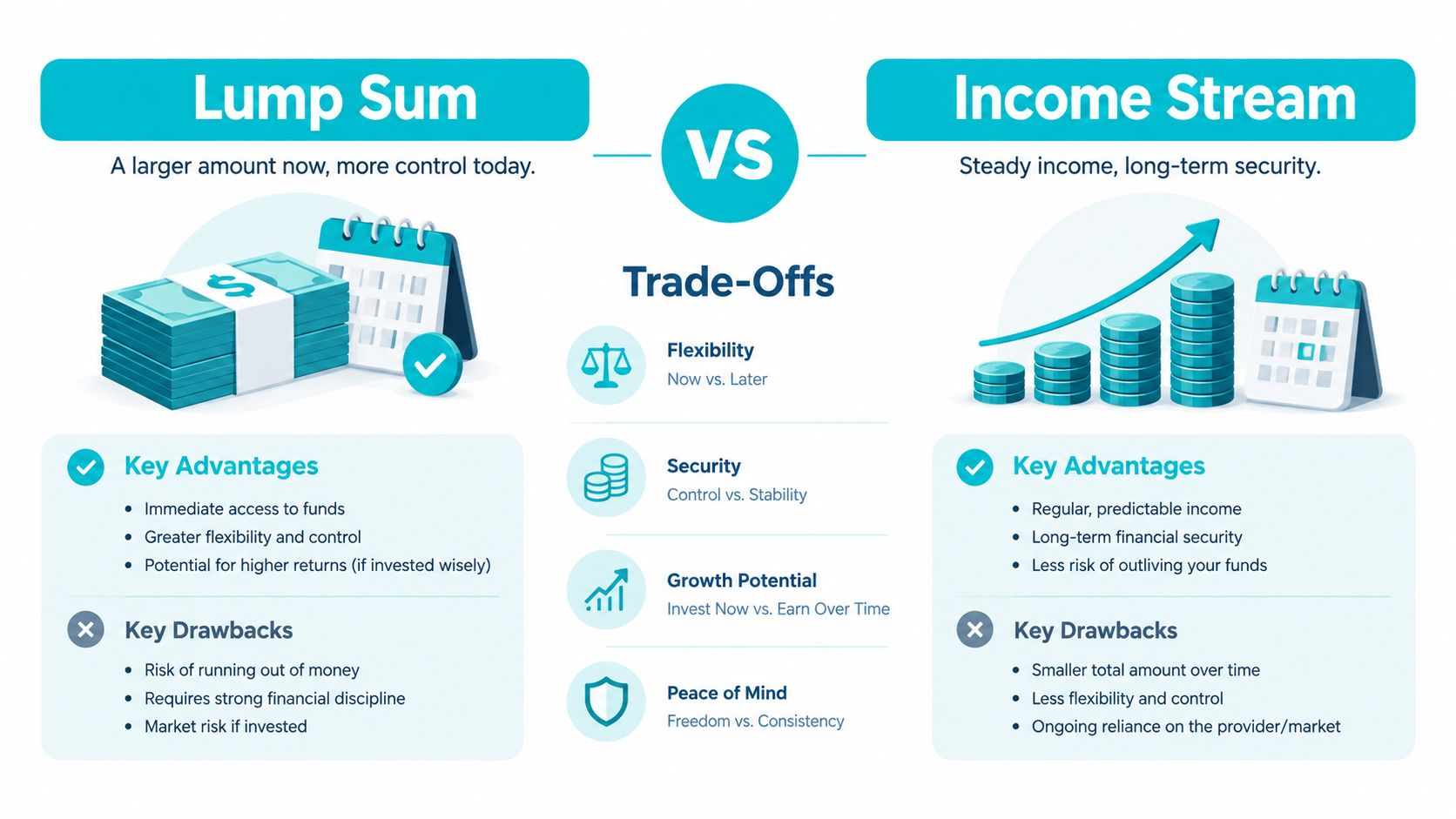
A lump sum gives you control over the capital. You can use it for a home project, keep a cash reserve, invest it or make a gift. An income stream gives your capital a job, providing regular payments while limiting the temptation to spend the full balance at once.
Neither option removes risk. They place different risks in your hands.
What changes when you choose each path
| Question | Lump sum | Income stream |
|---|---|---|
| Access | Broad control over the withdrawn money | Regular payments, with access governed by the account structure |
| Longevity | You must manage the risk of spending too quickly | Creates a framework for ongoing retirement income |
| Investment decisions | You decide where the withdrawn money sits | The pension account remains invested under its chosen strategy |
| Centrelink | Withdrawn money generally becomes an assessable financial asset | Treatment depends on the income stream and Centrelink rules |
| Estate planning | Unspent cash or investments can form part of your estate | Remaining account-based pension value may generally be paid to beneficiaries, subject to the rules |
| Behaviour | A large balance can feel flexible and reassuring | Regular payments can make budgeting more predictable |
A retiree who fears running out of money may value the discipline of an income stream. Someone facing a major renovation or wanting to help adult children may place greater weight on access. Someone else may prefer a blended approach, taking only the amount needed for a known expense and leaving the remainder structured for income.
Centrelink treatment deserves particular care. An account-based income stream may receive partial or full exemptions under the assets and income tests in some circumstances, while a withdrawn lump sum may sit directly among assessable assets. Services Australia's guidance on lump sums while receiving income support also explains that lump sums can count in the income test and affect payment rates. Compensation payments can involve additional preclusion-period calculations where an economic loss component is included.
If you want to explore how regular retirement payments are designed, review retirement income streams alongside your own spending needs and Centrelink position. The best comparison isn't based on which option sounds more flexible. It's based on which risks you're willing and able to manage.
Tax and Timing Rules That Change the Outcome
Timing can change the amount you keep, the point at which you can access super and what happens after the money leaves the fund. Three questions should be answered before you request a payment.
First, can you access the money?
Your preservation age depends on your date of birth. It was 55 for people born before 1 July 1960, then rose through the transitional ages, reaching 60 for people born from 1 July 1964 onward. The ATO confirms that the transitional period has ended and preservation age is now 60 for people born after 30 June 1964 in its guidance on accessing super to retire.
Reaching preservation age doesn't automatically mean every withdrawal is available for every purpose. A valid condition of release still matters, and your fund may need evidence about retirement or another qualifying event.
Second, what happens at age 60?
For a lump sum from a taxed fund, the taxable component becomes fully tax-free once you're 60 or older. Before that age, the taxable and untaxed components can face different rates and thresholds. The same balance can therefore produce a different net result depending on whether the withdrawal is made at 58 or 61.
Consider a $200,000 withdrawal. At 58, some or all of the taxable component may be subject to the relevant super lump-sum tax rules. At 61, a lump sum from a taxed fund can be fully tax-free. The $200,000 gross amount is unchanged, but the amount available for spending may not be.
That example isn't a personal tax calculation. Your fund type, components, age and prior payments must be checked before acting. The practical questions are covered in whether superannuation is taxed.
Third, what happens after withdrawal?
Once super is withdrawn, it is no longer super. Future earnings on that money are taxed under ordinary investment rules rather than the concessional super environment, as the ATO explains about retirement withdrawals. That means sequencing matters. Taking money earlier than necessary may create tax and Centrelink consequences that don't appear on the withdrawal form.
Why the Money Does Not Stop Working Once You Withdraw
A lump sum can feel finished once it reaches your bank account. In reality, the money has moved from one tax and investment environment to another.
While the balance remains inside super, its earnings are generally treated within the superannuation tax system. Once you withdraw it, future interest, dividends and other investment income are dealt with under ordinary investment rules outside super. The investment may be the same, but the account wrapper isn't.
| Scenario | Investment | Gross return | Tax rate applied | Net return | Notes |
|---|---|---|---|---|---|
| Inside super | Investment held by super fund | Depends on the investment | Super tax rules apply | Depends on fund earnings and tax treatment | The money remains within the super environment |
| Outside super | Same or similar investment held personally | Depends on the investment | Ordinary personal tax rules apply | Depends on your taxable income and deductions | Future earnings are assessed outside super |
| Cash outside super | Bank deposit | Depends on the account | Ordinary personal tax rules apply | Depends on your taxable income | Easy access can come with a different tax result |
The table doesn't provide a universal return comparison because no investment produces a guaranteed result and individual tax rates differ. It shows why “I have the cash now” isn't the end of the decision. The capital may still need to fund spending, produce income, support an Age Pension strategy or remain available for care.
A withdrawn balance can also affect government payments. Services Australia's rules mean lump sums may count in the income test and affect payment rates, while compensation payments can receive special treatment. The consequence depends on the payment and your circumstances, so don't assume that moving money into a different account makes it invisible.
A better question than “Is it invested?”
Ask three practical questions:
- Where is the money held? Super, bank deposit, managed investment and personal shareholdings can have different tax treatment.
- What income does it produce? Interest, dividends and realised gains may affect your tax position.
- What job does it have? A cash reserve for a planned expense shouldn't be managed in the same way as capital intended to fund many years of retirement.
Practical rule: Don't judge a withdrawal by the balance on the day it arrives. Judge it by the income, tax and government-payment consequences that follow.
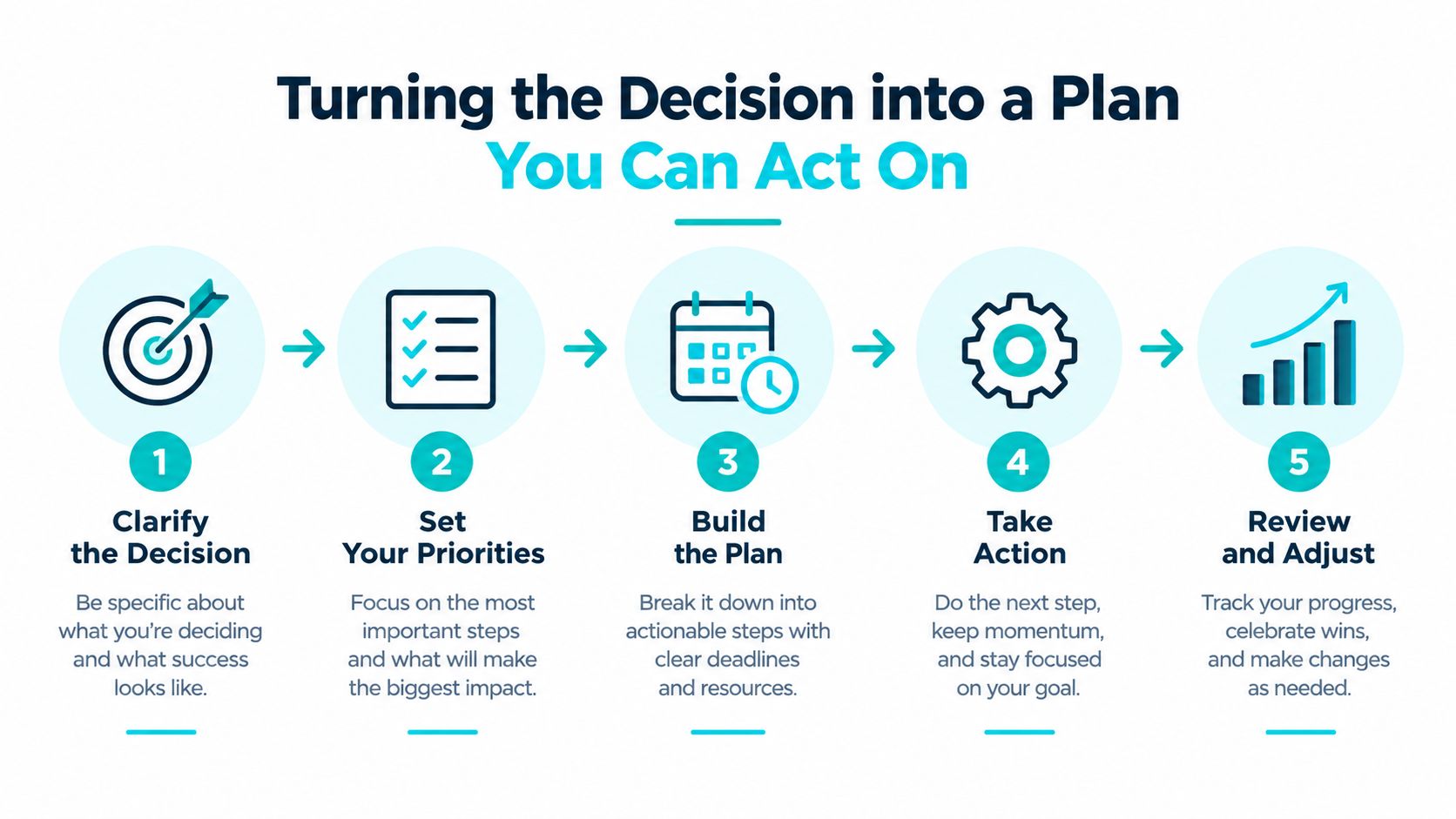
Turning the Decision into a Plan You Can Act On
The decision becomes easier when you turn it into a written process rather than a single yes-or-no question. A useful plan should show what you know, what remains uncertain and what action would change if circumstances moved against you.
Start with the facts
Bring your latest super statement, details of any pension accounts, expected retirement date, household spending, debts, insurance policies and information about Centrelink payments. Include your partner's position if you share finances. The adviser should identify the taxable and tax-free components, preservation-age position, investment options, beneficiary nominations and any known future expenses.
Test more than one future
A plan shouldn't rely on one account balance or one life expectancy assumption. Compare a full lump sum, a partial withdrawal and an income-stream approach. Stress-test each option against higher spending, market volatility, health-related costs, helping family and the possibility of needing aged care.
The useful output is a decision record, not just a spreadsheet. It should state how much money is available, what remains invested, where spending will come from and which assumptions need review.
Sequence the withdrawals
The order of withdrawals can affect tax, future investment earnings and government payments. A sound sequence may involve keeping a reserve outside super for near-term spending while leaving longer-term retirement capital in an appropriate structure. It may also involve delaying an avoidable withdrawal until the tax treatment is more favourable.
For broader support, financial planning for retirees can help you consider income, super, investments, protection and estate objectives together rather than treating the lump sum as an isolated transaction.
Review the plan as life changes
Retirement planning isn't a document you file away. Review it when spending changes, markets move sharply, a partner's health changes, family needs emerge or government rules are updated. The review should confirm whether your withdrawals still match your lifestyle and whether the money is still held in the most suitable place.
Wealth Collective can take clients through a discovery-to-review process that connects fact-finding, scenario testing, withdrawal sequencing and ongoing reviews. If you're weighing a lump sum, book an initial call with an adviser before making the decision irreversible.
Wealth Collective helps Perth and Dunsborough retirees assess super withdrawals, income streams, tax timing, Centrelink considerations and long-term spending needs through a structured retirement planning process. Visit Wealth Collective to arrange an introductory call and pressure-test your lump sum decision before you act.