Business hours
Monday to Friday (8.30AM - 5PM)
Weekend (Closed)


You're checking your super statement after a mortgage repayment comes out, and you notice charges for insurance. There's a death benefit and something called TPD, but you're not sure whether either would keep your household financially secure if you couldn't work.
That's a sensible question. Understanding death disability insurance starts with more than the amount beside your name. The policy definition, how you obtained the cover and the insurer's claims history all help you judge whether it could deliver the support you expect.
Death, TPD and Income Cover Compared at a Glance
Death cover, total and permanent disability cover and income protection answer different questions. Who receives money if you die? What financial support is available if you can never return to work? And how will you pay bills during an illness or injury that interrupts your earnings?
Think of them as different parts of a household safety plan. Death cover protects the family's financial future. TPD provides capital for someone whose working life has permanently changed, while income protection helps replace the pay cheque during a qualifying absence.
Death, TPD and income protection at a glance
| Cover type | Pays out when | Form of benefit | Typical use |
|---|---|---|---|
| Death (life) cover | The insured person dies | Lump sum to nominated beneficiaries or estate, subject to ownership and superannuation rules | Replacing income, clearing debts, funeral costs |
| TPD cover | Permanently unable to work under the policy definition | Lump sum | Rehabilitation, living costs, medical treatment, home modifications |
| Income protection | Temporarily unable to work due to illness or injury, under the policy terms | Monthly benefit after the applicable waiting period | Replacing wages while off work |
The TPD distinction matters: Moneysmart's TPD insurance guide explains that the benefit is a lump sum and that insurers use different definitions of permanent disability. Matching benefit amounts therefore don't guarantee matching protection.
A lump sum isn't a replacement salary
Say you suffer an injury and can't work while receiving treatment. Income protection may respond if you satisfy its conditions, even though your doctors expect you to recover. TPD requires a different assessment, including whether your inability to work meets the policy's permanence test.
A TPD payment also needs to stretch across competing priorities. Paying down the mortgage might reduce ongoing expenses, but using the entire benefit for debt could leave little for treatment, rehabilitation or everyday spending.
Death cover creates a similar budgeting question for surviving family members. Clearing debts can help, but the household may still need money for childcare, education and the work previously done by the person who died.
Establish what you already have
Before considering another policy, make a simple inventory:
- Superannuation cover: Record whether each account includes death, TPD or income protection.
- Personally arranged policies: Find the policy schedules for cover outside super.
- Employer arrangements: Confirm whether any workplace benefit belongs to you personally or only applies while you remain employed.
- Missing protection: Mark any risk for which you can't identify an active policy.
Don't assume a policy labelled life insurance includes every type of protection. Check the actual benefits listed on the schedule, not just the name on the statement.
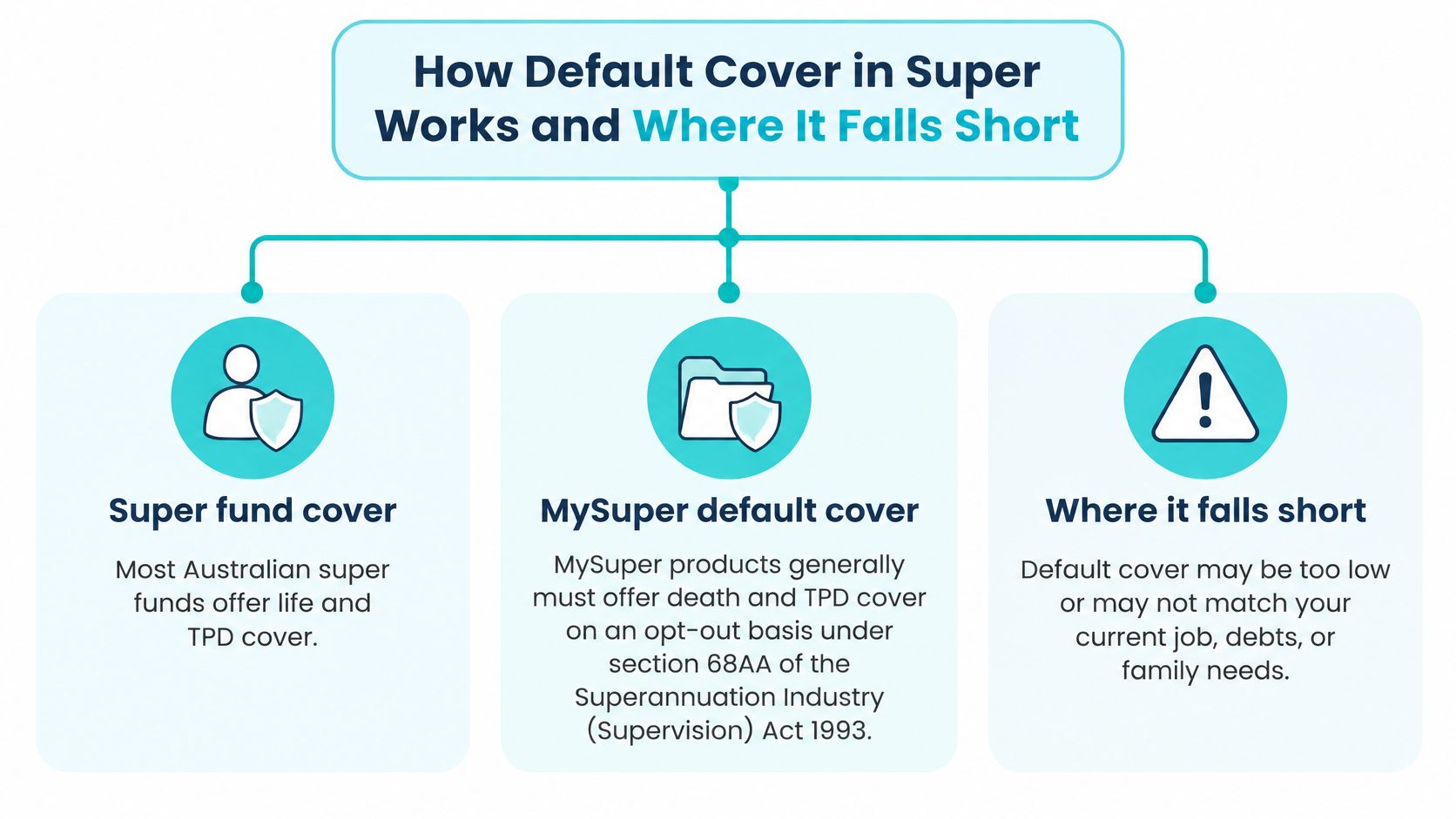
How Default Cover in Super Works and Where It Falls Short
Insurance inside super is a substantial part of Australia's financial safety net. In its 2018 insurance-in-superannuation report, ASIC reported that more than 70% of Australian life insurance policies, over 13.5 million policies, were held through super, with approximately 46,000 death benefits and 17,000 disability benefits paid through super each year.
That report also explained that MySuper products were generally required to offer death and TPD cover on an opt-out basis under section 68AA of the Superannuation Industry (Supervision) Act 1993. These historical figures show why checking existing super cover is a useful starting point, rather than assuming you need to arrange everything from scratch.
Premiums are commonly deducted from your super balance. You might therefore hold insurance without seeing a separate payment leave your everyday bank account.
That convenience is valuable, but it can also mean you haven't consciously chosen the benefit amount or checked its terms.
Default settings aren't a household plan
A fund's default arrangement isn't built around your particular mortgage, dependants or partner's earning capacity. It may provide useful protection without providing enough protection for your circumstances.
Consider a dual-income household where either partner could manage the mortgage while both are working. If someone becomes permanently unable to work, the remaining partner may also reduce their hours to provide care. The financial effect extends beyond the injured person's lost salary.
Our guide to life insurance through super can help you understand the arrangement before deciding whether to retain, adjust or supplement it.
Practical rule: Treat default cover as something to assess, not something to dismiss or automatically trust.
Start with these questions:
- What's active? Identify the benefits currently in force on every account, rather than relying on an old statement.
- What's insured? Record the current benefit amount and whether it changes under the policy.
- What wording applies? Find the relevant insurance guide, product disclosure statement and any individual policy conditions.
Pull your latest statements and note every insurance line before comparing premiums elsewhere. If a statement is unclear, request written confirmation from the fund so you're working with current cover, not an assumption.
Policy Definitions That Decide Whether a Claim Pays
The definition is the gate; the sum insured is the size of the room. A generous benefit offers little practical help if you can't satisfy the wording that allows entry.
TPD definitions ranked by how strictly they apply
| Definition | What the claimant must show | Claim risk |
|---|---|---|
| Own occupation | Unable to perform their own job under the policy wording | Lowest of these tests in general terms; usually the broadest occupational test |
| Any occupation | Unable to work in any job suited to their training, education or experience | Stricter than own occupation |
| Activities of daily living (ADL) | Unable to perform several basic functions such as washing, dressing or feeding | Highest functional threshold; a person unable to work may still fail this test |
These are plain-language comparisons, not substitutes for the policy wording. Qualifications such as permanence, employment status and the precise duties being assessed can change the result.
Why the distinction matters
Say a surgeon develops a condition that prevents operating but leaves them capable of teaching. They may satisfy an own-occupation test yet fail an any-occupation test because teaching remains suitable work. If they can wash, dress and feed themselves, an ADL definition may present a different barrier again.
ASIC's review of gaps in the TPD safety net described nearly 500,000 people insured under narrow ADL definitions and a 60% decline rate, compared with 12% for other TPD claims, approximately five times higher.
The lesson isn't that every ADL policy will fail. It's that inability to earn an income and inability to perform basic personal activities are different things.
A diagnosis alone also doesn't answer the insurer's question. Medical evidence needs to explain the functional consequences: what tasks you can no longer perform, what treatment you've received and what your doctors expect about future capacity.
Check the conditions surrounding the definition
Read the exclusions section alongside the disability definition. Look specifically for:
- Pre-existing-condition restrictions: Check whether the policy limits cover for a condition present before insurance started and how it defines that connection.
- Waiting or qualifying periods: Identify when an assessment can proceed and any employment or disability-duration requirements.
- Named exclusions: Look for expressly excluded conditions, activities or circumstances, including individual exclusions recorded on your schedule.
- Evidence requirements: Note the medical, occupational and other information needed to establish eligibility.
These checks apply to default super cover as well as personally arranged insurance. Don't assume every policy contains the same restrictions, or that changing insurers preserves your existing terms.
Write the exact definition beside the sum insured in your insurance inventory. A benefit amount without its eligibility wording is an incomplete description of your cover.
How Often Death and TPD Claims Get Accepted
Claim admission rates by channel, death and TPD
APRA and ASIC figures for the 12 months to 31 December 2018 show different admission rates across insurance channels, as reported in ASIC's review of TPD consumer outcomes.
| Channel | Death claims admitted | TPD claims admitted |
|---|---|---|
| Individual advised | 96% | 87% |
| Group superannuation | 98% | 88% |
| Individual non-advised | 88% | 59% |
The gap between death and TPD claims is understandable, though it does not predict an individual outcome. A death claim generally centres on confirming the death and checking policy eligibility. A TPD assessment must also consider medical evidence, permanence and work capacity against the policy's definition.
What the sales channel can tell you
An advised application gives an adviser a chance to consider your occupation, health disclosures and needs together. With a non-advised purchase, you may have to identify potential mismatches yourself.
The table does not show that advice alone caused the differences. Policy terms, the people insured and the claims submitted can also affect the results. The channel is one part of the picture, alongside the policy definition and the history of how claims have been assessed.
Historical admission rates can help you ask informed questions about an insurer, but they are not your personal probability of receiving a benefit.
These figures describe a past period, not current insurer performance. Check recent claims information before relying on historical results, and distinguish claims admitted from claims finalised or still under assessment.
For your own policy, establish:
- How it was arranged: Was it advised, bought directly or provided through a group super arrangement?
- What was assessed: Did the application consider your duties and health history, and are your disclosures recorded accurately?
- What a claim requires: Get the insurer's current claim checklist and identify the evidence relevant to your circumstances.
A higher historical percentage does not make a channel the right choice for everyone. Focus on whether your policy's definition fits your circumstances, what information was considered when cover was arranged, and how the insurer handles claims. Those details tell you more about the protection you hold than the premium or sum insured alone.
A Worked Claim Timeline and What Payouts Look Like
A serious back injury leaves a breadwinner in a dual-income Perth family unable to do her usual work. She has TPD cover through super and lodges a claim. Mortgage payments and groceries continue while the insurer assesses whether her circumstances meet the policy's definition of TPD.

From application to payment
- Lodge the claim. She contacts the fund or insurer and provides medical details, employment history and a description of her duties.
- The insurer checks the policy definition against her work capacity. Treating doctors may need to explain her prognosis, restrictions and response to treatment.
- Respond to evidence requests. Specialist reports, occupation questionnaires or clarification of inconsistent records may extend the assessment. Keeping copies and tracking outstanding requests can help avoid administrative delays.
- The insurer makes a decision. If it accepts the claim, payment follows the relevant insurer and, where applicable, super fund processes.
The steps and documents involved can vary with the policy and how cover was arranged. This guide to making a TPD insurance claim explains the paperwork and assessment process.
Put the waiting period into the household budget
The Association of Superannuation Funds of Australia's insurance-in-superannuation paper reports that group super insurance paid approximately $1.7 billion in death benefits and $3.0 billion in TPD benefits during 2023–24. It also reports the average payments and finalisation times below.
Average payments and claim timing, 2023–24
| Benefit type | Average payment | Average finalisation time |
|---|---|---|
| Death | About $496,000 | No average time provided |
| TPD | About $661,000 | 4.4 months |
| Disability income | No average payment provided | 1.6 months |
These averages describe past claims, not a promised benefit or deadline. Your policy's definition, the channel through which you bought cover, and the history of claims under the policy all help explain what protection may deliver. The sum insured matters, but it does not determine eligibility on its own.
For the family in this example, the average TPD assessment time represents months of bills to cover from savings, another income or other available benefits. Income protection does not automatically bridge the entire period, since it has its own conditions and payment rules. If the condition includes mental-health symptoms, medical records should describe how the full condition affects reliable attendance, concentration and work duties, alongside physical limitations.
How long could your household meet essential expenses before a payout arrives? Work out that runway using accessible money, rather than assets that would be difficult to sell quickly.
Gaps That Open After Job Changes and Age Milestones
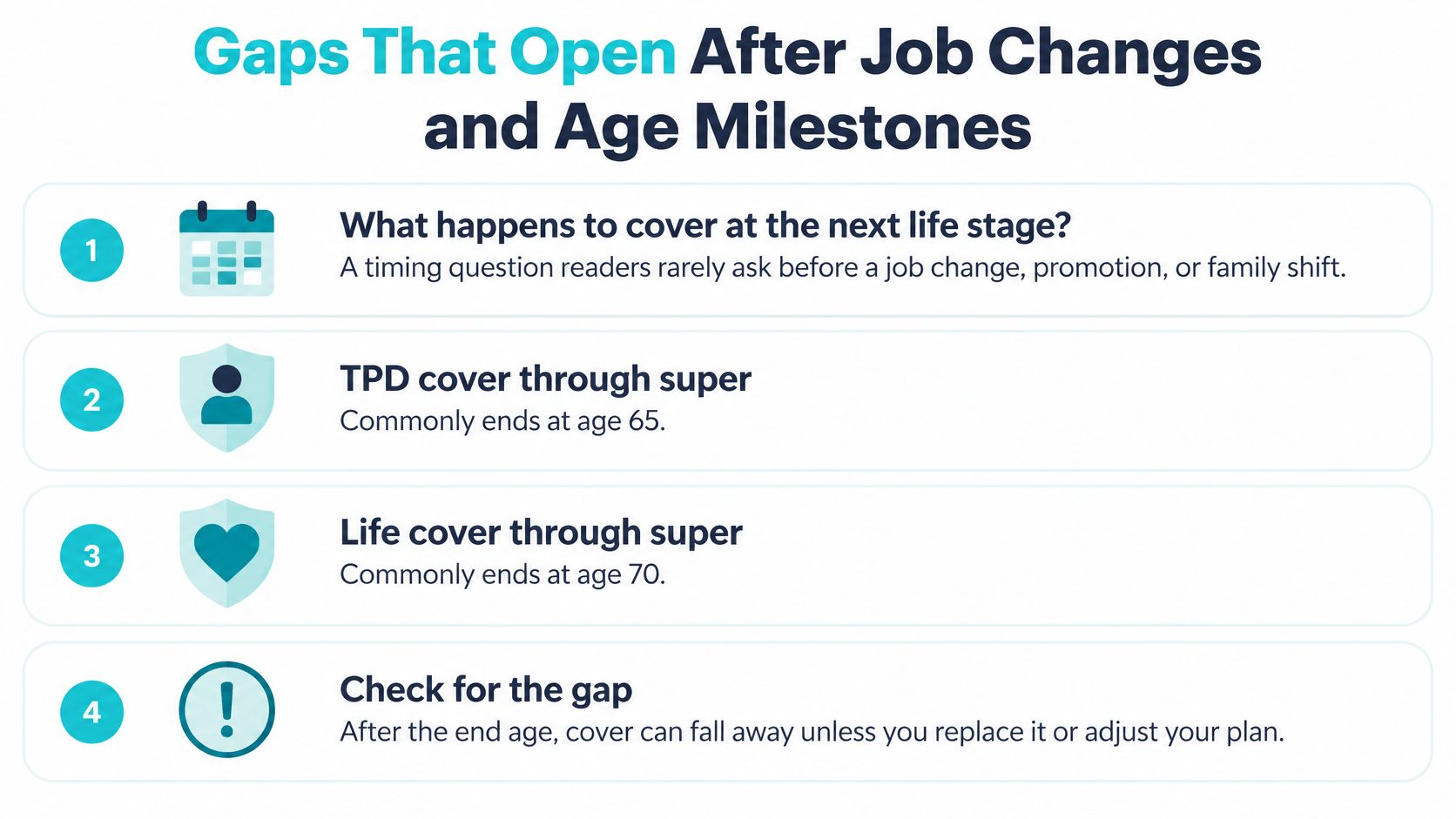
What happens to your cover at the next life stage? Insurance that suited your last job or family arrangement might not remain active, or appropriate, indefinitely.
Moneysmart's insurance-through-super guide notes that TPD cover through super commonly ends at age 65, while life cover commonly ends at age 70; many funds automatically provide life and TPD insurance to members aged 25 or over, often without medical checks.
The ASFA Insurance and Superannuation report identifies potential exclusions from automatic cover affecting people under 25, members with balances below $6,000, inactive accounts and many self-employed workers. These are reasons to confirm eligibility, not assume everyone in those groups is uninsured.
Is the cover still active?
A job change can leave an old account without contributions. Consolidation can close an account that carried useful insurance, while the receiving account may not provide equivalent terms.
Before moving money or cancelling an account, obtain written confirmation of what will cease and what replacement cover is in force. Applying for replacement insurance isn't the same as having it accepted.
Does it still suit the household?
A promotion, business purchase or new dependant can change the consequences of losing income. Moving into self-employment also makes it important to check how the policy assesses occupation, earnings and work status.
Compare both partners' protection without assuming equal salaries mean equal needs. Unpaid care, household management and the ability to reduce working hours all affect the financial impact of illness or death.
Premiums and benefit design can change, too. A yearly review helps you decide whether the arrangement remains affordable and suitable rather than treating the original purchase as permanent.
Actions to complete this week
- Confirm status: Request current insurance confirmation for each super account.
- Check milestones: Record the policy's benefit-reduction and cessation terms in your calendar.
- Review consolidation: Identify insurance you would lose before authorising an account closure.
- Compare partners: List each person's financial and caring responsibilities beside their protection.
- Update work details: Check whether your current duties and employment status affect eligibility.
You don't need to replace every policy after a life change. You do need to know whether the change has altered the protection you're relying on.
How Cover Fits Retirement and Estate Planning
Retirement planning should account for insurance ending, not assume protection will continue alongside your super balance. If cover ceases while you still have debt or financially dependent family members, decide how those obligations would be funded.
Replacement insurance isn't automatically the answer. You might instead plan to reduce debt, retain accessible savings or adjust spending, depending on your circumstances and the availability of suitable cover.
Make the recipient part of the plan
For death benefits held through super, beneficiary nominations operate within superannuation rules. A nomination may be binding or non-binding, and the trustee's responsibilities and the nomination's validity affect who receives the benefit.
Your will doesn't automatically control every super death benefit. If a benefit is paid to your estate, it may then be distributed under your will, with estate administration potentially affecting when family members receive money.
Our explanation of what happens to super when you die helps connect these decisions with the wider estate plan.
A policy can provide an appropriate amount yet leave a practical problem if the intended recipient can't access the money when it's needed.
Align the paperwork
- List policies and nominations. Include ownership details and whether a nomination is recorded.
- Compare those instructions with your current will and family circumstances. Separation, remarriage and changing dependants deserve particular attention.
- Confirm the fund's requirements. Establish which nomination options are available, what formalities apply and whether renewal is required.
Finally, weigh premiums against retirement objectives. Money deducted from super for insurance isn't available to remain invested for retirement, but removing useful cover can expose the household to a different financial risk.
The decision is a balance between protection now, access to money after a claim and the retirement resources you're building.
Book a Free Call to Test Your Cover
Before booking advice, complete a short claimability audit. You don't need perfect answers; identifying what you can't confirm is useful preparation.
- Policy definition: Copy the relevant wording from the product disclosure statement or insurance guide.
- Likely evidence: Identify the medical reports, occupation details and income records an insurer may request.
- Restrictions: Record exclusions, waiting periods and qualifying conditions.
- Overlapping policies: List cover that might respond to the same event, then check interactions rather than assuming every benefit will be paid together.
Turn the audit into a decision
At Wealth Collective, Protection Plus simplifies personal insurance and superannuation, helping clients get better coverage and lower fees. We assess protection alongside personal circumstances, debts, dependants and future costs, rather than treating the premium as the whole decision.
Where relevant, the advice can connect with Guided Growth and Retirement Roadmap, so insurance decisions support wealth-building and retirement goals rather than sitting apart from them.
The first step is a free 10-minute introductory call. From there, we can discuss your goals and outline the next steps towards a customized plan.
Have your super statements, policy documents, debts, dependant details and occupation information ready. If you're missing a document, note that gap rather than delaying the conversation indefinitely.
Review your arrangements each year and after significant family or employment changes. The aim is confidence grounded in the terms you hold, not reassurance based only on a benefit amount.
Wealth Collective offers personal insurance and superannuation advice to help you assess whether your death and disability cover fits your household and future plans. Visit Wealth Collective to book your free introductory call, and bring your policy inventory so we can discuss the gaps and questions that matter to you.