Business hours
Monday to Friday (8.30AM - 5PM)
Weekend (Closed)


You've cut back on discretionary spending, but the mortgage still absorbs a large part of your household cash flow. Your credit card balance isn't falling quickly enough, your car loan competes with super contributions, and every unexpected bill threatens to send you back to the card. Falling rates may have eased some pressure, but lower repayments don't automatically create financial security.
Effective debt reduction strategies in Australia require more than choosing between the avalanche and snowball methods. You need to understand which debts threaten your housing and income, where surplus cash should sit, how much liquidity you need, and whether paying down debt is competing with retirement planning. The right process reduces what you owe without leaving you financially exposed.
Why Generic Debt Repayment Plans Often Fail in Australia
Most online repayment plans treat debt as a simple contest between balances and interest rates. Put every spare dollar against the most expensive loan, keep paying minimums elsewhere, and repeat until the debt disappears. That can work for a stable borrower with ample cash reserves, but it can fail badly when a household has a mortgage, dependants, irregular expenses, or retirement goals.
Australian households have carried high debt levels for decades, and that debt affects more than the interest bill. A large mortgage can restrict career choices, delay retirement, reduce investment capacity, and make a temporary income shock much harder to absorb. The borrower who directs every spare dollar into the home loan may appear disciplined while holding no accessible cash for medical costs, urgent repairs, or a period without work.

Start with diagnosis, not repayment
Before choosing a payoff method, map the household properly:
- List every liability: Include mortgages, credit cards, personal loans, car finance, HELP debt, tax debts, and informal family loans.
- Separate fixed commitments from flexible spending: You need to know what must be paid before deciding what can be redirected.
- Identify the key risk: A high-interest credit card is expensive, but an unpaid mortgage, essential utility bill, or work vehicle repayment may create more immediate damage.
- Protect liquidity: A repayment plan that forces you to borrow again after one surprise expense isn't a successful plan.
The avalanche method directs minimum repayments to all debts and every extra dollar to the highest-interest debt first. The snowball method directs extra money to the smallest balance first, which can provide faster psychological wins. ANZ outlines both approaches in its explanation of avalanche and snowball debt repayment methods.
Neither method should be applied blindly. If a borrower has unstable cash flow, the first move may be a realistic budget and a liquidity buffer rather than an aggressive extra repayment. If consolidation is under consideration, practical guidance such as Nomu debt consolidation tips can help clarify the questions to ask about fees, loan terms, and repayment behaviour.
Wealth advice begins with pressure points, not products. The objective is to reduce debt while keeping the household capable of handling the next financial shock.
Understanding the Scale of Household Indebtedness
A household can earn a respectable income and still have little room after mortgage payments, childcare, insurance, transport, and daily expenses. That pressure reflects a broader Australian borrowing pattern, not poor decisions by a small group of borrowers. Families need to assess debt against cash flow, future income, and retirement plans.
The Reserve Bank of Australia found that household indebtedness, measured by the debt-to-income ratio, rose markedly over the 40 years to 2018. Australia moved from the bottom half of advanced-economy rankings in the late 1980s to the top quartile by 2018, according to the Reserve Bank of Australia's household indebtedness analysis.
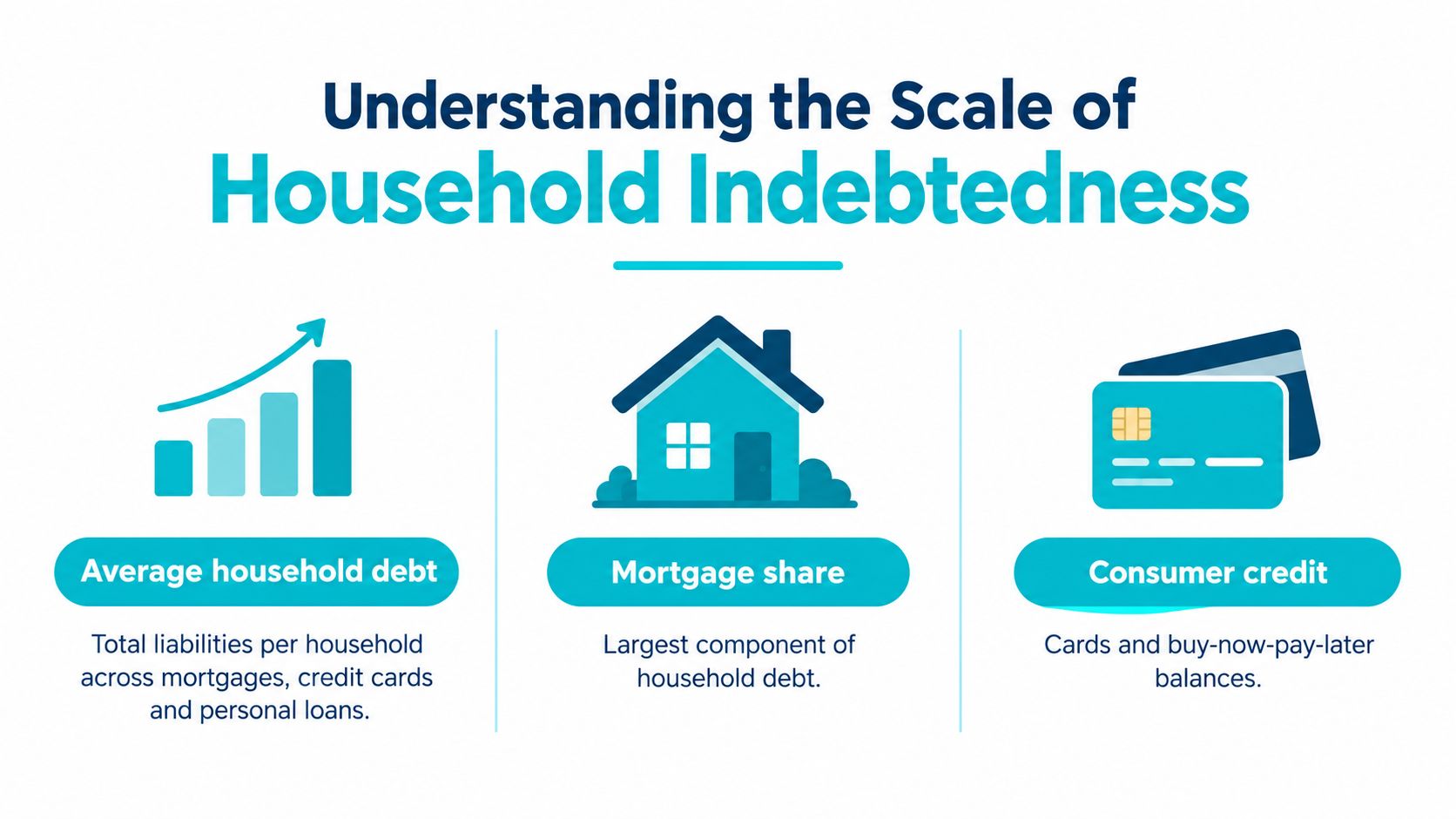
What the household figures mean
The household figures show how widely debt is distributed. three in four households, or 75%, had debt in 2019–20, and 30% of indebted households were servicing debt equal to at least three times their annualised disposable income. That share had risen from 24% in 2009–10 and 28% in 2017–18. Average household liabilities reached $203,800 in 2019–20, up 7.5% from 2017–18 and 39% over the decade, as reported in the linked RBA analysis.
Those figures matter because high liabilities reduce choice. A household may have strong earnings on paper but limited capacity to absorb a rate change, replace a vehicle, reduce work hours, or fund retirement. Falling rates can improve monthly repayments, yet total borrowing costs remain high when a large balance runs for many years. Strategic deleveraging means using any cash-flow improvement deliberately, directing surplus funds to the highest-priority debt while preserving appropriate liquidity.
A high debt-to-equity ratio creates four practical risks:
- Cash flow becomes rate-sensitive: A modest change in loan pricing can reduce the money available each month.
- Retirement decisions become harder: Debt that continues into retirement may require larger super withdrawals or a lower standard of living.
- Borrowing capacity narrows: Existing liabilities affect future applications, particularly when lending standards tighten.
- Resilience weakens: Limited accessible cash can force a household back onto expensive credit after an unavoidable expense.
Car finance deserves close attention. The vehicle may support employment, while its repayment competes with housing and family costs. This overview of auto loans going unpaid provides practical context for that risk.
The right question is not how quickly to clear a balance. Ask how much financial obligation the household can safely carry while funding retirement, protecting income, and responding to change. That answer should determine which debt receives extra repayment first and how surplus cash is held.
Leveraging Mortgage Offset and Redraw Facilities
Australian borrowers have access to mortgage structures that can make debt reduction more flexible than a standard extra-repayment approach. Offset accounts and redraw facilities can both reduce mortgage interest, but they don't provide identical access, control, or behavioural safeguards.
An offset account links an eligible transaction or savings account to the mortgage. The balance in that account reduces the loan amount on which interest is calculated, while the cash remains accessible for approved uses. A redraw facility generally allows a borrower to access additional mortgage repayments, subject to the lender's terms and conditions.
The distinction matters. Paying money directly into the loan can reduce principal, but moving surplus cash into an offset may preserve a stronger emergency reserve. The most suitable structure depends on the loan contract, account fees, interest rate, lender rules, and the household's ability to avoid spending the available balance.
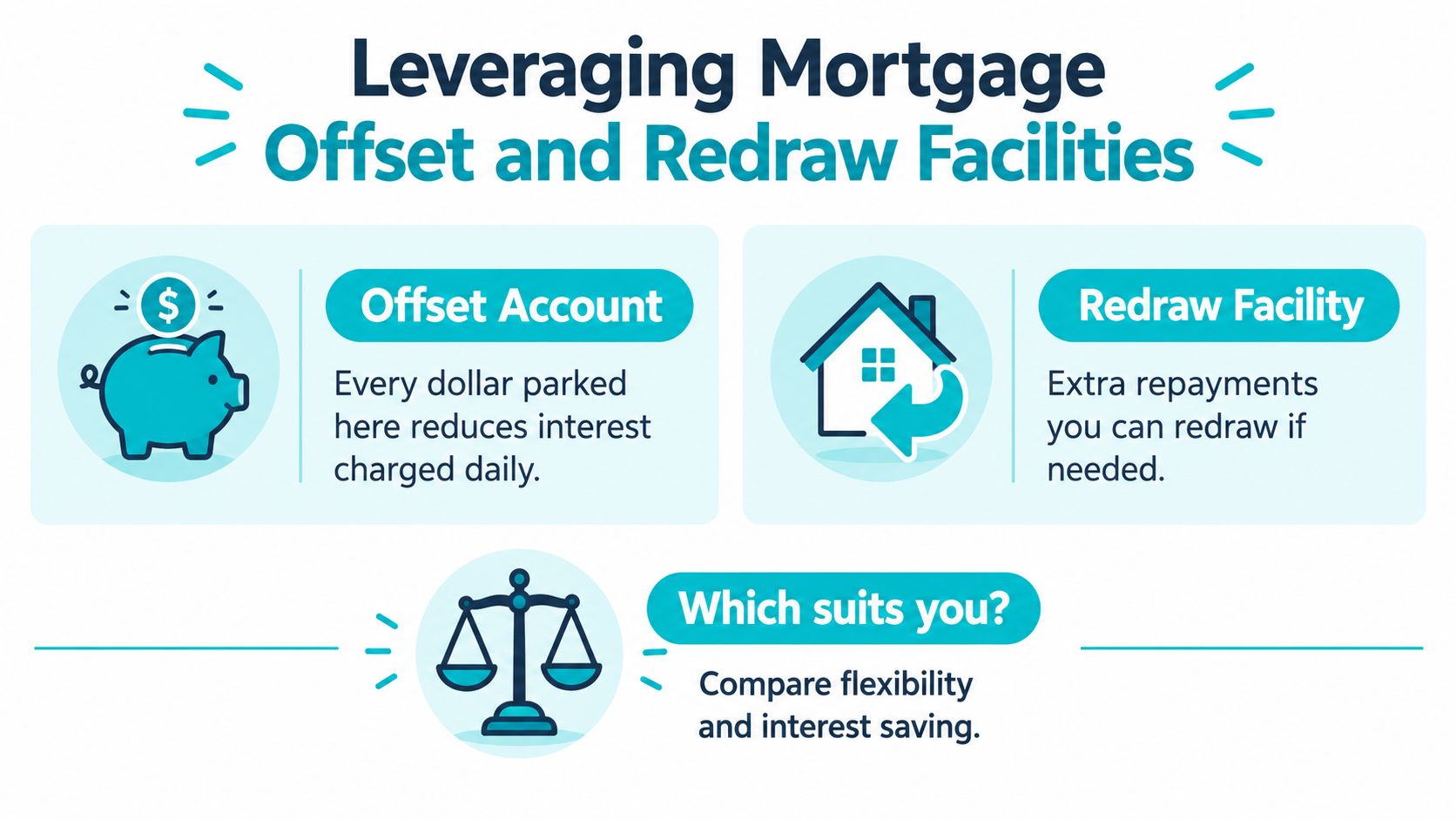
Offset and redraw compared
| Feature | Offset account | Redraw facility |
|---|---|---|
| Access to surplus cash | Usually designed for everyday access, subject to account conditions | Access depends on the lender's redraw rules |
| Interest effect | Cash reduces the balance used to calculate mortgage interest | Extra repayments reduce the loan balance |
| Liquidity | Often offers stronger day-to-day flexibility | Can provide access, but conditions may change |
| Behavioural risk | Easy access can encourage spending | Less visible access may discourage casual withdrawals |
| Best use | Emergency reserves, salary deposits, planned expenses | Deliberate extra repayments when access is less important |
The RBA reported that offset accounts were attached to around 40% of Australian mortgages, while redraw facilities were used by around 70% of home mortgages. An earlier RBA appendix estimated offset accounts at around 45% of the total value of residential mortgage debt, with redraw facilities covering around 70% of the total number of residential mortgages, as outlined in the RBA analysis of mortgage offset and redraw facilities.
Use an offset as a working part of your cash-flow system. Direct salary into it, keep your emergency reserve there, and pay regular expenses from it without allowing lifestyle spending to absorb the benefit. Use redraw only after checking access rules and considering whether withdrawing the money could turn a repayment strategy into fresh borrowing.
For a detailed comparison of the mechanics, see offset account versus redraw. The key decision is simple: preserve liquidity where you need it, and place irreversible extra repayments against the mortgage only when your cash buffer is adequate.
Triage Your Debts by Criticality, Not Just Rate
A lower interest rate does not make a debt safe. If missing one payment could put your housing, utilities, or ability to earn income at risk, that liability deserves attention before a higher-rate balance with less serious consequences.
Start with a full list of debts, income, and expenses. ASIC recommends paying priority debts first, including rent or mortgage payments, council rates, body corporate fees, utilities, and car repayments when the vehicle is needed for work or travel. The practical framework is set out in ASIC's debt repayment and hardship information.
Build the order of attack
Use this sequence before choosing avalanche or snowball repayments:
- Protect housing and necessary services. Keep mortgage or rent, rates, body corporate obligations, utilities, and transport for work current.
- Stabilise the monthly budget. Separate unavoidable bills from subscriptions, discretionary purchases, and irregular spending that can be cut.
- Build a cash buffer. Direct surplus into an emergency fund or an appropriate mortgage offset. This reduces interest while keeping cash available for an unexpected bill, which is especially useful when rates are falling but total borrowing costs remain high.
- Pay every minimum on time. Keep each account current while deciding where extra money will have the greatest effect.
- Choose the next target deliberately. Send additional repayments to the highest-rate debt for the strongest mathematical result, or the smallest balance when quick progress will keep the plan on track.
- Reassess after major changes. A new job, parental leave, inheritance, rate change, or approaching retirement can change the right repayment order.
Your offset should support this triage, not become an excuse to delay repayments. Keep the cash buffer there if you need access, then direct surplus to the selected liability once the buffer is adequate. That approach preserves flexibility while reducing the cost of debt.
Credit card minimums can keep an account technically current while making little progress. CommBank states that its minimum repayment is the greater of the amount above the credit limit, 2% of the closing balance rounded down to the nearest dollar, or $25, with a different $75 threshold applying to certain CommBank Business Cards, as explained in its credit card minimum repayment guidance. Check your own card terms. Other lenders may use a different formula.
Practical rule: Never sacrifice a housing, utility, or other necessary payment to make an extra repayment on a discretionary debt.
Consolidation also requires a hard cost check. One repayment may look simpler, yet fees, interest, and a longer term can increase the total amount paid. Securing the new loan against a home or car can also put that asset at risk. The strategy only works if the old balances are closed and newly available credit is not used again.
Repayment pressure is widespread. ASIC has reported that many Australian adults with debt struggled to make repayments during the previous 12 months. If your budget cannot cover minimum repayments, stop chasing a faster payoff method and request hardship assistance from your lender.
Navigating Debt Help and Government Protections
Paid debt-management services are not the starting point for a household under pressure. First, ask the lender what hardship assistance is available, then seek free financial counselling before paying a commercial provider to organise debts.
ASIC has scrutinised debt-management and credit-repair services because consumers can struggle to compare fees, service quality, and results. In one enforcement case, ASIC alleged that 64% of customers had no payments passed to creditors, while only 5.3% achieved a debt reduction after fees, according to this financial counselling evidence review. The same review reported that among people who received financial counselling, 66% resolved financial difficulties, 74% avoided legal action, 53% avoided bankruptcy, and 63% experienced improved mental wellbeing.
Use a safer escalation path
Use the least costly and most transparent option first:
- Speak to the lender's hardship team: Ask about a hardship variation, an altered repayment arrangement, or other assistance before missing payments. Early contact gives the lender more room to work with your cash flow.
- Contact free financial counselling: A counsellor can organise your debts, communicate with creditors, and assess suitable options without steering you towards a sales-based consolidation product.
- Check the payment flow: If you engage an external service, confirm whether payments go directly to creditors, when they are sent, and what happens if you cancel.
- Calculate the net result: Add every fee, interest charge, and loan cost, then compare that total with the actual reduction in your debt.
- Reject credit repair promises: Treat claims about removing accurate information from a credit report, or guaranteeing an outcome outside the provider's control, as a warning sign.
The counselling figures do not mean every debt problem disappears. They show why regulated, independent assistance should come early, especially if you are already missing payments or receiving legal notices. The practical sequence is free counselling, lender hardship negotiation, and a structured repayment arrangement with creditors where required.
A debt solution should reduce your total burden, not transfer money from your household budget to a provider before creditors receive anything.
Keep debt help separate from loan sales. A refinance or consolidation product may fit after a proper cash-flow diagnosis, but compare the total cost, loan term, fees, security, and repayment risk before signing. Lower interest can still leave you paying more if the new term runs longer. Offset funds and spare cash should also be assessed before debt is shifted, because preserving accessible liquidity may matter more than making an irreversible repayment.
If the proposed plan depends on continuing to use the same credit facilities, it is not a debt reduction plan. Close or restrict those facilities and direct every agreed surplus towards the balance that the plan is designed to eliminate.
Strategic Deleveraging in a Changing Rate Environment
Falling mortgage rates create an opportunity, but they don't remove the need for discipline. The extra cash created by lower repayments can disappear into lifestyle spending, or it can be used to improve the household's balance sheet and future options.
RBA data indicates that variable mortgage rates fell by 75 to 80 basis points during 2025, while scheduled principal-and-interest mortgage payments remained near 10% of household disposable income in the December quarter. The same RBA financial conditions update notes that APRA's new debt-to-income guardrails took effect in February 2026 to limit riskier new lending.
Decide where the rate relief goes
A sensible allocation starts with the household's next major objective:
| Situation | Sensible priority |
|---|---|
| High-cost consumer debt remains | Direct most surplus cash towards the expensive balance while maintaining a buffer |
| Mortgage is the main liability | Use an offset or extra repayments, depending on access needs and loan structure |
| Retirement is approaching | Model debt at retirement, super contributions, and required cash reserves together |
| A future property or business decision is possible | Preserve liquidity and review borrowing capacity before making irreversible repayments |
| Income is variable | Hold a stronger reserve and avoid committing every surplus dollar to debt |
APRA notes that Australia has the third-highest household debt among OECD countries, at about 180% of incomes, according to the RBA source above. Rate cuts can therefore coexist with stretched budgets. A lower repayment today doesn't justify taking on new debt or assuming that future refinancing will always be available.
For pre-retirees, the decision often comes down to the balance between mortgage reduction, super contributions, and accessible cash. Paying down debt can reduce interest and future retirement obligations. Holding money in an offset can preserve flexibility while still reducing mortgage interest. Contributing to super may support long-term retirement outcomes, but the appropriate decision depends on age, tax position, access rules, insurance, and the remaining loan.
Western Australian dual-income households should also consider what happens if one income stops. A plan based on two full salaries may look efficient but leave little margin for parental leave, illness, redundancy, or caring responsibilities. A strong offset balance can act as a strategic reserve, provided the household treats it as protection rather than spending money.
For another perspective on the mortgage decision, Everglow Prosperity mortgage advice provides a useful prompt for comparing repayment, liquidity, and broader financial priorities. If refinancing could improve the structure, review when to refinance a mortgage only after comparing the full cost and your long-term plan.
Strategic deleveraging means making the balance sheet safer without making the household brittle. The goal isn't to show the lowest mortgage balance at any cost. It's to reduce expensive debt, retain enough liquidity, and preserve the capacity to make sound decisions under tighter lending conditions.
Next Steps for Tailored Debt Reduction Support
A repayment method can tell you where the next dollar goes. It can't decide how much should remain in your offset, whether super contributions should continue, how insurance protects the plan, or what debt level is realistic before retirement. Those decisions require the household's complete financial picture.
Start by gathering current loan statements, interest rates, repayment schedules, offset balances, credit limits, superannuation details, insurance policies, and household spending. Include upcoming changes such as school costs, a planned property purchase, business investment, reduced work hours, or retirement. Accurate decisions depend on accurate information.
Build the plan around your life
A useful advice process should answer practical questions:
- Which debts should be cleared first, and why?
- How much cash should remain accessible?
- Should surplus funds sit in an offset, go into redraw, or reduce another liability?
- How will debt reduction affect superannuation and retirement income?
- Does the household have enough personal insurance if an income earner can't work?
- Would refinancing improve the structure after all fees and risks are included?
Wealth Collective's Guided Growth service includes debt reduction as part of a broader financial advice process. Its advisers can consider repayment methods, refinancing, mortgage offset use, superannuation, investment strategy, and protection rather than treating the loan in isolation. The firm works with clients in Perth, Dunsborough, and elsewhere in Australia through a process that begins with a free 10-minute introductory call.
You don't need to have every answer before seeking advice. You do need to be willing to disclose the full position, including debts you'd rather avoid discussing and spending patterns that keep rebuilding balances. The adviser's role is to turn that information into clear priorities and an organised plan.
Choosing the right adviser matters as much as choosing the right repayment method. Use this guide on how to choose a financial adviser to assess qualifications, transparency, service scope, communication, and whether the advice reflects your actual goals.
The next sensible action is to stop treating debt as a collection of disconnected accounts. Map the full balance sheet, protect the essentials, optimise the mortgage structure, and connect repayment decisions to retirement and wealth-building priorities.
Wealth Collective helps Australian households coordinate debt reduction with mortgage strategy, superannuation, investment planning, insurance, and retirement goals. Visit Wealth Collective to book a free 10-minute introductory call and start building a debt plan around your circumstances.