Business hours
Monday to Friday (8.30AM - 5PM)
Weekend (Closed)



You're probably at the same point most borrowers hit. The loan's nearly approved, the lender asks whether you want an offset account or a redraw facility, and it sounds like a minor setup choice.
It isn't.
I've seen plenty of Australians focus on rate discounts and repayment size, then gloss over the loan structure. That's backwards. The offset account vs redraw decision affects how easily you can access cash, how disciplined you're forced to be, and, for investors or future investors, whether you create a tax mess you'll regret later.
It also matters if you're planning bigger moves. If you're thinking ahead to a kitchen upgrade, extension, or structural work, Templeton Built has a practical overview of funding home renovations that's worth reading before you touch equity or redraw.
Making the Right Choice for Your Home Loan
A common scenario goes like this. A couple in Perth buys their first home, builds up surplus cash, and wants that money working harder than it would in a standard savings account. Their lender says both offset and redraw can reduce interest. That part is true.
The problem is that borrowers often stop there.
On the surface, these features look interchangeable because both can cut interest. In real life, they behave very differently. One keeps your cash separate and flexible. The other pushes money into the loan itself and gives you conditional access later. That distinction matters more than is initially apparent.
Why this choice shapes your long-term strategy
If you're a pure owner-occupier, highly disciplined, and never expect the property to become an investment, redraw can be workable. It can even help people who spend too freely because the money is a little harder to touch.
But if you're a high-income earner, a business owner managing lumpy cash flow, or someone who might rent the property out later, a lazy redraw setup can create avoidable problems. I'm direct on this point because it deserves it. Loan structure is wealth strategy.
The wrong loan feature won't just inconvenience you. It can reduce flexibility right when you need it most.
The quick comparison
| Feature | Offset account | Redraw facility |
|---|---|---|
| Structure | Separate account linked to the loan | Feature inside the loan |
| Everyday access | Strong | Usually limited |
| Spending use | Suitable for salary, bills, and emergencies | Better for extra repayments, not daily banking |
| Tax safety for investment use | Stronger | Riskier if funds are reused privately |
| Best fit | Borrowers who want flexibility and future options | Disciplined owner-occupiers with simple plans |
My view is simple. For those serious about building wealth, offset usually beats redraw. Not because the maths is better, but because the strategy is better.
Offset vs Redraw The Fundamentals Explained
The easiest way to understand this is to stop thinking about “features” and start thinking about where the money sits.
An offset account is your money sitting in a separate account beside the loan. A redraw facility is extra money you've already paid into the loan, with the option to ask for some of it back later.

Offset is a linked bucket
Think of your mortgage as a large pool of debt. An offset account is a bucket of cash sitting next to that pool. The bank looks at both every day and charges interest on the difference.
Bendigo Bank explains it clearly. An offset account linked to a home loan is a legally separate transaction or savings account, and if you had a $300,000 loan with $50,000 in offset, interest would be charged on $250,000 instead.
That separate-account structure is the key point. It's still your cash account. You haven't repaid the loan balance with that money. You've just reduced the balance the bank uses to calculate daily interest.
Redraw is a tap on the loan
A redraw facility works differently. You make extra repayments above the minimum required amount. Those extra repayments reduce the loan balance. Later, if the lender allows it, you can withdraw some of that surplus back out.
So the money doesn't sit beside the loan. It goes into the loan.
That's why redraw tends to feel less like banking and more like a controlled release valve. It can be useful if you want to force discipline and reduce the temptation to spend. It's less useful if you want your cash available for business expenses, emergencies, or changing family costs.
The practical distinction
Use this test.
- If you want your salary, cash buffer, and emergency funds to stay accessible, offset is the cleaner setup.
- If you want to hammer debt and keep your hands off the money, redraw may suit your behaviour.
- If there's any chance the property becomes an investment later, treat the structure choice as a tax and planning issue, not just a convenience issue.
Offset is a cash-management tool. Redraw is a repayment feature. Borrowers get into trouble when they treat them as identical.
Comparing Interest Savings Costs and Fees
Often, many articles waste your time. They imply one option somehow produces better interest savings than the other.
It doesn't, assuming the same dollar amount is sitting against the loan.
According to Mozo's guide to offset vs redraw interest savings, in Australia both options reduce home loan interest by the exact same mathematical amount for any given balance. Their example shows $60,000 in either an offset or redraw against a 5.9% variable home loan saving about $3,540 per year in interest when the RBA cash rate is 4.35%.
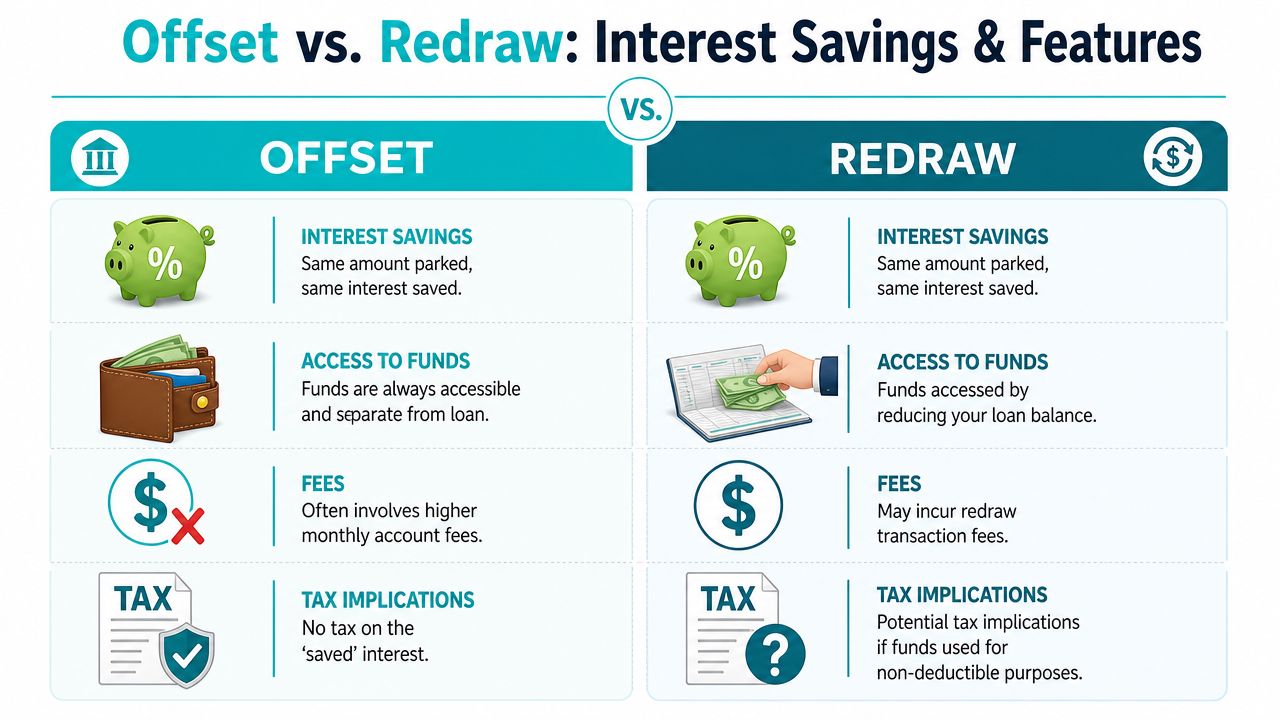
The interest maths is equal. The trade-offs aren't.
If you park the same amount of money in either structure, the pure interest result is the same. That myth needs to die.
The difference sits elsewhere:
| Question | Offset account | Redraw facility |
|---|---|---|
| Same interest saved for same balance? | Yes | Yes |
| Separate account? | Yes | No |
| Usually easier for daily cash flow? | Yes | No |
| Better for borrowers who want forced discipline? | Less so | Often yes |
| More strategic for future flexibility? | Usually yes | Usually no |
That's why cost comparison needs context. A redraw feature can look cheaper because it may sit inside a simpler loan product. An offset can come attached to a loan package or more feature-rich setup. But choosing solely on visible cost misses the bigger issue, which is whether the structure suits your future plans.
Extra repayments only help if they fit your system
Some borrowers do better with redraw because it removes temptation. Others need full visibility and flexible access because their income changes month to month or they're building a cash reserve for future plans.
If you're actively looking at strategies for extra mortgage payments, that can help you think through repayment behaviour. Just don't confuse repayment strategy with loan structure. They're related, not identical.
Use the right calculator before you decide
Before choosing, model the result properly. A basic rate comparison won't tell you enough. Run your own scenario with a proper mortgage offset account calculator so you can see how cash parked beside the loan affects interest and loan reduction over time.
Practical rule: Don't ask which feature “saves more”. Ask which structure gives you the same savings without boxing you in later.
The Critical Tax Difference You Cannot Ignore
This is the part most borrowers miss, and it's the part that matters most if you own investment property, may buy one later, or run your finances with any level of sophistication.
The Australian Taxation Office cares about the purpose of the borrowing. That's the issue. Not your intention. Not what seems fair. The actual purpose.
ANZ notes in its guide to offset and redraw tax differences that withdrawing funds from an offset account does not alter the loan's original purpose and preserves interest deductibility for investment properties. By contrast, redraw withdrawals are treated as re-borrowing, which may jeopardise deductibility if the funds are used for private purposes such as a holiday or car purchase.
Why redraw can contaminate a loan
Let's say you aggressively pay down a loan tied to an investment property. Later, you redraw some of that money to pay for personal expenses. From a tax perspective, you've effectively created a mixed-purpose loan.
That's where things get ugly.
You no longer have a clean investment debt position. Part of the loan may now relate to private use. Record-keeping becomes harder. Deductibility can be compromised. Fixing the mess later can be difficult and expensive.
If you redraw for private spending from an investment-related loan, you can damage deductibility without realising it until tax time.
Why offset is usually the safer structure
With an offset, your money stays separate. You can pull cash out for personal spending without changing the purpose of the loan itself. That's the strategic advantage.
This is why I'm firm with investors, executives, and business owners. If tax deductibility matters, offset is usually the superior structure. It protects optionality. It keeps the loan cleaner. It reduces the risk of accidental contamination.
Who should care most
- Property investors: You need clean deductibility and clean records.
- Future investors: Today's home can become tomorrow's rental.
- Business owners: Cash often moves unpredictably. Structure matters.
- High-income earners: Tax mistakes hurt more when balances are larger.
If any of those descriptions fit, redraw is not just a convenience decision. It's a potential tax trap.
Access Flexibility and Lender Policies
Tax strategy matters, but so does daily life. The cleanest structure on paper is useless if it doesn't match the way you use money.
Offset typically holds a clear advantage.
Commonwealth Bank explains that offset accounts typically allow full transactional flexibility, including debit or credit card linkage, ATM access, and salary deposits. Redraw facilities generally don't support card transactions or ATM withdrawals and may impose minimum redraw amounts such as $500 to $1,000, depending on the lender.
Liquidity matters more than people expect
An offset can function like your operational cash hub. Salary goes in. Bills come out. Emergency cash stays available. Every dollar sitting there still reduces the interest calculation.
Redraw is different. Access may be slower, more restricted, or dependent on lender rules. Some lenders only let you redraw amounts above the required minimum repayment threshold. Some apply transaction limits or minimum withdrawal amounts. Some fixed-rate products make redraw less useful again.
That matters if your cash flow isn't perfectly smooth.
The more variable your life is, the more valuable immediate access becomes.
Fixed rates, policy quirks, and refinancing
Lender policy also matters more than headline marketing suggests. A redraw feature can look fine until you need the money quickly, or until you discover your product treats access differently during a fixed period.
That's why reviewing the broader loan structure is often smarter than obsessing over one feature. If your current setup is clunky, inflexible, or no longer fits your goals, it's worth understanding what refinancing a mortgage involves before you accept the bank's default recommendation.
The blunt assessment
If you want bank-account functionality, choose offset.
If you want friction, because friction stops you spending, redraw can help.
Neither is morally better. But they are not interchangeable, and borrowers who rely on flexible cash access usually feel the difference very quickly.
Which Is Best For You Scenarios for Australians
Blanket advice is lazy. The right answer depends on who you are, how you behave with money, and what this property may become later.
Here's the version I'd give clients in plain English.
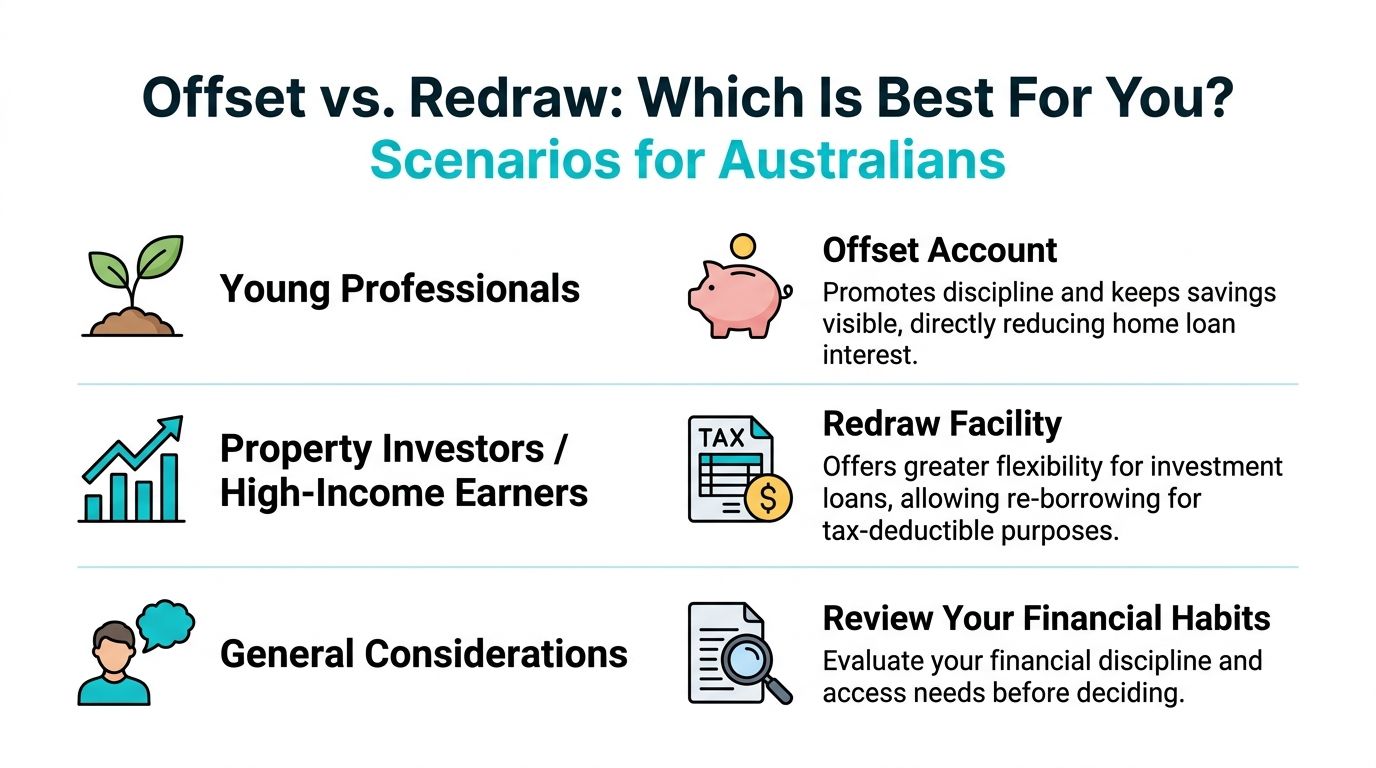
Young professionals
If you're early in your career, building savings, and still want freedom to move, offset is usually the better pick.
You need flexibility. You may upgrade homes later. You may move cities. You may keep this property and turn it into an investment. An offset keeps cash visible and usable while still reducing interest.
A redraw can work if you're very disciplined and want the money out of sight. But most young professionals benefit more from optionality than restriction.
Property investors and high-income earners
This group gets the clearest recommendation. Choose offset.
The tax risk attached to redraw is too easy to underestimate. If there's any chance you'll use cash for personal purposes while trying to preserve deductible debt, offset is the cleaner and safer structure. That matters even more if you expect to buy more property over time.
I'd only view redraw favourably here if the loan purpose is simple, the use of funds is tightly controlled, and the borrower understands the consequences. Most don't need that complexity.
Pre-retirees
At this point, the answer can split.
If you want to preserve liquidity for health costs, family support, travel, or uneven household spending, offset makes life easier. It keeps your cash working while staying accessible.
If your main goal is behavioural discipline and you don't need fast access, redraw can be perfectly reasonable for a straightforward owner-occupied loan. Some borrowers in this stage also care about monthly repayment management more than aggressive flexibility, so the right structure depends on how they want cash flow to feel.
Small business owners
Business owners should lean hard toward offset.
Cash flow can be lumpy. BAS, wages, supplier payments, and seasonal revenue don't arrive in a neat pattern. You need working capital available without creating unnecessary tax complications inside the home loan.
Using redraw for convenience is where people drift into poor structure. If the loan may one day connect to investment planning, wealth building, or debt recycling discussions, separation matters.
Business owners usually don't need a stricter loan. They need a cleaner cash system.
The short version
- Want flexibility and future options? Offset.
- Expect investment use now or later? Offset.
- Need simple debt reduction and strong spending discipline? Redraw can work.
- Run a business or manage uneven income? Offset.
- Have a plain owner-occupied loan and don't touch spare cash? Redraw is acceptable.
If you're also focused on broader debt strategy, this guide on how to pay off your mortgage early is a useful next read. The feature choice should support that strategy, not work against it.
Your Decision Checklist and Next Steps with Wealth Collective
By this point, the core issue should be clear. This isn't a debate about which feature sounds nicer. It's about whether your loan structure supports flexibility, tax integrity, and long-term wealth creation.
Qualitatively, the tax difference is the big dividing line for investment-related debt. For investment loans, redraw can change the purpose of the loan if you pull money back out for private use, while an offset preserves the original purpose and protects deductibility of the interest bill, as noted earlier from Mozo.
Use this checklist before you choose
- Could this property become an investment later? If yes, offset usually gives you a cleaner structure.
- Do you need access to cash for emergencies or uneven expenses? If yes, offset is stronger.
- Do you tend to spend whatever you can see? If yes, redraw may help with discipline.
- Will you use the loan around business cash flow or future strategy changes? Keep the structure clean and flexible.
- Are you choosing based only on a fee difference? That's usually too narrow.
- Would a tax mistake here be expensive for you? If yes, don't take shortcuts.
My recommendation
For most borrowers who want to build wealth, preserve options, and avoid future restructuring pain, offset is the better default.
Redraw still has a place. It suits disciplined owner-occupiers with simple finances and no investment plans. But plenty of people think their finances are simple until life changes. A promotion, a move, a renovation, a business opportunity, or a future rental conversion can change the equation quickly.
If you need clarity, get advice before you lock in the wrong structure.
If you want a personalised answer rather than a generic rule, speak with Wealth Collective. Their Perth and Dunsborough advisers help Australians build, protect, and transfer wealth through clear strategy across debt, super, investments, protection, and retirement planning. A free 10-minute introductory call is the simplest next step if you want to sort out your offset account vs redraw decision properly and make sure it fits the rest of your financial life.