Business hours
Monday to Friday (8.30AM - 5PM)
Weekend (Closed)



You've probably got the letter on the desk already. Maybe it came in with other ATO mail, maybe your accountant forwarded it with a short message, maybe you opened it between supplier calls and payroll headaches, and your stomach dropped when you saw Director Penalty Notice. If that's you, stop and read this carefully. A DPN is not just another compliance letter, it can make you personally liable for company obligations like PAYG withholding, net GST, and superannuation guarantee charge (ATO director penalty regime).
The mistake most directors make is treating this like a paper problem. It isn't. It's a cash-flow problem with personal consequences, and the next 21 days matter more than the last 21 months of stress. If the company can pay, appoint an administrator, or start winding up inside that window, you still have room to move. If it can't, you need to know that fast, because the ATO doesn't care about hope, only action.
The Letter Every Director Dreads
A director in a Perth office at 7.30 am, coffee cold, opening an ATO envelope is usually dealing with more than paperwork. That letter can turn a company tax problem into a personal one fast. A Director Penalty Notice is the ATO's way of saying the unpaid company obligation can now land on the director directly, not just on the company.
That is why the letter feels different from ordinary ATO mail. It shifts the issue from “the business owes money” to “you may owe money”. The regime applies to PAYG withholding, net GST, and super guarantee charge, which means it targets money you collected or should have set aside, not a random business bill (Sparke Helmore on DPNs). The ATO treats those amounts as money that should have been handled properly long before the letter arrived.
Practical rule: If the notice is in your hands, the clock has already started. Don't waste time arguing about who missed what. Find the debt, check the date, and check the cash position.
What matters now is blunt. Can the company pay the debt in full. Can it appoint an administrator or start winding up inside the window. Or has the liability already hardened into something the ATO can enforce against you personally. Those are the questions to answer first.
If you have dealt with personal tax penalties overseas, the logic will feel familiar. The closest comparison is defend against IRS penalties, because once an authority shifts liability onto an individual, speed and records matter immediately.
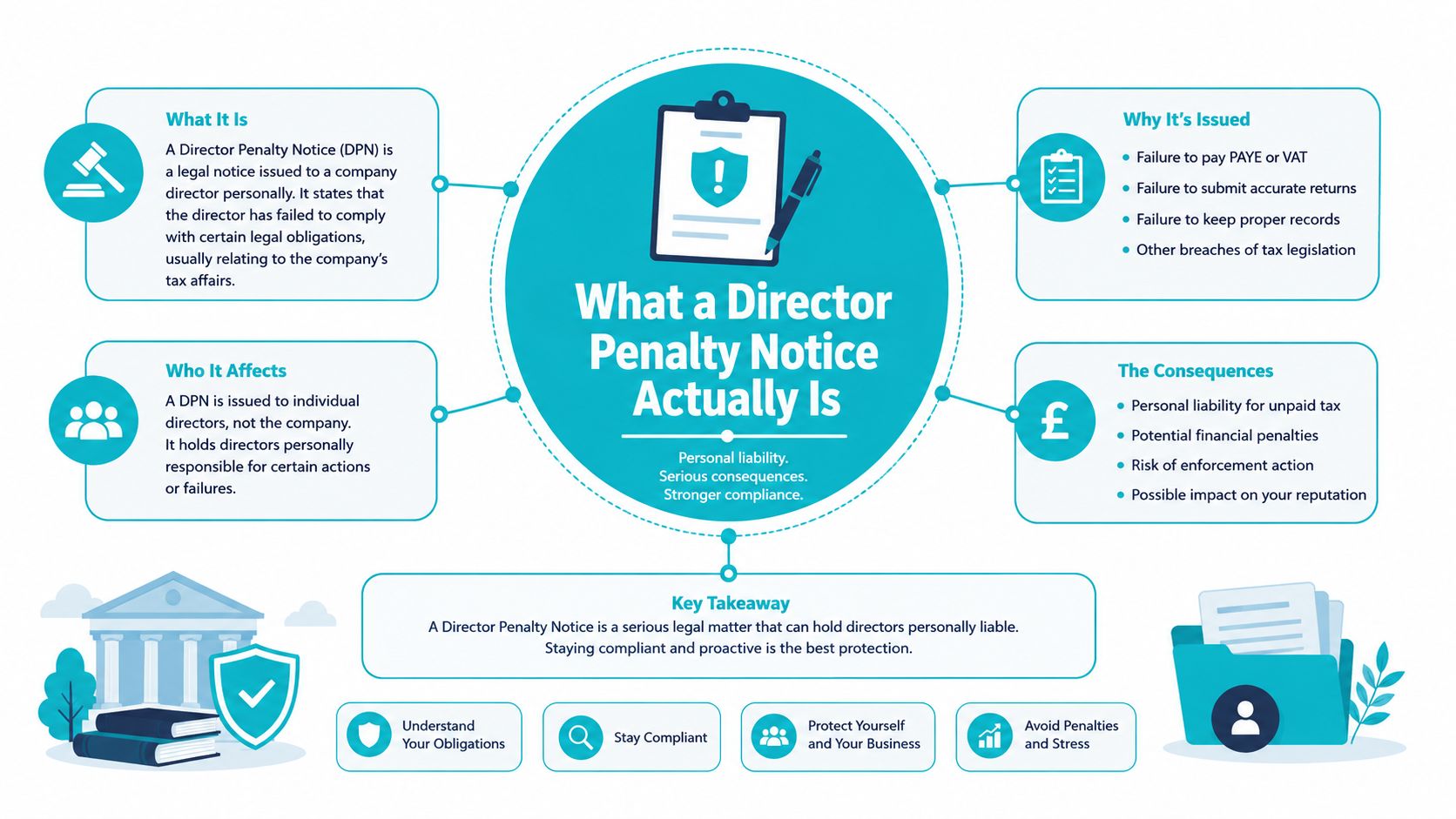
What a Director Penalty Notice Actually Is
A DPN is not a warning, and it is not a polite reminder to sort things out later. It is the ATO's formal tool for making a director personally liable for certain unpaid company obligations. Those obligations are limited to PAYG withholding, net GST, and superannuation guarantee charge.
The company normally sits between the debt and the director. A DPN cuts through that protection and puts the liability on the person who held the director role. That is why this notice feels so harsh. It moves the problem from the business balance sheet to your own name.
The notice does not cover every company debt. It is aimed at employee-related and tax amounts that should have been withheld, reported, or paid on time. If you are looking at a DPN and wondering whether every tax issue in the company has suddenly become yours, the answer is no. It only attaches to the specific obligations listed in the regime, and that distinction matters.
The three obligations that trigger the regime
- PAYG withholding, amounts withheld from employees and sent to the ATO.
- Net GST, the business activity statement GST shortfall that should have been paid.
- Superannuation guarantee charge, where super hasn't been paid by the due date.
The ATO says a director penalty can be recovered 21 calendar days after issue of a non-lockdown notice, and any written defence application has to identify the statutory defence being relied on. That is not paperwork trivia. It tells you the ATO expects directors to respond with accuracy, not with a bit of wishful thinking.
If you want a broader compliance checklist that helps small businesses keep their records and obligations straight, this detailed compliance guide is worth a read.
A DPN also changes the personal risk picture fast. Once the notice lands, the company debt is no longer just a business accounting issue. It can become your problem as an individual director, which is why you need to know exactly what the notice covers and what it does not.
For a practical look at keeping tax obligations from colliding with day-to-day trading money, see small business cash flow management. If you have dealt with personal tax penalties overseas, the logic will feel familiar, the closest comparison is defend against IRS penalties, because once liability shifts onto an individual, speed and records matter immediately.
How the 21-Day Clock Really Works
A DPN is not a document you sit on. Once it lands, the clock starts ticking and the only question that matters is how much time the company has left to act. For a stressed director, that means reading the notice against the cash in the bank, the state of the BAS lodgements, and whether the business can still do something sensible before the window closes. The 21-day compliance window is the whole game here, and the 21-day rule guidance explains why that timing matters.
What to do in the first 48 hours
Day 1 is for hard facts, not panic. Check the exact debt, the issue date, and whether the notice is a non-lockdown DPN or a lockdown DPN. Then look at the company's cash position, whether it can pay from its own account, whether an administrator can be appointed in time, and whether winding up is already the only honest path.
If you burn the first two days hoping the problem will shrink, you are just wasting time you do not get back.
Day 7 should be decision time. By then, you should know whether the business can clear the debt from available cash, whether an insolvency step makes commercial sense, or whether the notice itself gives you a defence point. Lodging a BAS is not the same as paying it, so do not confuse compliance paperwork with genuine relief. For a practical look at how tax trouble and trading cash collide, see small business cash flow management.
| Feature | Non-Lockdown DPN | Lockdown DPN |
|---|---|---|
| Reporting status | Lodged within the relevant time | Lodged late, or the debt was reported after the window |
| Main escape route | Pay, appoint an administrator, or start winding up within 21 days | Pay in full |
| Practical meaning | You still have several response paths | Your options are sharply reduced |
| Recovery timing | ATO can recover 21 calendar days after issue (ATO) | Same recovery pressure, but less room to fix it |
By day 22, if nothing has been done, the penalty can be treated as personally enforceable. That is the point where delay becomes exposure. Do not let the clock run out while you are waiting for a better mood or someone else's opinion. A short, practical rule helps here, keep the decision tied to cash, solvency, and the remaining window, not to wishful thinking.
Your Four Real Options Once a DPN Arrives
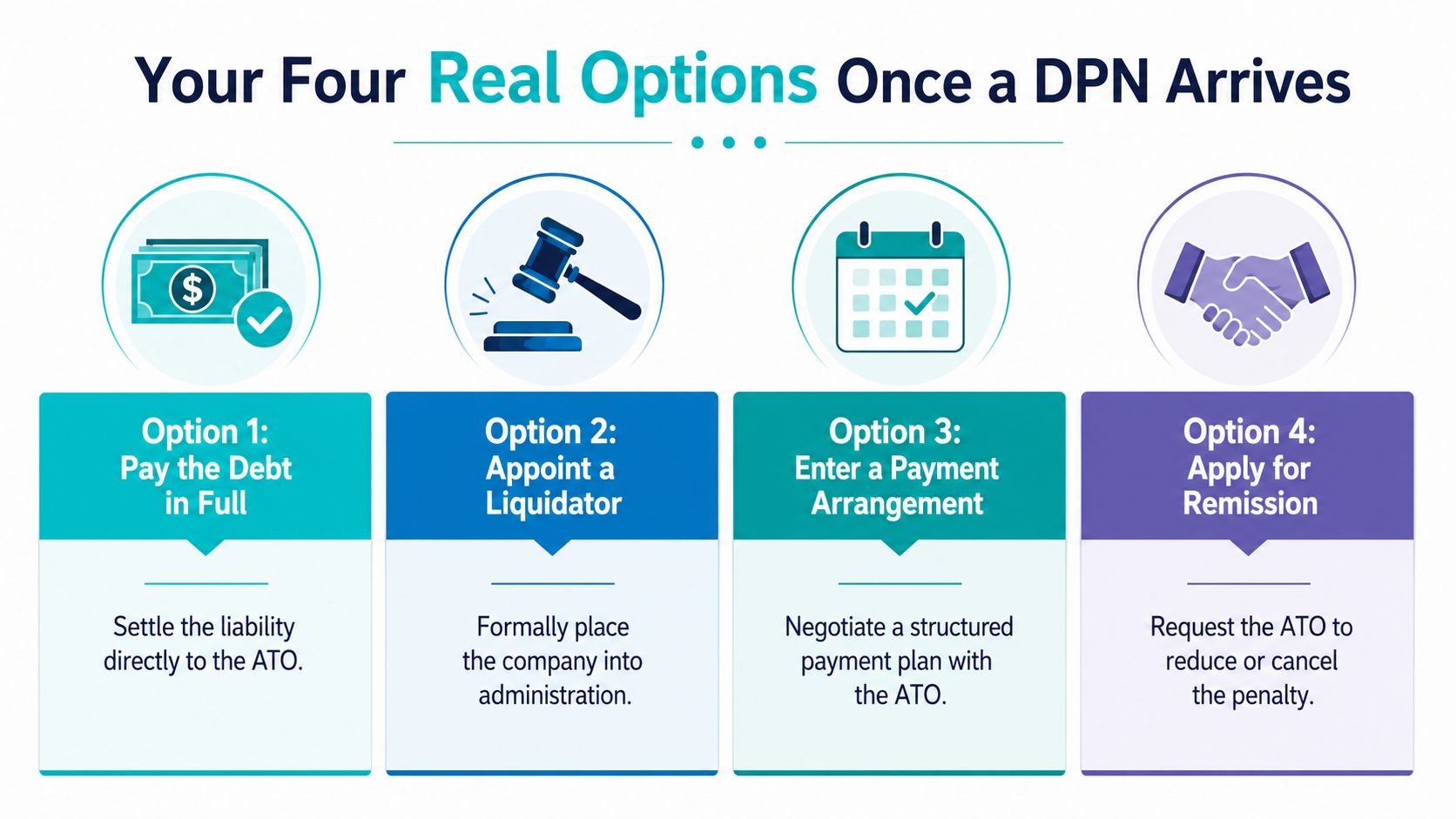
A DPN is not the time for theory. It is the time to look at the cash in front of you and the clock on the notice, then decide whether the business can pay, whether an insolvency step makes sense, or whether the notice gives you a defence. If the company has money, pay. If it does not, move straight to a formal process or a defence. Everything else burns time.
Option one, pay the debt in full
Use this option only if the company can pay from its own funds without dragging the rest of the business under. Paying from your personal account is a separate call, and it can be the wrong call if the company is already insolvent. Pouring personal savings into a business with a broken cash position does not fix the problem, it just shifts the pain.
Option two, appoint a liquidator or administrator
If the company cannot pay and has no real path back, this is usually the cleanest response. A DPN can be remitted by appointing the right insolvency professional within the window that applies to the notice, and the sooner you act, the better the chance of doing it properly (Lexology on remission rules). If the business is done, pretending otherwise only wastes the remaining window. For a wider look at how cash pressure shapes every response, see small business cash flow management.
Option three, enter a payment arrangement
A payment arrangement can keep a business trading, but it does not remove the DPN issue. Use it only where the company has real forward cash flow and the debt can be met over time. If the business has to rob Peter to pay Paul just to stay open, the plan is only delaying the fall.
Option four, apply for remission or object
Use this route only if the facts are solid. If the notice is wrong, the debt is wrong, or you have a genuine defence, act immediately. Do not build a wishful argument. Keep it specific, keep it documented, and keep it tied to the notice itself. A written defence application needs a clear ground, not a vague complaint, so the paper trail has to match the facts.
| Cash position | Best first move |
|---|---|
| Company has enough cash | Pay the debt in full |
| Company is viable but strained | Consider a structured arrangement and get advice fast |
| Company is insolvent but can use a formal process | Appoint an administrator or liquidator |
| Notice or debt looks wrong | Prepare a defence immediately |
Statutory Defences and How to Use Them
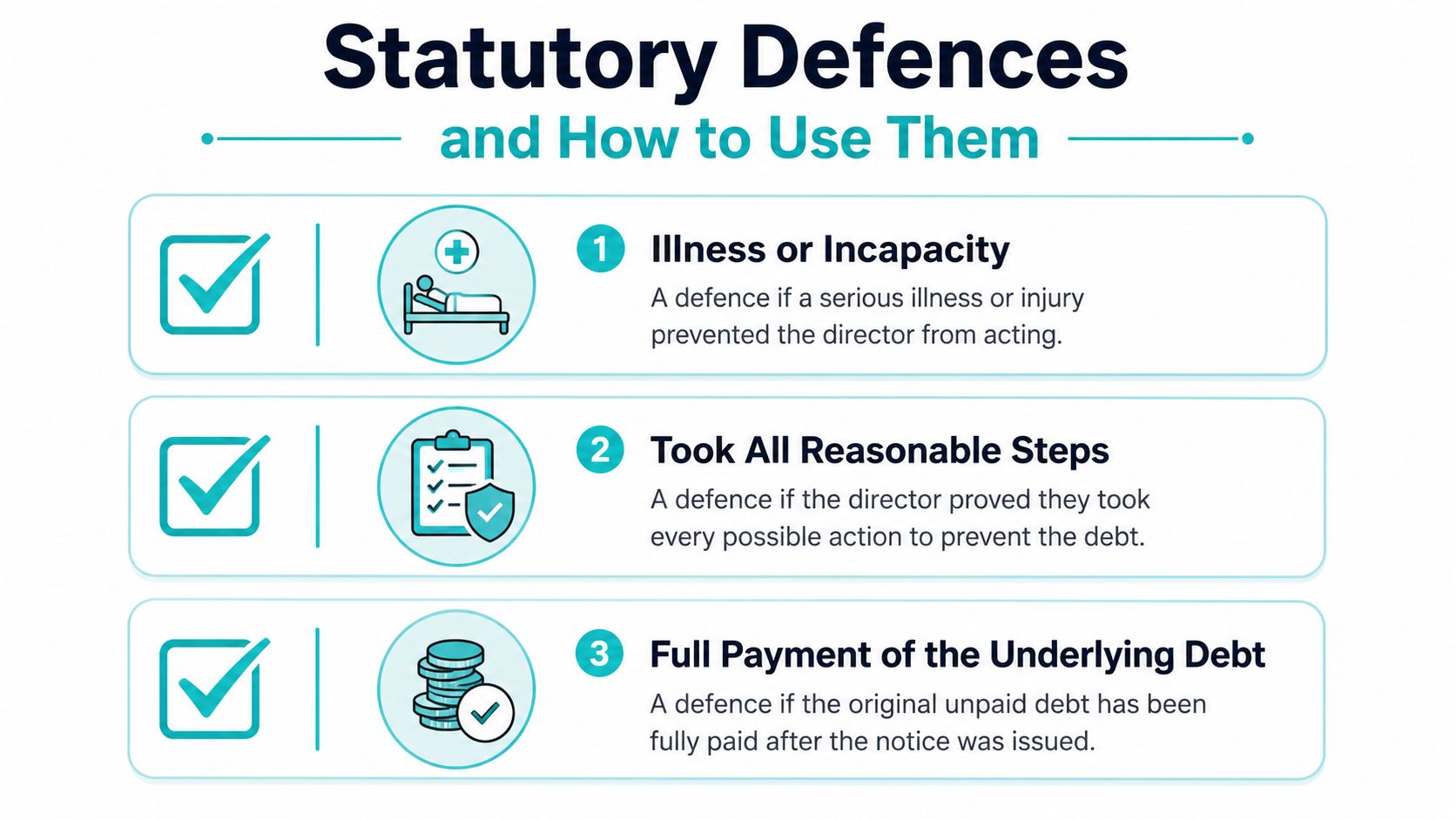
A defence is not a comfort blanket. It is a narrow legal answer to a specific notice, and it only works when the facts are solid. The three statutory defences are illness or incapacity, taking all reasonable steps, and full payment of the underlying liability.
Practical examples directors face
If you were seriously ill or injured and could not act, that may be a defence. If a co-director controlled payroll and misled you, and you took all reasonable steps to stop the problem, that may help too. If the underlying debt was already paid and the notice still arrived, that is the clearest path of the three.
A defence only works when the paper trail matches the story.
The ATO's own guidance says a written defence application must specify which of the three grounds you rely on. That means no lazy letters, no broad “this isn't fair” submissions, and no hoping the officer fills in the gaps for you. You need documents, dates, and a clear line between the facts and the defence.
A lot of directors waste time here. They think a good explanation is enough. It isn't. You need evidence that supports the explanation, and you need it quickly. If the defence depends on illness, get records. If it depends on someone else handling payroll, show the structure and the steps you took. If it depends on payment, prove the payment trail.
Use this guide to keep your business records and obligations straight, this comprehensive compliance guide sits well beside a proper tax calendar and a cash-flow forecast. For owners trying to keep tax pressure under control, a practical review of small business tax reduction strategies can also help you see where cash can be freed up before the position gets worse.
The hard truth is that defences are technical and time-sensitive. If you do not have the evidence, do not pretend you do. Get the file together first, then decide whether the defence is real.
How to Prevent a DPN Before It Happens
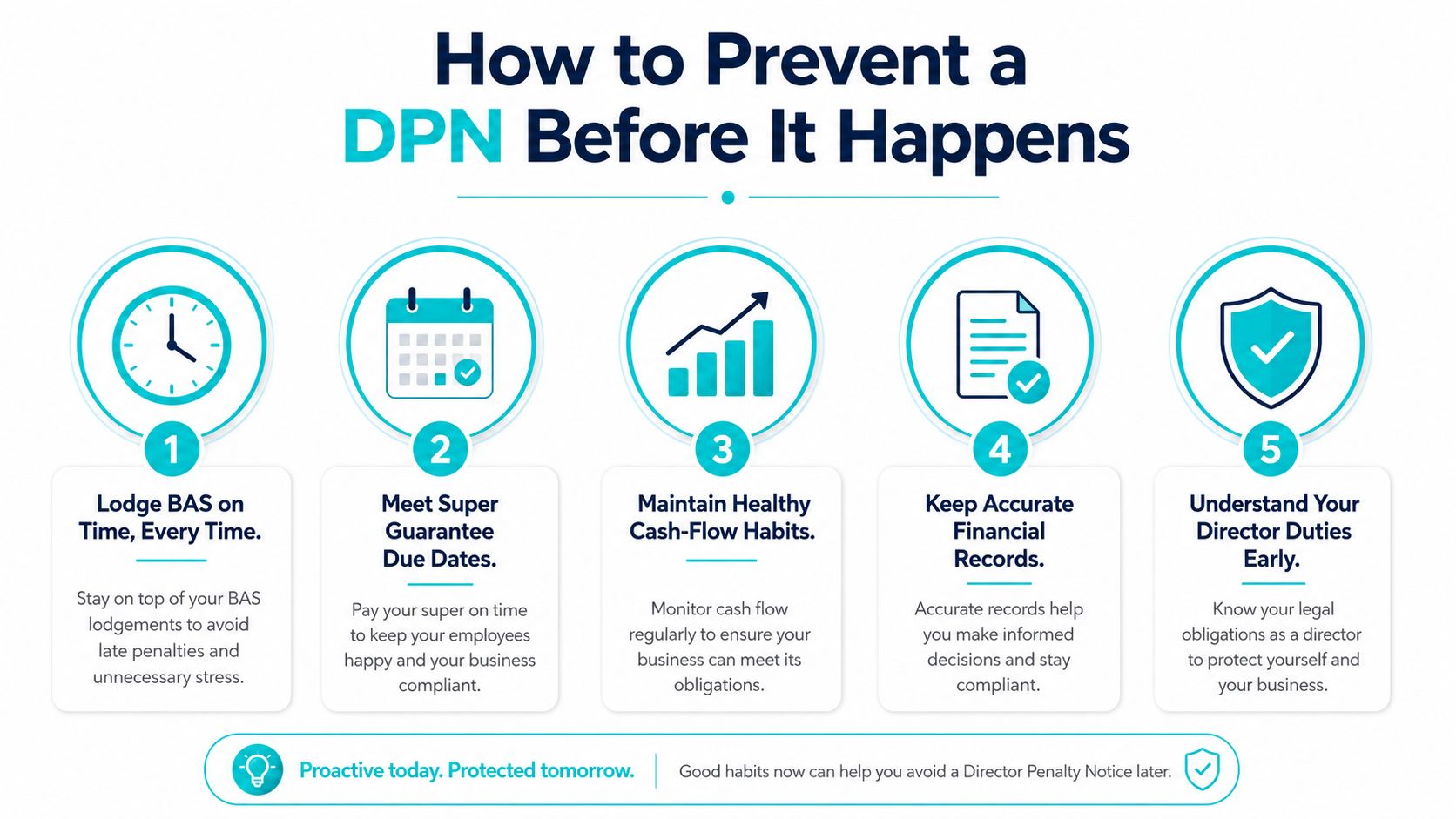
The best defence starts long before an ATO letter lands on your desk. If you are running a small business, stop treating PAYG withholding, super, and BAS money as working cash. Ring-fence it the moment it comes in. If you spend it to cover stock, rent, or wages, you are setting up the exact cash squeeze that turns into a director problem later.
A director under pressure needs habits, not wishful thinking.
Five habits that keep you out of trouble
- Lodge BAS on time, even if payment is delayed. Late lodgement narrows your options and makes the ATO more likely to act.
- Pay super guarantee by the quarterly due date. Unpaid super is one of the fastest ways into DPN territory.
- Keep payroll cash ring-fenced. If that money is meant for staff and tax, it should not be used to prop up trading.
- Keep the director's loan account current. Messy drawings blur the picture and make it harder to prove the business is being run properly.
- Review solvency every quarter. If the company cannot pay debts as they fall due, the risk is already there.
If you want a practical compliance checklist that helps small businesses keep their records and obligations straight, this comprehensive compliance guide is worth a read. It fits alongside a proper tax calendar and a cash-flow forecast. For owners trying to free up cash before the position gets worse, a look at small business tax reduction guide can help you spot where the money is being trapped.
A common error is confusing turnover with cash. A business can look busy and still be heading straight for trouble if tax, super, and supplier bills keep rolling forward unpaid. That is why routine checks matter. They show you whether the company can pay, or whether you need to act before the clock starts on a DPN.
When to Bring in a Professional Adviser
Bring someone in early, while the notice is fresh and the choices still matter. A director who gets advice on day 2 still has time to check the debt, test solvency, and choose a clean path. The one who waits too long often loses the chance to appoint the right person in time and ends up managing panic instead of options.
That difference is harsh, which is why advice is not a luxury here. It is a decision tool. A good adviser helps you work out whether the company can pay, whether a formal insolvency process makes sense, and whether personal exposure can be avoided. That is better than sitting alone with an ATO letter and guessing.
The best advice on a DPN is blunt. If the business cannot pay, do not pretend it can. If it cannot trade, do not delay the formal step.
You also want someone who looks beyond the notice itself. A director under cash pressure usually has more than one weak point, maybe super, insurance, structure, or debt settings that all need attention. If you are trying to work out who to call first, this how to find a good accountant guide will help you screen for someone who can read the situation, not just file returns.
What you need is a short, focused conversation that gets you from fear to facts. A proper adviser will help you map the debt, test the company's viability, and work out the next move before the 21-day window closes. If you want the right support, start with someone who understands director penalties and the cash-flow pressure behind them, then move fast.
Common Questions From Worried Directors
Can I resign and escape the notice
No, and it is not a clean exit. If the liability attached while you were still a director, resigning later will not erase it. The only time resignation changes anything is when the timing and records were already clean before the liability arose, and that depends on the facts, not on wishful thinking.
Does a DPN affect my personal tax return
Yes, because the penalty becomes a personal liability. The ATO can pursue you personally, and that can include garnishee action against salary or other money owed to you. Do not assume the debt stays neatly inside the company. Once the notice lands, your own position is on the line.
Does a DPN ever expire
The underlying company debt remains just because you ignore it. What changes is the ATO's recovery path and timing. If you sit on it, the problem does not fade, it hardens.
What directors usually ask next
Practical examples directors face are usually not about the notice in the abstract. They are about cash, timing, and whether there is still a real path to pay the debt, appoint an administrator, or start winding up inside the 21-day window. A director who has enough cash to clear the debt is in a different position from one who is already juggling payroll, GST, and super. The answer changes with the company's money position, not with hope.
A proper question is simple. Can the business pay now, can it appoint an administrator now, or can it begin winding up now. If the answer to all three is no, delay only makes the situation worse. If one path is still open, move on it immediately and keep the records clean.
If you are holding a DPN right now, stop reading forums and start checking the numbers. Get the notice reviewed, get the cash position clear, and get proper advice before the 21-day window closes. Wealth Collective helps business owners make sharp decisions under pressure, and if you want plain-English guidance on your next move, visit Wealth Collective and book an initial call today.