Business hours
Monday to Friday (8.30AM - 5PM)
Weekend (Closed)


You've probably had this thought after a few noisy market headlines or a messy annual review, you're doing well, but you don't want to spend your retirement years second-guessing every portfolio decision. That's where a discretionary fund manager comes in. It's a structure built for people who want professional investment decisions made within a clear mandate, without having to approve every buy, sell, or hold along the way.
What a Discretionary Fund Manager Actually Does
A discretionary fund manager is the person or team you authorise to make portfolio decisions for you inside agreed limits. In plain English, you set the destination and the guardrails, then the manager handles the day-to-day driving. That's different from a non-discretionary arrangement, where every trade needs your sign-off before it happens.
For a pre-retiree, that can sound like a small distinction. It isn't. Once markets start moving quickly, delegated authority can matter because decisions can be implemented without the delay of repeated approvals. That's why discretionary management sits in the advice chain as a service, not a product, and why it often exists alongside financial advice rather than replacing it.
A useful way to think about it is that the adviser helps define the plan, while the discretionary manager helps execute the investment side of that plan. If you want a broader background on how investment oversight fits into professional wealth management, effective portfolio management for wealth managers is a useful lens for understanding the role of process, governance, and implementation discipline.
Practical rule: if you'd rather spend your time reviewing life decisions than debating fund switches, discretion can remove a lot of friction.
The best DFM arrangements are built around a mandate that reflects your objectives, risk tolerance, tax position, and retirement timeline. The weakest ones are vague, expensive, and hard to monitor. The rest of this guide focuses on how to tell the difference.
How the Discretionary Mandate Works Step by Step
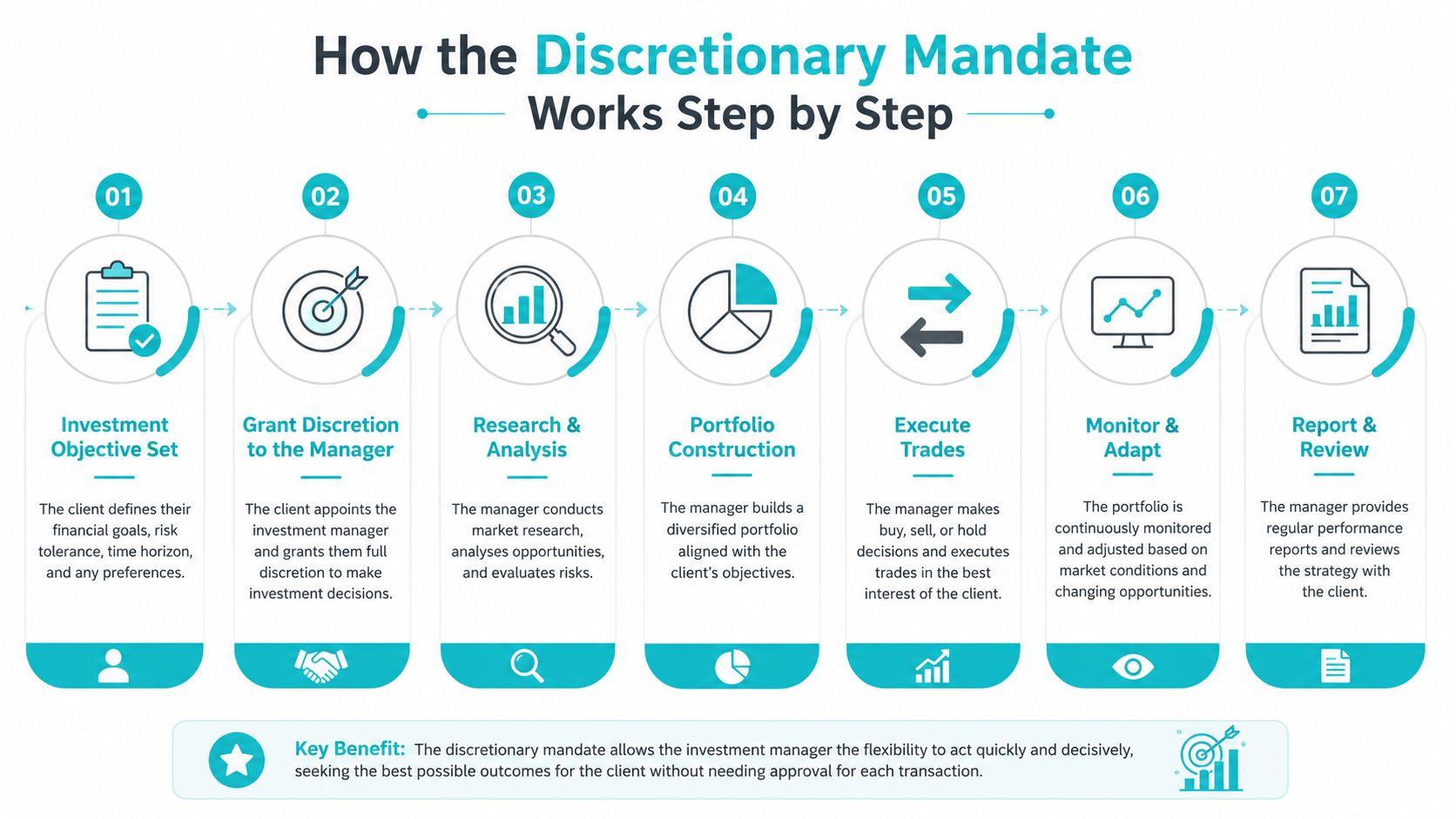
Think of a discretionary mandate like a pilot flying on autopilot within a defined flight path. The plane isn't free to go anywhere it likes, but the pilot doesn't need to ask for permission every time the weather changes. Your job is to set the route, the altitude limits, and the destination. The DFM's job is to keep the portfolio inside those boundaries.
The mandate sets the rules
The first document is usually the mandate or investment policy statement. The account's purpose, risk level, asset mix, exclusions, and any special instructions are written down in it. If you care about income, capital preservation, ethical screens, or tax sensitivity, those preferences belong there.
After that, the manager has authority to act within the agreed framework. That can include rebalancing, changing exposures, selling positions that no longer fit, and adjusting risk as conditions change. The client still owns the account and can change the mandate, but day-to-day implementation is delegated.
Reporting keeps the arrangement honest
You should expect regular reporting that shows what was done, why it was done, and how the portfolio is tracking against the agreed objective. The quality of reporting matters as much as the investment ideas themselves. If the portfolio is hard to understand, the mandate is too loose or the communication is too thin.
Review is part of the process
A good DFM doesn't operate on autopilot forever. The mandate should be reviewed when your circumstances change, not just when the market does. Retirement, downsizing, a pension starting, or a change in income needs are all reasons to revisit the instructions.
DFMs Compared With Advisers, Managed Funds and Wrap Accounts
The easiest way to understand a discretionary fund manager is to place it beside the other parts of the advice stack. People often use “adviser”, “managed fund”, “wrap account”, and “DFM” as if they're interchangeable. They're not. Each sits at a different point between decision-making, implementation, and administration.
A financial adviser gives personal advice and helps you frame the strategy. A managed fund pools many investors into one portfolio, so the underlying holdings are set for the whole fund rather than customized for you. A wrap account or IDA is mainly an administration layer, not an investment decision-maker. A DFM is the delegation layer in between, where someone else gets authority to manage your portfolio inside a specific mandate.
| Feature | Discretionary Fund Manager | Financial Adviser | Managed Fund | Wrap / IDA |
|---|---|---|---|---|
| Control | Delegated within the mandate | Client retains decision approval unless delegated elsewhere | Manager controls the pooled portfolio | Mostly administration and access |
| Customisation | High, within agreed limits | High at the advice level | Low to moderate, shared across investors | Moderate through account structure, not direct portfolio design |
| Day-to-day trading | Done by the manager | Usually not, unless authority is delegated | Done by the fund manager | Not the main function |
| Reporting | Portfolio-level, mandate-focused | Advice and strategy-focused | Fund performance and holdings disclosures | Holdings, tax, and account administration |
| Typical use | Investors wanting outsourced implementation | Investors wanting personal advice | Investors wanting pooled exposure | Investors wanting consolidated administration |
If you're still sorting out the difference between pooled investments and custom implementation, the basics in what is a managed fund will help anchor the comparison. That matters because many investors assume they need a DFM when what they need is a simpler structure.
The overlap usually comes down to this. If you want someone to decide how your individual portfolio is run, a DFM is relevant. If you mainly want advice, a financial adviser may be the primary relationship. If you want market exposure without customisation, a managed fund may be enough. If you want clean administration and consolidated reporting, a wrap account can be useful on top of the other pieces.
Understanding the Fee Structure and True Cost
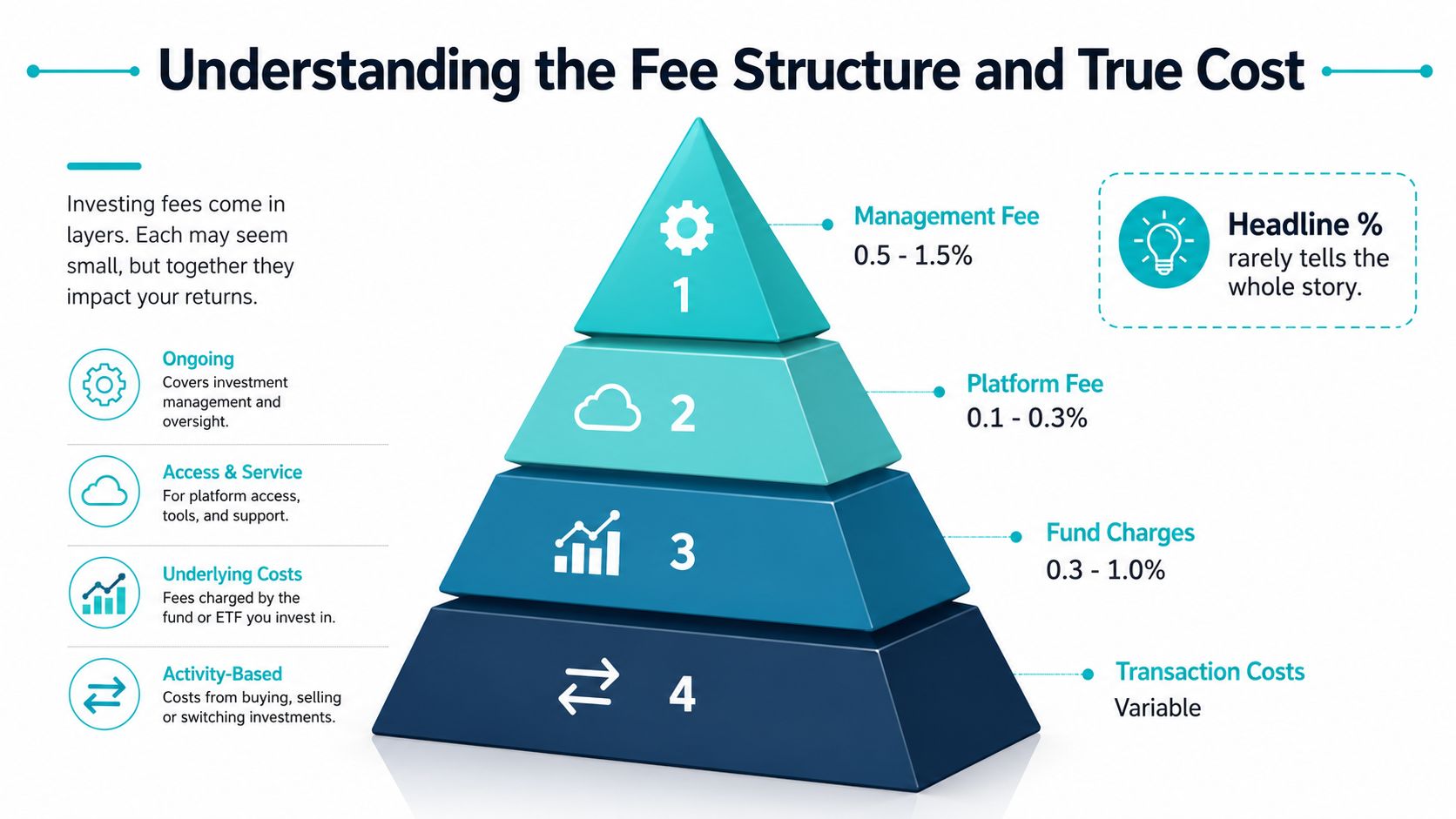
Fees are where many investors get caught out, because the headline rate rarely tells the whole story. A DFM arrangement often includes a DFM fee, plus platform charges, underlying fund expenses, and sometimes adviser fees. Independent industry commentary says the DFM fee alone typically sits between 0.5% and 1.5% per year, while the total annual expense ratio can rise to 1% to 3% of assets under management once the other layers are added, according to AES International's overview of discretionary fund management.
For a A$500,000 portfolio, that total cost range can translate to roughly A$5,000 to A$15,000 a year before performance differences are even considered, which is material for anyone relying on the portfolio to fund retirement income. The reason this matters is simple. A retirement portfolio doesn't just need to grow, it needs to keep growing after fees, taxes, and withdrawals.
Practical rule: don't compare DFM fees in isolation, compare the whole investment stack.
A clearer way to judge value is to ask what each layer is buying you. The DFM fee pays for portfolio construction and ongoing management. Platform costs pay for administration. Underlying fund costs pay for the managers inside the portfolio. Advice fees pay for planning, monitoring, and accountability. When those costs are bundled together, it's easy to lose sight of the actual impact on cash flow.
For a broader look at the advice side of the equation, financial advice fees in Australia gives useful context on how professional advice is typically priced. That's important, because a fee that feels manageable in accumulation can become far more significant once you're drawing an income from the same assets.
Why Discretionary Management Matters for Australian Retirees
Retirement changes the job of the portfolio. In accumulation, the main question is whether the account is growing. In retirement, the question becomes whether the portfolio can support withdrawals without forcing bad decisions at the wrong time. That's why a DFM can be more useful for retirees than for younger investors who are still building assets.
The Australian context matters here. APRA's latest quarterly statistics show superannuation assets reached about AU$4.2 trillion by March 2026, which gives you a sense of how large the retirement pool is that these decisions affect. In a system that big, the difference between a tidy accumulation portfolio and an income-aware retirement portfolio becomes more than a technical detail. It shapes the standard of living people can draw from their savings.
Sequencing and cash-flow pressure
One reason retirees use delegated management is sequencing risk. If markets fall just as withdrawals begin, the portfolio can be forced to sell assets at poor prices. A DFM with a clear mandate can adjust cash buffers, income assets, and rebalancing decisions more quickly than a committee-style process.
That can help inside an account-based pension, where timing matters. The manager can keep an eye on cash flow without waiting for the client to approve every move. That's especially useful when the goal is not just return, but a smoother income stream.
SMSFs and pension design
A DFM can also sit inside an SMSF structure, although that doesn't make the job automatic or hands-off. Trustees still carry responsibility, and the investment rules inside super and pension phases still matter. The useful question is whether delegated management improves the quality of decisions without weakening oversight.
The Retirement Income Covenant has pushed trustees and advisers to think harder about income sustainability, not just the size of the balance. That's where a DFM can add value if the mandate is aligned to retirement spending needs rather than accumulation-style growth targets.
A simple example is a couple moving from work to part-time income. They may not need daily portfolio tinkering, but they may want disciplined drawdown management, regular rebalancing, and enough cash planning to avoid selling growth assets after a market drop. In that setting, a DFM can be helpful. In a straightforward accumulation account with no near-term income need, the extra layer may be unnecessary.
Questions to Ask Before Choosing a Discretionary Fund Manager
A good DFM conversation sounds less like a sales pitch and more like an evidence check. You're not just asking whether they can invest. You're asking whether their process fits your mandate, your tax position, and your retirement timeline. That's why the questions below matter.
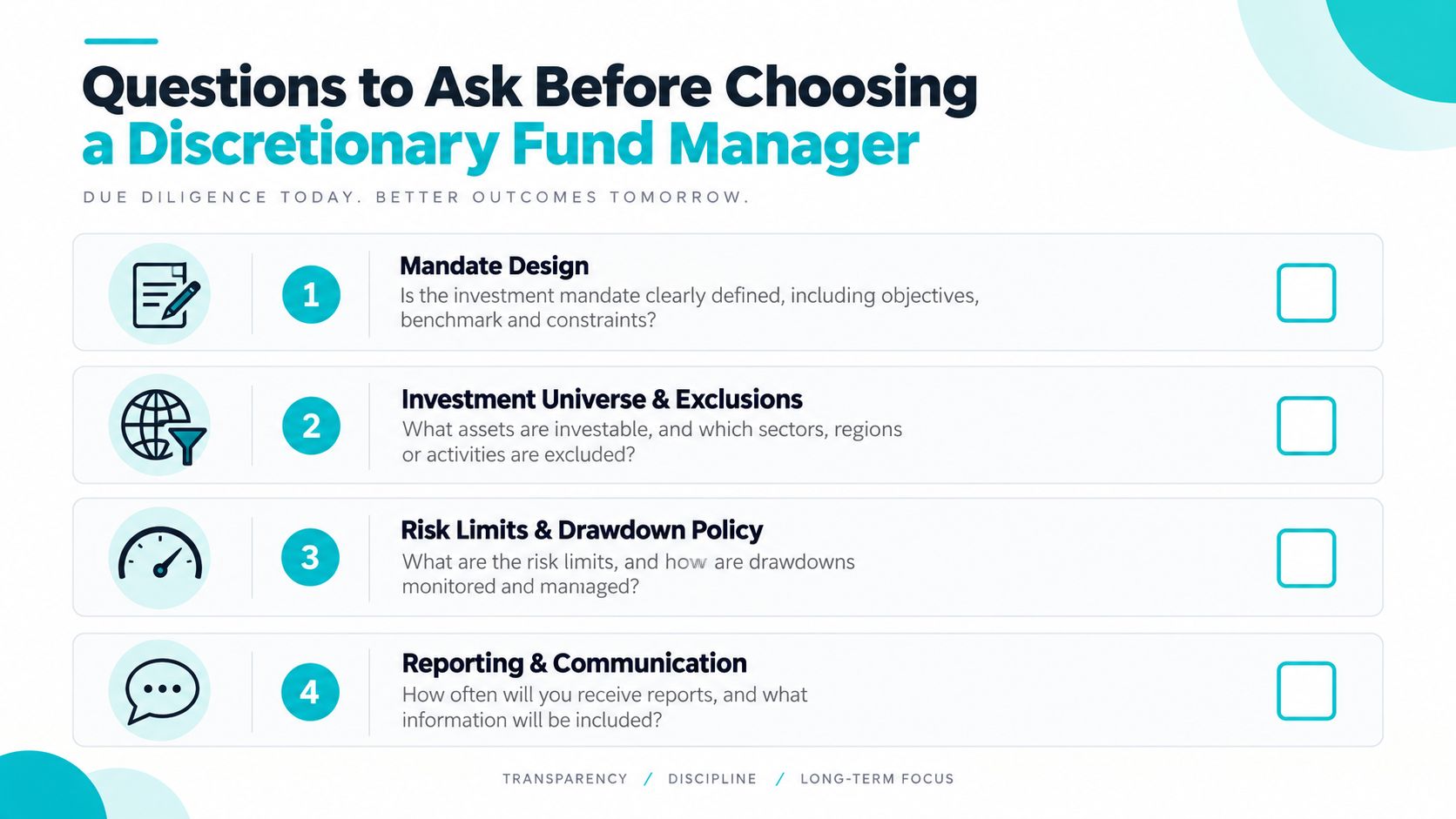
What exactly is included in the mandate? Ask whether the manager can change asset allocation, individual holdings, cash levels, and defensive settings without asking first. The tighter the mandate, the less room there is for surprises.
What sits outside the mandate? Exclusions matter. If you want no direct property, no overseas currency exposure, or no use of certain securities, make sure those limits are written down before the first trade.
How are risk limits and drawdown decisions handled? You want to know who decides when to reduce risk, how losses are monitored, and what triggers a review. This is especially important if you're already drawing pension income.
How often will I receive reporting and commentary? Reporting should explain the decisions, not just list holdings. If the updates don't help you understand the “why”, the arrangement will feel opaque very quickly.
How do tax issues get handled? Real portfolios create real tax consequences. Ask whether the manager considers realised gains, income timing, and the difference between accumulation and pension phase.
Are there any conflicts of interest? You want clarity on product bias, related-party arrangements, and whether the manager is free to use external investments when they're better suited.
What are the exit terms? A mandate should be flexible enough for life changes. If the break costs or notice period are heavy, that's a warning sign.
If you're also comparing the broader advice relationship, how to choose a financial advisor is a useful companion piece. A DFM can't compensate for a poor strategic fit, so the adviser question still matters.
Benefits, Risks and Common Misconceptions
A key benefit of a discretionary arrangement is speed with discipline. Decisions can be implemented quickly, portfolios can be adapted to your circumstances, and the manager can stay focused on execution instead of waiting for approvals. That can improve behavioural discipline too, because you're less likely to react emotionally to every market headline.
The risks are just as real. Decision-making is concentrated in one manager, so you need confidence in their process and oversight. Fees can be layered and hard to see, and mandates can drift if no one is checking whether the portfolio still matches your goals. A DFM also doesn't remove the need for advice, because the investment mandate is only one part of a broader financial plan.
A discretionary service is only as good as the rules around it. Good process protects you. Loose process just creates another layer of complexity.
One common misconception is that all discretion is the same. It isn't. Some managers run tightly controlled, retirement-aware mandates. Others use a looser investment style that may be fine for one investor and completely wrong for another. Another misconception is that a DFM is automatically “safer” than self-direction. Delegation can reduce mistakes, but it can also hide them if the reporting is poor or the mandate is too broad.
If you're helping an older parent or partner compare options, it's also worth thinking about the risk of financial exploitation in vulnerable situations. The guidance in protect seniors from scams is a good reminder that oversight, transparency, and trusted support matter just as much as returns.
Your Next Step With Wealth Collective
If you're weighing a DFM, the next sensible move is a conversation, not a leap. Wealth Collective's Protection Plus, Guided Growth, and Retirement Roadmap services are built to help people sort out what belongs in advice, what belongs in delegation, and what should stay simple. The process starts with a free 10-minute introductory call, then moves into a plan with clear communication and a satisfaction guarantee.
Wealth Collective helps Australians turn a confusing investment decision into a clear retirement strategy, whether that means using a discretionary fund manager, keeping things simpler, or combining advice with delegated portfolio management. If you want straight answers about your next step, visit Wealth Collective and book an initial conversation.