Business hours
Monday to Friday (8.30AM - 5PM)
Weekend (Closed)



You're standing in the kitchen when another bill arrives, or one of you mentions a major purchase and the conversation suddenly goes quiet. It may not be the amount that feels difficult. One partner might be unsure what's in the joint account, while the other assumes the household is on the same page.
Good financial advice for couples starts by making those assumptions visible. The aim isn't to merge every account or agree on every purchase. It's to build a household plan that both people understand, with clear responsibilities and enough individual financial security to make the arrangement work for each partner.
Starting the Money Conversation
Money conversations often get postponed because neither partner wants to sound critical. One may worry that asking about a credit card balance will look accusatory; the other may hear a question about spending as a challenge to their independence. Meanwhile, bills still need paying, and unspoken concerns can turn routine decisions into flashpoints.
There's a practical reason to talk before a problem becomes urgent. Relationships Australia research involving more than 1,200 people found that financial stress was cited as a factor in more than one in four relationship break-ups. During the 2008 global financial crisis, it was associated with one in three break-ups. ASIC reported that Relationships Australia identified financial stress, communication difficulties, different expectations and values, and lack of trust as four main reasons relationships suffer. (ASIC's report on money and relationships)
Start with curiosity, not a verdict
Choose a calm time, rather than raising money during an argument or just as a payment is due. Explain what you want to understand and why: “I'd like us to see what our regular commitments look like so we can decide what's manageable together.” That opens a discussion without implying that one person is to blame.
Then give each partner space to describe what money means to them. Someone who values a large cash buffer may be seeking security, not trying to control spending. A partner who wants to spend on travel may be prioritising experiences, not ignoring the future. Naming the underlying concern makes it easier to discuss the trade-off.
Discuss the hard topics directly
A useful first conversation covers a few areas without trying to solve everything at once:
- Financial stress: What feels uncertain or difficult to manage right now?
- Communication: What would help both partners feel informed about bills, balances and upcoming decisions?
- Different expectations and values: What does each person want money to make possible, and which priorities don't currently align?
- Trust: Are there debts, spending commitments or account arrangements that one partner doesn't know about?
Listen for the difference between a shared problem and a personal preference. A debt repayment plan may need joint decisions; each person's agreed personal spending may not need approval from the other.
A useful opening: “I don't need us to agree on every detail today. I'd like us both to understand the situation and decide what we should tackle first.”
End the first talk with a small, concrete next step: collect account and debt details, list upcoming expenses, or set a time to revisit a particular decision. Couples often make more progress by being clear about one next action than by trying to settle their entire financial future in one sitting.
Setting Shared Financial Goals
A shared goal only works if both partners can explain why it matters. “We should save more” is too broad to guide a trade-off. “We want to build a cash buffer before one of us changes jobs” gives the household a reason to prioritise saving and a way to discuss whether discretionary spending fits.
Goals should connect the life each person wants with the life they're planning together. One partner may want to reduce work to care for family, while the other is focused on paying down the mortgage. Neither priority is automatically more legitimate. The important question is how the choice affects each person's options, income, retirement saving and access to money.
Make room for personal security
Shared household wealth doesn't automatically mean both partners have equal personal financial resilience. If one person controls the accounts, knows the passwords and makes the major decisions, the other may have little visibility even if the household appears financially comfortable. Separate access to account information and agreed personal cash can be sensible safeguards, not signs of mistrust.
That distinction matters when partners have different super balances, incomes or periods away from paid work. A partnered woman can't assume she'll have access to her partner's superannuation or other assets. Research on retirement security reports that men aged 40–44 held median super of $101,231, compared with $74,066 for women, a difference exceeding $27,000. (The University of Sydney's research on retirement and gender)
Discuss what each partner needs to understand and access independently: account details, debts, insurance, super information and essential documents. Consider whether each person can see household cash flow without giving up all privacy. Joint visibility doesn't require every transaction to come from a joint account.
Turn priorities into a written plan
Group goals by when you expect to need the money, then agree which matter most to both of you. For example, a near-term goal might be stabilising cash flow; a medium-term goal could be preparing for a property purchase; and a long-term goal might be coordinating retirement income. The timing and trade-offs depend on your circumstances, so avoid copying another couple's priorities just because they sound sensible.
Write down what each goal means in practice: what the household is trying to achieve, who is responsible for the next action, and what you'll revisit if income or circumstances change. Include personal goals as well as shared ones. That way, a partner's individual aspiration isn't treated as less important just because it isn't a household bill.
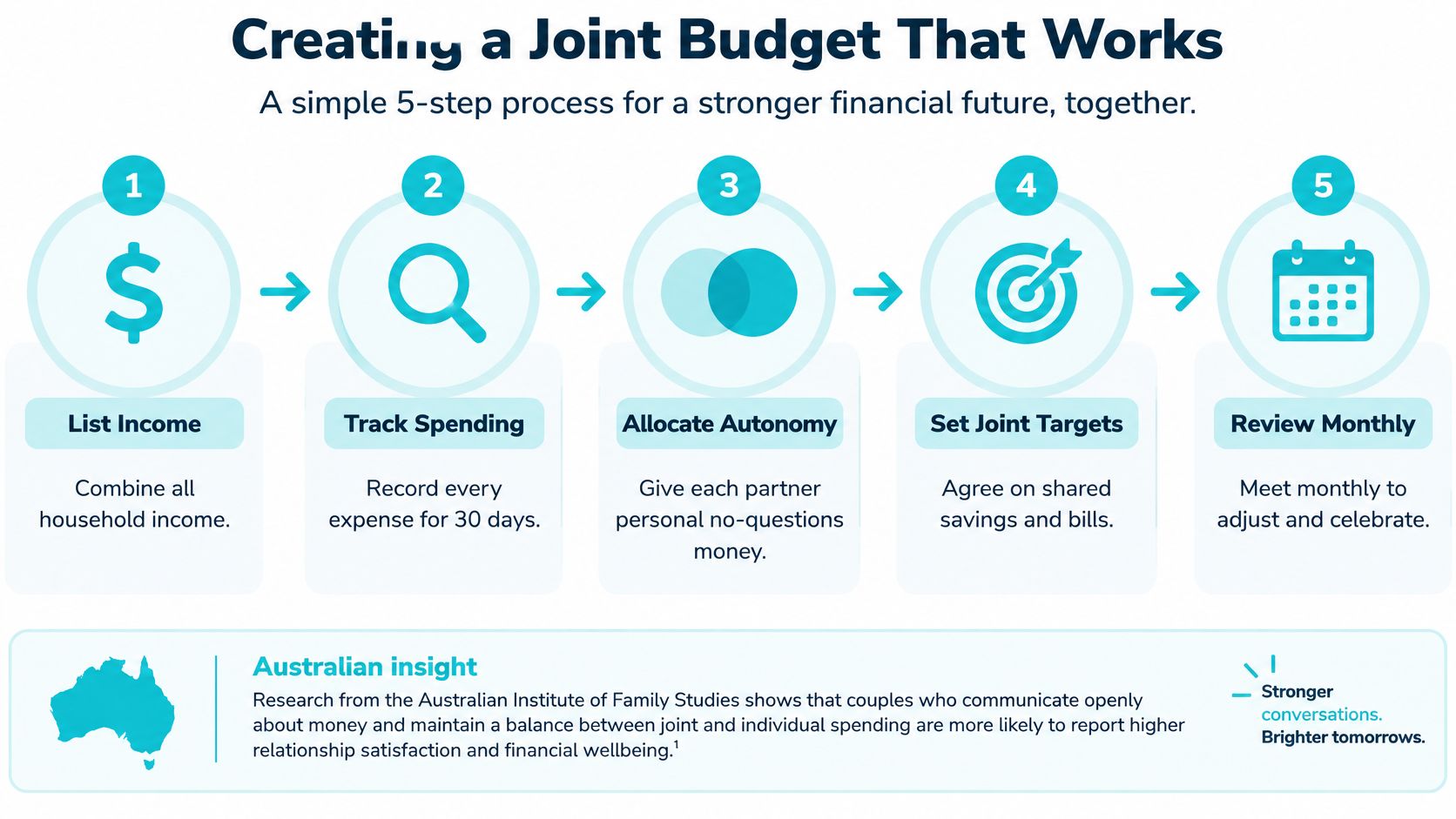
Creating a Joint Budget That Works
A workable budget gives both partners a shared view of the household without assuming that every dollar must be pooled. Some couples prefer one joint account for bills; others keep individual accounts and contribute to shared costs; many use a mix. What matters is that both people understand the arrangement, can see the information they need, and know how decisions get made.
Survey findings reported by AdviserVoice show why a clear system matters: 29% of Australians in relationships said they'd kept a financial secret, 32% had lied about a purchase price, 25% maintained separate accounts without sharing expenses, and 26% said one partner made all household financial decisions. The same survey found 55% experienced money-related conflict or stress at least annually and 19% experienced it monthly. (AdviserVoice's summary of research on Australian couples' finances)
Build the system together
Start with a full inventory. Each partner should list income, debts, superannuation, insurance, recurring expenses and financial dependants. Include irregular costs as well as monthly bills. A complete picture helps prevent one partner from unknowingly carrying a commitment that affects the household's plans.
Next, classify accounts as joint, individual or purpose-specific. A joint bills account may keep household payments straightforward. Individual accounts can preserve agreed autonomy. A separate savings account for a shared goal can make progress easier to track. Couples who rent together and have different incomes or room arrangements may also need to agree how housing costs are divided; this guide to per-person vs per-room rent methods outlines considerations that can help structure that conversation.
Then set a recurring decision meeting. Review cash flow, debt repayments, emergency savings and insurance gaps, and agree what kinds of major purchases need a conversation beforehand. You don't need to scrutinise every small expense. You do need a shared understanding of which decisions can affect the household plan.
A shared dashboard can be as simple as a spreadsheet with balances, bills, savings goals and upcoming decisions. Couples looking for advice on organising household income and expenses can also explore cash flow management.
Agree on what must be disclosed
Set a disclosure rule together. It might cover new debt, a change to income, or a purchase above a dollar limit you both choose. Make the rule mutual and specific, so neither person is expected to guess what counts as important.
Review the arrangement after major changes such as having children, buying property, redundancy or approaching retirement. A system that worked when both partners had similar incomes may need to change when one person takes on more caring responsibilities or household income shifts. If you rent and split costs, revisit the arrangement when the household or room use changes too.
Optimising Superannuation and Insurance
Superannuation is held in individual accounts, so a household projection alone doesn't tell each partner how secure they are personally. In 2023, women's median super balance was $190,850, compared with $310,326 for men. The typical woman's balance was 61.5% of the typical man's. Research also attributes one-third of the gender super gap to time spent caring for family and interruptions to full-time employment. (The University of Melbourne's analysis of the retirement gender gap)
Those differences can reflect years of unequal paid work and unpaid caring, not different choices about saving. Equal contributions going forward may not fully recognise the partner who took a career break or reduced work to support the family. At the same time, couples shouldn't treat one person's super as automatically available to the other. Each partner needs to understand their own account, ownership and options.

Review contribution splitting carefully
Super contribution splitting may let a member direct eligible contributions from one financial year into their spouse's super account. For taxed splittable contributions, up to 85% may generally be transferred, subject to the concessional contributions cap and eligibility rules. Eligible contributions commonly include employer contributions and deductible personal contributions. The receiving spouse must generally be below preservation age, or between preservation age and 65 and not retired. The super fund may approve or reject an application, which is usually made after the financial year in which the contributions were made. (The ATO's guide to spouse super contributions)
A split doesn't create extra concessional-contribution capacity. The transferred amount is treated as a rollover to the spouse, and the original contribution still counts towards the contributing member's cap. Personal contributions that can't be claimed as a tax deduction generally can't be split. If claiming a deduction, the required notice of intent must be submitted before applying to split the contribution. Check the contribution type, timing, fund rules and cap before acting. (The ATO's technical guidance on contribution splitting)
Couples can review spouse superannuation contributions as part of a broader discussion about balancing retirement security. Contribution splitting isn't automatic or universal, so get advice that considers both accounts and each partner's circumstances.
Check protection as a household
List each partner's life, total and permanent disability (TPD), and income protection cover. Compare the cover with the household's debts, dependants and reliance on each person's income or unpaid care. Check policy ownership, beneficiaries and what happens if circumstances change; don't assume that similar policies provide equivalent protection.
A useful review looks beyond the amount of cover. It considers whether each person can access relevant policy information, whether cover is held through super or outside it, and whether the household could manage if one partner became ill, unable to work or died. Insurance recommendations should reflect the household's needs and the terms of the policies, rather than a generic target.
Debt Reduction and Investment Strategies
Debt decisions are easier to make when the household separates urgency from habit. A family with a mortgage, childcare costs and competing savings goals may need a different plan from a couple with no dependants. ANU's Household Financial Stress and Wellbeing Index recorded financial stress in 2019–20 for 33% of couples with dependent children, compared with 23% of couples without dependent children. For couples with children, the rate had improved from 38% in 1998–99. Across all Australian households, financial stress was 32.8% in 2019–20, down from 36.5% in 1998–99 but above the 28.5% low recorded in 2015–16. (ANU's Household Financial Stress and Wellbeing Index)
Those figures aren't a forecast for your household. They do underline why couples should test how debt payments, childcare, insurance and saving fit together before taking on another commitment.
Choose a debt priority you can sustain
List each debt, its interest rate, required payment and any conditions that matter. Then decide how to direct extra repayments. Paying down the most expensive debt first can reduce interest costs; clearing a smaller balance may help a couple who need to see progress to stay engaged. The best approach is one both partners can explain and maintain.
Keep the mortgage in view, but don't assume that making extra mortgage payments is always the first move. Compare the mortgage with other debts, emergency cash needs and the household's goals. A debt plan that leaves no accessible savings can make a surprise expense harder to manage.
For couples reviewing their options, debt reduction strategies in Australia can be a starting point for weighing repayment priorities against other goals.
Make room for resilience and investment
Before committing every spare dollar to debt or investing, consider whether the household could manage an urgent cost. The Australian Bureau of Statistics' financial-stress framework asks whether a household can raise $2,000 within a week for an important need. Use that as a practical discussion point, not a universal target: the appropriate cash reserve depends on income reliability, dependants, expenses and access to other resources.
Once urgent needs and debt priorities are clear, match investments to the purpose and timeframe of the money. A couple saving for a near-term expense may have different needs from pre-retirees coordinating super and future income. Don't let one partner's preference for higher risk set the household's entire strategy, or let the more cautious partner veto every long-term investment without discussing the trade-off.
Review the plan together when income, debt or family responsibilities change. For pre-retirees, look at both partners' super, investments and expected income as a household while preserving a clear record of who owns each asset. Wealth Collective's advice process can bring cash flow, debt, investment strategy, protection and retirement planning into a coordinated plan. Book a free introductory call with Wealth Collective to discuss how a couple's plan could fit your goals and circumstances.