Business hours
Monday to Friday (8.30AM - 5PM)
Weekend (Closed)


You've saved the deposit, picked a suburb, and now the settlement statement lands on the table with a number that stings. For a lot of Perth couples, that's the moment first home owners stamp duty wa stops being theory and starts eating into cash they thought was already spoken for. The question isn't whether duty exists, it's whether you can keep the deal alive without blowing out your deposit, your buffer, or your borrowing power.
What First Home Buyers in WA Are Really Trying to Solve
A young couple finds the place, agrees on the price, and then realises they still need money for duty, legal fees, inspections, and the bits that always show up late. That's the trap. The home itself may be affordable, but the upfront cash can be the thing that kills the purchase.
WA's framework is built to reduce that shock at settlement, not to make the loan easier month by month. That matters because the pain point for first buyers is usually not the repayment on day one, it's the pile of cash needed before they get the keys. WA's first home buyer duty settings sit inside the state's transfer duty system, and the practical effect is simple, if the property lands in the right band and the buyer qualifies, the saving can be large enough to change the entire purchase.
Practical rule: treat stamp duty as part of your deposit strategy, not a side issue. If you leave it out of the plan, you're not budgeting, you're guessing.
If you're still building your deposit, the decision gets real. Chasing a lower duty band can free up money for settlement, furniture, or an emergency buffer, but it can also tempt you into focusing on the tax before the home itself. That's backwards. The right move is to price the house, then test the duty outcome, then ask whether the deal still works on cash, debt, and lending terms. For a broader budgeting lens, the starting point is usually your savings plan, and a useful breakdown is the best way to save for a house.
Stamp Duty in WA Explained in Plain English
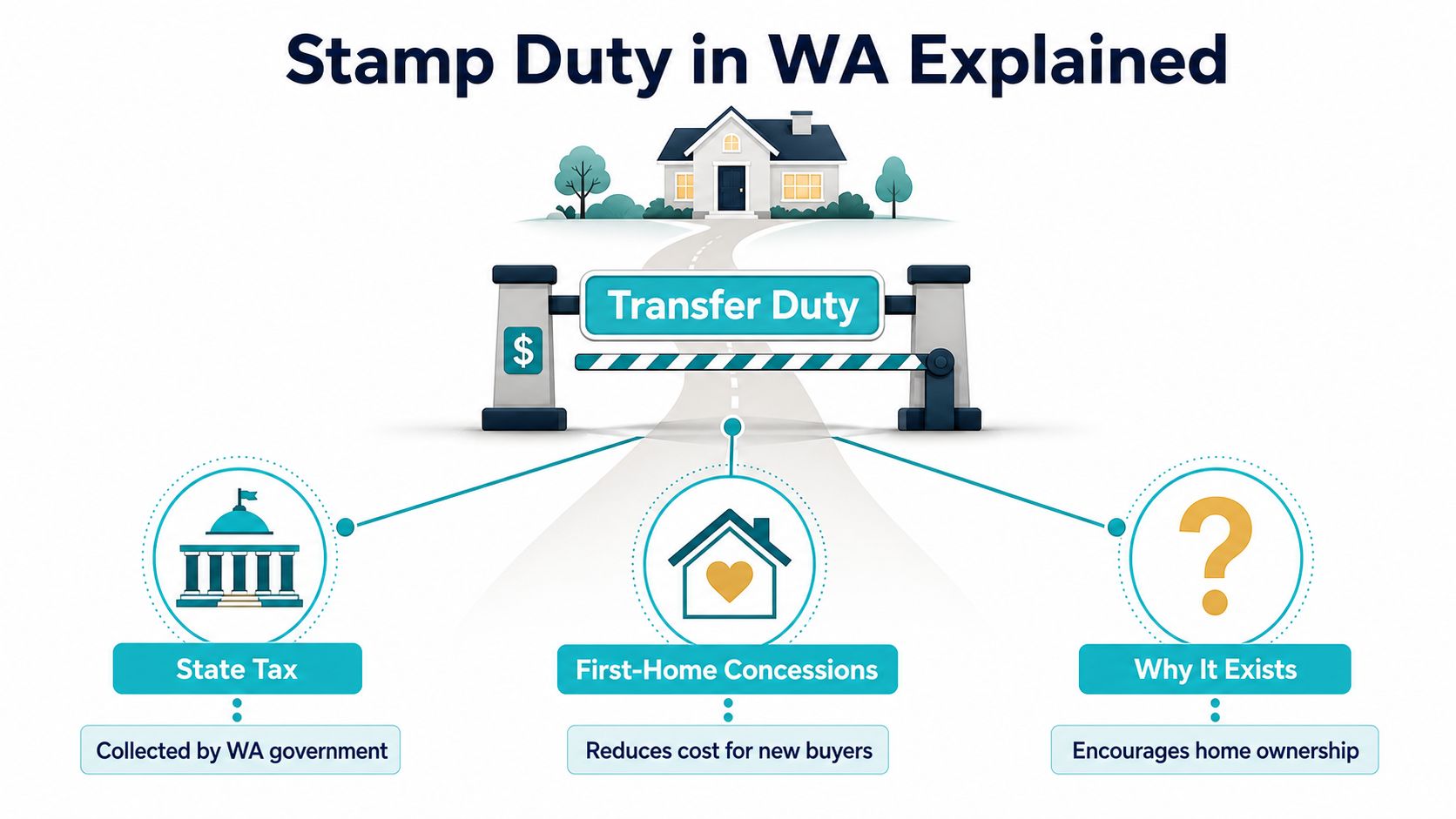
Stamp duty is a state tax charged when property changes hands. In WA it's more properly called transfer duty, but most buyers still say stamp duty, so that's the language people use at the settlement table. Think of it as the toll gate on the road to ownership, the government collects it once, upfront, before the keys change hands.
The base amount depends on the property's dutiable value, not just the number in the contract. That's why first-home concessions matter so much, they reduce the biggest one-off cost in the transaction instead of trimming your mortgage repayment for a few dollars a week. WA's policy is clearly aimed at lowering upfront friction, which is why it can improve borrowing capacity and reduce the cash needed at settlement.
For buyers comparing the cost burden across Australia, it helps to see how much the upfront tax can vary by state. If you want a broader national view of the cost stack, the guide on stamp duty cost in Australia is a handy reference point.
What catches people out is the distinction between the duty and the home loan. The bank doesn't automatically absorb duty into the mortgage. If you want to finance it, that changes the loan size and the long-term interest bill. That's why the concession is more valuable than a polite discount, it can be the difference between settling comfortably and scrambling to find extra cash.
The $430,000 and $530,000 Thresholds in Practice
WA's First Home Owner Rate of Duty gives eligible buyers $0 duty at $430,000 or less and then tapers until it ends at $530,000. That sliding scale matters more than the headline exemption because buyers often focus on the top line and miss the margin. A small increase in price can mean a very different duty outcome.
Here's the point in plain terms. A buyer at $380,000 is inside the zero-duty band. A buyer at $480,000 is still getting relief, but not the full exemption. A buyer at $580,000 is outside the concession altogether and pays full duty under the WA scale.
Worked Duty Examples for Eligible First Home Buyers in WA
| Dutiable Value | Concession Status | Approx. Duty Payable |
|---|---|---|
| $380,000 | Full exemption | $0 |
| $480,000 | Partial concession | Reduced duty on a sliding scale |
| $580,000 | No concession | Full duty applies |
The part buyers miss is the dutiable value rule. WA assesses duty on the greater of consideration or market value, so the number in your contract isn't always the number that matters. That's especially relevant for newly built homes, house-and-land packages, and related-party transactions, where the valuation basis can shift the duty outcome.
If you're comparing properties around the edge of the threshold, don't just ask, “Can I get the concession?” Ask, “What is the actual dutiable value once the property is assessed?” That's the number that decides whether the saving is meaningful or gone. For buyers who are close to the cap, that question is worth more than a weekend of open-home browsing.
Bottom line: a property just below the threshold can be more valuable than one that looks better on paper but blows the duty saving.
Eligibility Tests That Catch Buyers Out
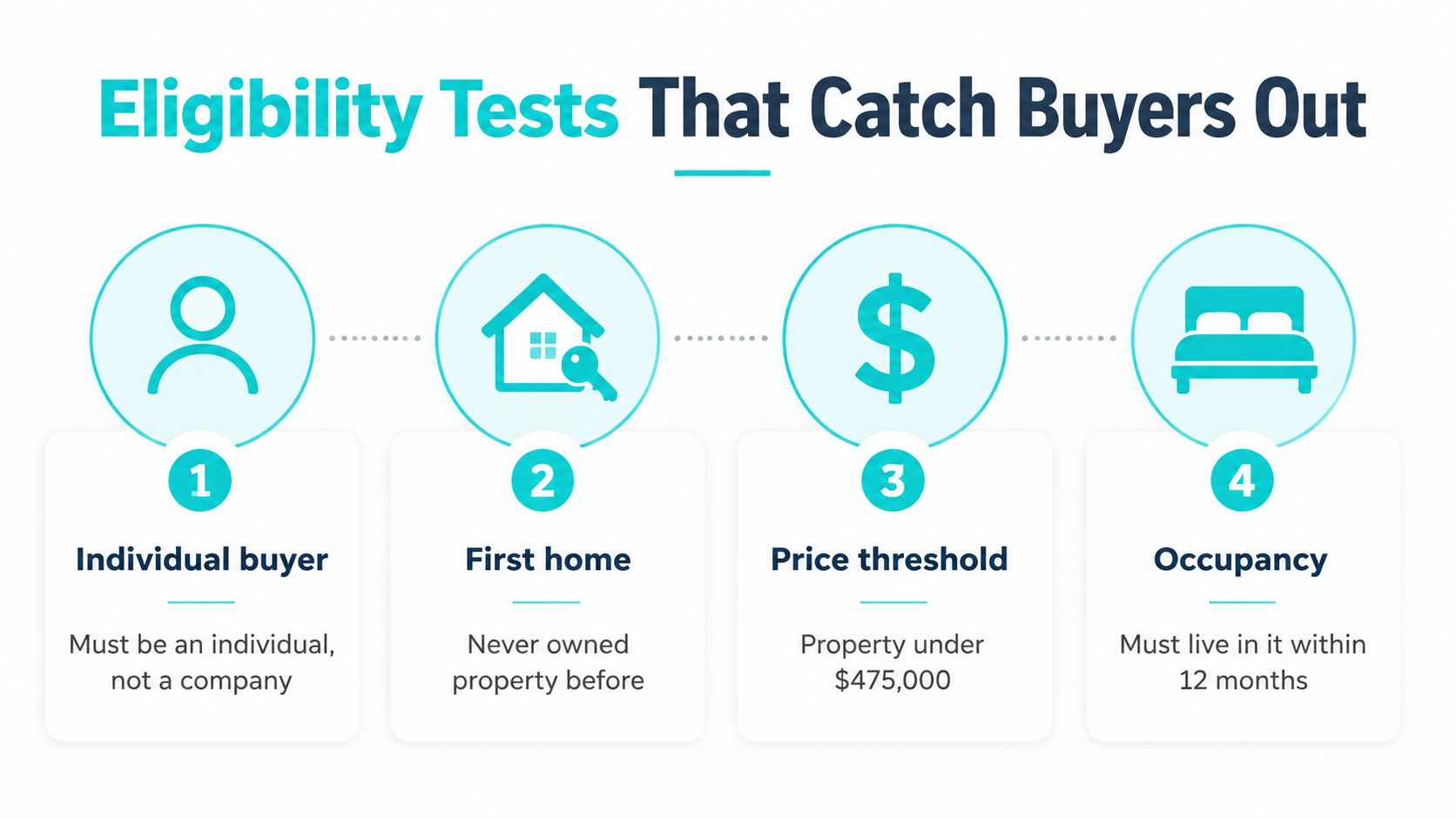
The biggest mistake first buyers make is treating the price threshold as the whole test. It isn't. You can be under the cap and still miss the concession if the ownership structure, residency intent, or property type doesn't line up.
Start with the buyer, not the property
The relief is tied to an individual first home buyer, not a company and not a casual ownership setup. If you're buying with a partner, the ownership history of both people matters. If one of you has owned an interest in residential land before, that can knock out the concession entirely.
Then test the property and the occupancy plan
The home has to be intended as your principal place of residence. If your plan is to rent it out, use it as a holiday place, or leave it vacant, that's a problem. The concession is built for people who are moving in, not for investors trying to capture a tax advantage while holding a different property strategy.
Don't ignore the valuation and transaction structure
The dutiable value is assessed under the duty framework, not the story you tell yourself about what the place is worth. That matters with off-the-plan purchases, strata, and related-party deals. The cleanest way to avoid disappointment is to assume nothing, check the title history, confirm the occupancy plan, and make sure your settlement agent has the facts before the contract is locked in.
Quick self-check before you offer
- Ownership history: Have either of you ever owned residential land in Australia?
- Occupancy intent: Will you live in the property as your main home?
- Property type: Is it a qualifying residential dwelling, not a holiday or commercial use case?
- Buyer structure: Are you buying as individuals, not through a company or trust?
If any of those answers is shaky, stop and get advice before you sign. That's cheaper than fixing a failed concession after settlement.
How the Stamp Duty Saving Changes Your Deposit and Borrowing
The cleanest way to think about duty relief is this, it can act like an instant cash injection on settlement day. If you keep more cash in hand, you may need a smaller deposit contribution at settlement, you may hold a stronger buffer, and you may have a better shot at staying within lender comfort zones. That's a far bigger win than a small rebate.

Say a couple is looking at a home around the middle of the concession range. The duty saving doesn't just reduce the cheque they write to settlement. It can also help them preserve savings for moving costs, reduce the amount they need to borrow, or stop them from draining every dollar they've got. That's why the same concession can feel small in theory and huge in practice.
A good way to pressure-test the effect is to run your numbers through a borrowing model before you get emotionally attached to the property. A tool like estimate mortgage borrowing capacity can help you see whether the concession changes the shape of the deal or just shifts cash from one bucket to another. If you're also using salary-sacrifice or voluntary savings strategies, it's worth checking those alongside your deposit plan, including your eligibility for the First Home Super Saver.
The trade-off is simple. If the duty saving keeps you under the line where lenders start to get uncomfortable, the concession has genuine value. If it only lets you borrow more and stretch tighter, the win is less impressive. Don't confuse a lower settlement cost with a cheaper home.
When the Concession Is Worth More on Paper Than in the Bank
The concession looks brilliant when you focus only on the tax bill. It looks less brilliant when the buyer stretches to stay under the threshold and ends up compromising on the home, the location, or long-term flexibility. That's the trap.
Buyer A stays under the cap and keeps the duty down. Buyer B pays more duty, but buys the property that suits their life for the next few years. If Buyer A has to compromise on commute, size, or resale quality just to save the tax, the concession may not be the better deal. A lower upfront cheque isn't automatically a better wealth decision.
The real test is what happens after settlement. If the cheaper property traps you in a location you'll outgrow quickly, or forces you into a tight loan that limits how you handle a baby, a job change, or a relocation, the concession may only look smart in the broker's spreadsheet. A slightly higher price can be the better answer if it buys you breathing room and a stronger property choice.
This is why I'd rather see a buyer make a solid, boring purchase than chase a threshold like it's the prize. The concession should support the deal, not distort it. If the property only works because of the duty saving, that's a weak deal. If the property works with or without the saving, that's a stronger one.
Applying for the Concession Without Costing Yourself the Saving
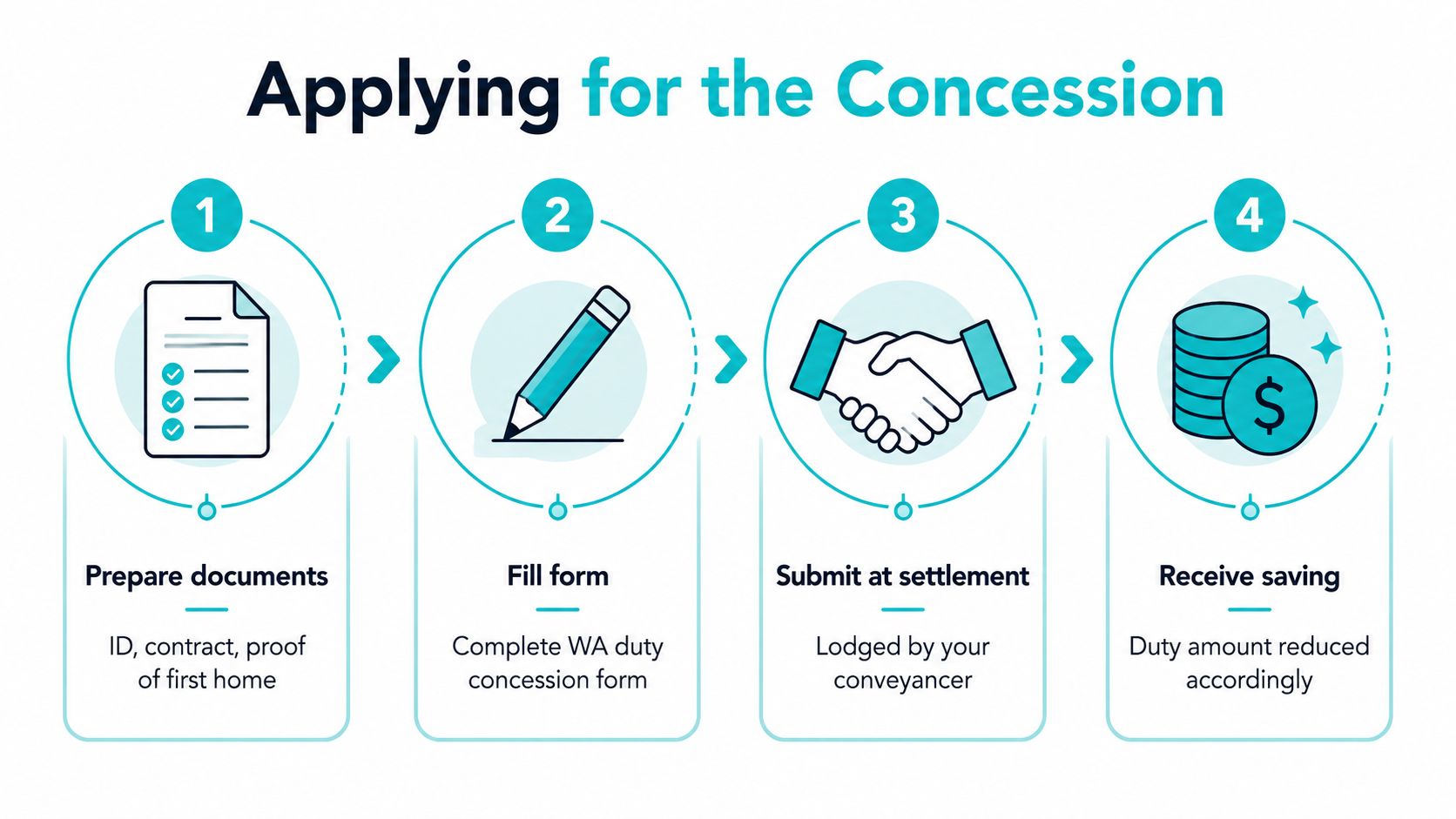
The concession needs to be handled early, not after everyone has signed and the pressure is on. In WA, the claim is typically dealt with through the transfer process, and your settlement agent or lawyer works out the duty using the dutiable value. If you leave the conversation too late, you risk missing documents, slowing settlement, or being reassessed.
What to have ready
- Identification: Make sure your ID documents are current and match the contract details.
- Residence evidence: Be ready to show the property is intended as your principal home.
- Ownership history: Have a clear record that supports your first-home status.
- Contract details: Your settlement agent needs the correct property and buyer information.
Where people get it wrong
The biggest errors are usually simple. Buyers understate the value on off-the-plan purchases, assume one partner's history doesn't matter, or forget that the occupancy condition has to be honoured. That last point is not a small detail. If the residency promise isn't met, the relief can be lost.
Get the timing right. Talk to your conveyancer before the offer is final, not after finance is approved and everybody is rushing. If you're cleaning up your finances first, it also helps to tidy any lending issues early, and a practical starting point is how to improve your credit score in Australia.
The clean process is boring, and boring is good. It means the saving lands where it should, at settlement, without drama.
Turning This Into a Plan You Can Actually Act On
Before you make an offer, answer three questions. Can I claim the concession? Does the property sit inside the duty band that gives me meaningful relief? And does the saving improve my deposit, borrowing, and settlement position enough to justify the purchase?
If the answer to any of those is unclear, pause. That's where a lot of first-home buyers go wrong, they treat duty as an afterthought and only look at the mortgage repayment. In reality, the duty outcome can decide whether you need to empty your savings, whether you keep a buffer, and whether the deal still feels safe once all the other costs land.
My view is straightforward. Run the numbers before you get attached. Don't assume the concession makes the home affordable, and don't ignore a slightly higher-priced property if it's the better fit for your life and your finances. The right decision is the one that leaves you with a workable loan, enough cash at settlement, and room to breathe after you move in.
A sensible next step is a short planning conversation that pressure-tests your deposit, duty, and borrowing assumptions against your actual situation. Wealth Collective can help you do that through a free 10-minute introductory call, then map out the next move using Protection Plus, Guided Growth, and Retirement Roadmap where they're relevant to your cash flow, debt structure, and long-term plan.
If you're weighing up a first-home purchase in WA, book a free introductory call with Wealth Collective before you sign anything. We'll help you test the duty saving, the deposit gap, and the borrowing impact against the property you want, so you can make the offer with your eyes open.