Business hours
Monday to Friday (8.30AM - 5PM)
Weekend (Closed)


You've had a good quarter, the BAS is starting to matter, and someone has probably asked whether you need to register for GST yet. For many first-time owners, that question lands right in the middle of a busy week, after a few strong invoices, a growing bank balance, and a nagging feeling that the rules might be more complicated than the simple threshold people keep mentioning.
The good news is that the rules are manageable when they're laid out plainly. The trap isn't just the threshold, it's missing the date the 21-day clock starts, counting the wrong figures, or assuming GST only matters once sales are already high. If you've got a side hustle, a trades business, a consultancy, or an online store that's starting to move, the right question isn't just “Do I need GST?” It's “What exactly triggers it, what counts, and what happens next?”
Where Most Business Owners Get Stuck With GST Registration
A plumber can finish a strong quarter, open the BAS folder, and find the numbers look better than expected. A designer who began as a side hustle can land a few steady clients, and suddenly the bookkeeping no longer feels like a hobby. The problem usually shows up at the worst moment, after the invoices have gone out and the business owner is trying to work out whether GST has already become part of the picture.
A key challenge in gst registration requirements is timing. Many explainers stop at the turnover threshold, but the harder part is knowing when the clock starts, whether your figures really count toward GST turnover, and whether you must register even if sales are still low for other reasons. That is why the ATO's registration rules matter, and why the practical question is usually not “Do I ever need GST?” but “Have I crossed the point where registration is already required?” (ATO GST registration rules).
Practical rule: do not wait for an annual review if sales are changing quickly. The question is whether your current pace points to a registration trigger, not whether last year's figures were comfortably below it.
A sensible way to approach it is to check whether registration is required, identify when the obligation started, and then gather the records that support the decision. If the numbers are still fuzzy, a conversation with a small business accountant can help you test the figures before you lodge anything.
The A$75,000 Turnover Threshold and the 21-Day Rule
A café owner can have a quiet few months, then a couple of strong trading periods push the numbers into GST territory before the owner has really noticed. That is why the threshold matters, and why waiting for year-end can be the wrong habit.
For most businesses, the registration trigger is A$75,000 in GST turnover, while non-profit organisations have a higher threshold of A$150,000. New businesses also need to watch projected turnover, because the rule applies when you expect to reach the threshold in your first year as well as when an existing business crosses it later. The ATO's registration guidance sets out those rules clearly, and the practical question is often whether your figures are already pointing to registration, not whether you feel ready for it.
How to think about turnover in practice
A steady business does not need wild growth to reach the line. If your business earns roughly A$7,000 a month, that points to A$84,000 over a year, which is enough to put GST registration on the table even before the full year has passed.
That is where owners often get caught. The relevant test is not limited to last year's final total, it also looks at whether the business is expected to reach the threshold, so a clear run of sales can bring the registration decision forward. If your books show regular trading and the pattern looks stable, the question belongs on your desk now, not after you have finished a full-year review.
The other trap is timing. Once the threshold is exceeded, the business must register within 21 days. The clock starts when the threshold is crossed, not when you finish the BAS draft, clear the inbox, or get around to checking the bank feed.
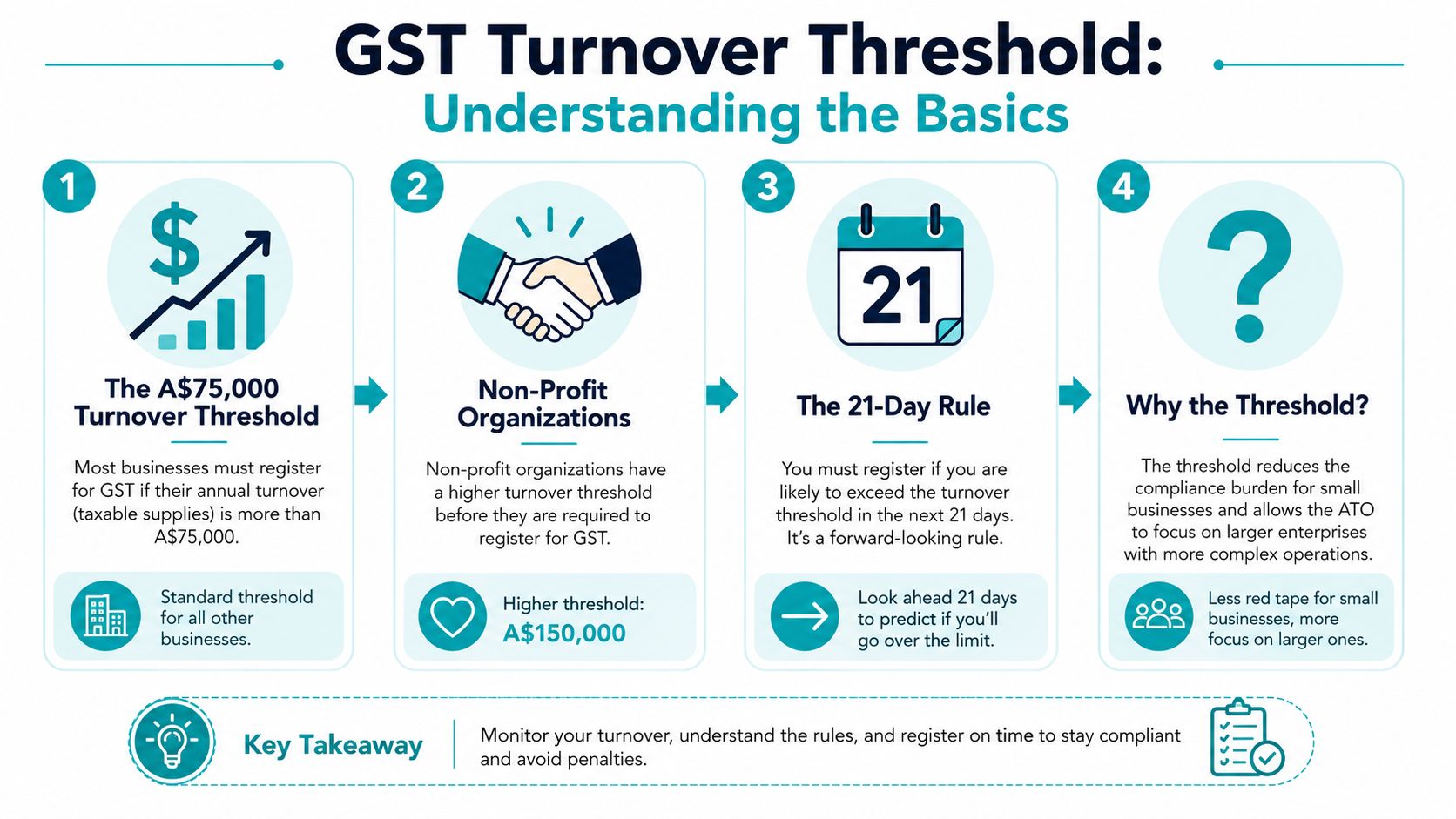
A useful way to handle the rule is to treat turnover like a running total, not a neat annual snapshot. If your current pace suggests the business will land above the threshold, the decision should be made now, not after the next quarter closes. For owners also sorting out tax timing and cash flow, a small business tax reduction guide can help you think through the wider planning choices.
What Counts as GST Turnover and What Does Not
GST turnover catches a lot of owners out because it is not the same thing as cash in the bank. A bank deposit can look like sales at first glance, but the GST test only works if you separate ordinary trading income from amounts that belong outside the threshold calculation. Get that wrong, and the registration decision can be early or late for the wrong reason. The ATO GST registration rules only make sense once the turnover figure itself is being tracked properly.
The simplest way to sort the numbers
Start with the receipts that arise from normal business activity. Those are the amounts that usually belong in GST turnover. Then look at the other money coming through the books and ask a simple question, is it payment for goods or services, or is it something else entirely? A one-off windfall, an owner's capital injection, or money that does not come from ordinary trading should not be treated as the same thing as sales.
The best habit is to test the character of the receipt, not just the fact that cash arrived.
Practical rule: if a receipt does not reflect ordinary business activity, pause before adding it into your GST turnover test.
| Income Type | Counts Toward GST Turnover | Notes |
|---|---|---|
| Ordinary sales of goods or services | Yes | These are the core figures most owners should track first |
| One-off windfalls | Not always | Check whether the receipt is trading income |
| Capital introduced by the owner | No | This is funding, not sales |
| Investment returns or other non-trading receipts | Not always | The character of the receipt matters more than the bank deposit itself |
A clean chart of accounts helps here, especially when a business is young and startup funding, sales, and side income can blur together. If you are setting up that system and want the tax side linked to the wider planning picture, a taxation and tax planning resource can help frame the decision with the right structure around it.
Documents and the ATO Registration Process Step by Step
GST registration is a formal application, so the ATO expects more than a quick tick in a box. You need documents that identify the business, support the details you are lodging, and show that the information aligns with how the business is operating. For Australian GST purposes, that usually means your records already need to tell a clear story about who is applying, what the business does, and how it is structured.

What to have ready before you start
Start with the basics, your ABN, identity details, business address, bank account information, and a plain description of the goods or services the business provides. If you operate through a company or a trust, those details need to match the legal structure, not just the trading name on your invoices or your website. That is where many first-time registrations slow down, because the form is only as good as the records behind it.
A simple way to check your file is to ask whether every key detail points to the same business. The ABN, identity documents, bank account, and operating description should all line up, the same way matching pieces in a puzzle do. If one piece looks out of place, the ATO may want clarification, and that is easier to fix before you lodge than after.
The online ATO process itself is usually direct. You log in, enter the registration details, confirm the business activity, and submit the application with the right identifiers. If the records are incomplete or inconsistent, pause and correct them first. Lodging a messy application and hoping it sorts itself out later is a common trap.
A startup founder who wants more context on how advisers approach these registrations can also look at this guide for startup founders, because the issue is often not the form itself, but whether the business has the right system around it.
When You Must Register Even Below the Threshold
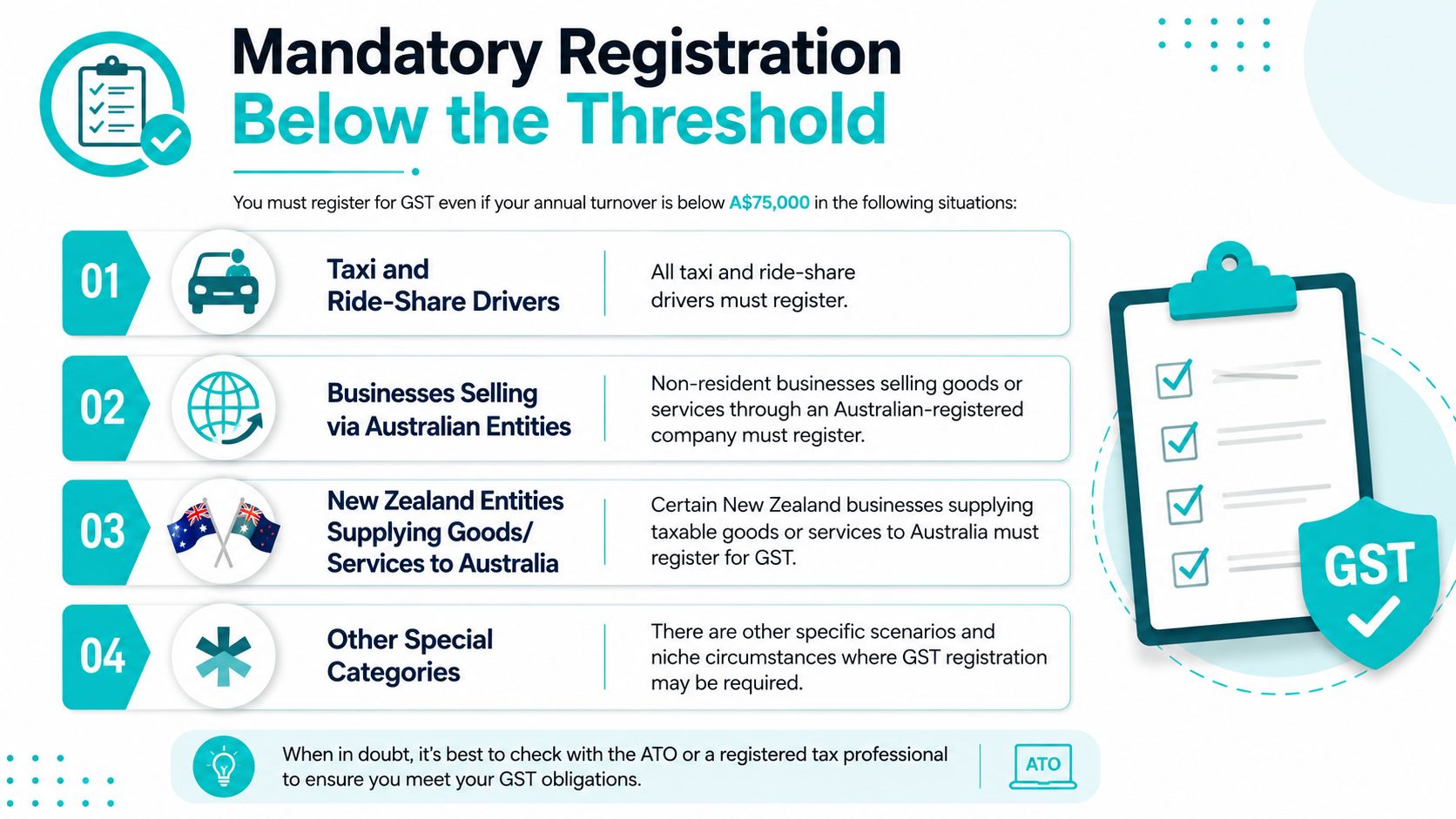
A café owner can be well under the usual turnover threshold and still have a GST registration obligation. That catches a lot of first-time operators off guard, because they assume GST only matters once sales get large enough. In practice, some business models trigger registration because of the type of supply being made, not just the size of the business.
For Australian small businesses, the clearest example is a taxi or ride-sourcing service. If you provide that service, GST registration can be required even when your turnover is still low. The same trap appears when owners focus only on monthly sales and miss a rule that applies from the start, or from the point the activity begins to fit a GST category that requires registration.
A simple compare-and-decide view
A turnover test is like a gate with one lock, but some business models have a second lock beside it. If the second rule applies, the gate is still shut until you register, even if the sales number has not reached the usual level. That is why a small operator can be caught out by the business structure long before revenue feels substantial.
A sole trader driving passengers, for example, does not get to wait for turnover to grow before thinking about GST. The obligation comes from the type of service, so the right question is not only, “How much have I sold?” It is also, “Does what I do fall into a category that requires registration now?”
The common trap is assuming every GST question starts and ends with turnover. It does not. Some businesses need to register because the activity itself carries the obligation, and that means the decision has to be made by looking at the business model, not just the income figure.
Practical rule: if the activity is one that requires GST registration, the turnover test is only part of the picture.
Voluntary Registration and Its Real-World Trade-offs
Voluntary registration can be a smart move, but only when the business understands what it's buying. The upside is simple, you may be able to claim back input tax credits on business setup costs, and some B2B customers prefer dealing with suppliers who already issue GST-ready invoices. The downside is just as real, because registration adds reporting, record-keeping, and the need to charge GST on taxable sales.
The decision comes down to how you trade
If you're buying equipment, paying for professional services, or setting up software and premises before revenue is stable, registration can improve the way those early costs are treated. If you're mostly selling directly to consumers at a price point that's already tight, GST can create pricing pressure. There's no universal answer, because the right choice depends on margins, customer base, and how fast the business is likely to grow.
The ongoing obligations are the part owners often underestimate. Once registered, you need to keep invoices in order, report through BAS, and maintain records that line up with what you've charged and claimed. That's manageable when the bookkeeping is tidy, but it becomes a drag when the business is still relying on spreadsheets, memory, and a once-a-month bank check.
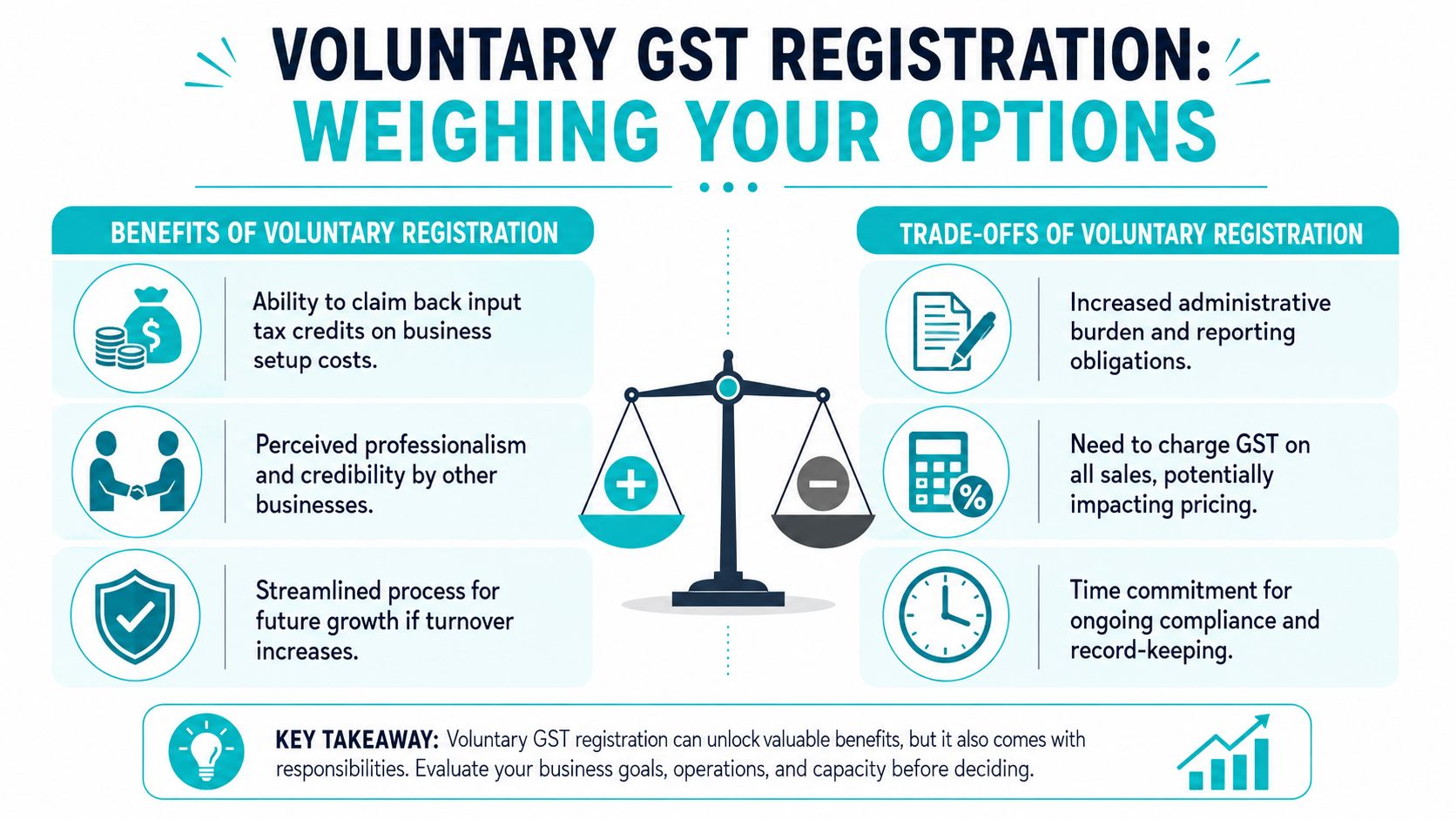
A good rule is to register voluntarily only when the numbers, the customer mix, and the admin load all make sense together. If the business is still experimenting with pricing or product fit, keeping GST out of the model for a little longer may be the cleaner option.
Ongoing Obligations After Registration
Once you're registered, the question shifts from whether you need GST to how you keep it running without creating avoidable errors. You need to issue invoices correctly, lodge BAS on time, and keep records that match what happened in the business. For a first-time owner, that can feel like another layer of admin, because GST stops being a background rule and starts sitting inside your day-to-day bookkeeping.
The businesses that handle GST well usually treat it like a process, not a last-minute task. They keep the GST treatment attached to each sale and purchase, store the supporting documents with the transaction, and check whether the setup still fits if the business changes. If you're still getting your systems in place, the guide for startup founders can be a useful reference for how advisers often think about setup and compliance.
A few habits save a lot of stress:
- Match invoices to GST settings: make sure the tax treatment shown on invoices agrees with the way the sale was recorded.
- Keep records organised: retain the paperwork behind sales, purchases, and GST claims so you can explain the numbers later.
- Review the position regularly: if turnover, customer mix, or operating structure changes, the GST setup may need a second look.
Small errors are easy to make and easy to miss. A wrong invoice template, a sale coded to the wrong account, or a claim entered against the wrong GST label may not look serious at first, but they can make a BAS harder to prepare and harder to explain later.
Bringing It Together and Booking the Next Conversation
A lot of business owners fixate on the turnover number and miss the details that cause trouble. GST registration can turn on A$75,000 for many businesses, A$150,000 for non-profits, and the 21 days to register starts once the threshold is crossed, as set out in the ATO GST registration rules. The common traps are usually simpler than people expect. The first is getting the timing wrong. The second is counting turnover incorrectly. The third is assuming GST only matters once sales look obviously large.
A small online store can hit the line faster than it expects if it counts every taxable sale but forgets that some income is treated differently. A contractor may also have a GST obligation before the business feels “big enough” because another rule applies. That is why the first question is rarely just, “Have I reached the threshold?” It is also, “What counts, and from when?”
If the answer is unclear, it is better to sort it out before the records start to blur together. A short conversation at the right time can prevent a registration that is late, incomplete, or based on the wrong turnover figure.
Wealth Collective helps business owners make sense of the moving parts around tax, structure, cash flow, and long-term planning. If you want clear guidance on GST, bookkeeping, and the wider financial decisions that sit around your business, visit Wealth Collective to book an initial call and talk through your situation.