Business hours
Monday to Friday (8.30AM - 5PM)
Weekend (Closed)


You're sitting with your tax agent, notice of assessment open, and there's a line you didn't expect. You held private hospital cover all year, your insurer reduced every premium, and you assumed that settled it. It didn't. Your income moved, your partner's birthday mattered, or your family income landed in a different band than the one your insurer used.
That's the conversation I have most often with Perth pre-retirees. They don't need another definition. They need to know what their health insurance rebate tiers position means for the premium they're paying now and the tax they'll owe later. Get the tier wrong and you're not just mispricing a discount. You're misunderstanding your tax position.
What the Rebate Tiers Actually Are
Take a dual-income couple in their early sixties, one still working full time, one cutting back. Their insurer has applied a rebate to their premium all year. At tax time they discover their combined income put them in a higher tier, so part of that reduction has to be reconciled. Nothing went wrong with the policy. They only treated an estimate as a final entitlement.
The rebate isn't a loyalty discount from your fund. It's a means-tested government contribution toward the cost of a complying private health insurance policy, designed to keep private cover attractive and take pressure off the public hospital system. The Australian Taxation Office administers it, and your final position is tested when you lodge your return.
Four tiers, one income test
There are four bands: Base Tier, Tier 1, Tier 2 and Tier 3. As your income rises through them, the percentage the government contributes falls, then disappears. For people under 65, the drop from Base Tier to Tier 3 is 24.118 percentage points, based on the rates in the ATO income thresholds and rates for the private health insurance rebate.
Three things decide where you land:
- Your income for surcharge purposes: Not just the taxable income figure you glance at first.
- Your family status on 30 June: Single or family treatment is locked in at year end.
- Your age band: Older policyholders receive a higher percentage in the lower tiers, covered later.
My recommendation: Stop asking what rebate your insurer applied. Ask what tier you'll actually be assessed in. Those are different questions, and only the second one determines your tax outcome.
You also need Medicare eligibility and an Australian-registered complying policy. If your income reaches Tier 3, you can still hold cover for hospital choice and Medicare levy surcharge reasons, but you shouldn't budget for any rebate at all.
Income Thresholds for Singles and Families
Start with your status, then find your band. If you're assessed as a family, don't compare your individual salary to the singles column and assume you're safe. That mistake causes more surprises than the rates themselves.
For 2025–26, singles sit in the Base Tier at $101,000 or less, Tier 1 at $101,001–$118,000, Tier 2 at $118,001–$158,000 and Tier 3 from $158,001, while families sit at $202,000 or less, $202,001–$236,000, $236,001–$316,000 and $316,001 or more respectively, as set out in the table below. Families also receive an additional $1,500 threshold allowance for each Medicare levy surcharge-dependent child after the first.
Private Health Insurance Rebate Income Thresholds 2025–26
| Tier | Singles | Families | MLS Rate |
|---|---|---|---|
| Base Tier | $101,000 or less | $202,000 or less | See MLS section |
| Tier 1 | $101,001–$118,000 | $202,001–$236,000 | See MLS section |
| Tier 2 | $118,001–$158,000 | $236,001–$316,000 | See MLS section |
| Tier 3 | $158,001 or more | $316,001 or more | See MLS section |
Note the $1,500 allowance applies for each dependent child after the first, so it lifts the family thresholds rather than changing the rebate percentage itself. I've left the Medicare levy surcharge column as a pointer here because those rates belong to a separate calculation with its own year, and mixing them into this table without context invites exactly the confusion you need to avoid.
How to read your own position
- Step one: Decide whether you'll be single or family at 30 June. A change in relationship status during the year can change which column applies.
- Step two: Add the relevant household income together if you're in the family column. Don't test each partner in isolation.
- Step three: Adjust the family threshold if you have more than one Medicare levy surcharge-dependent child.
- Step four: Check how close you are to the next boundary. If you're near an edge, a bonus, capital gain or extra super-related income item can move you.
If you're comfortably inside a band, you have planning certainty. If you're sitting just below a threshold, you don't. You have a forecast that needs monitoring before year end, not after your assessment arrives.
How Age Changes the Rebate Percentage
Income decides your tier. Age decides where you sit inside that tier, unless you're in Tier 3. That's the part many retirees miss because their insurer talks about the dollar premium, not the percentage underneath it.
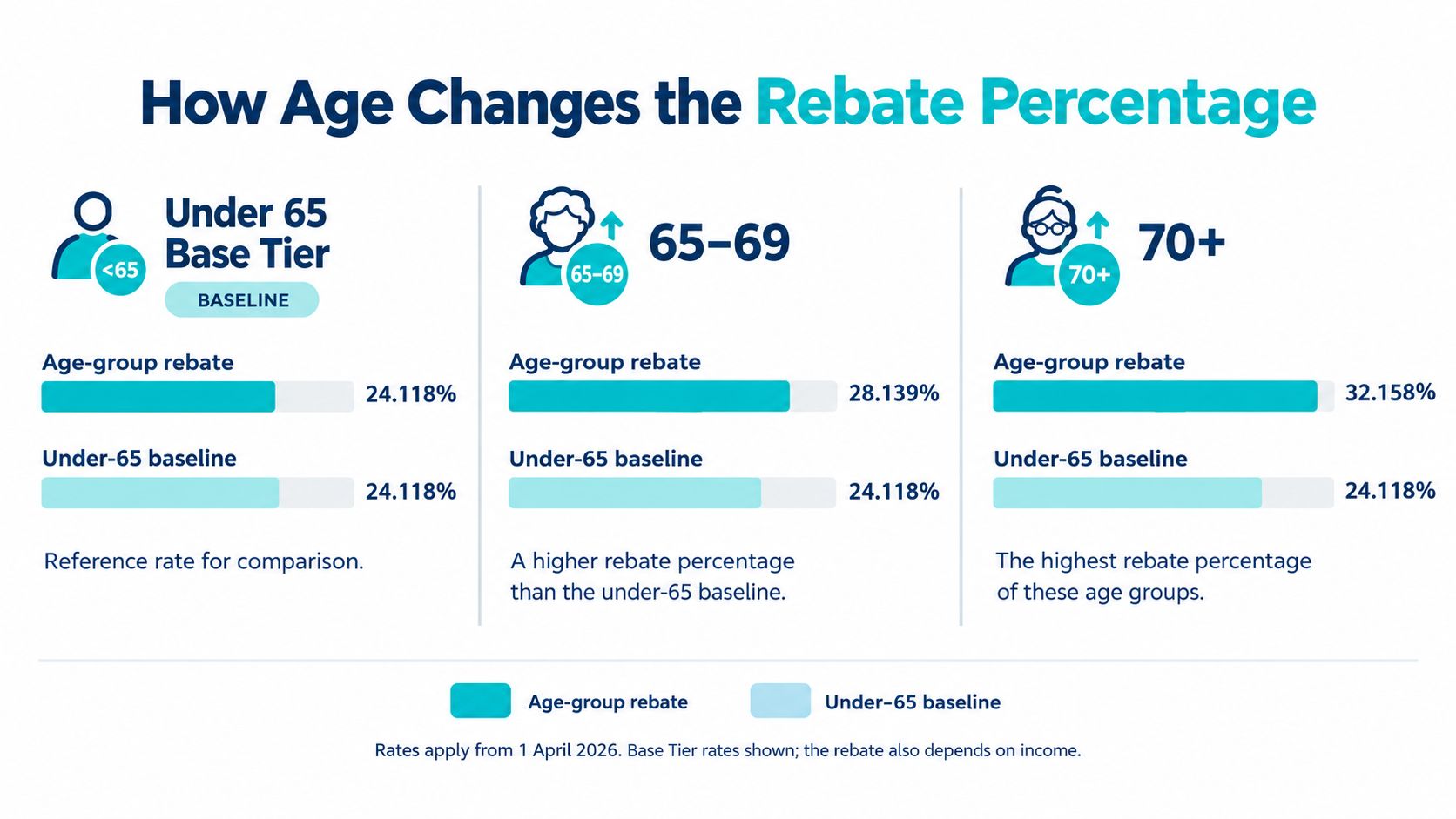
Under the schedule effective from 1 April 2026, people under 65 in the Base Tier receive 24.118%, those aged 65–69 receive 28.139% and those aged 70 or over receive 32.158%, with Tier 1 at 16.079%, 20.098% and 24.118%, Tier 2 at 8.038%, 12.058% and 16.079%, and Tier 3 at 0% at every age, as shown on PrivateHealth.gov.au's insurance rebate page.
What the uplift is worth in percentage terms
At Base Tier, turning 70 puts you 8.040 percentage points above an under-65 policyholder on the same tier, based on the rates in the source linked above. At Tier 1 the gap between under 65 and 70 or over is 8.039 percentage points on those same published rates.
That doesn't mean older cover is cheap. Premiums themselves are a separate pricing decision by your fund. It means the government meets a larger share of the eligible premium for older Australians in Base Tier, Tier 1 and Tier 2, which is a deliberate incentive to keep them in private cover.
Don't assume today's percentage is permanent either. The under-65 Base Tier rate was 25.059% for the period from 1 April 2020 to 31 March 2021, compared with the lower 2026 schedule figure already cited above. Rates get adjusted over time, so a retirement cash flow plan that hard-codes one rebate percentage for decades is built on sand.
If you're approaching 65 or 70, treat the birthday as a financial planning date, not just a family event. It can change what your household should expect from the same policy.
Tier 3 is the exception that proves the means test matters more than age. Once income is high enough, the age uplift doesn't rescue the rebate.
The Link Between Rebate Tiers and the Medicare Levy Surcharge
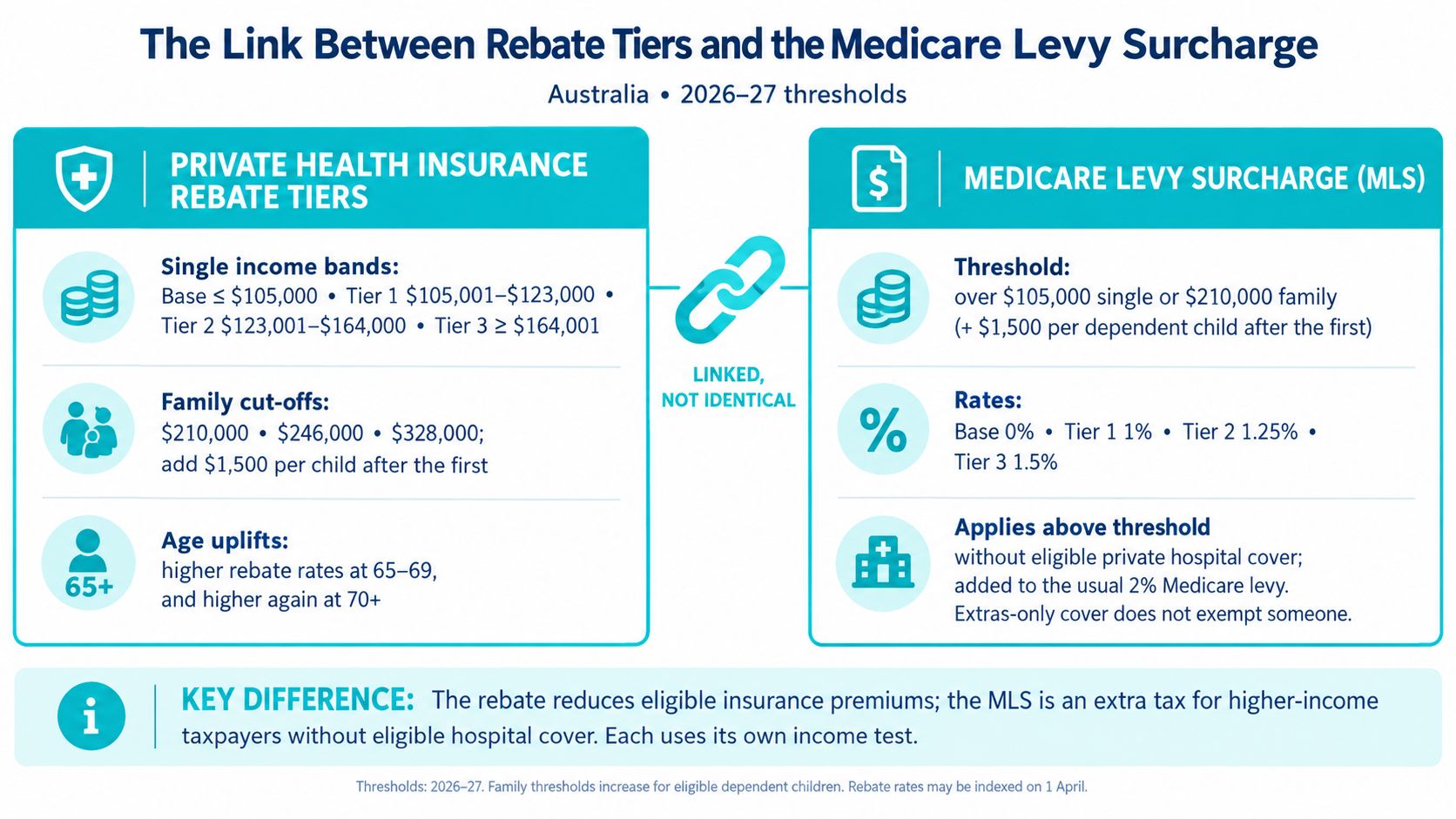
The rebate and the Medicare levy surcharge (MLS) use the same tier labels. They are not the same calculation, and conflating them leads to poor cover decisions.
For 2026–27, MLS rates are 0% at Base Tier, 1% at Tier 1, 1.25% at Tier 2 and 1.5% at Tier 3, according to the ATO Medicare levy surcharge rate content. The rebate follows its own age-adjusted schedule, already covered above, while MLS is a surcharge exposure for higher-income taxpayers without appropriate hospital cover.
Two decisions, not one
- Rebate decision: How much of your eligible premium will the government contribute, given your tier and age band?
- MLS decision: If you don't hold complying hospital cover that meets the statutory requirements for the required period, will you face an additional surcharge?
A high-income client can receive no rebate and still have a strong tax reason to hold hospital cover. The opposite error also happens. Someone focuses only on avoiding MLS, buys the cheapest hospital product they can find, and never checks whether the cover suits their likely hospital needs in Perth or down south.
Read the two together using our guide to the Medicare levy and private health insurance before you change cover for tax reasons alone. Cheap cover that fails you clinically isn't a saving. It's a deferred cost.
My view is blunt. Don't buy hospital cover purely as a tax product, and don't drop it purely because your rebate fell. Price the MLS exposure, price the after-rebate premium, then judge the cover on whether you'd actually want to use it.
Estimating Your Income for Rebate Purposes
Your payslip salary is the starting point, not the answer. Rebate entitlement is tested against income for surcharge purposes, so you need a broader estimate than the taxable income line you remember from last year's return.
Work through it in order:
- Confirm single or family status: Use your expected status at year end, not how the policy was set up years ago.
- Count dependent children correctly: This affects the family threshold discussed earlier.
- Check policy ownership and who's covered: The people on the policy affect the age rate and how statements are issued.
- Confirm days of eligible cover: Gaps, suspensions and mid-year changes matter for both rebate and MLS testing.
- Estimate all relevant income sources: Employment, business, investment and super-related amounts that count for surcharge purposes need to be in the forecast.
Where households get caught
A single professional with a good salary plus investment income can land higher than expected. A dual-income family where only one partner holds the policy can still be tested on the family position. A retiree mixing part-time work with pension and investment income can drift across a boundary without any single dramatic change.
If you're actively managing taxable income, pair this estimate with our Australian guide to reducing taxable income and, for business owners thinking beyond salary, the practical thinking in founder tax planning strategies from Nexist. Use them as planning inputs, not as a promise that one deduction fixes your tier.
Practical rule: Run the estimate before 30 June while you can still act. After year end, you're mostly documenting what already happened.
Executives, dual-income households and anyone with variable bonuses shouldn't rely on the tier their insurer has on file. Update the insurer if your forecast changes. A slightly higher premium during the year is easier to manage than a reconciliation debt you didn't budget for.
Worked Example for a Retiring Couple
Consider a WA couple I'll call Mark and Helen. Helen is the older partner and turns 65 partway through the financial year. Mark is younger, still in his early sixties, and both are stepping back from full-time work while drawing on super as part of their transition into retirement.
Before Helen's birthday, they think about their cover the way most couples do. They look at the monthly premium after the insurer's reduction and assume that's their settled cost. They don't ask which age band the policy is using, or whether their changing work income will still match the tier on file at year end.

Entitlement depends on family status at 30 June and the rebate rate can depend on the oldest person covered by the policy, which creates planning issues around birthdays and membership changes, as explained in the Department of Health rebate modernisation document. For Mark and Helen, Helen's age is therefore not a personal detail. It's a policy pricing input.
What changes, and what doesn't
Helen moving into the next age band can lift the applicable rebate percentage within their income tier, using the age schedule covered earlier. It doesn't move their income tier by itself. If their combined surcharge-purpose income also falls as work reduces, the two effects can combine favourably. If investment income or a capital gain pushes income the other way, the age benefit can be partly or fully offset.
At tax time, the ATO reconciles what was applied to premiums against their final entitlement. If the insurer used too generous a tier during the year, the assessment corrects it. If they were entitled to more, the return is where that difference is recognised.
The lesson isn't to time a birthday. You can't. The lesson is to forecast the year you'll be assessed in, including who's oldest on the policy, who's still working, and what super drawdowns are planned. Couples who do that rarely get surprised. Couples who only watch the direct debit often do.
Premium Reduction Versus Tax Return Claim
You can receive the rebate in two ways, and the method changes your cash flow experience, not your underlying entitlement. Choose based on predictability of income, not habit.
Eligible policyholders may have the rebate deducted from premiums or claim it through their tax return, with eligibility tested against income for surcharge purposes and Tier 3 producing a nil rebate, while the rebate doesn't apply to the Lifetime Health Cover loading portion of a premium, as set out on the ATO private health insurance rebate eligibility page.
Premium reduction
Your fund lowers the premium upfront based on the tier you nominate. That's convenient if your income is stable and you're confident in your band. It spreads the benefit through the year and keeps household cash flow smoother.
The risk is obvious. Get a promotion, bonus or unexpected income lift, and the reduction you enjoyed may exceed your final entitlement. The ATO then reconciles the difference at assessment.
Tax return claim
You pay the fuller premium during the year and claim through the return. That suits people with variable income who'd rather avoid owing money back. It also suits you if you genuinely don't know which tier you'll land in and don't want to guess.
- Stable salary, clear tier: Premium reduction usually works well.
- Variable business or bonus income: Consider claiming at tax time, or nominate a more conservative tier with your fund.
- Premium includes Lifetime Health Cover loading: Remember only the eligible premium component attracts the rebate, not the loading.
Don't treat a reconciliation as a penalty. It's the system correcting an estimate. But do treat repeated reconciliations as a signal your nominated tier is wrong and needs updating with your insurer.
Planning Around Super, Pensions and Investment Income
Retirement income rarely comes from one tap. You might have an account-based pension, some part-time work, dividends, rent and an occasional capital gain. Each source needs to be considered when you estimate income for surcharge purposes, because the tier test looks at the combined picture.
That's why two retirees paying the same headline premium can receive different rebate outcomes. One household structures drawdowns and investment income to stay within a lower band. Another crystallises a large gain in the same year they increase pension drawdowns, and lands in a higher tier without connecting the two decisions.
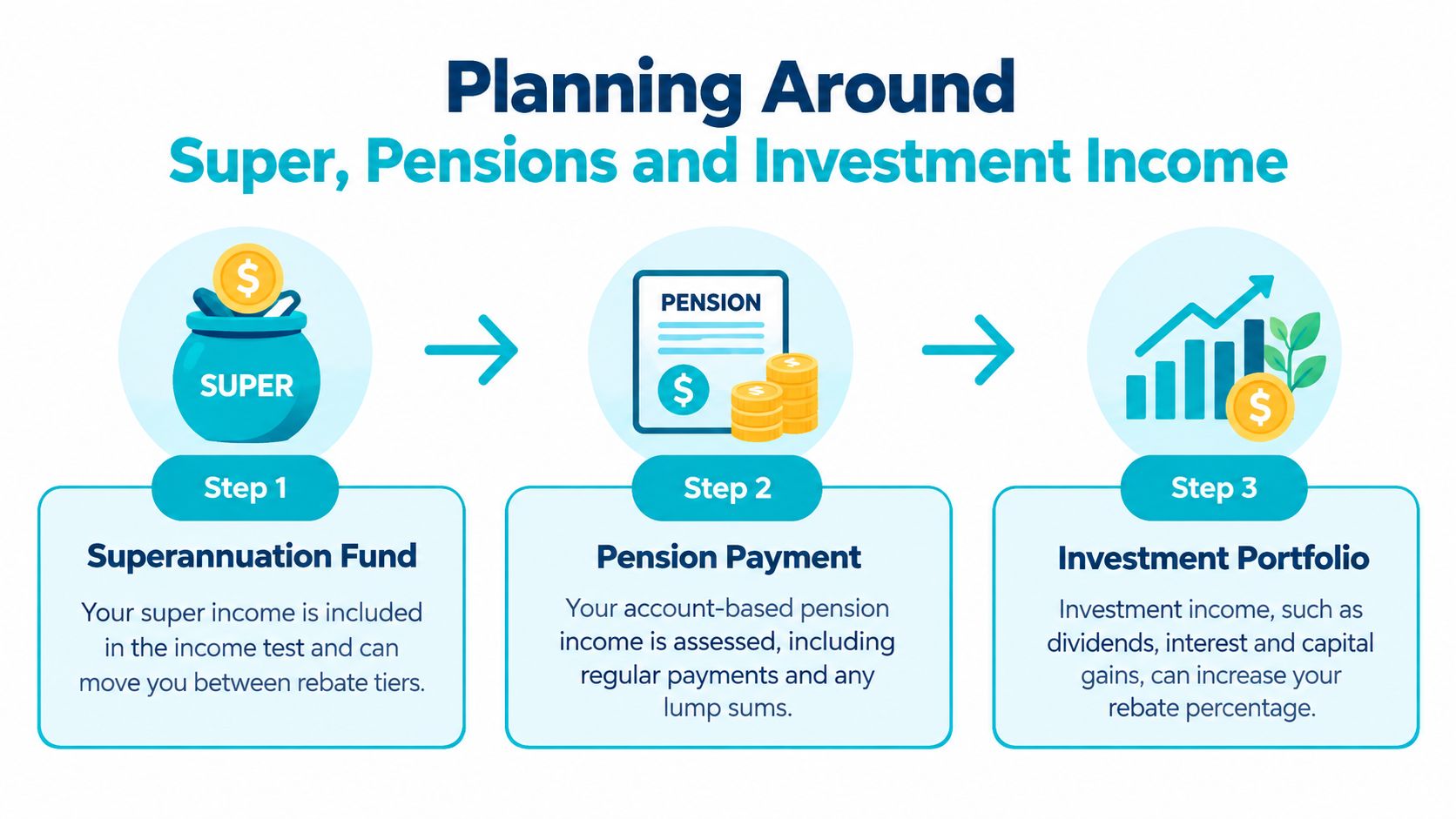
If you're drawing an account-based pension, read how an account-based pension works alongside your rebate estimate, not months later. The pension decision, the investment decision and the health cover decision all hit the same year-end tax assessment.
A planning sequence that works
- Forecast first: Estimate surcharge-purpose income from work, pensions, super drawdowns and investments before you trigger extra income.
- Test the boundary: If you're near a tier edge, model the rebate and MLS effect before selling an asset or increasing drawdowns.
- Coordinate as a couple: Family assessment means one partner's income move affects both partners' rebate position.
- Update the fund: If the forecast tier changes, tell your insurer rather than waiting for the ATO to fix it.
I'm not suggesting you let a rebate dictate your retirement income strategy. That would be letting a secondary benefit drive primary decisions. I am suggesting you price the tier consequence before you act, so a deliberate super or investment move doesn't create an accidental tax surprise.
Quick Reference Checklist Before Year End
Use this before 30 June, while changes still count. Don't file it away for your tax agent to discover problems after the fact.
- Estimate surcharge-purpose income: Include both partners where family assessment applies, plus work, investment, pension and super-related amounts that count toward the test.
- Confirm single or family status: Check your expected status at year end and count Medicare levy surcharge-dependent children for the family threshold adjustment.
- Check the oldest person covered: Confirm whose age band drives the policy rate, especially if a partner is approaching a milestone birthday.
- Verify policy details: Confirm it's a complying Australian policy, who's covered, and your days of eligible cover during the year.
- Separate the loading: Remember the rebate doesn't apply to the Lifetime Health Cover loading component, as covered in the premium section above.
- Compare nominated tier to forecast tier: If they differ, update your insurer now or plan for a tax return reconciliation.
If you can't confidently tick every item, you don't have a rebate position yet. You have an assumption.
Revisit the retiring couple example if birthdays or changing work patterns apply to you. That's where most pre-retiree households find their gap.
Reforms on the Horizon and Open Planning Issues
Don't build a long-term plan on the assumption that the current two-dimensional structure, income plus age, will stay untouched. The government has announced a planned reform from 1 April 2027 intended to give people within the same income tier the same rebate rate, as flagged in the Department of Health document cited earlier. Treat that as an announced direction to monitor, not as a rate you can claim today.
That proposal matters because it goes to the heart of current planning. Couples with different ages, households where the oldest member changes, and retirees relying on the age uplift would all need to retest their expectations if age stops differentiating rates within a tier.
Other open issues won't wait for reform:
- Mid-year promotions and bonuses: Your insurer's tier can lag your real income by months.
- Changed family status: Separation, a new partner or a child ceasing to be a dependent can alter the test at year end.
- Premium reduction gap: The amount applied during the year is an estimate until assessment.
- Mixed retirement income: Super, pension, investment and part-time work income can combine in ways a single salary forecast misses.
The common assumption to challenge is that the rebate is set and forget. It isn't. It's an annual, income-tested, family-tested entitlement that happens to be delivered through your premium. Plan it annually, or accept that the ATO will correct your estimate for you.
Where to From Here
Your next step depends on why the rebate matters to you right now. If the issue is cover structure, premium efficiency and whether hospital cover still fits your health risks, that sits in the Protection Plus conversation. If the issue is drawdowns, retirement income sequencing and your tax position across super, pensions and investments, that belongs in Retirement Roadmap planning.
In practice, most pre-retiree couples need both lenses at once. A projection built around your situation combines your forecast surcharge-purpose income, family composition at year end, the oldest person on the policy, days of cover, and your MLS exposure if cover changed. That gives you an actual expected premium cost, not the insurer's default estimate.
Start with a short introductory call and bring three things: your current policy statement, a realistic income forecast for both partners, and any planned super drawdown or asset sale before year end. With those inputs, an adviser can identify your likely tier, whether to update the tier with your fund, and whether claiming through the return suits you better.
Stop estimating from last year's direct debit. Know your tier before 30 June, and make your cover, super and tax decisions with the same numbers in front of you.
Book a free introductory call with Wealth Collective and we'll project your rebate tier, Medicare levy surcharge exposure and after-rebate premium using your real household income, family status and retirement drawdown plans. Whether your priority is Protection Plus cover efficiency or a Retirement Roadmap income strategy, you'll leave knowing what to update with your fund before year end instead of finding out on your notice of assessment.