Business hours
Monday to Friday (8.30AM - 5PM)
Weekend (Closed)



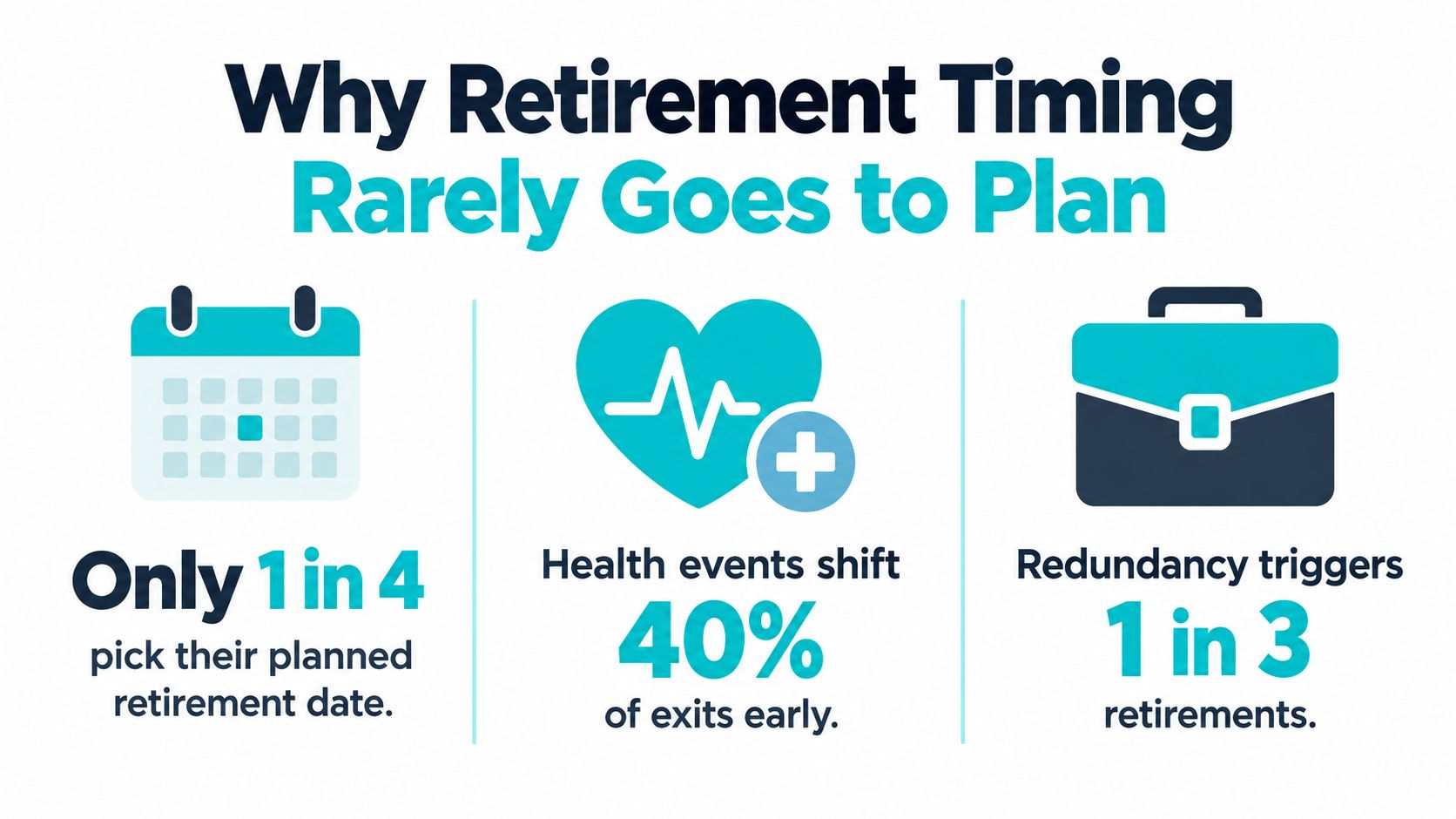
156,000 Australians aged 45 and over left the labour force for retirement in 2024–25, but people still working expected to retire at an average age of 65.6 years, compared with an actual average retirement age of 63.8 years, according to the Australian Bureau of Statistics retirement data. That gap is the clearest warning that retirement isn't a date you circle on the calendar.
If you're learning how to transition to retirement, plan for movement rather than certainty. Your health, job, family responsibilities, housing costs and appetite for work can all change the route. The right roadmap tests what happens if you keep working full-time, reduce your hours or leave earlier than expected, then shows how each decision affects super, tax, cashflow and government support.
Why Retirement Timing Rarely Goes to Plan
A retirement plan built around one date is fragile. Employment can end early, health can change, or caring responsibilities can increase. If that happens, the income you expected may disappear before your super and other resources are ready.
The ABS retirement and retirement-intentions release records 4.5 million retirees aged 45 and over. It also shows that men who retired during 2024–25 did so at an average age of 64.9 years, compared with 62.7 years for women. Retirement does not follow one standard timetable, so your plan must allow for different stopping dates, work patterns and household needs.
Build three workable routes
Set up three scenarios before you reduce your hours or leave work:
- Target-date scenario: You remain in full-time work until your intended retirement date, receiving your expected salary and employer super contributions.
- Part-time scenario: You reduce your hours, replace part of your salary with an income stream and continue contributing at a lower level.
- Early-exit scenario: You stop work sooner because of redundancy, health changes or family responsibilities, drawing on savings and super earlier than planned.
Test each route against your housing tenure. A mortgage or rent payment can make an early exit far more difficult than the same income change for a homeowner with no debt. Include the effect on household spending, not just the effect on your super balance.
These are working decisions, not theoretical variations. Reduced hours can lower contributions, extend the period of investment drawdown and change potential eligibility for government support. They can also alter your tax position, household cashflow and the timing of pension applications. For couples, model separate stopping dates rather than assuming both partners will finish work together.
Practical rule: Ask, “What happens to our plan if one of us stops working earlier than expected?” Then set a clear action for each scenario, such as building cash reserves, reviewing insurance or delaying a large housing commitment.
Modelling Your Retirement Cashflow Before You Commit
A retirement cashflow model turns an emotional decision into a sequence of manageable choices. Start with your household spending, not your super balance. Separate essential costs, such as housing, utilities, food, insurance and healthcare, from lifestyle spending, such as travel, hobbies, gifts and discretionary upgrades.
Then map the money coming in under each work scenario. Include salary, employer super contributions, personal contributions, investment income, super withdrawals and any government payments you may qualify for. Don't assume both partners have matching balances or contribution histories. One partner may have taken time out for caring responsibilities, worked part-time or accumulated less super, which can materially change the household result.
A simple three-scenario worksheet
Create three columns labelled work to target date, part-time wind-down and earlier-than-planned retirement. For each column, record:
- Expected employment income and the date it changes.
- Super contributions before work reduces or ends.
- The annual amount required from savings or super.
- Essential spending and optional spending.
- Housing costs, including mortgage repayments or rent.
- Potential government support and the assumptions behind it.
- The point at which cash reserves would become uncomfortable.
Among Australians aged 65 and over with an income source, 57% relied mainly on a government pension or allowance, while 21% relied mainly on superannuation, an annuity or a private pension, based on Australian Institute of Health and Welfare data from the ABS 2018 Survey of Disability, Ageing and Carers. The AIHW income and finances overview also recorded wages and salary as the main source for 8% of this group.
| Income source | All Australians 65+ | Retired men | Retired women |
|---|---|---|---|
| Government pension or allowance | 57% | 49% | 44% |
| Superannuation, annuity or private pension | 21% | 30% | 17% |
| Wages and salary | 8% | Not specified in the cited data | Not specified in the cited data |
The same AIHW data shows why household planning needs more than a single combined balance. In 2018–19, superannuation was the main income source for 30% of retired men but only 17% of retired women. Those figures don't predict your outcome, but they do justify checking each person's balance, insurance, contribution history and likely income separately.
You can begin with a basic retirement income calculator, then have the assumptions tested before changing your work arrangements. Advice becomes particularly valuable when the scenarios produce different answers about whether you can reduce hours, when to start an income stream or how much cash to hold outside super.
Choosing Between a TTR Strategy and an Account-Based Pension
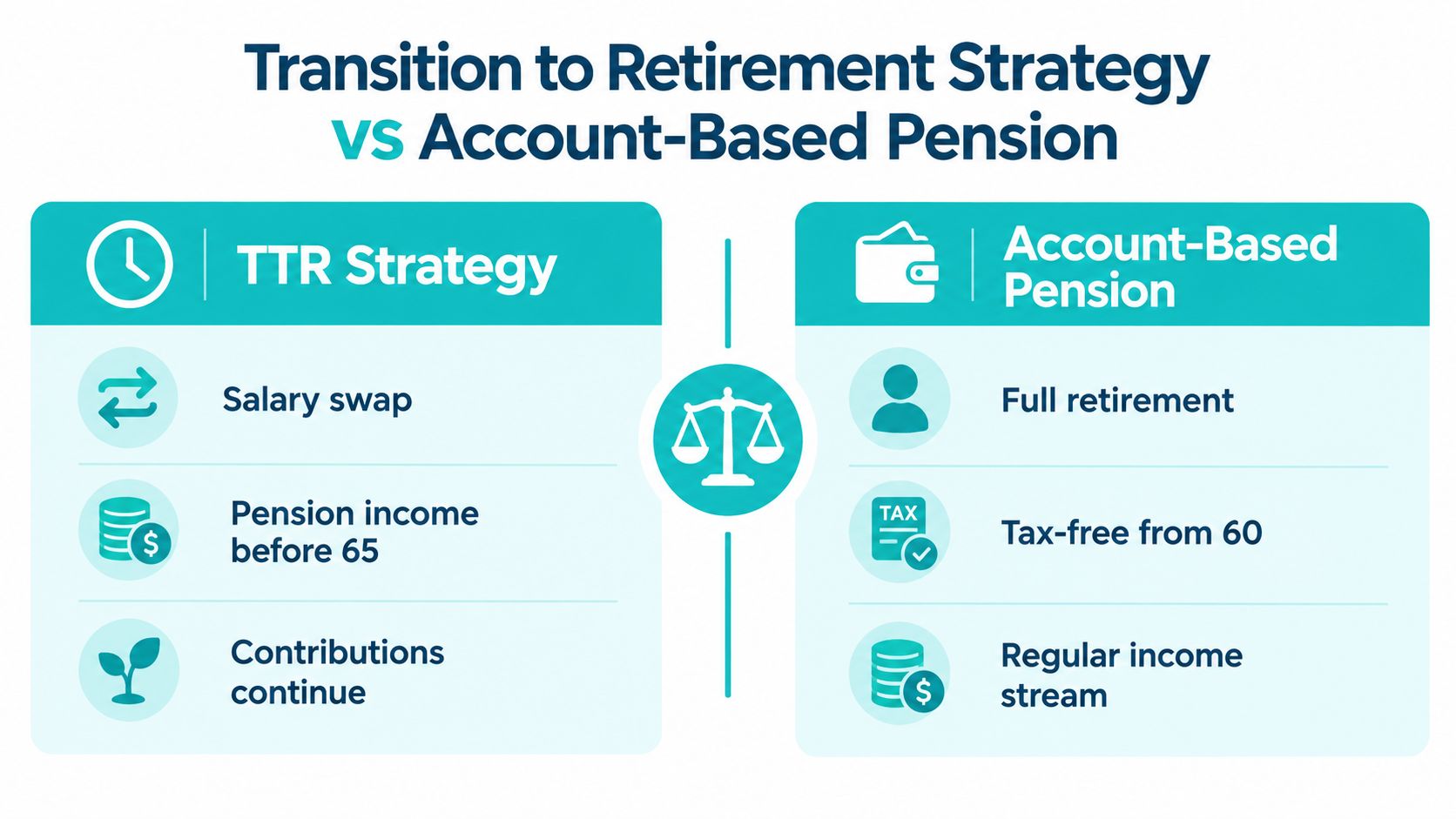
A transition-to-retirement strategy and an account-based pension can both provide income from super, but they serve different stages of working life. A TTR strategy is designed for someone who is still working and wants to replace part of their salary with super income. An account-based pension generally suits someone who has retired and needs a regular income stream from their super.
How the two structures differ
| Question | TTR strategy | Account-based pension |
|---|---|---|
| Are you still working? | Usually, yes | Usually, no longer working |
| Main purpose | Replace part of salary while hours reduce or contributions continue | Provide ongoing retirement income |
| Access | Preservation age and a condition of release apply | Access depends on meeting the relevant super rules |
| Tax treatment | Depends on age and payment rules | A taxed-fund payment is generally tax-free from age 60 |
| Main trade-off | Adds flexibility but requires careful coordination | Provides retirement income but draws down invested capital |
A TTR strategy generally requires you to have reached your preservation age and satisfied a condition of release before accessing superannuation. For a taxed super fund payment, someone aged 60 or over generally receives the payment tax-free because it is treated as non-assessable, non-exempt income. Someone who has reached preservation age but is under 60 may receive amounts tax-free up to the low-rate cap, while amounts above that cap are generally taxed at 15%. The Australian Taxation Office explains the payment rules here.
Consider a 58-year-old reducing work hours. A TTR income stream may help replace some of the salary lost through the reduction, while employment and employer contributions continue. But the person must check the access rules, payment limits, tax treatment and whether drawing super now undermines the longer-term balance.
Now consider a 62-year-old who has retired. The question is no longer how to swap salary for pension income. It is how much income the account-based pension should provide, how much cash should be held separately and how withdrawals fit with investment risk and potential government support.
A TTR strategy is useful when it solves a real cashflow or tax problem. It isn't automatically useful because someone has reached preservation age.
The common trap is treating every super withdrawal as equivalent. The same withdrawal can have a different tax outcome depending on age, employment status, preservation age and the structure of the income stream. Use TTR when reduced work is part of a deliberate plan and the numbers justify the administration. If you're fully retired, an account-based pension is usually the more direct structure to assess.
Getting Tax, Caps and Centrelink Working Together
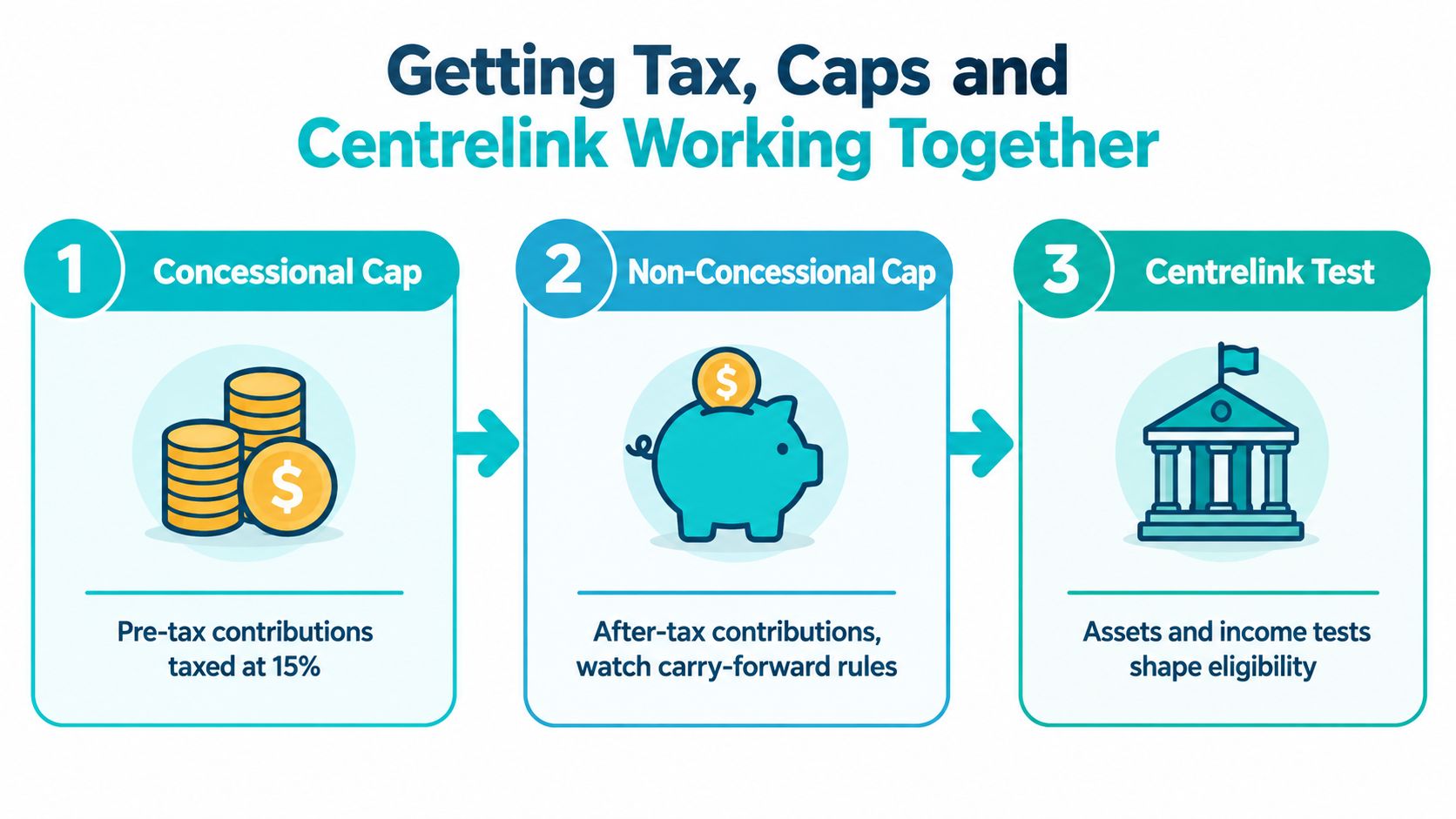
The order of your decisions matters. A final employer contribution, salary sacrifice arrangement, personal deductible contribution or redundancy payment can all affect how much room remains inside your super contribution caps. Starting a pension can also change the balance of assets and income considered in government-support assessments.
For the 2025–26 financial year, Australia's general concessional contributions cap is $30,000. Employer super contributions count towards it, as do personal contributions for which you claim a tax deduction. Eligible unused concessional-cap amounts from previous years may be carried forward, so your available limit may be higher than the general cap. The annual non-concessional contributions cap is $120,000, although the amount may be higher under the bring-forward arrangement or nil where your total super balance was at least $2 million on 30 June 2025. The ATO's personal super contribution guidance sets out these limits.
Check the cap before changing work
Suppose you plan to reduce your hours and make a final salary-sacrifice contribution. First, add the employer contribution already expected for the financial year. Then add salary sacrifice and any personal contribution for which you intend to claim a deduction. If a redundancy payment or business-sale proceeds will fund an after-tax contribution, check the non-concessional position separately.
Carry-forward rules can create useful scope, but they don't remove the need to check eligibility and past balances. A rushed contribution near the end of employment can create excess-contribution tax or force you to reverse a decision that looked sensible on paper.
Centrelink needs its own calculation
Don't treat Age Pension eligibility as an afterthought. The value and structure of your super, pension income, other investments, home ownership and household circumstances can affect the assets and income tests. The right decision may involve comparing the result of contributing more, retaining cash, starting an income stream or paying down debt.
Before altering your hours or starting a pension, prepare this checklist:
- Confirm contribution totals: Include employer contributions, salary sacrifice and deductible personal contributions.
- Check super balances: Establish whether the non-concessional cap, bring-forward rules or total-balance restrictions apply.
- Test payment timing: Compare the tax outcome before and after age 60.
- Model support eligibility: Use the Age Pension eligibility information as a starting point, then check your personal circumstances.
- Record assumptions: Note your partner's income, assets, housing position and intended work date.
The practical recommendation is simple. Don't make a contribution, commence an income stream or resign from work until the tax and Centrelink consequences have been modelled together. A decision that improves one part of your plan can weaken another.
Housing Decisions and the Downsizing Reality Check
Your home may matter more to retirement security than a small improvement in investment returns. Housing costs continue after work stops, and renters and mortgage holders don't have the same starting point as people who own their home outright.
In 2023, 66% of recent retirees owned their home outright, while 12% were renters, double the renter share recorded in 2003. Recent retirees who owned their home outright had average total wealth of about $1.66 million, compared with approximately $277,000 for those renting privately. The SBS report on housing and retirement provides this comparison.

Don't downsize by default
Downsizing can release capital and reduce maintenance, but selling and buying also brings transaction costs, moving expenses and the risk of losing familiar services or community support. A smaller property may be cheaper to maintain but unsuitable for visitors, mobility needs or the lifestyle you want.
Model three housing choices:
- Stay put: Include mortgage repayments, maintenance, rates, insurance and likely accessibility changes.
- Downsize locally: Include selling costs, purchase costs, renovations, storage and the impact on your daily routine.
- Relocate: Compare housing costs, healthcare access, transport, family proximity and social connections. If a move interstate is under consideration, practical resources such as budgeting for a Victoria move can help you identify moving expenses that don't appear in a super projection.
Renters need a separate plan. Model rent as a core retirement expense, not a temporary inconvenience, and test what happens if housing costs rise while investment income or super withdrawals fluctuate. Mortgage holders should check whether repayments continue after employment ends and whether clearing debt would leave enough liquid capital.
People whose home ownership was interrupted by divorce, caring responsibilities or insecure employment shouldn't be pushed towards a generic downsizing answer. Compare downsizing in retirement with staying, renting or relocating based on the full cashflow, not just the sale price.
The right home is the one that keeps your essential costs manageable and supports the life you intend to live. It isn't automatically the smallest or most expensive option.
Insurance, Estate Documents and Beneficiary Cleanups
The first pension payment shouldn't be the first time you check your insurance and estate documents. Employment changes can alter the level of life, total and permanent disability, income protection or other cover you need, particularly if salary is about to reduce or stop.
Start with insurance held inside super. Ask what cover exists, what it costs, when it expires and whether it still matches your debts, dependants and health circumstances. If you stop working or stop contributing, the fund's rules may affect how cover continues. Don't cancel anything until you understand the replacement options and the consequences of losing existing terms.
Work through the documents
Use a short prompt list rather than relying on memory:
- Insurance: Is income protection still relevant if work becomes part-time? Would dependants manage if you died? Is disability cover aligned with your current work?
- Beneficiaries: Is the nomination current? Does it reflect your relationship, children and intended distribution? Is it binding, and when does it expire?
- Will: Does it match your assets, debts and preferred beneficiaries? A will alone generally doesn't control how a super death benefit is paid.
- Enduring powers of attorney: Who can make financial and personal decisions if you can't? Are the documents valid in the jurisdictions relevant to you?
- Super accounts: Can you consolidate old accounts without losing valuable insurance or creating unnecessary tax and administration issues?
A beneficiary nomination deserves particular attention because superannuation is held through the fund structure. Your will and your super nomination should work together, not tell conflicting stories. Ask your solicitor and financial adviser to coordinate the legal and financial sides rather than assuming one document overrides the other.
Set a review trigger
Review the cleanup when you reduce hours, finish employment, enter a new relationship, separate, receive an inheritance or change your housing plan. Keep copies of the documents where your attorney and family can locate them, while protecting sensitive account details.
This administrative work isn't glamorous, but it prevents avoidable confusion at the point when your household is already adjusting to new income patterns. Do it before the income stream starts, while you still have employment access, records and decision-making capacity.
Your Transition to Retirement Action Checklist and Timeline
A workable roadmap gives each decision a place on the calendar. Use these timeframes as planning prompts, then adjust them to your employment arrangements, health and household needs.
Roughly five years out
- Define the lifestyle: Write down essential spending, preferred work hours, housing goals and the activities you want retirement to fund.
- Build three scenarios: Model full-time work, a part-time wind-down and an earlier exit.
- Review super structure: Check investment settings, insurance, fees, beneficiary nominations and old accounts.
- Inspect the home decision: Compare staying, downsizing, renting and relocation using real housing costs.
- Check contribution scope: Identify whether salary sacrifice, carry-forward space or personal contributions may fit your plan.
Roughly two years out
- Refine the cashflow: Update salary, contributions, debt repayments, housing costs and planned withdrawals.
- Coordinate the household: Compare each partner's retirement date, super balance, insurance and likely government support.
- Test tax outcomes: Check whether changing hours or starting an income stream alters the result.
- Prepare documents: Refresh your will, enduring powers of attorney and super beneficiary nominations.
- Plan the work conversation: Discuss reduced hours, flexible arrangements or a staged exit with your employer early.
Roughly six months out
- Confirm dates: Record the final work date, first reduced-hours date or expected redundancy date.
- Check payments: Confirm how much income the super strategy will provide and where it will be paid.
- Prepare claims: Gather the records needed for relevant government-support applications.
- Protect liquidity: Keep enough accessible cash for transition costs, repairs, moving expenses and unexpected gaps.
- Recheck insurance: Don't let cover lapse while your employment and income are changing.
On the day the income stream starts
- Confirm the first payment: Check the amount, frequency and destination account.
- Update the budget: Replace salary with the new income mix and track essential spending closely.
- Store the paperwork: Keep pension documents, tax records, nominations and advice together.
- Set a review date: Revisit the plan when work, health, housing, investment markets or family circumstances change.
The most important decision isn't choosing a perfect retirement date. It's building a plan that still works when your date changes.
Wealth Collective's Retirement Roadmap process can bring the work scenarios, super strategy, cashflow, housing decisions and government-support considerations into one plan. A free 10-minute introductory call is a sensible first step if you know your intended timeline but haven't tested what happens when life takes a different turn.
Wealth Collective helps Australians map the move from full-time work to part-time work or full retirement, coordinate super and cashflow decisions, and organise a practical Retirement Roadmap. Visit Wealth Collective to book your free 10-minute introductory call and start testing the transition that fits your household.