Business hours
Monday to Friday (8.30AM - 5PM)
Weekend (Closed)



You might be doing all the right things on paper and still feel stuck.
A Perth couple with a mortgage, decent incomes and growing super balances often reaches the same point. They're earning well, but every big decision seems to compete with the next one. Should they put extra cash into the loan, build investments outside super, top up super for tax efficiency, review insurance, or finally get serious about retirement planning? Another household might be closer to retirement and asking a different version of the same question: are we on track, or just hoping we are?
That's where many people start looking for independent financial advice in Perth. Not because they want jargon or a thick report. They want clarity, a way to sort priorities, and advice that fits their life rather than a product shelf.
Navigating Your Financial Future in Perth
The challenge isn't only financial complexity. It's also knowing who to trust.
Australia's financial advice industry is projected to be worth $6.1 billion in 2026, yet adviser numbers have dropped from over 26,000 in 2019 to less than 16,000 in January 2025 after major professional standards changes, according to IBISWorld's industry outlook. For clients in Perth, that tighter market has changed the search. People increasingly want one adviser who can help across superannuation, retirement, loans, investments and SMSFs, instead of juggling fragmented providers.
Why this matters for Perth households
When advice is hard to compare, many people default to whoever is closest, whoever a friend mentioned, or whoever sounds confident in a first meeting. That often leads to the wrong question.
The better question is not, “Who's the best adviser?” It's, “What advice model suits my situation right now?”
Someone building private wealth building through property may need advice that coordinates debt, cash flow, risk protection and ownership structure. A pre-retiree may need retirement income modelling and super strategy. A young family might only need targeted help with insurance and mortgage prioritisation.
Good advice reduces noise first. Products come later, if they're needed at all.
A clearer way to approach the search
The households who get the most value from advice usually start with three practical questions:
- What decision is holding me up most right now: debt, super, retirement, investing, insurance, or all of them together?
- Do I need a full long-term advice relationship: or one focused piece of work to solve a specific issue?
- Can the adviser explain trade-offs clearly: without pushing me towards one product or one institution?
If you can answer those, the field narrows quickly. That's also why a structured advice process matters. It gives you a way to move from uncertainty to action without feeling like you've signed up to something vague or open-ended.
What Independent Advice Really Means for Your Money
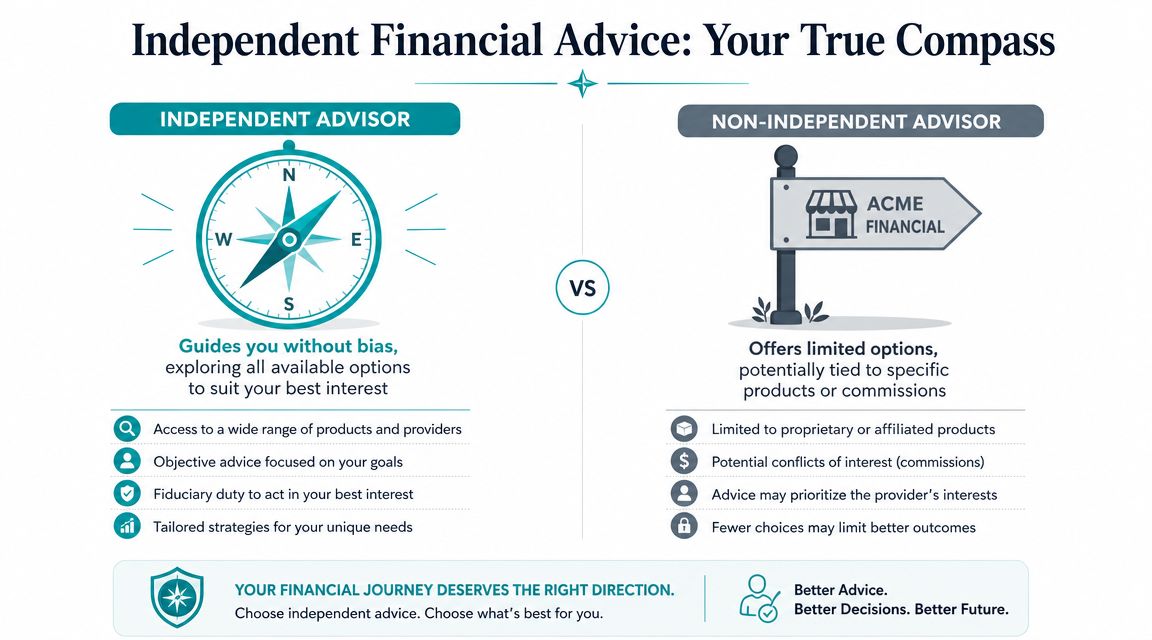
In Australia, independent is not a marketing word. It has a strict legal meaning.
An adviser can only use that label if they don't receive commissions, volume-based payments, or other product issuer benefits that are not rebated to clients, and if their business model is free of product-provider links and conflicts of interest. Anyone giving financial product advice must also hold an AFS licence or be authorised under one, as outlined in this explanation of independent financial advice and licensing in Australia.
The easiest way to think about it
Think of an independent adviser like an architect. They start with your needs, your block, your budget and your goals, then design the right solution.
A non-independent model can be closer to a project home display. It may still be useful. It may still solve a problem. But the range of options can be narrower, and the business model may influence what gets recommended.
That doesn't mean every non-independent adviser gives poor advice. It means you should understand the structure before you assume the advice is product-neutral.
Why the distinction matters
If an adviser is legally independent, the advice model is designed to remove common conflicts around product payments and issuer relationships. For clients, that can matter most when the decision itself is nuanced.
Examples include:
- Super versus mortgage decisions: where there isn't a universal answer
- Insurance reviews: where you need cover that fits your actual cash flow
- Retirement planning: where the right strategy depends on tax position, timing and income needs
- One-off strategic questions: where you may not need a full ongoing arrangement
Canstar notes there are just over 30 independent financial advisers listed on the PIFA directory across Australia, which shows how uncommon the independent segment is, as outlined in Canstar's guide to independent financial advisers in Australia.
What to verify before you engage anyone
Don't rely on a website headline alone. Check the basics yourself.
- Financial Advisers Register: confirm the adviser is authorised to provide advice
- Financial Services Guide: review how they're paid, what services they offer and any conflicts
- Scope of service: see whether they handle strategy only, implementation, ongoing reviews, or a mix
- Advice model: ask directly whether they are legally independent, not just “independent in approach”
If an adviser can't explain their independence status in plain English, keep looking.
Common Services a Perth Financial Adviser Offers
Clients don't hire an adviser because they want “financial planning”. They hire one because a real-life problem needs solving.
That might be a retirement date that feels too close. It might be a mortgage that's squeezing flexibility. It might be insurance gaps, multiple super accounts, or money sitting in cash because nobody has made a decision yet.
Advice areas that usually matter most
A Perth financial adviser will often work across several connected areas rather than one isolated topic.
| Service area | What it helps you do |
|---|---|
| Retirement planning | Turn savings and super into a workable income strategy |
| Superannuation advice | Improve structure, contributions and investment alignment |
| Investment strategy | Build and manage investments around goals and risk tolerance |
| Debt reduction | Decide how debt repayment fits with wealth-building priorities |
| Personal insurance | Protect income, family and long-term plans from disruption |
| Small business advice | Coordinate personal and business decisions more effectively |
The key is integration. A super strategy without debt context can miss the point. An investment plan without insurance or cash flow awareness can create pressure later. Retirement planning without a clear drawdown framework often leaves people uncertain even when they've accumulated substantial assets.
Full-service advice versus episodic advice
Many articles get too simplistic on this point. Not everyone needs an extensive ongoing arrangement.
PIFA and ASIC's broader framing of independent advice highlight an important point. Independence isn't just a trust signal. It's a business model that can suit clients who want episodic or one-off advice on a specific issue rather than a permanent adviser relationship, as explained by PIFA's guidance on independence and advice models.
That can be useful if you want help with one decision such as:
- Consolidating and reviewing super: before changing jobs or nearing retirement
- Checking insurance cover: after having children or taking on a bigger mortgage
- Working out contribution strategy: when income rises
- Sense-checking retirement timing: before moving from accumulation to drawdown
What tends to work and what doesn't
What works is advice tied to a decision.
What doesn't work is paying for a broad plan that never gets implemented because the recommendations were too generic, too complex, or didn't reflect how you live.
Some firms structure their services around the life problem being solved. Wealth Collective, for example, groups advice into Protection Plus, Guided Growth and Retirement Roadmap, which is a practical way to match the service to the client's stage and priorities.
A good adviser should be able to tell you, early on, whether you need a broad plan, a narrow project, or just a single strategic piece of work.
How Financial Advice Applies to Your Life Stage
The right advice model becomes clearer when you look at the problem through a life-stage lens.
Australian inflation was 2.9% on a trimmed mean basis in early 2026, and households are still dealing with a restrictive cash rate environment. That's why many Perth clients are facing sequencing decisions around mortgage reduction, super contributions and insurance funding, not just investment selection, as discussed in this piece on 2026 financial priorities and advice sequencing.

Young professionals in Fremantle
They've bought recently, repayments are higher than expected, and both are contributing to super through work. They also want to start investing outside super.
The mistake here is chasing three priorities equally. In practice, most households in this stage need a clear order. Emergency liquidity, debt pressure, insurance basics and super strategy all affect each other. If the mortgage is restricting cash flow, that usually needs attention before an ambitious investment plan.
A targeted piece of advice can be enough here. They may not need an ongoing relationship. They may need a framework for the next few years and clarity on what to ignore.
High-income earners in Dalkeith
This client profile often has a different problem. Income is strong, but the finances are messy. There may be bonuses, multiple accounts, legacy investments, family commitments and tax-sensitive decisions around super or ownership structures.
The risk isn't inactivity. It's fragmented action.
One part of the portfolio gets attention, another doesn't. Insurance sits untouched for years. Cash accumulates without a plan. Good advice at this stage often acts like a central strategy layer, so the client can make decisions with purpose instead of reacting quarter by quarter.
High income doesn't create financial clarity on its own. It just gives you more decisions to get right.
Small business owners in Osborne Park
Business owners tend to delay personal planning because the business takes all the oxygen. That's understandable, but it creates exposure.
They often need advice that connects business cash flow, personal wealth, debt, succession thinking and asset protection. Retirement may depend on a sale, a wind-down, or ongoing income from business assets. Insurance needs are usually more complex too, especially if family lifestyle relies heavily on one owner's earning capacity.
This is also where practical administration matters. If you're trying to bring order to key records before a major life transition, Family Folder's guide to document organization is a useful plain-English resource for getting essential documents into one place.
Pre-retirees in Mandurah
These clients usually ask one of two questions. “Can I retire soon?” or “How do I know I won't run short?”
The answer rarely sits in one account balance. It depends on spending expectations, super structure, debt, partner circumstances, investment risk, timing, and how income will be drawn over time.
At this stage, broad reassurance isn't enough. People want modelling, trade-offs and a process. They need to understand whether to accelerate debt reduction, alter contribution strategy, simplify investments, or prepare income streams for the transition out of work.
Understanding Adviser Fees and Payment Structures
Fees make people nervous because they're often explained badly.
A good fee discussion should feel straightforward. You should know what you're paying for, when you're paying it, and what happens next. If the explanation feels slippery, the relationship probably will too.
The common ways advice is priced
Most advice fees sit in one of these buckets:
- Initial advice fee: usually for the research, analysis and preparation of your strategy or formal recommendations
- Project fee: used when the work is limited to a defined issue, such as super, insurance or retirement readiness
- Ongoing service fee: where regular reviews, implementation support and adjustments continue over time
It's comparable to building work. Sometimes you need a full design and long-term project oversight. Sometimes you only need a specialist to solve one problem and hand you a clear plan.
The document you should always read
In Australia, anyone providing financial product advice must hold an AFS licence or be authorised under one, and their Financial Services Guide must disclose fees, commissions and potential conflicts. That makes the FSG one of the most important documents in the process, as explained in this guide to financial adviser fees in Perth.
Before you commit, read it carefully and ask direct questions such as:
- What exactly is included in the initial fee
- What implementation work is extra
- Whether ongoing service is optional or assumed
- How often reviews occur and what they cover
Practical rule: If you can't explain the fee structure back to someone else after the meeting, ask again before signing anything.
What transparent pricing looks like
Transparent pricing isn't just a dollar figure. It's a clear scope.
You should be able to tell whether the adviser is charging for strategy, implementation, ongoing management, or all three. You should also understand whether the service is appropriate for your actual need. Paying for full ongoing service when you only need one-off strategic advice is just as unhelpful as under-scoping a complex retirement brief.
Your Step-by-Step Guide to Engaging an Adviser
For many, the hardest part is starting. Not because the process is impossible, but because it feels unknown.
The easiest way to reduce that friction is to know what a normal engagement should look like. A clear process removes a lot of the anxiety around independent financial advice in Perth.
A simple five-step journey
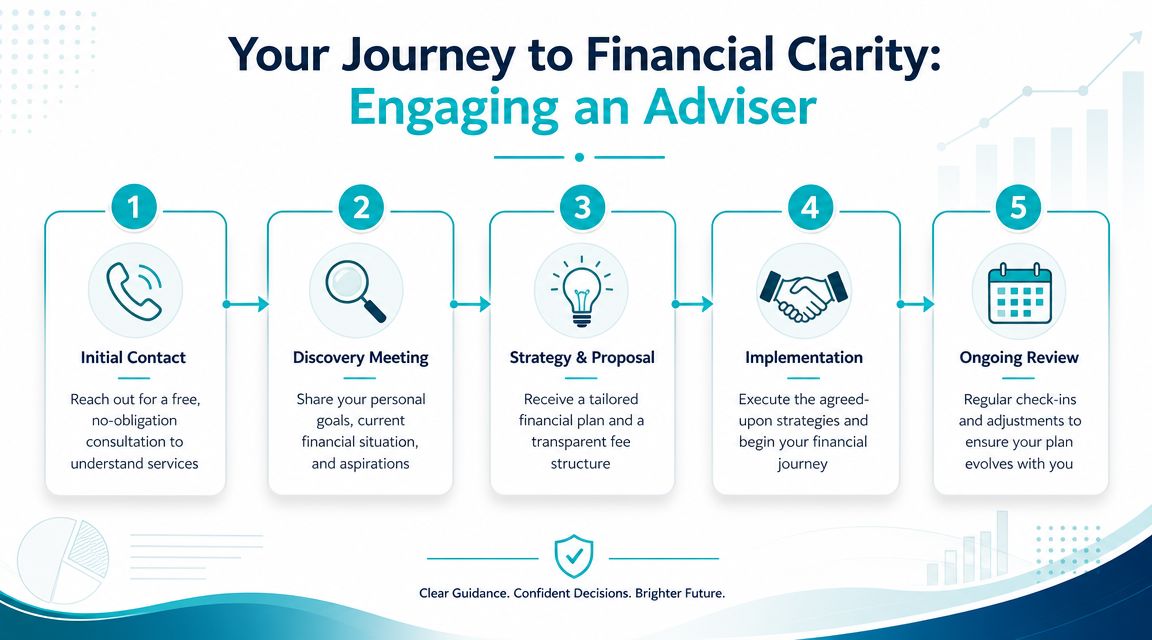
Initial contact
This should be low-pressure. You outline the issue, the adviser explains their model, and both sides decide whether there's a fit. If you're still comparing firms, a practical shortlist can help. This overview of the best financial advisers in Perth is one example of how to narrow the field.Discovery meeting
During this meeting, comprehensive fact-finding takes place. Income, debts, assets, super, insurance, goals, timeframes and concerns all come into focus. A good adviser listens more than they talk at this stage.Strategy and proposal
You should receive advice that addresses your problem directly. Not a generic template. Not a shopping list of products. A coherent strategy with trade-offs explained in plain language.Implementation
Momentum is key. Advice only has value when it's put into action. That may involve account changes, contribution adjustments, insurance applications, investment changes or debt strategy execution.Ongoing review
Some clients need this. Some don't. If your situation is changing, ongoing reviews can keep the plan aligned. If the initial issue was narrow and self-contained, you may only need ad hoc check-ins later.
What to bring to the first real meeting
You don't need perfect records to start, but these help:
- Recent super information: including balances and fund details
- Loan details: especially if debt reduction is part of the brief
- Insurance summaries: whether inside or outside super
- A rough cash flow picture: even if it's approximate
- Your main questions: written down so nothing gets lost in conversation
The best client experiences usually come from a process that is organised, transparent and paced properly. A free introductory call can be useful because it lets you test fit before committing to the deeper work.
Your Perth Adviser Checklist and Red Flags
The final check is simple. You want an adviser who welcomes scrutiny.
If someone gets vague when you ask about fees, independence, scope or process, that's useful information. Good advisers don't avoid these questions because they answer them every day.
Questions worth asking
- Are you legally independent: under the Australian definition, or are you using the term more loosely?
- Who holds the licence: and are you an authorised representative under it?
- What kind of clients do you usually help: and where would my situation fit?
- Do I need ongoing advice: or can this be handled as a one-off or project engagement?
- How are your fees structured: and what is excluded?
- What does implementation involve: and who handles it?
- How will progress be measured: over time?
If you want a broader framework for vetting options, this guide on how to choose a financial advisor is a useful companion.
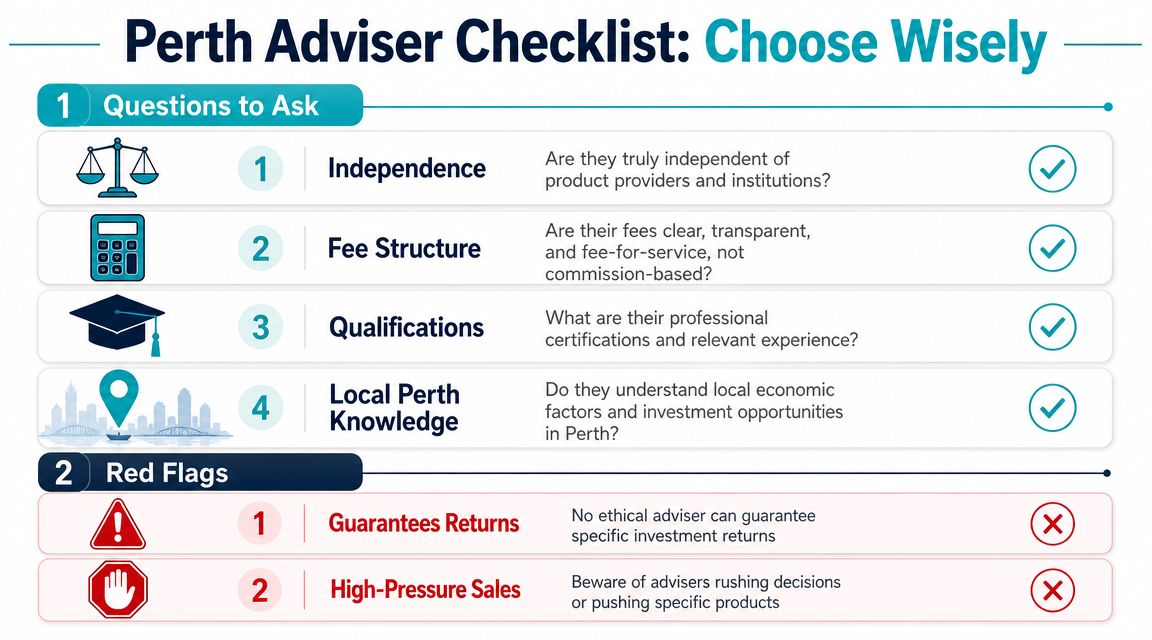
Red flags that should slow you down
| Red flag | Why it matters |
|---|---|
| Pressure to act quickly | Good advice should stand up to review and reflection |
| Vague answers about fees | Confusion early usually becomes frustration later |
| Heavy focus on one product | Strategy should come before product selection |
| No clear process | You may end up paying for motion rather than progress |
| Jargon instead of explanation | If it isn't understandable, it isn't usable |
The right adviser doesn't just recommend actions. They help you feel clear about why those actions matter and what happens next.
Choosing independent financial advice in Perth isn't only about finding someone with the right credentials. It's about finding the right model for your stage of life, your current decisions and the level of support you need.
If you want a practical next step, Wealth Collective offers a straightforward way to start with an introductory call. It's a simple opportunity to discuss your situation, understand which advice model fits, and decide whether a broader plan, a focused project, or no further action is the right move.