Business hours
Monday to Friday (8.30AM - 5PM)
Weekend (Closed)



You've got a written SMSF investment strategy. Your auditor has accepted it. The fund owns a couple of properties, some shares and cash, so it feels organised.
Then you check the document's date. It hasn't been updated since 2019. Your members are closer to retirement, the property weighting has grown, pension payments may be approaching, and the strategy no longer describes how the fund is invested. That's not a paperwork problem. It's a decision-making problem.
An SMSF investment strategy should tell trustees what the fund is trying to achieve, why each asset belongs in the portfolio, how the fund will meet its obligations and when the plan must change. A compliant document can still support a poorly diversified portfolio. The job is to make the strategy useful before the auditor, the ATO or a difficult market forces the issue.
What an SMSF Investment Strategy Must Actually Cover
A Perth couple with two rental properties and a term deposit may believe their SMSF strategy is in good shape because it exists in writing. But if that strategy was last reviewed in 2019, it probably doesn't reflect their current ages, retirement timetable, rental income, debt position, liquidity needs or exposure to property. The document has drifted away from the portfolio.
The ATO describes an investment strategy as the fund's plan for making, holding and realising assets in line with investment objectives and retirement goals. It must be prepared, implemented and reviewed regularly, and it should account for each member's circumstances, liquidity, diversification and insurance needs. See the practical explanation of what an SMSF is before treating the strategy as a standalone document.
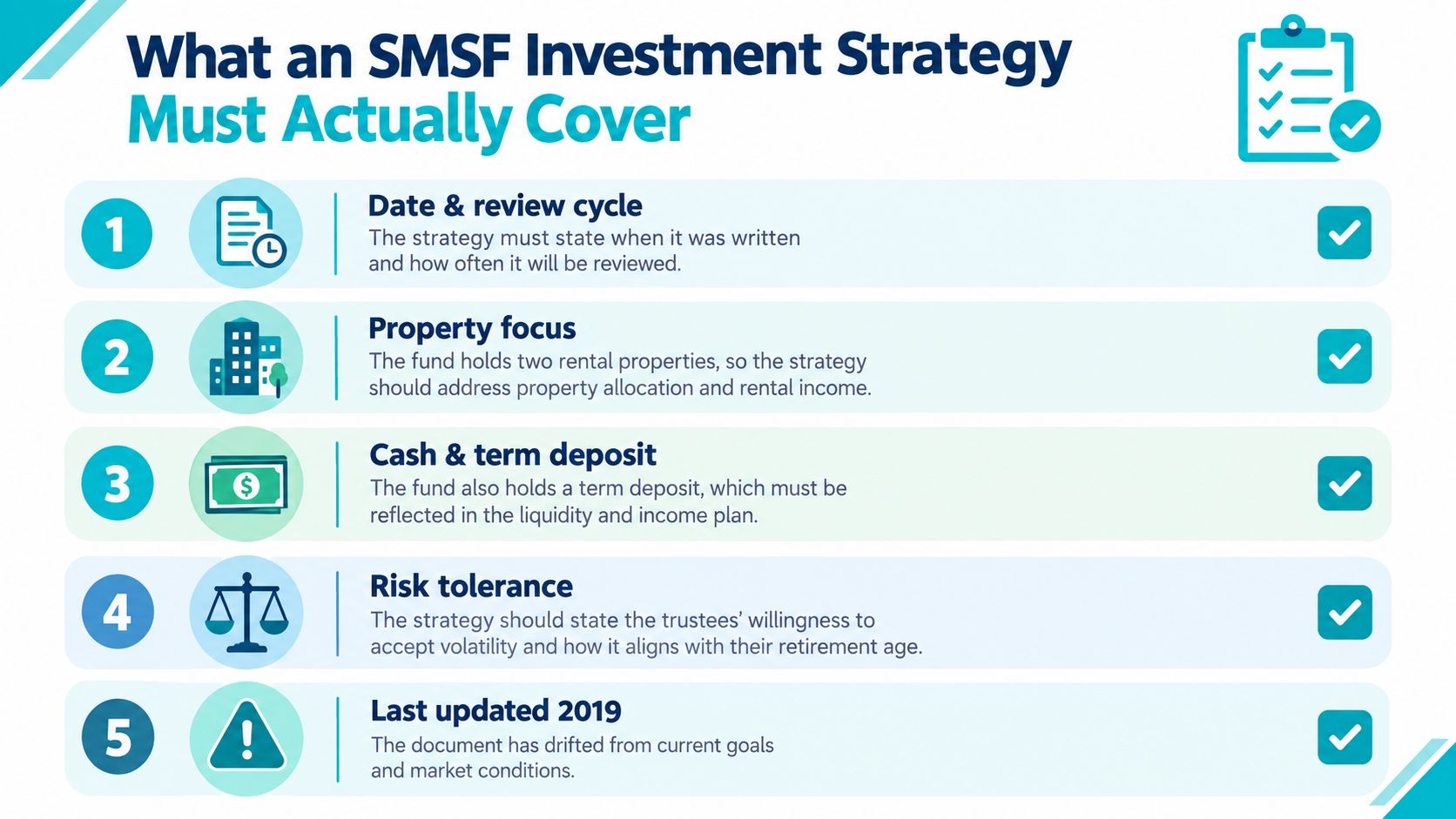
The seven questions trustees must answer
Under SIS Reg 4.09, the strategy needs to consider:
- Diversification. Does the portfolio spread risk across suitable investments, or does it rely heavily on one property, issuer, sector or market?
- Risk and return. What risks are acceptable, and what level of return is needed to meet retirement objectives?
- Liquidity. Can the fund access cash when it needs to pay expenses, tax, insurance, pension payments or loan obligations?
- Insurance. Has the fund considered whether insurance should be held for each member?
- Member age and benefits. Are the investment choices appropriate for the members' ages, accumulation or pension status and expected benefit payments?
- Existing liabilities. Can the fund discharge everything it already owes?
- Future liabilities. Can it meet obligations that are reasonably expected to arise?
The ATO also expects trustees to consider cash-flow needs and the fund's ability to pay liabilities. A strategy that says “property is suitable for long-term growth” but ignores rental vacancies, repairs, pension withdrawals and the difficulty of selling a property is incomplete in substance, even if the document looks polished.
Practical rule: If the strategy wouldn't help you decide whether to buy, sell, retain or rebalance an asset, it's too vague.
A narrow portfolio deserves more explanation, not less. If the fund is heavily invested in property, trustees should document why that exposure suits the members, how concentration risk is managed and where liquidity will come from. Trustees dealing with substantial retirement assets may also find a specialist retirement fund loss lawyer useful when investigating losses or disputes outside ordinary investment planning.
The strategy should sit on the desk during investment decisions. It shouldn't be a once-off compliance artefact retrieved only for the annual audit.
Setting Retirement Objectives That Drive the Strategy
Start with the life you're funding, not the investments you happen to own. A useful strategy separates lifestyle objectives from structural objectives.
Lifestyle objectives include the income members want in retirement, when paid work is expected to stop, whether capital should pass to beneficiaries and whether members want flexibility for travel, health costs or family support. Structural objectives describe how the fund should behave, including the importance of capital preservation, the drawdown members could tolerate in a bad market and whether borrowing or gearing is acceptable.
A 48-year-old member still accumulating super usually has more time to recover from market falls than a 62-year-old member starting a transition-to-retirement income stream. That doesn't automatically justify an aggressive portfolio. The younger member may have high debt, low tolerance for volatility or a retirement goal that requires more certainty. The older member may still need growth because retirement could last for decades, but near-term cash-flow needs deserve greater weight.
Turn preferences into tests
“Moderate risk” isn't a usable instruction. Write down what it means.
You might define the risk profile through:
- Volatility tolerance: the level of portfolio movement the member can accept without abandoning the plan.
- Concentration tolerance: the maximum exposure to one asset class, property, issuer or tenant.
- Drawdown tolerance: the fall in portfolio value the member could withstand while continuing the strategy.
- Income gap: the difference between expected retirement spending and income from super, investments and the Age Pension.
- Time horizon: the period before benefits commence and the period over which benefits are expected to continue.
The strategy should also contain dates. “Retire at some point” can't be reviewed. “Reduce paid work by a specified retirement date and fund a defined income objective from super and other assets” gives trustees something to test.
| Member Stage | Time Horizon | Primary Objective | Target Real Return | Maximum Drawdown Tolerance |
|---|---|---|---|---|
| Accumulating member aged 48 | Longer accumulation period | Build retirement capital while accepting measured growth risk | Set after modelling income needs, contributions and inflation | A documented fall that won't cause panic selling |
| Transition-to-retirement member aged 62 | Nearer-term income commencement | Balance continued growth with reliable access to benefits | Set around expected withdrawals and preservation of capital | A smaller fall where withdrawals are already required |
| Retirement-phase member | Ongoing retirement funding | Fund pension payments and preserve appropriate capital | Set around income needs, longevity and liquidity | Must reflect the effect of withdrawals during market weakness |
Use the ATO's guidance on setting an SMSF investment strategy as the compliance foundation, then make the objectives specific to your members. The question is not whether the fund can tolerate a theoretical loss. It's whether the members can stay invested, pay their obligations and continue withdrawals if that loss arrives at the wrong time.
For a broader retirement planning sense-check, review how much super you may need to retire. The strategy becomes far more useful when it connects the portfolio to a measurable retirement income requirement rather than a generic risk label.
Designing an Asset Allocation That Fits Your Risk Profile
SMSFs commonly favour control, liquidity and direct ownership. ASIC's REP 575 reported SMSFs holding 48% in Australian equities, 25% in cash and 16% in property, compared with APRA-regulated funds holding 27% Australian equities, 13% cash and 9% property. SMSFs held only 2% in fixed interest and 1% in international equities, highlighting a more domestic and less diversified structure. ASIC's REP 575 provides the underlying comparison.
More recent ATO data shows the same practical issue. In December 2024, listed shares represented 27.28% of SMSF assets, cash and term deposits 15.86%, unlisted trusts 13.23% and non-residential property 10.78%. Those figures don't tell you what your fund should own. They do show why a portfolio can look familiar to SMSF trustees while still carrying substantial concentration risk. The ATO SMSF statistics are useful benchmark data, not a recommended allocation.
Build the portfolio from risk, not habit
A balanced accumulation member might use an illustrative structure of 50% growth assets, 30% defensive assets, 10% alternatives and 10% cash. That's a starting framework, not a universal answer. The strategy should then set meaningful ranges and sub-limits, such as a maximum exposure to Australian equities, direct property, one issuer or one property.
| Asset Class | Diversified Growth Model | Diversified Balanced Model | Typical SMSF Allocation | Concentration Flag |
|---|---|---|---|---|
| Growth assets | Higher allocation | Moderate allocation | Often concentrated in direct shares and property | Domestic cycle and single-asset exposure |
| Defensive assets | Lower allocation | Larger allocation | Fixed interest can be limited | Insufficient downside ballast |
| Alternatives | Selective allocation | Selective allocation | May be accessed through trusts or other holdings | Complexity and valuation risk |
| Cash | Liquidity reserve | Larger liquidity reserve | Material cash exposure is common | Drag on long-term growth if excessive |
Test the proposed mix against more than one market environment. A severe global equity and property shock tests drawdown tolerance. A rapid market disruption tests whether cash and liquid holdings can fund expenses while illiquid assets remain unsold. The point isn't to predict the next crisis. It's to find out whether the trustees' stated risk profile survives an unpleasant one.
Direct property can remain appropriate, especially where the fund has a clear retirement purpose and adequate liquidity elsewhere. But trustees should understand the difference between direct ownership and diversified real estate exposure. Education about ways to discover fractional real estate can help clarify the distinction, although any investment still needs to fit the SMSF's deed, strategy and retirement purpose.
Tie asset allocation to insurance and cash flow in the same document. A fund with property, debt and pension obligations needs more than three disconnected paragraphs. It needs one operating plan.
Diversification, Cash Flow and Liquidity Rules
Diversification should be written as a set of operating rules. “The fund is diversified where appropriate” doesn't tell trustees what to do when property grows to dominate the portfolio or when a large cash balance sits idle for years.
The ATO expects the strategy to address portfolio composition, diversification, liquidity, risk, likely return and the ability to discharge existing and future liabilities. Trustees should identify the key concentration risks, including exposure to one property, one tenant, one fund manager, one company or one economic cycle.
Use ranges that force a decision
Set target allocations and practical bands across growth, defensive and cash holdings. A trustee can then identify when an investment has drifted far enough to require a decision. The ranges should be narrow enough to demonstrate planning, but realistic enough to accommodate market movement and transaction costs.
A deliberately concentrated fund isn't automatically prohibited. It does, however, need a defensible rationale. If more than 80% of the fund sits in one asset class, trustees should document why that position suits each member, what risks it creates, how the fund will access cash and what would cause the trustees to reduce the exposure. The explanation must be specific to the fund, not copied from a template.
Build the cash buffer from actual outflows
List every expected payment, then identify the assets that will fund it:
- Pension payments: Include the required drawdown and any additional income members need.
- Tax and administration: Allow for tax liabilities, accounting, audit and legal costs.
- Insurance: Include premiums and the timing of payments.
- Property costs: Budget for rates, repairs, vacancies, loan repayments and other property obligations.
- Investment commitments: Record any contractual payments or capital calls.
A useful liquidity plan separates assets by access rather than labelling everything “defensive”.
| Liquidity Tier | Examples | Typical % of Fund | Cash Flow Purpose |
|---|---|---|---|
| Immediate | Bank cash and at-call deposits | Set from forecast outflows | Pension payments, bills and urgent expenses |
| Short term | Term deposits and highly liquid listed holdings | Set from the fund's obligations | Tax, insurance and planned payments |
| Medium term | Bonds, diversified funds and listed real assets | Set from the portfolio design | Rebalancing and scheduled withdrawals |
| Illiquid | Direct property and selected unlisted investments | Deliberately limited or justified | Long-term growth and income |
The “typical” percentage must be calculated from your own expected outflows. A pension fund with substantial property needs a different cash plan from an accumulating fund receiving regular contributions. Stress-test the strategy for vacancy, delayed property sales, market falls and a sudden member benefit payment.
A strategy can state: “The trustees will maintain sufficient liquid assets to meet forecast pension payments, tax, insurance, administration and property obligations, review the cash forecast regularly, and avoid selling growth assets under distressed conditions where practical.” Then attach the forecast and update it when circumstances change.
Implementation Examples for Accumulation and Retirement
A strategy becomes easier to test when it reads like a set of decisions. Consider three fictional snapshots, not templates to copy.
The 40-year-old accumulation couple
Their priority is building retirement capital. They're still receiving contributions, have a long investment horizon and don't need the fund to pay regular benefits. Their documented allocation might use target ranges around a growth-oriented portfolio, with a defined ceiling for direct property and a separate liquidity reserve.
The important clause isn't the asset list. It's the rule that no single asset class or issuer can dominate the fund without a recorded trustee decision, and that cash must remain available for known costs. The couple might accept meaningful market volatility, but they should still document what would make them rebalance rather than sell in fear.
The pre-retirement fund at 55 to 60
This fund has a different job. The members may be preparing to reduce work, commence pensions or shift from accumulation to retirement income. Their strategy should identify which assets will fund the first withdrawals and which assets remain invested for later years.
Trustees should model the timing of pension commencement, contribution changes and potential capital gains tax when selling shares or restructuring holdings. Moving from a growth-tilted portfolio to a drawdown-aware allocation should happen because the cash-flow plan requires it, not because a market headline creates anxiety.
The retirement-phase fund
A retirement fund paying account-based pensions needs a clear income engine. It should document the payment schedule, the liquid assets supporting those payments and the process for replenishing the cash reserve through distributions, contributions where available or planned sales.
Property may still form part of the portfolio, but trustees must confront its limited liquidity. A fund can't pay a pension from a building merely because the building has a high valuation. For broader context on property ownership inside super, see Wealth Collective's guide to buying property in an SMSF.
Risk control: Protecting retirement assets involves more than choosing investments. Trustees should also consider ownership structure, insurance, liquidity, fraud controls and the consequences of a forced sale. Guidance on safeguarding assets with risk mitigation can help broaden that risk discussion.
Across all three examples, the document should state the objectives, risk profile, target allocation, acceptable ranges, liquidity rules and concentration limits. It should also record what changes would trigger a new review.
Monitoring, Rebalancing and Reviewing the Strategy
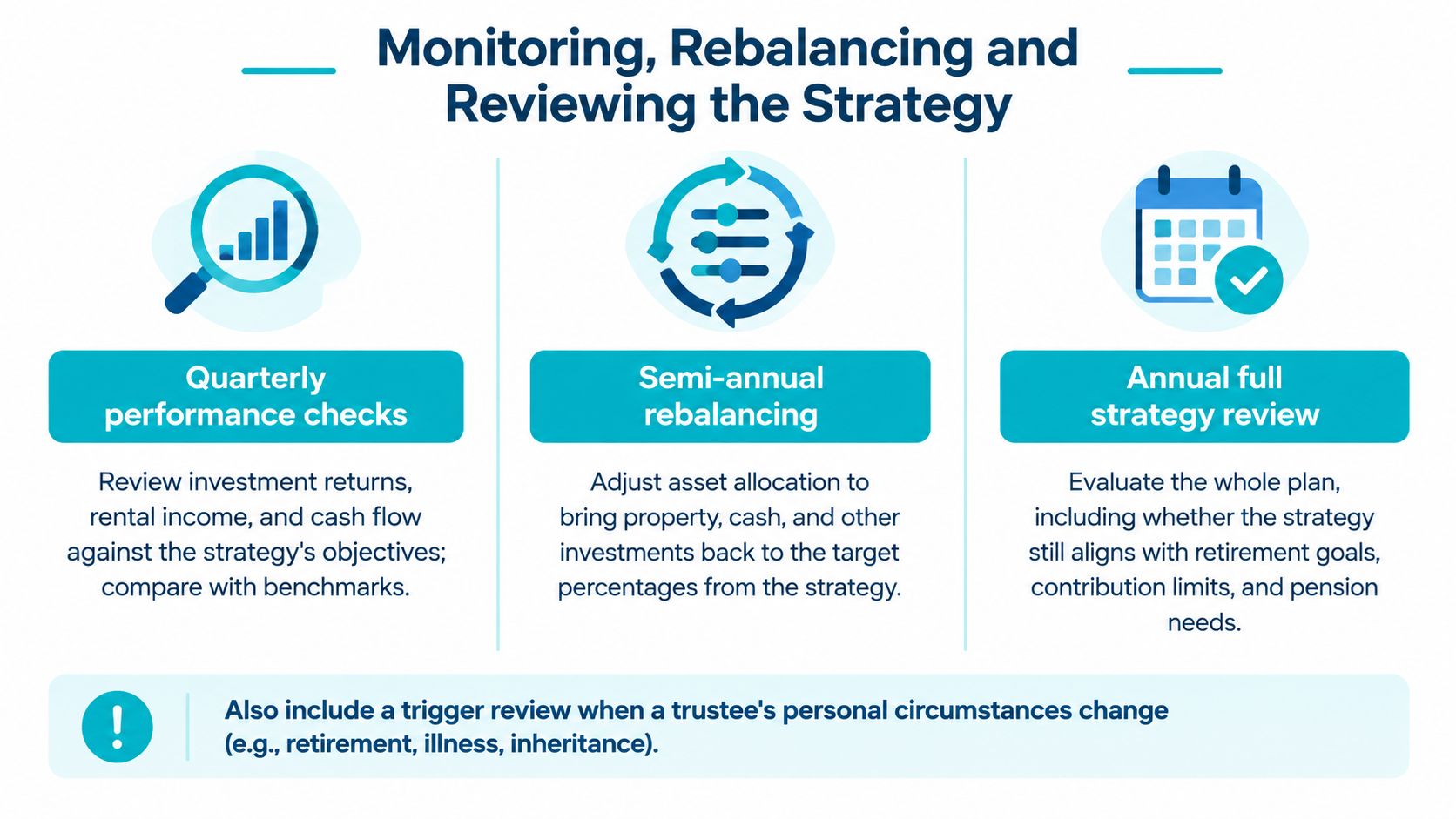
A strategy only works if trustees compare the fund's position with the plan. The ATO requires regular review, and the review should be visible in trustee minutes, not assumed from an annual signature.
Use three different review rhythms.
- Quarterly checks: Review returns, distributions, rental income, expenses, cash flow and the position of each asset against the strategy.
- Semi-annual rebalancing: Compare actual allocations with target ranges and decide whether contributions, distributions, pension payments or sales can bring the portfolio back into range.
- Annual full review: Reassess member objectives, ages, benefit status, insurance, liquidity, diversification, liabilities and the suitability of each investment.
Rebalance when the portfolio tells you to
Calendar reviews create discipline, but allocation bands create action. If an asset moves outside its documented range, trustees should record the reason for holding, reducing or adding to it. Use tax-aware methods first where suitable. Direct new contributions toward underweight assets, use investment income for rebalancing and coordinate sales with pension payments and capital gains tax planning.
An out-of-cycle review is necessary when a member retires, starts a pension, becomes ill, receives an inheritance, changes contribution patterns or experiences a material change in personal circumstances. A major market shock, property sale, new borrowing arrangement or significant change in insurance needs should also prompt a review.
Keep an audit trail
The file should contain:
- Dated strategy reviews: Record what changed and why.
- Trustee minutes: Note decisions, disagreements and the final resolution.
- Current valuations: Support the portfolio position used in the review.
- Cash-flow forecasts: Show how liabilities and benefits will be funded.
- Allocation reports: Compare actual holdings with targets and ranges.
- Supporting advice: Retain relevant tax, investment, property or insurance analysis.
The ATO's trustee obligations guidance makes the cash-flow and liability obligation clear. A strong review demonstrates that trustees considered the fund's real position, not merely that someone changed the date on an old document.
Wealth Collective helps trustees connect their SMSF investment strategy with retirement income, diversification, superannuation, insurance and broader wealth decisions through a structured advice process. Visit Wealth Collective to book an initial call and discuss whether your current strategy still matches the portfolio you own and the retirement you're building.