Business hours
Monday to Friday (8.30AM - 5PM)
Weekend (Closed)


Debt recycling is worth considering only for some borrowers, and it pays only when the after-tax investment return is likely to beat the after-tax cost of the investment loan, such as when a 6.5% pre-tax return clears a 4.55% after-tax cost on a $100,000 recycled loan. Everyone else is taking market risk for a tax deduction that softens a cost without creating a profit.
If repaying your mortgage already gives you a predictable, tax-free saving, why would you swap that certainty for increased market exposure? That's the question most debt recycling pitches skip. Start with cash flow and record-keeping, not the deduction, and the answer becomes much clearer.
Is Debt Recycling Worth It for Your Situation
Debt recycling doesn't increase your total debt in its basic form. You repay non-deductible home-loan debt, then borrow the same amount again through a separate split to buy income-producing investments. The purpose of that slice of debt changes, so its interest may become deductible.
That swap isn't a free return. You're replacing a loan balance you could have left repaid with an investment that can fall, while the loan stays. Whether it's worth doing depends on your time, income stability, buffer and discipline.
The rule that decides every row
Use two hurdles, not one. In the worked example that follows, the 6.5% investment loan rate sets the cost of recycling, while the 6.24% owner-occupier mortgage rate sets the value of keeping private debt repaid. After tax, the first number is what your investment must beat.
If your realistic after-tax return only matches the after-tax loan cost, you've added risk for no expected gain. A higher marginal tax rate lowers the after-tax cost, but it doesn't turn a weak investment into a good one.
| Borrower situation | Usually worth considering? | Main reason |
|---|---|---|
| Seven or more years to invest, stable employment income | Possibly | Time to recover from market falls and keep up repayments |
| High marginal tax rate with a long horizon | Possibly | The deduction is worth more, but it lowers the cost of a loss and never creates a profit |
| Within five years of retirement and relying on the portfolio | Usually not | Less time to recover losses and less income to service debt |
| Expected after-tax return close to the after-tax loan cost | Usually not | Little or no net gain for the added market risk |
| No emergency buffer covering 6 to 12 months of repayments | Not recommended | A forced sale in a downturn locks in losses |
| Cannot keep separate loan splits and records | Not recommended | Mixed-purpose loans can lose the interest deduction |
The first two rows only earn a "possibly" because the return still has to arrive. Stable income gives you a way to fund the interest shortfall when dividends don't cover it, and seven years or more gives a portfolio time to recover. Neither protects you from buying at a high price or selling in panic.
A tax deduction lowers the cost of borrowing. It never guarantees that the investment will earn more than that cost.
The last two rows are structural, not temporary. Without a buffer, a job loss or rate rise can force a sale at the worst time. Without separate splits, you may lose part of the very deduction that made the maths look attractive.
So, is debt recycling worth it? Run the break-even test before you restructure anything. If the expected return doesn't clear the after-tax loan cost by enough to compensate for risk, repaying the mortgage is the stronger answer.
Worked Example Showing the Break-Even Return
Put assumptions on the table first, or the result means nothing. This example recycles $100,000, uses a 6.24% private home-loan rate, a 6.5% investment loan rate and a 30% marginal tax rate. For a conservative view, all investment return is treated as taxable income.
The Reserve Bank of Australia interest rate statistics put Australian owner-occupier mortgage rates at around 6.21% for outstanding loans and 6.24% for new loans in the available data. That's a high hurdle before any tax benefit is counted. A borrower who repays debt at 6.24% gets a relatively predictable, tax-free saving.
Three ways to use the same $100,000
Imagine you have $100,000 of surplus cash and the same 30% tax rate. Each option has a different hurdle and a different risk.
- Option 1, repay and stop: The $100,000 cuts private interest by $6,240 a year, with no deduction and no market exposure. That 6.24% tax-free saving is your benchmark.
- Option 2, debt recycle: You repay, then borrow $100,000 at 6.5% to invest. Interest is $6,500, the tax saving is $1,950, and the net after-tax cost is $4,550, or 4.55%. The investment must return more than 4.55% after tax, which is 6.5% pre-tax, to beat doing nothing further.
- Option 3, invest the surplus without borrowing: There's no interest cost and no deduction. But you give up the 6.24% saving from repaying, so the investment must return more than 6.24% after tax, about 8.9% pre-tax, to beat Option 1.
That comparison explains the appeal and the trap. Recycling lowers the hurdle compared with investing spare cash while keeping the mortgage, because the interest is deductible. But it's riskier than both alternatives, because a market fall doesn't reduce the loan.
It also raises the question that decides suitability for a long-term investment. What return, holding period and cash reserve would justify swapping a guaranteed debt reduction for borrowed-money exposure? If you can't answer that with numbers, you're not ready to recycle.
Where break-even sits
The table assumes a 30% marginal rate, a 6.5% investment loan, a 4.55% after-tax loan cost and all return taxed as income. Net position means after-tax return minus that $4,550 after-tax cost.
| Pre-tax total return | After-tax return | After-tax return on $100,000 | Net position after loan cost |
|---|---|---|---|
| 3% | 2.1% | $2,100 | -$2,450 |
| 5% | 3.5% | $3,500 | -$1,050 |
| 6.5% | 4.55% | $4,550 | $0 (break-even) |
| 8% | 5.6% | $5,600 | $1,050 |
| 10% | 7% | $7,000 | $2,450 |
At 5%, many people would call the result a gain because the portfolio went up. After tax and loan cost, you're still $1,050 behind. At 8%, you're only $1,050 ahead, which is a thin reward for the risk taken on $100,000 of borrowed money.
Real life won't match the table neatly. Capital growth is usually taxed only when you sell and may receive a discount, so mixed income and growth can look better than this all-income model. Returns can also be negative, and one bad year early on can leave you funding interest from salary while the portfolio sits below the loan.
Do your own version before you act. Replace the loan rate with your split's rate, use your marginal tax rate, and test a modest return, not just your hopeful one. If the strategy only works at 10%, it's a speculation, not a plan.
How Debt Recycling Works Step by Step
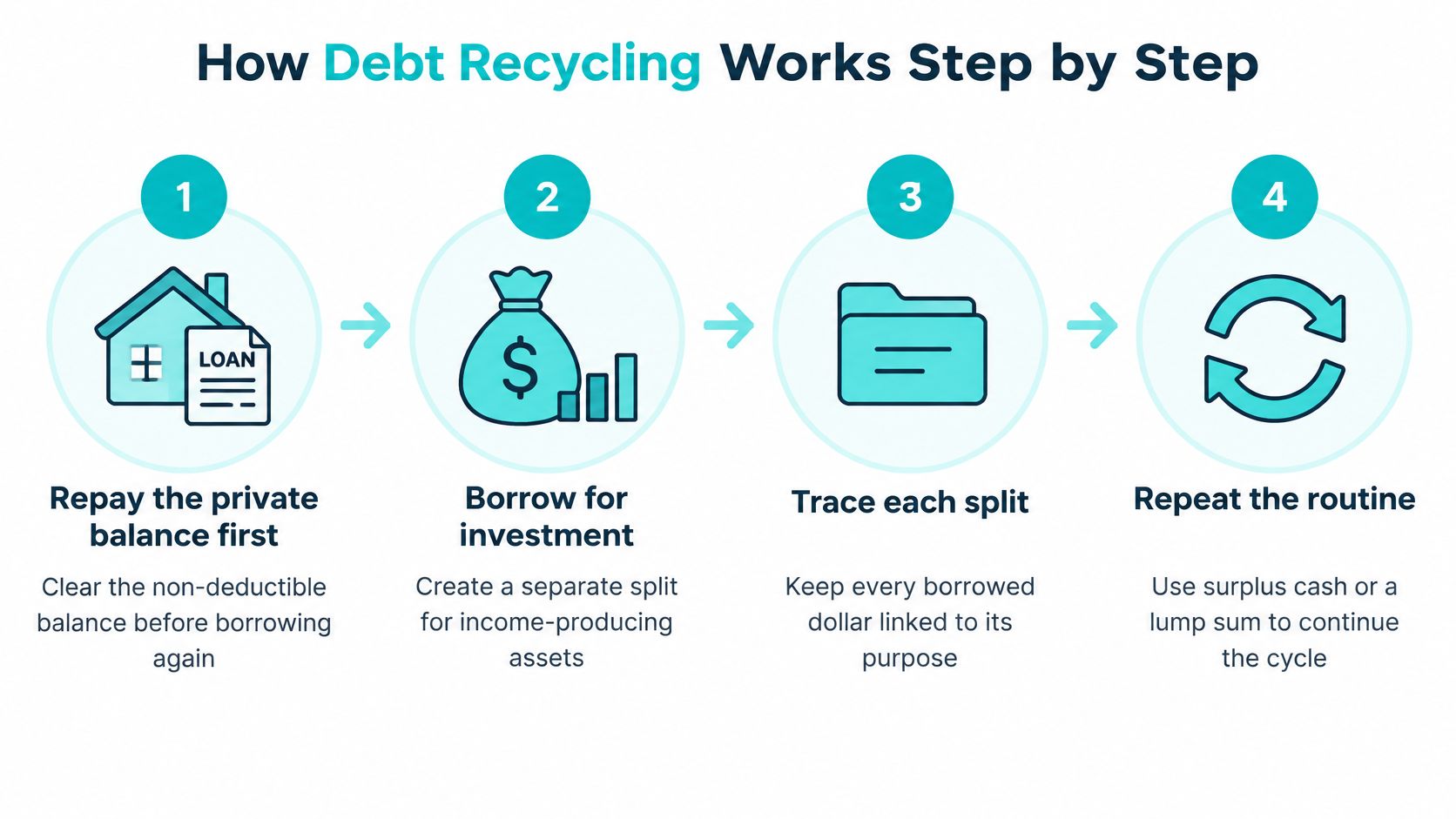
Order matters because you need to show where every borrowed dollar went. Repay private debt first, then borrow for investment through a separate split. Don't reverse those steps or pass the money through shared accounts.
The setup routine
- Repay the private balance first: Put surplus cash or a lump sum into the home loan and reduce the private balance, for example by $100,000. Keep the statement showing the payment and the lower balance. This is the amount available to recycle.
- Keep the repaid amount visible: Hold the loan in a structure that shows what you've cleared, usually through redraw or an offset arrangement. The choice between facilities affects tracing, which is why an offset account vs redraw comparison matters before you move money. Ask the lender how a new split will appear on statements.
- Create a separate investment split: Borrow or redraw $100,000 into a split used for investment only. A separate account number makes the purpose identifiable. Never pay a personal bill from this split, even if you plan to put it back later.
- Buy directly from that split: Transfer the funds straight to the brokerage or fund account and buy income-producing investments, such as Australian shares or ETFs. Don't park the money in a shared transaction account first. Keep the contract notes alongside the loan statement so dates and amounts line up.
- Pay interest from a dedicated account: Meet the investment loan interest from an account you can identify easily. Paying from a shared account mixed with household spending makes the deduction harder to prove. Don't capitalise the interest onto the split without tax advice.
- Direct income and review yearly: Use dividends and distributions to help meet interest, then send surplus cash back to the private loan if you repeat the cycle. Record every redraw, repayment and purchase in a simple annual log. Review the rate, balance and investment purpose each year.
Clean structure test: You should be able to point to two identifiable splits, one private and one investment, with separate statements and a short log linking each purchase to the borrowing.
The common slip is small and expensive. One holiday payment from the investment split means that split now has a private purpose mixed into it. From then on, your accountant has to untangle proportions that should never have been tangled.
Set the accounts up so the lazy choice is also the clean choice. Automatic interest payments, a single path from split to broker, and no debit card access to the investment split remove most temptation.
Tax Rules That Decide Whether the Deduction Holds
The deduction follows purpose, not security. Borrowing against your home doesn't make interest deductible. Using the borrowed money to buy an asset that produces assessable income is what matters.

Purpose test and apportionment
The Australian Taxation Office guidance on interest, dividend and other investment income deductions states that interest paid on money borrowed to buy shares or other investments can be deductible when those investments produce dividends or other assessable income. Where a loan is used partly for private purposes and partly for investment, the interest must be apportioned. A deduction isn't available when the borrowed funds aren't used for an income-producing purpose.
That rule splits a recycled loan into two jobs. If you pay down $100,000 of private home-loan debt and then separately borrow $100,000 to buy income-producing Australian shares, the interest on the investment borrowing may be deductible. Interest on the original private balance is not deductible merely because the property secures the loan.
Now change one transaction. If $10,000 of that new $100,000 split is redrawn for a car, the split is no longer wholly for investment. Your accountant must apportion interest between the investment and private portions, and keep tracking that proportion as balances and repayments change.
This is the same purpose principle that sits behind questions such as what is negative gearing in Australia, applied to shares instead of property. The label on the loan doesn't decide the claim. The use of the funds does.
What the deduction is actually worth
A deduction is worth your marginal tax rate, nothing more. At 30%, $6,500 of deductible interest saves $1,950, leaving you $4,550 out of pocket. At 37%, the same interest saves $2,405, leaving $4,095.
- Lower marginal rate: The deduction is worth less, so the investment return has to do more of the work.
- Higher marginal rate: The after-tax cost falls, but you still pay most of the interest yourself.
- Little or no taxable income: The deduction has limited immediate value, which weakens the case for carrying investment debt.
Don't let the refund mislead you. If the portfolio earns nothing, you've spent $6,500 to get $1,950 back at a 30% rate. That's a discounted loss, not a benefit.
Before your first tax return: Keep private and investment components identifiable, and have an accountant confirm the apportionment and records while the transactions are still fresh.
Australia's distinction between private and income-producing borrowing is longstanding, so don't expect informality to be forgiven. Separate splits, clear transfers and consistent statements are the price of claiming the deduction with confidence.
Records and Risks That Can Erase the Benefit
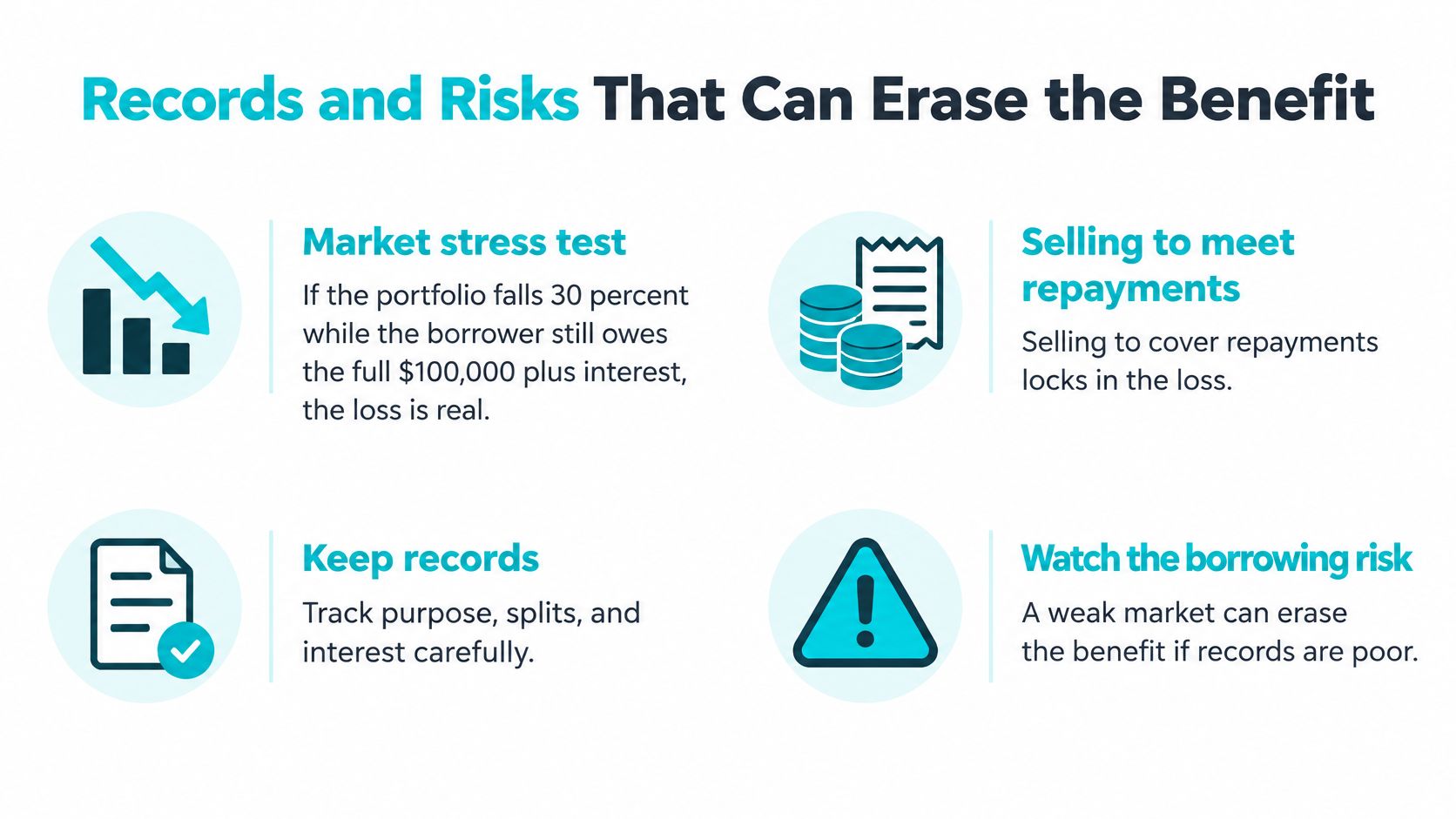
Start with a 30% market fall, not a rising portfolio. If $100,000 invested drops to $70,000 while you still owe $100,000 plus interest, there's a $30,000 gap before costs. Selling to meet repayments turns that paper gap into a realised loss.
Cash flow breaks before theory does
Your portfolio income won't always cover investment interest. When dividends fall short, the gap comes from salary or savings each month. For pre-retirees and retirees, that shortfall is harder to absorb because there's less employment income and less time to recover.
Rate rises squeeze from the other side. Test repayments at a rate two percentage points above your current rate and ask whether the household can still pay both loans. If that answer relies on selling assets, the strategy has already failed its stress test.
Falling rates also change the decision. When mortgage rates fall, the saving from repaying private debt shrinks, but so does the interest cost you're trying to deduct. Re-run the break-even whenever your rate resets instead of relying on the calculation you did at setup.
Poor records quietly remove the benefit
The Australian Taxation Office guidance on mixed purpose loans states that deductibility follows the use of borrowed funds and that mixed-purpose loans require interest apportionment between private and income-producing purposes. Taxpayers must maintain records of each redraw, loan balances, repayments, interest and evidence linking the investment purchase to the borrowed funds. Splitting a loan doesn't automatically make all later interest deductible.
Keep a folder, physical or digital, with these items:
- Split statements: Balances, interest charged and repayments for each loan split, kept separately.
- Transfer evidence: Dates and amounts moving from the investment split to the broker or fund.
- Purchase records: Contract notes and dividend or distribution statements.
- Annual summary: A one-page log your accountant can follow without reconstructing your bank history.
Retention habits matter across your whole file, not just loan documents. If you're unsure about supporting statements, this guide to how long to keep credit card statements is a useful prompt to set a consistent system instead of guessing at tax time.
Write your downturn plan before you need it. Decide which buffer pays interest first, what would trigger a pause in new recycling, and whether you'd sell, hold or reduce the loan. A plan written in calm conditions beats a decision made during a 30% fall.
Capital Gains Timing and Exit Planning
The investment loan creates an exit question that ordinary investing doesn't. Selling doesn't just trigger tax, it also forces a decision about repaying the split. Timing that sale badly can double the tax on the gain.
The 12 month rule in dollars
The Australian Taxation Office capital gains tax guide states that, for Australian resident individuals, the capital gains tax discount may reduce a qualifying capital gain by 50% when shares or units have been owned for at least 12 months. Shares sold within 12 months must instead use the other CGT calculation method and cannot receive the 50% discount. The net gain is then included in income and taxed at your marginal rate.
Say you make a $20,000 gain at a 37% marginal rate. Sell after 14 months and, if the discount applies, only $10,000 is taxable, giving tax of $3,700. Sell after 10 months and the full $20,000 is taxable, giving tax of $7,400.
The order matters too. Capital losses are offset against capital gains first, and the discount applies to the resulting net gain. It isn't half of your sale proceeds, and it isn't applied before losses are counted.
The discount rewards patience, but it isn't a reason to keep holding an investment you'd otherwise sell.
Match the exit to the loan
A recycled strategy built on frequent short-term trading gives up this discount while still carrying borrowing risk. A long-term portfolio is more likely to align the investment, loan and tax outcomes. That alignment should be deliberate, not accidental.
Before you borrow, write down three things:
- Intended holding period: The minimum time you expect to hold and whether it clears 12 months.
- Sale triggers: The conditions that would make you sell, such as retirement, a lower income year or a change in the investment itself.
- Loss plan: How realised losses would be offset against gains and whether sale proceeds would repay the investment split.
Tax outcomes depend on holding period, ownership structure, realised gains and losses, and your personal circumstances. Don't assume the discount will rescue a marginal break-even result. If the strategy only works because of a future discounted gain, model what happens if you have to sell early.
Exit planning also protects you from drift. An investment split that remains long after the shares are sold, with proceeds spent elsewhere, no longer matches the purpose you borrowed for. Decide in advance that sale proceeds go to the split unless you have advice supporting another use.
Confirm the Numbers Before You Recycle
Don't restructure a home loan until you can fill in every item below with a real figure. Estimates are fine for reading, not for borrowing against your home.
Your pre-decision checklist
- Private loan balance and rate: The exact amount and interest rate you'd be repaying.
- Offset or redraw balance: How much is surplus and how quickly you could access it.
- Marginal tax rate: The rate that sets the value of each deductible interest dollar.
- Emergency buffer: How many months of all repayments your cash would cover.
- Holding period: A realistic timeframe that survives a market fall, not an ideal one.
- Record systems: Whether you can keep separate splits, statements and an annual log.
If most of those are in place and your own break-even return looks achievable without optimistic assumptions, the next step is modelling your actual numbers. If the buffer, structure or budget isn't ready, fix that first. Debt recycling rewards preparation and punishes improvisation.
At Wealth Collective, we research and model your options and create a detailed financial plan that balances financial structure, money success and lifestyle, covering debt reduction and investment strategy alongside personal insurance, superannuation, retirement planning and strategic financial advice. You can book a free 10-minute introductory call to test whether debt recycling fits your situation, with no product push or hard sell. Once you're fully comfortable with the outcome, we handle the paperwork and implementation.
Before you redraw a dollar, have your break-even return, loan split structure and downturn plan modelled against your actual rate, tax position and buffer. Visit Wealth Collective to book your free 10-minute introductory call and get a clear answer on whether debt recycling belongs in your plan or whether repaying the mortgage is the better move.