Business hours
Monday to Friday (8.30AM - 5PM)
Weekend (Closed)



You've got the household budget organised around regular pay: the mortgage comes out, bills are covered, and there's room for the costs that make life run. Then an injury or illness keeps you from working, and the pay stops before the expenses do. Personal sickness and accident insurance can help replace some of that lost income, but the amount you receive depends on the policy's definitions, waiting period, offsets, tax treatment and ownership.
The useful question isn't only, “How much does this policy cost?” It's, “If I couldn't work, what would arrive in my account, and when?” That's the difference between comparing premiums and checking whether the cover could support your household through a difficult spell.
What Personal Sickness and Accident Insurance Pays For
A fall that keeps you home from work and an illness that stops you earning may lead to different claim outcomes. Personal sickness and accident insurance can pay a lump sum or a regular payment, depending on the policy. The policy wording sets out which injuries and illnesses qualify, how long you must wait, and how much may be paid. Those details matter more than the label on the cover.
An accident generally involves a sudden injury caused by an external event, such as a fall, fracture or car crash. Sickness refers to an illness that meets the policy's requirements, which may include being unable to work or needing treatment. Accident-only cover won't necessarily pay if an illness keeps you home.

Consider a household where one partner earns most of the income while the other takes on caring responsibilities. If the main earner can't work, the lost pay may squeeze the money available for rent or mortgage payments, childcare and everyday costs. Private cover may help replace some income, but it does not automatically pay medical bills or replace every other source of support.
Workers' compensation has limited eligibility. It applies when an injury or illness meets the relevant rules, so it may not help with every interruption to work. Personal sickness and accident or income protection cover may apply in a wider range of circumstances, but payment still depends on the policy's definitions, exclusions and claim terms.
To check what protection would mean in practice, list the income coming into your household and identify which sources would stop if you were unable to work for a month. Then compare that gap with the policy's payment terms, including when payments start and what could reduce them. The same injury can produce different payouts depending on waiting periods, offsets, tax treatment and whether the cover is held through superannuation. Auditing the likely payout gives a clearer picture than comparing premiums alone.
How It Differs From Income Protection, TPD and Life Cover
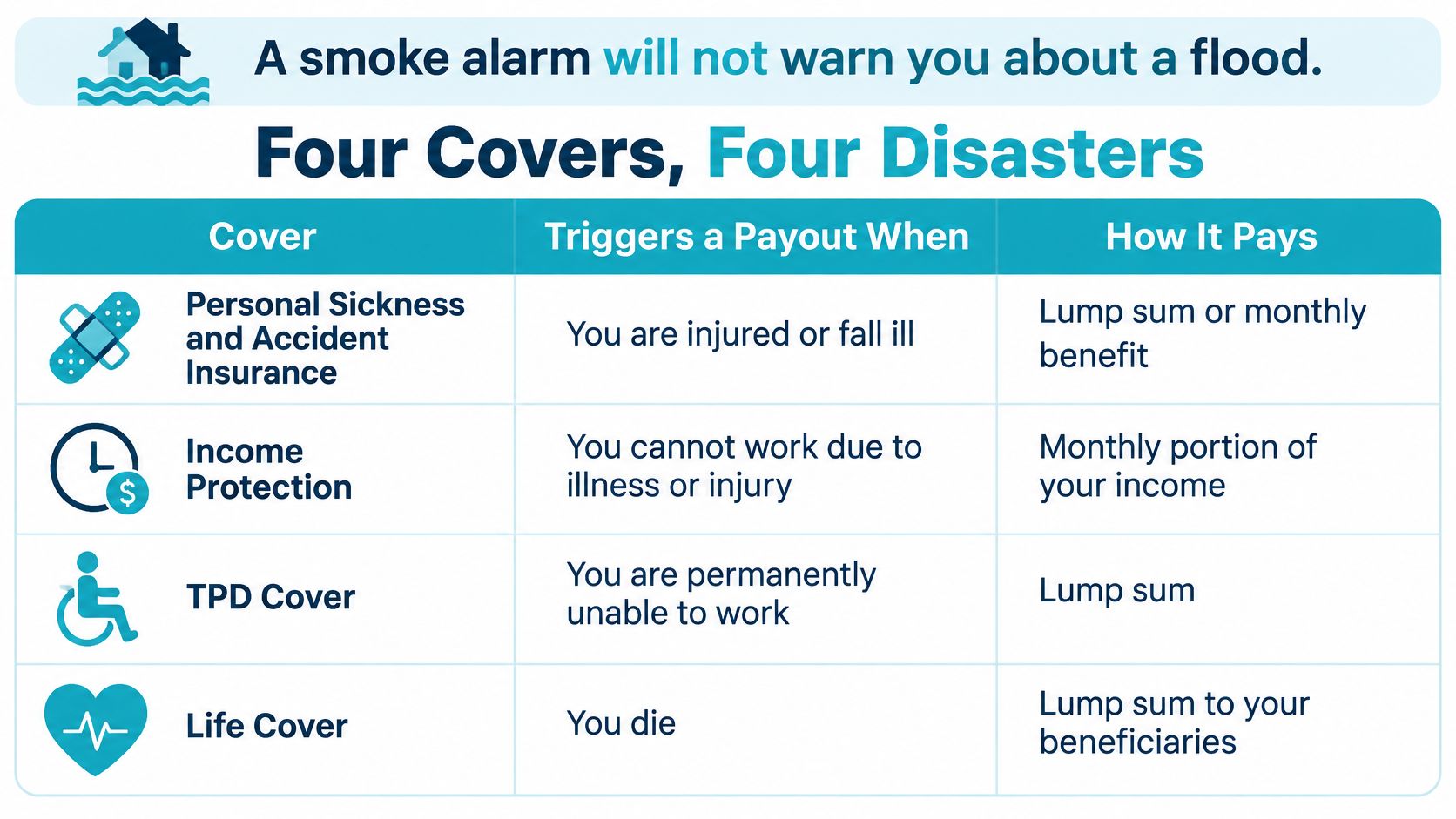
The same injury can lead to very different payments under different policies. A short-term injury may meet one policy's definition but not another's, and the amount received can depend on waiting periods, offsets, tax and whether cover is held inside super. Compare what each policy pays and when, rather than judging it by the premium alone.
| Cover | Pays when | Usual payment | Main gap |
|---|---|---|---|
| Personal sickness and accident | Injury or illness as defined in the policy | Lump sum or monthly benefit, depending on design | Pays only for events the wording covers |
| Income protection | You can't work because of illness or injury, after the waiting period | Monthly, usually 75% or 90% of pre-tax income | Pays nothing during the waiting period or after the benefit period ends |
| TPD | You're permanently unable to work, under the policy definition | Usually a lump sum | Pays only once disability is permanent; definitions can be narrow |
| Life insurance | Death of the insured | Lump sum to beneficiaries | Pays nothing while you're alive and unable to work |
| Trauma, or critical illness | Diagnosis of a named condition | Usually a lump sum | Covers only the conditions listed in the policy |
These policies work like different alarms around a home. A smoke alarm won't warn you about a flood. Each cover responds to a particular event, so one policy doesn't automatically fill the gaps left by another. The table is a starting point; the policy wording determines what triggers a payment.
Personal sickness and accident cover is a broad label for a policy that responds to an insured event set out in its contract. It may provide a lump sum, a monthly payment or another defined benefit. Check whether illness as well as injury is covered, and whether payment replaces income or depends on a particular event.
Income protection is designed to provide regular payments when illness or injury prevents you from working, subject to its definition, waiting period and benefit period. Australian policies commonly replace around 75% or 90% of pre-tax income. The payment may not start straight away, and it may stop when the benefit period ends. Check whether other payments reduce the benefit, and whether tax applies to what you receive.
TPD and life insurance address different financial events. TPD generally requires a permanent disability that meets the policy definition; life insurance pays when the insured person dies. Trauma cover depends on a diagnosis matching a condition and criteria listed in the policy. For more detail, see Wealth Collective's guide to life insurance types.
Cover inside super can add another layer to check. Seeing TPD or life insurance in a super account doesn't mean income protection is included. Ask what event each policy covers, how long you must wait, whether payments are offset, and how tax or super arrangements affect the amount reaching your household. Then consider which gap would be hardest to manage if an injury kept you from work.
Who Needs This Cover and How Much Makes Sense
Disability affects Australians at different stages of life, and the financial consequences can differ too. In 2018, approximately 4.4 million Australians, or 17.7% of the population, had disability. That included 13% of Australians aged 15–64 and 50% of those aged 65 and over; about 1.4 million people, or 5.7% of the population, had severe or profound disability (Australian Institute of Health and Welfare disability data). For working-age people, a central concern is often lost earning capacity. For older people, disability and the need for help with daily activities can become more prominent.
That doesn't mean there's one right policy or benefit amount for each life stage. A household's practical priority depends on who earns, what expenses continue, what cover already exists and how much cash is available while a claim is assessed.
| Situation | Main financial exposure | Cover priority |
|---|---|---|
| Single professional, no dependants | Rent, car loan and living costs | Monthly benefit sized to essentials; a shorter waiting period may matter if savings are limited |
| Young family on one income | Mortgage, childcare and school costs | A benefit that supports the household budget, with a longer benefit period if suitable |
| Dual-income household | Losing either income | Consider cover for both earners and check each partner's existing cover |
| Self-employed or business owner | Irregular income and no paid sick leave | Individually owned cover with clear rules for proving income |
| Executive or high earner | Income above the policy benefit cap | Confirm the cap and whether another policy is needed |
| Pre-retiree | Lost super contributions plus mortgage repayments | Check the benefit period and whether cover held in super still suits |
The table isn't a prescription. A single professional with strong savings may be able to fund a longer wait; a family with limited reserves may need payments to begin sooner. A business owner may need to pay particular attention to how the insurer assesses variable income. The details of personal insurance and its role in a financial plan can help frame those questions.
A household is only as protected as its most fragile income. Before choosing a benefit amount, rank your top two exposures, such as mortgage repayments and childcare. More cover isn't automatically better if the premiums are hard to maintain. A manageable policy that stays in place may be more useful than a larger one that strains the budget.
Policy Features That Decide How Much You Receive
Two people with the same injury can receive different amounts. One may wait longer before payments start; another may have an offset or tax withheld, or cover held through super with different terms. The premium alone won't show these differences. Check the path from injury to actual payout: what starts the benefit, what can reduce it, and how long it can continue.
Income protection commonly replaces around 75% or 90% of pre-tax income, with insured income generally based on earnings during the 12 months before illness or injury. The percentage is a starting point, not a promise of what reaches your bank account. For example, a $90,000 salary insured at 75% gives a simple estimate of $67,500 a year, or $5,625 a month before tax. The insurer still assesses your claim against the policy wording, and other terms may change the payment.
The wait and the maximum payment period
The waiting period is how long you must be unable to work before benefits can begin. Common options range from 14 days to two years, and you generally need to remain unable to work at the end of that period. With a 90-day wait, for example, household expenses still need to be covered while you wait. Savings may bridge the gap; borrowing to cover it can make a longer wait difficult.
The benefit period sets the longest time payments can continue. Common structures include two years, five years or payments to age 65. A shorter period may help with a temporary income interruption, but it can leave a prolonged incapacity uncovered once payments stop. Match the period to the commitments you'd still have if recovery takes longer than expected.
| Feature | Common options | What it changes |
|---|---|---|
| Waiting period | 14 days to two years | A longer wait can lower premiums but requires savings to bridge the gap |
| Benefit period | Two years, five years or to age 65 | Sets how long payments last if illness persists |
| Insured income | 75% or 90% of pre-tax income | Sets the monthly amount, based on earnings before the claim |
| Benefit type | Monthly benefit or lump sum | Monthly payments suit an income gap; a lump sum can suit debts or one-off costs |
| Disability definition | Own occupation, suited occupation or any occupation | Affects whether you can claim while working in a different role |
| Premium structure | Level or stepped | Stepped premiums start lower but rise with age; level premiums are designed to stay more stable |
Read beyond the headline benefit
A monthly benefit can replace income over time, while a lump sum may suit a debt or a one-off cost. The disability definition matters too. If you can't return to your usual job but can do different work, check whether the wording tests your ability to perform your own occupation, a suited role or any occupation. Those definitions can change whether the same injury qualifies for payment.
Premium structure affects the cost over time, not just at the start. A stepped premium may begin lower and rise with age; a level premium is designed to stay more stable, subject to its terms. If the policy sits in super, check its specific benefit and payment arrangements rather than assuming they match a policy held personally. Compare the likely payout with the waiting period, your emergency savings and the expenses the cover is meant to support.
Exclusions and Offsets That Quietly Reduce Payouts
A policy may show a monthly benefit, yet the amount that reaches your household can be lower. The same injury can lead to different payouts depending on the policy's exclusions, other payments, tax treatment and whether cover is held in super. Follow each step from the stated benefit to the money you could realistically receive.
Read exclusions before you compare price
Depending on the policy wording, claims may be restricted for pre-existing conditions, self-inflicted injury, intoxication, hazardous activities, war or criminal acts. Insurers may also set deadlines for notifying them and lodging a claim, along with documents you must provide. A missed deadline can complicate a claim, so check the requirements before you need to use the cover.
Exclusions can be specific to your medical history, occupation or activities. Two policies with similar names may treat the same injury differently. Read the Product Disclosure Statement and any personal terms issued with your policy. If a condition or exclusion is unclear, ask the insurer or adviser to explain how it could affect a claim.
Find out what gets offset
An offset reduces a benefit when the insurer counts another payment as compensation for the same lost income. Workers' compensation and other payments may trigger a reduction. Check the policy wording rather than assuming the full stated benefit will be paid, and review ASIC's review of insurance in superannuation for context on insurance held in super.
An offset can leave a gap in your budget, especially if the other payment is delayed, disputed or calculated differently. Ask whether the insurer offsets gross or net amounts, and which payments count. These may include workers' compensation, sick leave, Centrelink payments and benefits from other insurance. The timing matters too: a payment that arrives later may not cover bills due now.
For cover held in super, check how its terms affect the claim and your household finances. Review the waiting period, benefit period, definitions, premiums, cancellation risk and effect on retirement savings. Then ask for an estimate of what could be payable after offsets and tax, and when it might arrive. Before comparing premiums, request the Product Disclosure Statement and mark each exclusion or offset that could change the payout. The premium is only one part of the comparison; the useful figure is the amount left to meet household costs.
What It Costs and How Tax Changes the Payout
The premium is only part of the cost. The amount you pay can depend on your age, occupation risk class, insured benefit, waiting period, benefit period, health, lifestyle and whether the cover is held in super or owned personally. No single premium suits everyone, so compare policy terms alongside the price.
| Cost driver | Effect on premium | What to check |
|---|---|---|
| Age | Premiums generally rise as you get older | Compare level and stepped structures |
| Occupation risk class | Physically demanding or higher-risk jobs can cost more | Confirm how your occupation is rated |
| Benefit amount | A higher insured income raises the premium | Size cover to after-tax needs, not headline income |
| Waiting period | A longer waiting period can lower the premium | Match it to savings you can access |
| Benefit period | A longer benefit period can raise the premium | Consider how long an illness could affect your income |
| Ownership | Super-held premiums reduce retirement savings | Compare with personally owned cover |
| Health and lifestyle | Underwriting may add a loading or exclusion | Disclose accurately when applying |
Compare the cost you pay with the gap you take on
A longer waiting period may reduce the premium, but it shifts more of the early cost onto your savings. If you choose that trade-off, make sure the money is available and set aside for essentials, rather than assuming you can access it when needed. Likewise, premiums paid from super reduce the balance available for retirement. That cost may not be as visible as a direct debit, but it still belongs in the comparison.
Tax affects both premiums and claim payments. The Australian Taxation Office says payments that replace lost salary or wages must be declared, including qualifying payments under sickness or accident insurance. If an insurer pays the policy owner directly, tax may not be withheld, so you may need to set money aside. Personally owned income-protection premiums can be deductible in some circumstances, but deductibility depends on how the policy is owned and what it pays; premiums paid from super contributions aren't deductible to the individual (ATO guidance on income-protection payments; ATO guidance on income-protection premiums).
Before relying on a benefit for a mortgage, childcare or business costs, convert the advertised monthly amount into an after-tax estimate. An adviser or tax professional can help check the assumptions for your policy and circumstances.
Claim Examples Showing Where the Gaps Appear
The scenarios below are illustrative, not real client stories. They show how the same broad idea, cover for an injury or illness, can lead to different outcomes depending on what the policy pays and when.
| Scenario | What may respond | Where the gap can appear |
|---|---|---|
| An electrician breaks a wrist while doing a weekend job | An accident benefit may pay a lump sum if the event meets the policy terms; income protection may pay a monthly benefit after its waiting period | The household still needs to manage the wait, and the lump sum may not replace regular wages |
| An office manager is diagnosed with cancer and is off work for seven months | Trauma cover may pay if the diagnosis meets its definition; income protection may pay monthly after the waiting period | Savings may need to bridge the wait, and the trauma policy covers only named conditions |
| A self-employed builder is injured on site and receives workers' compensation | Income protection may be subject to an offset | The net benefit can be lower than expected, particularly if payments interact or arrive at different times |
| A parent with a chronic illness is off work for three years, but has a two-year benefit period | The policy may pay while the claim remains eligible and the benefit period continues | Payments can stop when the maximum benefit period ends, even if the person remains unwell |
The electrician's case highlights why a lump sum and monthly benefit aren't interchangeable. One may provide a payment tied to an insured injury; the other is designed to help with an ongoing income gap, after the conditions and waiting period are met. For an office manager, a trauma policy and income protection may address different financial needs. You can read more about the distinction in Wealth Collective's guide to trauma insurance.
Now consider the arithmetic. If a monthly income of $7,000 is insured at 75%, the calculated benefit is $5,250 before tax, assuming the policy accepts the claim and the full amount applies. The actual payment may differ because of the policy wording, offsets, tax and any limits that apply. That's why a useful comparison follows the money from the initial event to the amount that could reach the household.
Which of these four situations would put the most pressure on your household? Use that answer to guide what you check first: the event definition, waiting period, offsets or length of the benefit.
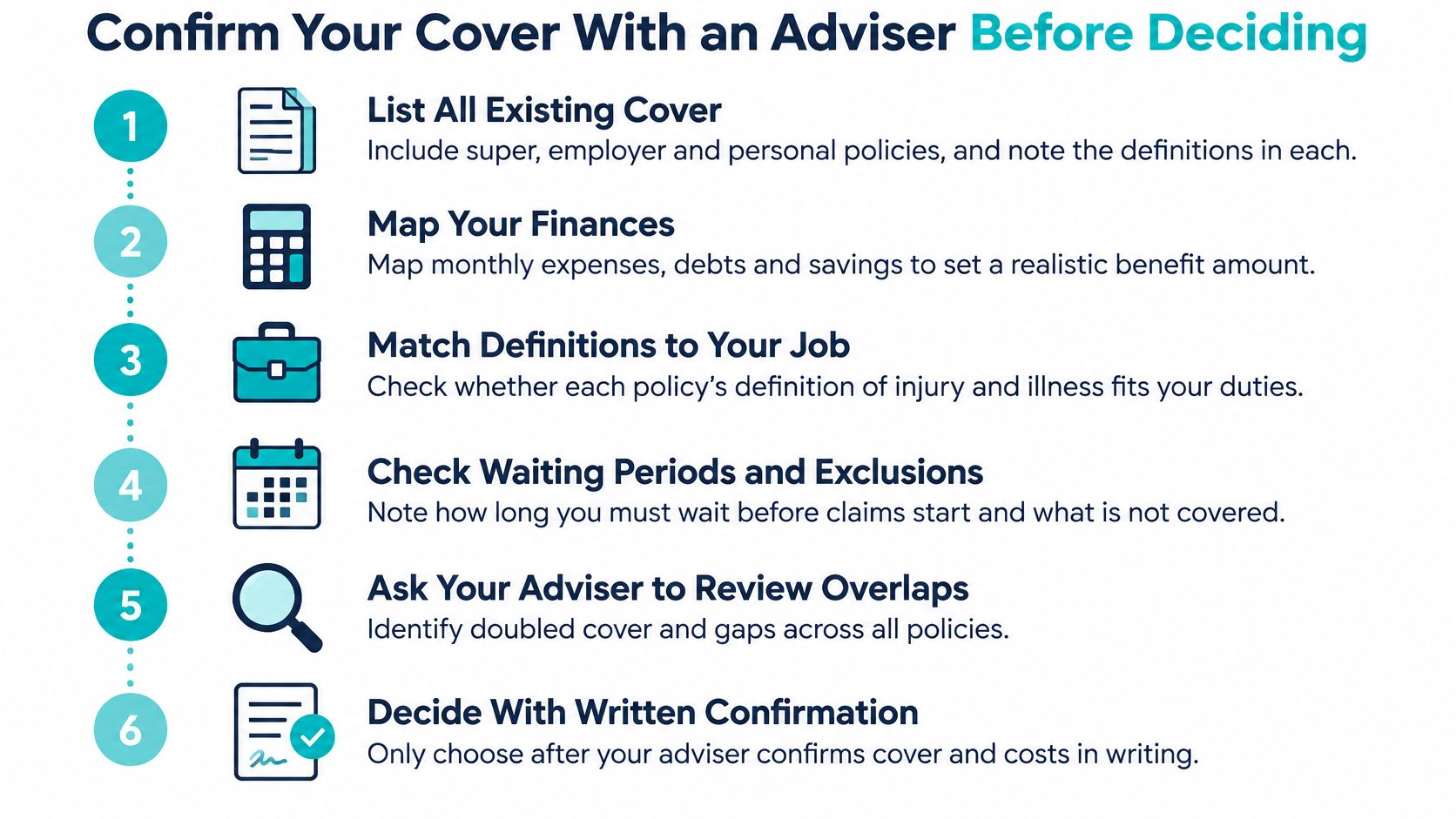
Confirm Your Cover With an Adviser Before Deciding
Before changing a policy, gather the details of the cover you already have. A household's protection is like a set of layers: each policy may respond to a different event, and the final payout depends on how those layers work together.
List existing cover. Include policies held through super, an employer or personally, and note which events each one covers. This can reveal overlap as well as gaps.
Map your finances. Record monthly expenses, debts and accessible savings. These figures help you judge how long you could manage before a benefit starts.
Estimate the after-tax benefit. Compare the amount you may in fact receive with the expenses it needs to cover. A policy's headline benefit is only the starting point.
Read exclusions and offsets. Check how pre-existing conditions, workers' compensation or sick leave could affect eligibility and payments. The same injury can lead to different payouts under different policy terms.
Compare the full cost. Include premiums paid from super and their possible effect on retirement savings, as well as premiums charged directly to your bank account.
Ask an adviser to explain the trade-offs. They can help you compare the cover with your needs and understand how waiting periods, offsets, tax and whether a policy is held in super may affect a claim.
Wealth Collective's Protection Plus service reviews personal insurance, including income protection, trauma and TPD cover. For a review, prepare your policy details, including any cover held through super or an employer, along with your regular expenses, debts and questions about the benefits you could receive. That gives you a clearer basis for discussing what is covered, what could reduce a payout and which gaps matter to your household.
A useful outcome is a written picture of your existing cover, the waiting period you could afford and a practical next step. Visit Wealth Collective to discuss a cover review through its Protection Plus service.