Business hours
Monday to Friday (8.30AM - 5PM)
Weekend (Closed)


Personal insurance is a set of cover types, including life, TPD, trauma and income protection, that pays when you die, become seriously ill or injured, or can't earn an income. In Australia, most of it sits inside superannuation rather than as a separate retail policy.
You may already have a policy and still carry a serious protection gap. You might see an insurance deduction in your super account, assume the mortgage and family are covered, then discover the benefit is too small, the definition doesn't fit your occupation, or the policy disappears when your circumstances change. The useful question isn't only what is personal insurance. It's what financial risk would your household carry if your income stopped tomorrow?
Why Personal Insurance Matters in Real Life
Consider a dual-income family with a mortgage, school-age children and regular household commitments. One partner suffers an accident or serious illness and can't work. The family doesn't just lose a salary. Mortgage repayments continue, groceries and utilities still need paying, school costs remain, and the healthy partner may need to reduce work to provide care.
Without suitable cover, the household usually turns to cash reserves, redraw facilities or superannuation. Those options can provide short-term relief, but they can also damage long-term retirement plans. Money withdrawn or redirected during a crisis is money that no longer has the opportunity to remain invested and support future retirement income.
That's what personal insurance is designed to address. It can provide:
- Income replacement, when illness or injury prevents you from earning.
- Debt reduction, including a mortgage or other liabilities after death or permanent disability.
- A lump sum for major disruption, such as a defined traumatic illness.
- Retirement protection, by helping the household keep making contributions and avoid selling investments under pressure.
Australia's protection gap is already substantial. APRA estimates that around one in seven Australian households are uninsured, equal to about 15% or 1.4 million households, and projects that the gap could reach about one in four households by 2050 if affordability pressures continue. APRA's material on insurance affordability and protection gaps makes the point clearly: insurance isn't only an issue for people with complex finances. It's a household resilience issue.
Practical rule: Start with the income, debts and people who depend on you. Choose the policy after you understand the financial problem it needs to solve.
A sound plan therefore works backwards. First, identify the cash flow your family needs to maintain. Then consider which risks require monthly benefits, which require a lump sum, and which can reasonably be funded from savings. Personal insurance belongs alongside debt management, superannuation and investment decisions, not in isolation.
The Main Types of Personal Insurance Cover
The four core types cover different events and pay in different ways. Confusing them is one of the easiest ways to buy the wrong protection.
Life cover
Life insurance pays a lump sum when the insured person dies, subject to the policy terms. In a household with dependants, the benefit may clear the mortgage, replace future financial support, cover immediate expenses and give the surviving partner more choice about work and housing.
Life insurance is generally about the financial consequences of death, not medical treatment. A policy can be useful even where the household has substantial assets, because the timing of death may occur long before the family has built enough capital to meet its future needs.
Total and permanent disability cover
Total and permanent disability, or TPD, pays a lump sum when a person meets the policy's definition of permanent disability. Definitions vary. Some focus on whether you can work in your own occupation, while others assess whether you can work in any occupation suited to your education, training or experience.
TPD can fund home modifications, rehabilitation, debt repayment, replacement capital and ongoing care. Claims can also take time to assess. APRA and ASIC reported that only 15% of TPD claims were finalised within 0 to 2 weeks in the second pilot round, compared with most death claims. The same data recorded an overall TPD admittance rate of 84%. APRA and ASIC's life claims data shows why the definition and claims process deserve close attention.
Trauma or critical illness cover
Trauma cover pays a lump sum when you suffer a predefined illness or traumatic event that meets the policy wording. APRA defines trauma cover as a lump-sum benefit for a specified illness or traumatic event, structured either as standalone cover or as an acceleration of a death or TPD benefit. APRA's life insurance glossary explains the technical structure.
Trauma cover is often used for treatment costs, time away from work, travel, home support or debt reduction. It isn't a substitute for TPD because a person can suffer a qualifying illness without meeting a permanent disability definition. APRA and ASIC recorded an overall trauma admittance rate of 87%, while only 33% of trauma claims were finalised within 0 to 2 weeks in the cited pilot data.
Income protection
Income protection insurance pays a regular benefit when illness or injury leaves you unable to work, subject to the policy's definition and conditions. It's usually paid monthly rather than as a lump sum, making it the most direct tool for protecting household cash flow.
Waiting periods matter. ASIC MoneySmart explains that waiting periods commonly range from 14 days to two years, and you must still be unable to work at the end of the selected waiting period before benefits can become payable. MoneySmart's income protection guidance is a useful starting point, but your employment arrangements and sick leave should drive the choice.
| Cover Type | Trigger Event | Benefit Paid | Typical Use Case | Key Considerations |
|---|---|---|---|---|
| Life | Death | Lump sum | Dependants, mortgage and family security | Beneficiary arrangements, exclusions and sum insured |
| TPD | Permanent disability under the policy definition | Lump sum | Debt repayment, rehabilitation and long-term support | Own-occupation versus any-occupation wording |
| Trauma | Defined illness or traumatic event | Lump sum | Treatment, recovery and household disruption | Covered conditions, severity requirements and exclusions |
| Income protection | Inability to work due to illness or injury | Monthly benefit | Replacing earnings and maintaining contributions | Waiting period, benefit period and work definition |
For a working parent, the combination matters. Life cover supports the family after death, TPD provides capital after permanent disability, trauma cover helps with a major health event, and income protection keeps monthly bills moving during a period away from work. For family planning around end-of-life costs, a practical resource such as this funeral insurance for parents guide can help separate funeral expenses from broader life insurance needs. You can also compare policy structures in this guide to life insurance types.
How Personal Insurance Works Through Super
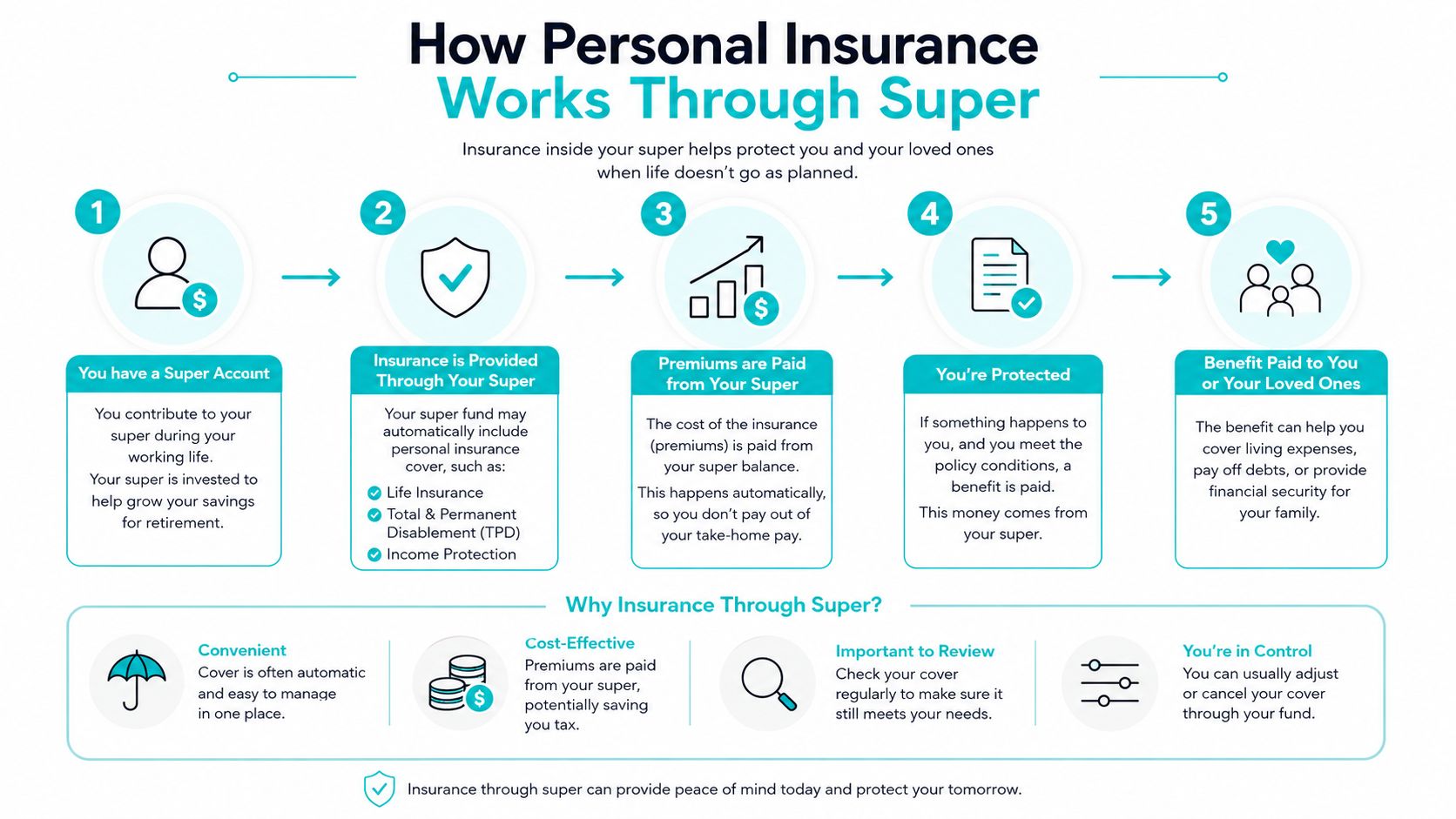
Most Australians don't buy personal insurance as a standalone retail product. They receive some cover through their super fund, often through group arrangements where the fund negotiates insurance terms for eligible members.
ASIC reported that almost 10 million superannuation accounts had insurance, while APRA and ASIC-linked data cited in a parliamentary submission indicated that approximately 70% of all life insurance in Australia is held within superannuation. ASIC's explanation of insurance through super shows why the first insurance check should usually begin with your super account.
The usual process is straightforward:
- Your super fund establishes group insurance arrangements.
- Eligible members receive default cover or can apply for additional cover.
- Premiums are deducted from the super balance rather than paid directly from after-tax cash flow.
- The fund records the cover and policy details in the member account.
- A valid claim is assessed under the policy terms and paid according to the structure of the cover.
Default arrangements can be convenient and may be cost-effective because the fund spreads risk across many members. They're not automatically sufficient. Default cover may provide basic life and TPD protection, while income protection can be limited or absent. Trauma cover is often not included, and the benefit period, waiting period and disability definition may not suit your employment or family obligations.
ASIC reported that around 800,000 accounts held income protection cover as at 30 June 2022, showing that the product is used through super but far less widely than death cover or broader life insurance. Industry reporting linked to APRA data put life insurance through super at around 9.3 million Australians in June 2025, with 8.2 million covered for TPD, average premiums of about $240 per life and an average sum insured of about $228,000. The Association of Superannuation Funds of Australia's insurance and superannuation report also records a material decline from 13.35 million covered people in 2018, reflecting policy changes, automatic cover settings and affordability pressures.
If you're dealing with a disputed or delayed insurance matter, practical guidance such as this letter of demand to an insurance company guide can help explain the purpose of formal communication, although personal insurance claims still need to follow the relevant fund and insurer process. For a broader review of cover held in super, see life insurance through super.
What Drives the Cost of Personal Insurance
Insurance pricing is personal. Two people with the same salary can receive different premiums because their age, health, occupation, policy design and sum insured differ.
The main drivers are easy to understand:
- Sum insured: More cover generally costs more, but a low benefit can leave the household unable to clear debts or fund future needs.
- Age: Premiums typically rise as the likelihood of claim increases over time.
- Occupation: A desk-based role may be assessed differently from manual, hazardous or high-travel work.
- Health and history: Medical conditions, smoking, hazardous activities and previous claims can affect underwriting and loadings.
- Waiting and benefit periods: A longer income protection benefit period generally provides broader protection, while a longer waiting period can reduce premiums if your cash reserves and employer benefits can bridge it.
- Premium structure: Stepped premiums usually start lower and rise with age. Level structures can provide a different long-term cost pattern but may require more cash flow earlier.
- Ownership: Super-held cover may be easier to fund from the account, while retail cover can offer different definitions, features and tax treatment.
There isn't a responsible universal premium range to quote without a person's underwriting details. The verified industry figures give useful context, but they aren't a quote for your household. Treat the $240 average premium per life and $228,000 average sum insured reported in the superannuation industry data as broad market reference points, not as a target or guarantee.
| Driver | Effect on Premium | Trade-Off to Consider |
|---|---|---|
| Sum insured | Higher benefit generally increases cost | More protection versus affordability |
| Age | Cost commonly rises over time | Delaying can mean higher future premiums or changed health terms |
| Occupation | Risk classification affects pricing | Cheaper cover may use a less favourable work definition |
| Health history | Loadings, exclusions or declined applications may apply | Full disclosure protects the claim outcome |
| Waiting period | Longer waiting periods can reduce cost | You need enough sick leave and cash reserves |
| Benefit period | Longer protection generally costs more | Short cover may end while your family still needs income |
| Super ownership | Premiums come from super rather than take-home pay | Account balance, definitions and tax outcomes need review |
The cheapest premium is a poor result if the policy doesn't respond to the event you're most likely to face. A review of the types of risk in insurance helps place premium decisions in the wider risk plan rather than treating price as the only test.
Common Misconceptions About Personal Insurance
“My super covers me, so I'm sorted”
Insurance through super gives you a starting point, not a complete protection plan. The default amount may not clear the mortgage, replace enough future income or meet the needs of dependants. Cover can also change, and it may lapse if the account becomes inactive or premiums can no longer be deducted.
Action: Log in to your fund portal. Confirm each cover type, the sum insured, policy definitions and beneficiary arrangements. A premium deduction only proves that cover exists. It says nothing about whether the amount is adequate.
“Income protection always pays”
Income protection pays only when your claim satisfies the policy definition and conditions. Waiting periods, pre-existing conditions, medical evidence, employment definitions and exclusions can all affect the result.
The APRA's life insurance claims and disputes publication recorded 9,474 individual-advised disability income insurance claims received, compared with 2,003 for individual non-advised products. It also showed claims-paid ratios for disability income insurance ranging from 60% to 134%, depending on the product and distribution channel. These figures do not guarantee an individual claim, but they show why policy wording and advice matter.
Action: Match the waiting period to your sick leave, cash reserves and employer benefits. Check whether the policy uses your own occupation, a suited occupation or another work test. If the definition does not fit your work, the cover may fail when you need it.
“I'm young and healthy, so I don't need cover”
Good health today does not remove the financial risk of losing your earning capacity. A younger worker can still carry substantial future income value, debt and family commitments, even with limited assets.
The ATO income protection data-matching program is expected to obtain records for about 850,000 individuals each year from 2021–22 to 2025–26, including premiums, payouts, policy dates and policy type. The ATO data-matching program described in APRA's claims material shows that income protection is a monitored part of the financial system. Keep the policy details, ownership and tax treatment organised.
“Trauma and TPD are the same”
They serve different purposes. Trauma cover pays for a defined medical event. TPD cover pays only when you meet a permanent disability definition. You may qualify for trauma cover and recover without meeting TPD conditions, or become permanently disabled without suffering a listed trauma event.
“My employer cover follows me”
Group cover is usually connected to a super fund, not permanently attached to your job. Changing employers, moving funds or allowing an account to become inactive can affect what remains in place. Check the cover after every employment or fund change.
Personal Insurance and Your Retirement Plan
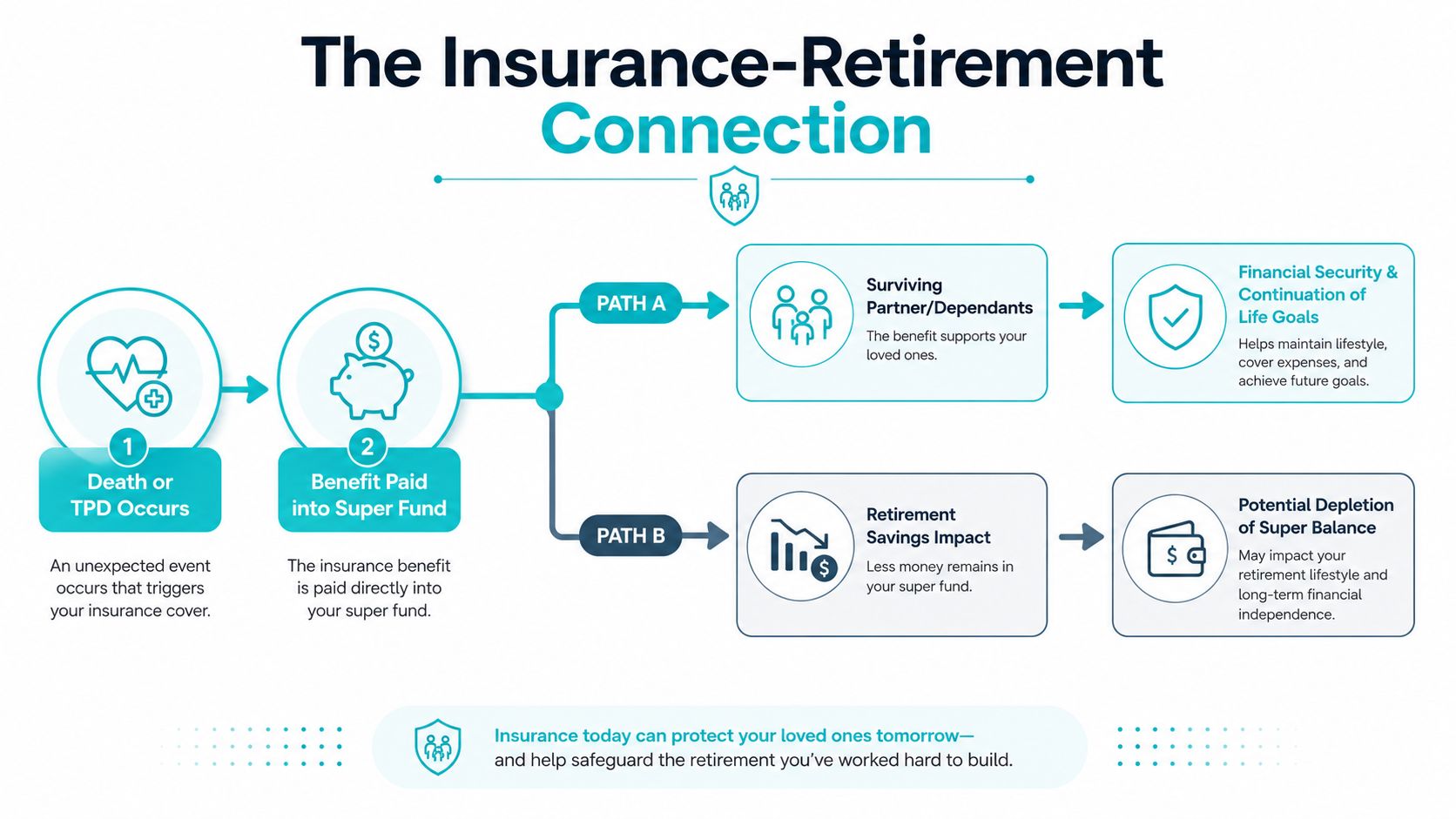
Insurance and retirement planning are connected through cash flow. A death or TPD benefit can provide capital when the household's earning capacity has been permanently reduced. That capital may help a surviving partner retain housing, support dependants and preserve their own retirement savings rather than consuming everything immediately.
Trauma cover serves a different retirement function. It can create liquidity during a serious illness, reducing the pressure to sell investments or draw heavily on super while treatment and recovery take priority. Income protection is even more direct. By replacing part of your earnings while you can't work, it can help preserve mortgage repayments, investment contributions and super contributions that would otherwise stop.
Holding cover through super can be convenient because premiums come from the account rather than household cash flow. It can also reduce the visibility of the cost. The trade-off is that group policies may have narrower definitions, limited benefit periods or features that don't match your occupation. Tax treatment can also differ depending on the policy, ownership and benefit, so the structure needs checking rather than assuming super is always the right home.
Protection should support your retirement plan, not quietly consume the money you're trying to build.
A sensible structure may split cover. Basic life or TPD insurance could remain in super where the terms and cost work, while personally owned trauma or income protection may provide features that the group policy lacks. The right answer depends on cash flow, tax, employment, family needs and the policy wording.
Wealth Collective's process puts this decision into a broader sequence:
- Protection Plus is the discovery and structuring stage, where life, TPD, trauma and income protection needs are identified and cover is reviewed.
- Guided Growth connects the insurance structure with super contributions, debt reduction and investment decisions while wealth is being built.
- Retirement Roadmap revisits the role of cover as you approach and enter retirement, when income replacement may become less important and aged-care, estate and legacy planning become more relevant.
The objective isn't to collect policies. It's to prevent an unexpected event from forcing a retirement decision before you're ready.
Your Next Steps and How Wealth Collective Helps
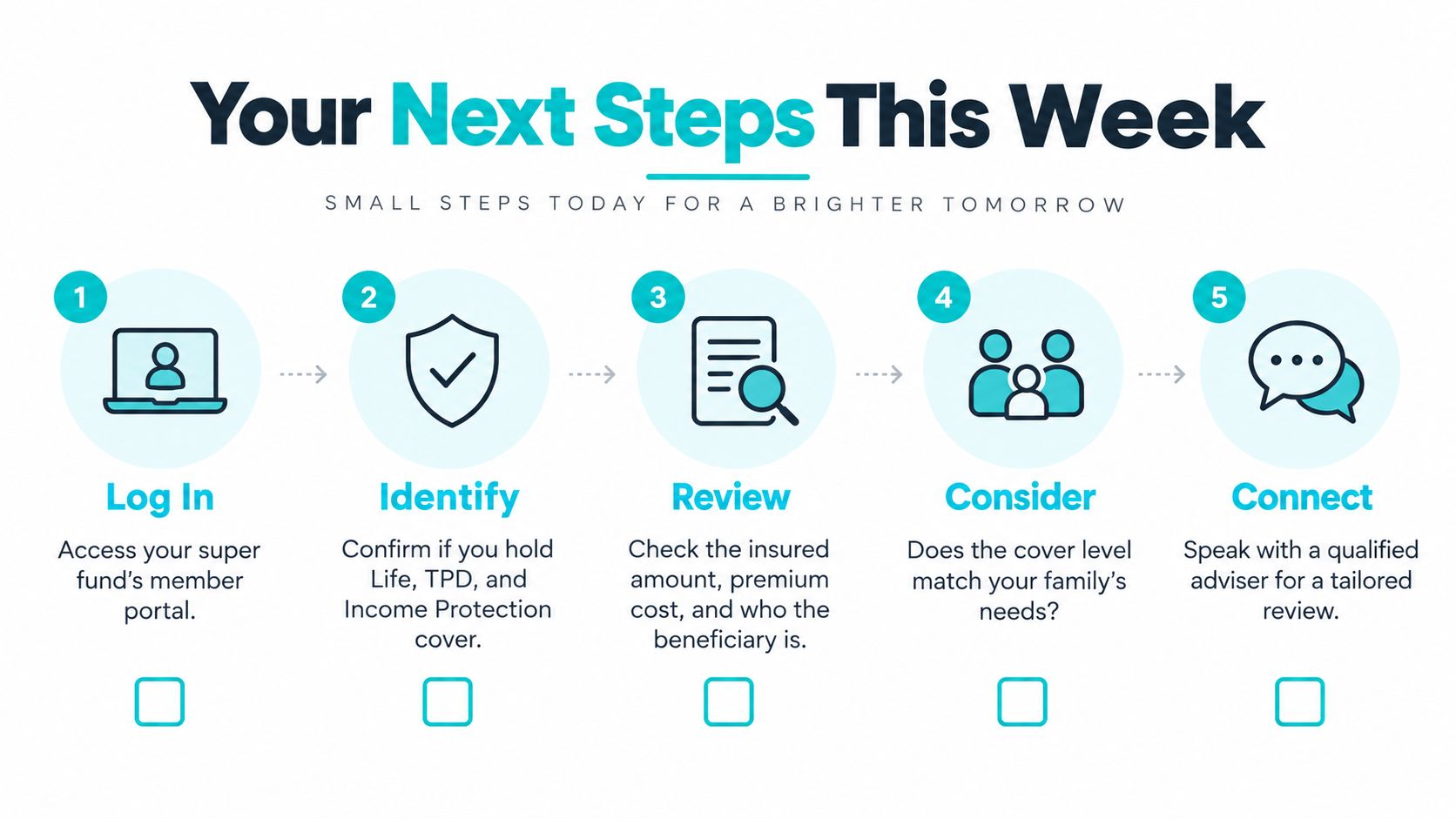
Start with evidence, not a product comparison website. You can complete a useful first review this week by collecting the information an adviser will need.
Check what you already hold
Log in to your super fund's member portal and download the latest statement or insurance summary. Confirm whether you have:
- Life cover: Record the insured amount and beneficiary details.
- TPD cover: Check the definition and whether the benefit is enough for your likely long-term needs.
- Income protection: Note the waiting period, monthly benefit and benefit period.
- Premium details: Confirm what's being deducted and whether the cover is active.
- Policy continuity: Check what happens if you change employer, fund or contribution arrangements.
Don't rely on a memory of what an employer offered. Read the current account information.
Build a household protection snapshot
Pull out a recent payslip or ATO notice of assessment so you know your gross annual income. List the mortgage, personal loans, credit cards and other liabilities, then write down who depends on your income and for how long.
For a family with young children, the calculation needs to consider more than today's bills. Ask whether the default amount could clear debts and help fund dependants through the years when they rely most heavily on household income. The answer won't be identical for every family, and an arbitrary rule can create false confidence.
Ask sharper adviser questions
Take these questions into the conversation:
- Is the sum insured enough to clear debts and fund dependants to age 65, based on our actual household needs?
- Do the waiting periods align with sick leave, employer benefits and our available cash reserves?
- Would premiums remain affordable if rates rose or the policy structure changed?
Also ask whether income protection is occupationally rated, how the insurer defines incapacity and whether the ownership structure creates tax or superannuation complications. Claims performance is measured across insurers and distribution channels, so the insurer, policy wording and advice process all deserve attention. APRA's claims statistics are used by ASIC's comparison tool to track claims acceptance, payment duration, disputes and cancellations across product types. APRA and ASIC's latest market update supports a practical conclusion: compare quality and suitability, not just premiums.
Wealth Collective offers a 10-minute introductory call as a starting point for a Protection Plus review, followed by a deeper discussion about Guided Growth and the Retirement Roadmap where appropriate. The purpose is to align insurance with debt, superannuation, wealth-building and retirement decisions, rather than treat it as a standalone product purchase.
Book a Wealth Collective introductory call to review the personal insurance already sitting in your super, identify the protection gap your household carries and decide whether your cover supports your broader retirement plan. Bring your latest super statement, income details and debt list, and the conversation can start with your real numbers and priorities.