Business hours
Monday to Friday (8.30AM - 5PM)
Weekend (Closed)



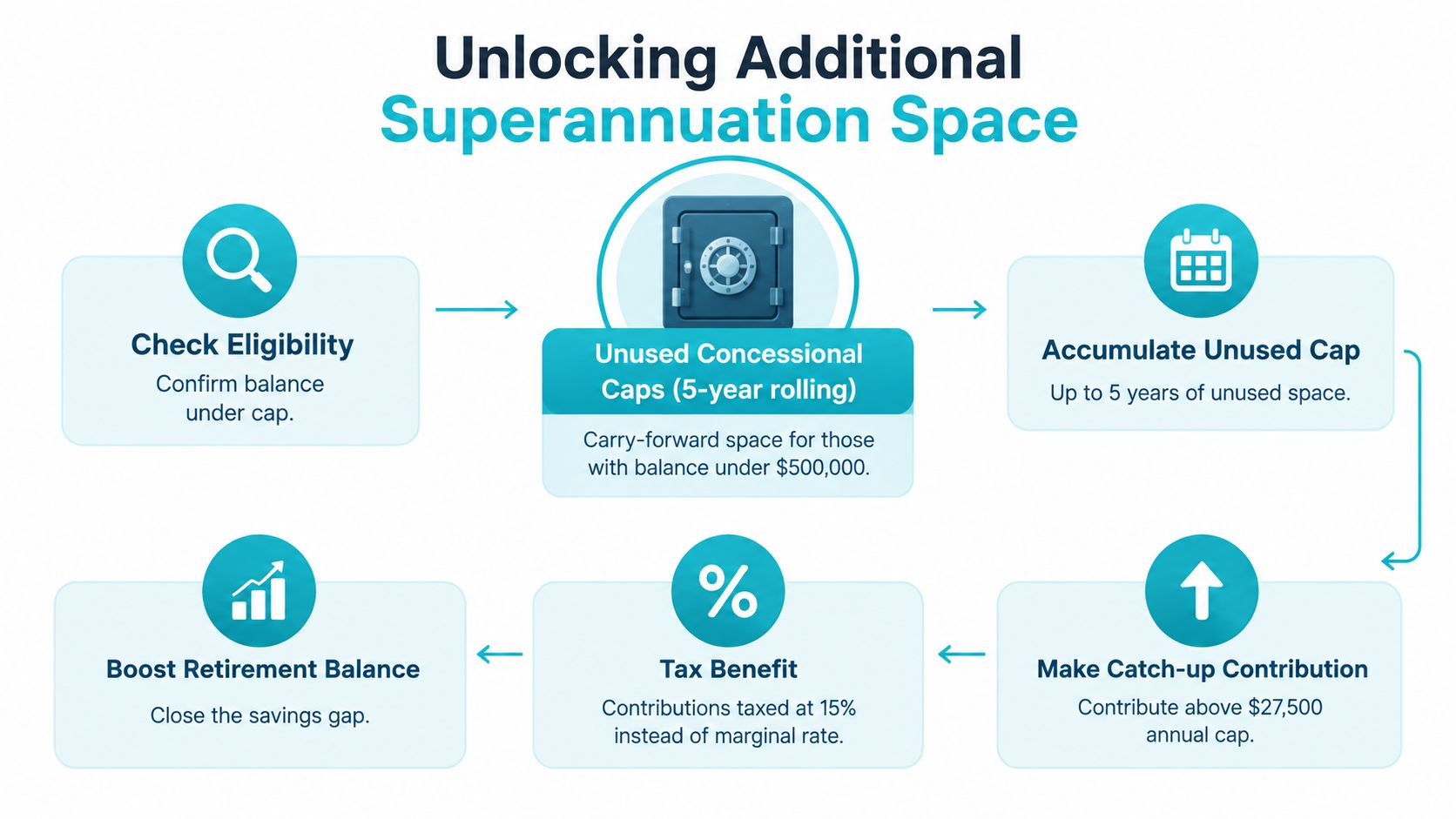
Eligible Australians can use unused concessional caps from up to five previous financial years, potentially allowing contributions well above the $30,000 standard cap for 2025–26. If $20,000 of unused cap is available and the balance test is satisfied, total concessional contributions could reach $50,000, before employer payments and other contributions are counted.
You may be approaching retirement, checking your super balance after a demanding year, and wondering whether the opportunity to improve your position has already passed. Perhaps you took time away from work, earned less during a business transition, or could not direct as much money into super as planned.
Australia's carry-forward rules can help in some of those situations. They allow eligible members to use unused concessional contribution capacity from earlier years, rather than treating each annual cap as permanently lost. But the strategy has two important limits that are often missed: your total superannuation balance must be below $500,000 at the relevant test date, and each unused amount expires after five years.
That means catch-up contributions aren't an automatic tax strategy for every high-income earner. They're a timing-sensitive planning decision that should be assessed alongside cash flow, debt, tax, and your intended retirement date.
Using Unused Concessional Cap Space
Five years before retirement, Sarah reviews her super after several years of part-time work and family responsibilities. Her income has now increased, but she assumes the annual contribution limit leaves little room to improve her position.
Earlier unused cap space may change that outcome. If Sarah meets the eligibility requirements, she can use available concessional capacity from prior financial years in the current year. This arrangement is commonly called a carry-forward or catch-up concessional contribution. It is not a government payment or separate deposit type. It is extra contribution room that remained available because earlier capacity was not used.
The familiar annual-cap example has already been outlined above. In that scenario, verified unused cap space can be added to the current-year limit, subject to employer superannuation guarantee payments, salary sacrifice, and deductible personal contributions. The rules are explained in the ATO guidance on the concessional contributions cap.
Why the timing matters
Unused amounts work like vouchers with expiry dates. Each one expires after five years, and the oldest available amount is used first when current-year concessional contributions move beyond the standard cap. Delaying a contribution can therefore mean losing an earlier opportunity for a deductible personal payment.
The balance test adds another timing risk. A strong income year or investment growth can place a member above the relevant threshold, even when unused cap space remains. Catch-up contributions may therefore suit someone with fluctuating income, a career break, or a later rise in earning capacity, but they may be unsuitable where liquidity is limited, expensive debt remains, or the balance test is not met.
Before arranging a large payment, review your unused super cap carry-forward position and confirm the available amount, expiry sequence, and contribution sources. That check helps distinguish usable cap space from an amount that has already expired or cannot be accessed under the relevant balance rules.
Who Qualifies for Catch-Up Contributions
Catch-up access depends on more than having made smaller contributions in the past. You must satisfy the total superannuation balance test, and the test is applied at a specific time.
Start with the balance test
Your total superannuation balance must be below $500,000 at 30 June of the previous financial year. This isn't tested on the day you make the contribution. A balance that rises above the threshold later may not change the result for the current year, while a balance below the threshold at the relevant prior-year date can preserve access even if circumstances change afterwards.
That timing creates a counterintuitive outcome. Two people can have the same income and identical unused contribution history, yet different catch-up capacity because one had crossed the threshold at the test date and the other hadn't. This is especially relevant to executives, dual-income households, and business owners whose super balances can change sharply from year to year.
Check the rolling window
Eligible members can use unused concessional cap amounts from up to five previous financial years. The unused amounts are applied automatically when current-year concessional contributions exceed the standard cap, with the oldest available amount used first. You don't nominate which historical year to use when the ATO applies the rules.
The practical process is:
- Check your balance date. Confirm your total superannuation balance at 30 June of the previous financial year.
- Review your ATO record. Available carry-forward amounts can be viewed through ATO online services.
- Reconcile contributions. Include employer payments, salary sacrifice, and personal contributions intended to be claimed as deductions.
- Check expiry. Identify whether an older unused amount will disappear if you delay.
- Confirm receipt. Contributions must reach the fund within the relevant financial year.
The balance threshold can remove eligibility precisely when accumulated super is highest. That's why a high income alone doesn't establish whether catch-up contributions are available. The answer depends on the historical cap record and the balance at the prescribed date.
Tax Implications and Considerations
Catch-up contributions are valuable because they use concessional treatment, but the tax result isn't just “contribute more and pay less”. Employer contributions, salary-sacrifice amounts, and eligible deductible personal contributions generally enter super under the same concessional cap and are generally taxed in the fund at 15%. For someone whose marginal personal tax rate is above 15%, directing eligible income into super can create a tax-rate differential.
The size of that advantage depends on the person's full tax position. A deductible personal contribution may reduce taxable income when the contribution is eligible and the required notice process is completed. Salary sacrifice can redirect pre-tax income, but it doesn't create extra cap space. Employer contributions already use part of the available limit.
Division 293 can change the calculation
Higher-income earners also need to consider Division 293 tax. The ATO says it may apply when income plus concessional super contributions exceeds $250,000 in a financial year, potentially adding 15% tax on relevant concessional contributions. The ATO explanation of concessional and non-concessional contributions provides the relevant framework.
For example, a senior employee might value the deduction from a large personal contribution but discover that Division 293 reduces the expected benefit. That doesn't automatically make the contribution inappropriate. It means the decision should include the fund tax, any additional tax, investment suitability, and the value of retaining money outside super.
Compare the benefit with the trade-offs
A useful comparison looks beyond the deduction:
- Potential benefit: eligible income may receive concessional treatment rather than being taxed entirely at the person's marginal rate.
- Fund tax: concessional contributions are generally taxed at 15% inside super.
- Additional liability: Division 293 may impose another 15% tax for qualifying higher-income individuals.
- Access: money placed in super is subject to superannuation access rules, so it isn't equivalent to cash savings.
- Timing: a contribution must be received by the fund in the relevant financial year.
A deeper discussion of the additional liability appears in Division 293 tax explained. The important point is simple: calculate the expected net result, rather than assuming that the largest possible contribution is automatically the most efficient one.
Types of Contributions and Caps
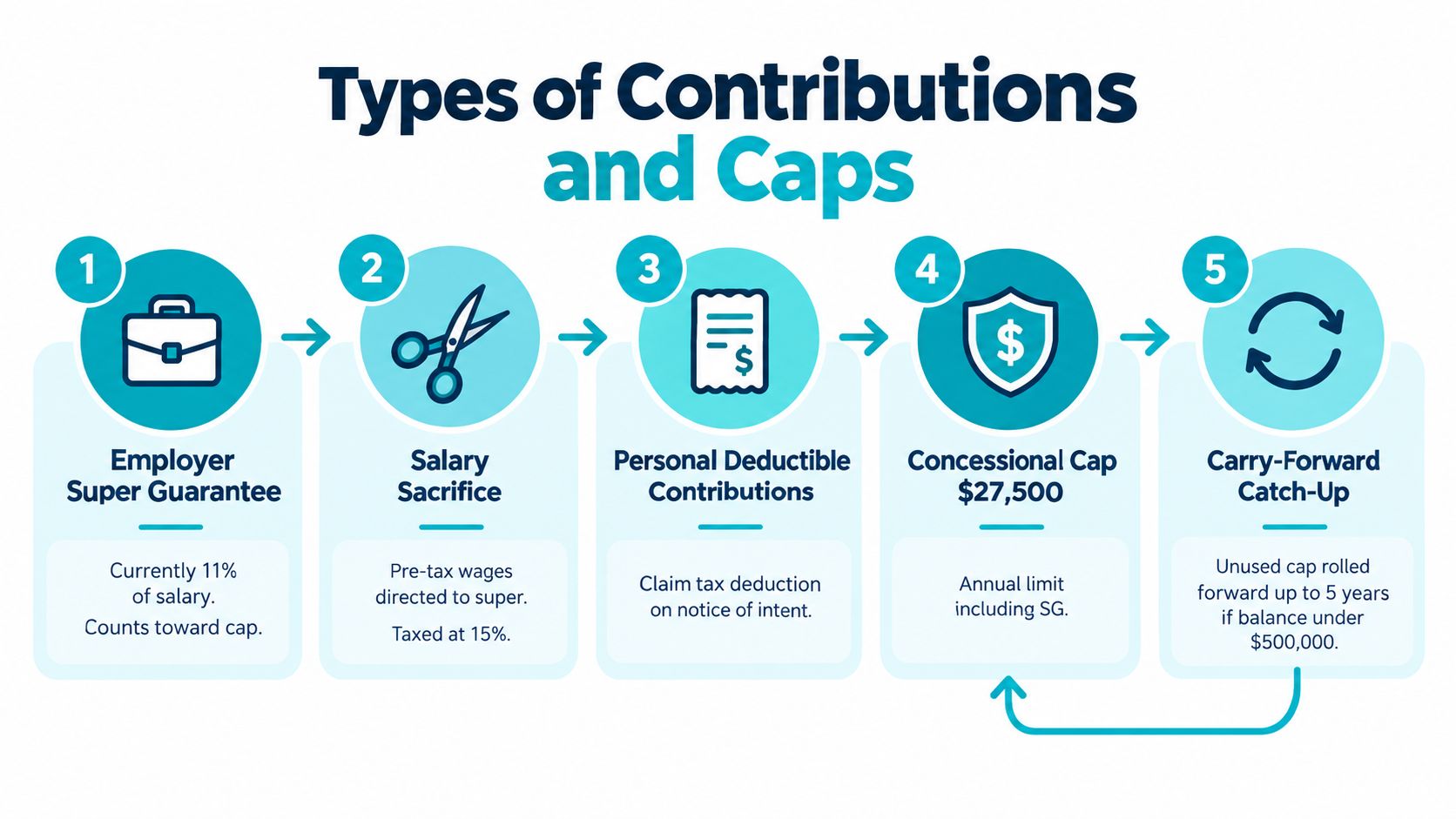
The concessional cap works like one shared bucket. Different sources can fill it, but they don't each receive a separate full allowance.
Your employer's superannuation guarantee payment goes into the bucket first. Salary sacrifice then uses more of the same bucket, while a personal contribution can also count if you claim a deduction and meet the relevant requirements. The source differs, but the cap interaction is the same.
One cap, several contribution sources
For 2025–26, the standard concessional cap is $30,000. If an employer contributes $18,000, only $12,000 of current-year space remains before considering any available carry-forward amount. Salary sacrifice or a deductible personal contribution would use that residual space.
| Contribution source | How it affects the cap |
|---|---|
| Employer superannuation guarantee | Counts towards the concessional cap |
| Salary sacrifice | Uses concessional cap space |
| Personal deductible contribution | Counts when claimed as a deduction |
| Carry-forward amount | Adds available historical space when eligibility is met |
This is why a payroll estimate matters. An employer payment made late in the financial year can reduce the room you thought remained. Multiple funds can also make reconciliation harder if contributions aren't reviewed together.
For readers comparing general retirement limits across systems, the 2026 retirement cap for W-2 clients offers separate context. It shouldn't be used as a substitute for Australian superannuation advice, because the contribution structures and eligibility rules differ.
Before making a payment, project employer contributions through year-end, review the ATO carry-forward balance, and leave a buffer for payroll timing and fund allocation. The concessional contribution limits guide can help frame the calculation, but your actual available space still depends on your personal records.
Worked Examples and Scenarios
The mechanics become clearer when the decision is placed in a household budget.
Cassandra took time away from work to care for her child. Treasury's example records that she had a $200,000 super balance and made no concessional contributions in 2018–19. In 2019–20, she could contribute $50,000, made up of the $25,000 annual cap and $25,000 of unused cap from the earlier year, as described in Treasury's superannuation reforms example.
That example matters because it shows what catch-up contributions are designed to do. They recognise that income and saving capacity don't remain constant throughout a career. A parent returning to work, a professional moving from part-time to full-time employment, or a small-business owner experiencing a stronger trading year may have a reason to use previously unused space.

A current-year calculation
Suppose an eligible member has a $30,000 standard cap for 2025–26 and $20,000 of unused cap. Their possible total is $50,000, but that is a ceiling before employer contributions and other concessional payments are included.
If the employer is projected to contribute $18,000, the member has $12,000 of current-year capacity before using earlier unused amounts. A staged salary-sacrifice arrangement or deductible personal contribution may then use part of the remaining capacity, provided the balance test and other requirements are satisfied.
When caution is wiser
A person may have available cap space but still decide not to use it. Someone with an unstable business cash flow may value liquidity more than a tax deduction. Another person may face high-cost debt, need an emergency reserve, or expect a near-term expense that super can't fund.
The strongest decision isn't always the largest contribution. It's the contribution that improves retirement readiness without creating a cash-flow problem or an excess contribution risk.
Integrating Catch-Up into Your Strategy
Catch-up contributions work best as one component of a retirement plan, not as a year-end reflex. The decision should connect four questions: how much cash you can commit, what tax result you expect, what debt you carry, and how soon you may need the money.
Start with a forecast rather than a target. Estimate employer contributions through the end of the financial year, add any planned salary sacrifice, and identify whether a personal contribution is intended to be deductible. Then compare the total with the standard cap and any verified carry-forward amount.
Planning principle: Available cap space is an option, not an obligation.
Your next decision is about priority. Paying down expensive debt may produce a more certain benefit than adding to super. Building cash reserves may protect your household from needing to sell investments or withdraw from unsuitable sources. Conversely, a stable high-income household with adequate liquidity may find that using an expiring carry-forward amount fits its retirement objectives.
Investment allocation matters as well. A larger contribution doesn't automatically produce a suitable retirement outcome if the underlying investment choice, risk level, or income strategy isn't aligned with your timeframe. Super optimisation should sit alongside retirement-income planning, insurance, debt management, and estate considerations.
A practical review can follow this sequence:
- Confirm eligibility: Check the prior 30 June balance test and ATO carry-forward record.
- Calculate the actual room: Include every employer, salary-sacrifice, and deductible personal contribution.
- Protect the deadline: Allow time for the fund to receive and allocate the payment.
- Stress-test cash flow: Keep enough accessible money for debt, reserves, and planned spending.
- Review the outcome: Consider tax, investment settings, and retirement income together.
Next Steps with Wealth Collective
A contribution decision can look straightforward until the balance test, expiry dates, payroll estimates, Division 293, and cash-flow needs are considered together. Pre-retirees may need to decide whether to use a disappearing cap amount, while high-income earners may need to weigh the tax benefit against additional tax and reduced liquidity.
Wealth Collective's Guided Growth and Retirement Roadmap services can help bring those decisions into one plan. The review can cover superannuation optimisation, contribution timing, investment strategy, debt reduction, and the income you'll need when work becomes optional. That broader view is important because a technically available contribution isn't automatically the right contribution.
The firm works with Australians in Perth, Dunsborough, and elsewhere in Western Australia, including executives, dual-income families, small-business owners, and people approaching retirement. Its process begins with a free 10-minute introductory call and uses transparent communication, personalised advice, and a satisfaction guarantee to help clients make informed decisions.
Bring your latest super statements, ATO carry-forward information, employer contribution estimates, and a clear view of your debts and cash reserves to the conversation. That gives an adviser the information needed to assess whether catch-up contributions support your actual retirement plan.
Wealth Collective can review your unused concessional cap, contribution timing, tax position, and broader retirement strategy through Guided Growth and Retirement Roadmap advice. Visit Wealth Collective to book your initial call and discuss whether a catch-up contribution fits your circumstances.